NEBIUS and CoreWeave raise prices: Is the surge in AI computing demand here to stay?

North America's 'Big Four Clouds' Lead the Rally, NeoCloud Soars: Morgan Stanley Outlines Three AI Endgames—Who Will Emerge as the Biggest Winner?
Last night, the AI computing power sector saw its first broad-based rebound in a long time.
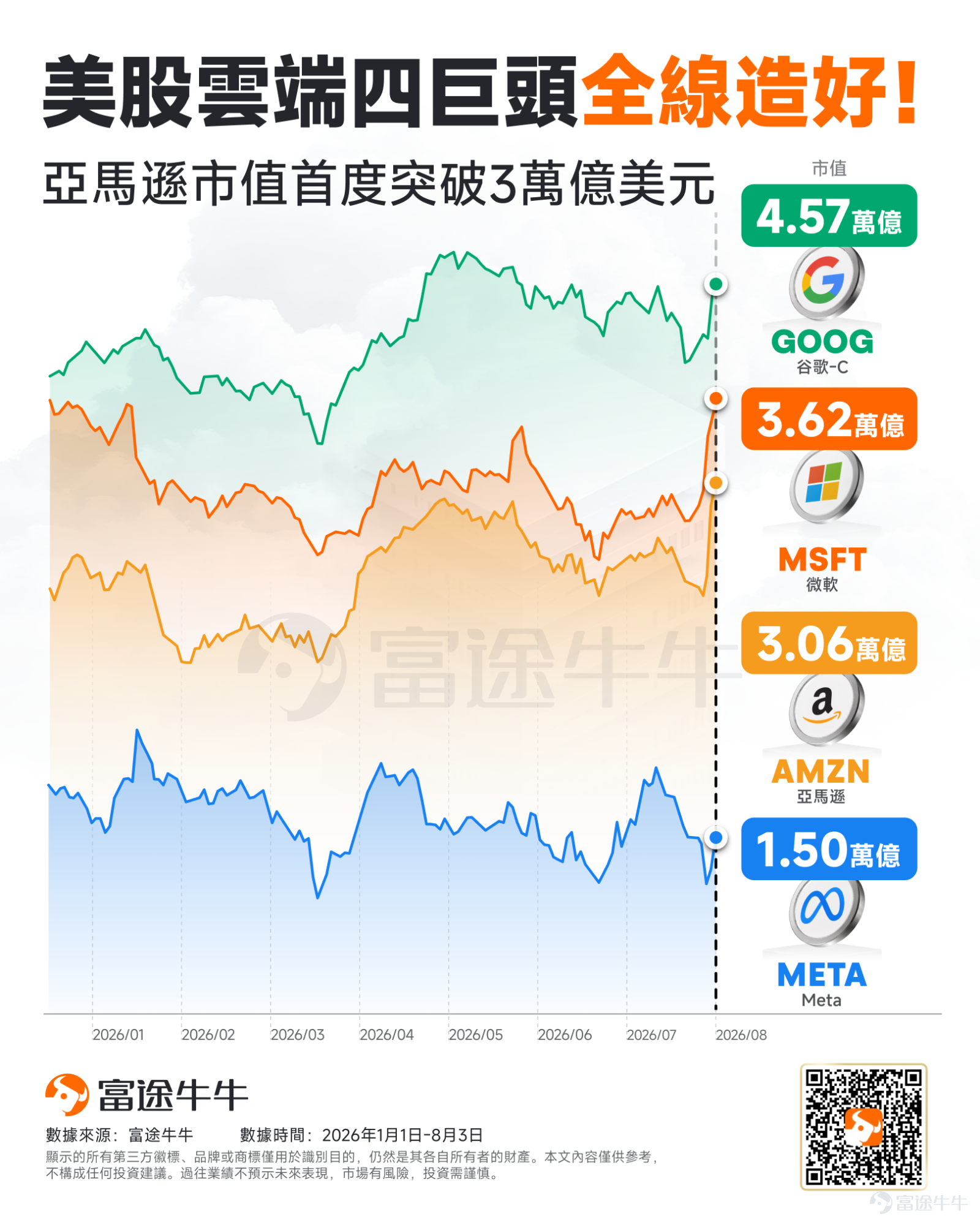
U.S. cloud providers surged across the board, $Amazon (AMZN.US)$ closing up 4.58%, hitting a new all-time high after 61 trading days, with a total market cap surpassing $3 trillion. In addition, $Alphabet-C (GOOG.US)$ 、 $Microsoft (MSFT.US)$ rose more than 4%, $Meta Platforms (META.US)$ gained over 6%, $Oracle (ORCL.US)$ even posting a single-day gain exceeding 9%.

--
--
--
Funds then quickly flowed into the highly elastic NeoCloud: $CoreWeave (CRWV.US)$ surged nearly 20%, $NEBIUS (NBIS.US)$ rose about 12%, $IREN Ltd (IREN.US)$ climbed approximately 8%.
On the surface, this appears to be a strong rebound following a deep correction in the AI computing power sector; however, looking at the capital flow pattern—CSPs rising first, followed by NeoCloud—the market is reassessing a more critical question:Can tech giants actually make money from investing hundreds of billions of dollars in AI infrastructure?
And the latest round of CSP (cloud service provider) earnings reports is providing an increasingly clear answer.
1. CSP earnings reports begin addressing the return on AI investment
Over the past year, market concerns about cloud service providers' (CSPs) AI arms race can be summarized as an 'old narrative':
Massive GPU purchases and data center construction → rising depreciation and capital expenditures → pressure on free cash flow → uncertainty remains over when AI revenue will cover these investments.
However, this earnings season is beginning to validate a more positive business feedback loop:
Growth in token usage volume → accelerated enterprise adoption and monetization of AI → simultaneous improvement in cloud revenue and profitability → CSPs continue to raise capital expenditure guidance → sustained demand for GPUs, optical modules, networking equipment, and data centers.
This doesn’t mean depreciation pressure has vanished, but the market is starting to believe that the pace of AI revenue growth could gradually offset depreciation, interest expenses, and new investments.
Previously,"Amazon Calculates a 'Three-Year Payback': After the Deep Correction in AI Infrastructure, Which Themes Remain Worth Watching?"An earlier article梳理梳理 provided fellow investors with key insights on ROI from AI investments: Amazon CEO Andy Jassy stated that the company is less than"three years"away from reaching breakeven on its server and networking equipment investments, indicating that a virtuous cycle of AI investment returns has already begun to take shape.
If this payback cycle can be sustained, AI capital expenditures will no longer merely be a cash-flow-consuming cost, but rather a productive asset capable of generating subsequent revenue and free cash flow.
HuaFu Securities judges that, based on Q2 earnings reports from the four major North American cloud providers, the industry as a whole remains in a high-intensity investment cycle, and market focus is rapidly shifting toward when the ROI from AI computing investments will materialize. HuaChuang Securities also points out thatThe CSP capital expenditure trend has not reversed, but greater attention should now be paid to inference costs and cash flow conversion.
In other words, the market is no longer just looking at how many GPUs cloud service providers are buying, but is beginning to ask:How many tokens can these GPUs generate, how much revenue will they bring in, and how long will it take to recoup the investment?
2. Computing demand continues to spill over, prompting NeoCloud’s repricing
The rally in both CSPs and NeoCloud reflects the same underlying AI demand theme, but their pricing logic is not entirely identical.
CSP gains primarily reflect improving expectations for AI-related revenue, profitability, and return on investment; NeoCloud’s larger gains, however, stem from the market simultaneously revising upward its expectations for compute utilization rates, order fulfillment, and financing capabilities.
Previously, the market had feared that hyperscale cloud providers’ continued in-house data center builds might ultimately squeeze third-party computing service providers out of the market. But reality may be precisely the opposite—AI demand is still growing faster than CSPs can deliver their own data centers.
Even as Microsoft, Amazon, and Google continue to increase capital expenditures, their compute capacity expansion remains constrained by factors such as power supply, land-use approvals, data center construction timelines, availability of advanced GPUs, and network deployment.
During periods of rapidly growing demand and insufficient internal capacity to meet delivery timelines, CSPs and enterprise customers still require NeoCloud to provide elastic computing power.NeoCloud is therefore not just a competitor to CSPs but could also become a critical supplement to their compute capacity expansion. The more CSP earnings reports validate the genuine existence of enterprise AI demand, the more the market will be willing to raise several key expectations for NeoCloud:
1) GPU cluster utilization can remain high; 2) long-term compute contracts are more likely to be fulfilled; 3) order backlogs can gradually convert into revenue; 4) newly built data centers can more easily secure customers and financing support; and 5) expansion in compute supply does not necessarily imply oversupply, but may instead fill structural gaps.
NeoCloud’s larger rebound magnitude also stems from its triple elasticity:operational leverage, financial leverage, and valuation elasticity.
When GPU utilization rises, NeoCloud’s substantial fixed costs can be spread over higher revenues, often leading profitability to improve faster than revenue growth. As order visibility improves, market concerns about its debt financing and future expansion capabilities also diminish. Furthermore, after experiencing significant valuation compression, a reduction in risk premium further amplifies its stock price rebound.
However, this logic can also operate in reverse. If AI demand weakens, NeoCloud could simultaneously face pressure on utilization rates, financing costs, capital expenditures, and valuation.Thus, NeoCloud is not only one of the most elastic plays when AI compute demand rebounds, but also a segment with higher risk if fundamentals become volatile.
III. Morgan Stanley models three potential AI scenarios: Under different model ecosystems, which stocks stand to benefit the most?
Aside from CSP earnings, the rapid advancement of open-source foundation models is another key variable driving the market to reassess AI compute demand.A common concern is: if open-source models continue to improve in performance and inference costs keep falling, could AI compute demand peak?
Morgan Stanley believes that open-source models could instead trigger the 'Jevons Paradox': as the cost per unit of intelligence declines, the barrier to AI adoption lowers, prompting businesses and individuals to develop more applications and make more API calls, ultimately driving up total token volume and overall compute consumption.
Therefore, cheaper models do not necessarily mean declining compute demand. A more likely outcome is that AI expands from a limited number of high-value, high-cost use cases to a vast array of low-cost, high-frequency scenarios. The competition between open-source and closed-source models may evolve into three primary scenarios.

--
--
--
Scenario 1: Closed-source models maintain leadership, with value continuing to concentrate among tech giants
In the first scenario, leading closed-source models—represented by companies like OpenAI and Google—continue to maintain their technological edge.
Developing large models requires massive investments in compute, data, and capital. High technical barriers and economies of scale will concentrate competitive advantages in the hands of a few tech giants. Larger model training scales and higher inference volumes will drive stronger demand for GPUs, switches, optical modules, cybersecurity solutions, and data center power.
In Morgan Stanley’s analysis, the key beneficiaries under this scenario would include:
– Networking and optical communications: $Arista Networks (ANET.US)$ 、 $Lumentum (LITE.US)$ 、 $Coherent (COHR.US)$ ;
– Cybersecurity: $Palo Alto Networks (PANW.US)$ 、 $CrowdStrike (CRWD.US)$ 、 $Zscaler (ZS.US)$ 、 $Netskope (NTSK.US)$ 、 $Okta (OKTA.US)$ 。
The stronger proprietary models become, the more AI training and inference tasks will likely concentrate on large cloud platforms, further consolidating industry value upstream: model giants control user access points, cloud providers dominate computing resources, while NVIDIA and Broadcom hold core capabilities in chips and networking.
Microsoft still benefits under this scenario, but Morgan Stanley classifies it as an 'other beneficiary' rather than a top beneficiary. This may reflect that, in pure proprietary model competition, Microsoft must rely on external model partners while simultaneously facing direct competition from Google and Amazon in both models and cloud services.
Scenario Two: Coexistence of open-source and closed-source models expands the range of beneficiaries
The second scenario assumes long-term coexistence between closed-source and open-source models—a path that likely aligns more closely with real-world developments.
For enterprises, not all tasks require invoking the most expensive or capable frontier models. Complex reasoning and high-value tasks can be handled by closed-source models, while internal knowledge bases, intelligent customer service, code generation, and vertical industry applications can leverage open-source, private, or smaller models.
Enterprises will likely end up using not a single model, but a multi-model system that flexibly switches based on cost, performance, security, and deployment requirements.
Under this structure, the range of beneficiaries is the broadest:
– $Alphabet-C (GOOG.US)$ 、 $Amazon (AMZN.US)$and $Microsoft (MSFT.US)$ All three major cloud providers are listed as core beneficiaries;
– $Datadog (DDOG.US)$ 、 $Palantir (PLTR.US)$ and $Appian (APPN.US)$ Infrastructure software companies benefit from rising demand for model orchestration, monitoring, and data management;
– $SAP SE (SAP.US)$ 、 $ServiceNow (NOW.US)$ Enterprise software vendors are expected to further embed AI capabilities into their existing products;
– $Palo Alto Networks (PANW.US)$ 、 $CrowdStrike (CRWD.US)$ 、 $Fortinet (FTNT.US)$ 、 $Zscaler (ZS.US)$ 、 $Netskope (NTSK.US)$ 、 $Okta (OKTA.US)$ 、 $SailPoint (SAIL.US)$ and $Varonis Systems (VRNS.US)$ Security vendors benefit from increasingly complex security requirements in multi-model environments.
Notably, Morgan Stanley also includes MiniMax, Zhipu, Alibaba, and Tencent on its list of beneficiaries. This indicates that, within Morgan Stanley’s framework, Chinese model developers are no longer merely low-cost alternatives to overseas models but are becoming key participants in the global open-model ecosystem.
The hybrid model will also drive a reallocation of AI computing power across public clouds, private clouds, and end-user devices. Some tasks will remain on large cloud platforms, while others will be deployed on enterprise servers, private data centers, or edge devices. Therefore, $Dell Technologies (DELL.US)$ 、 $Hewlett Packard Enterprise (HPE.US)$ 、 $Everpure (P.US)$ Local infrastructure and hardware vendors are also expected to benefit.
Scenario Three: Open models become mainstream, with value spreading to platforms, endpoints, and distribution channels
The third scenario is that open-source or openly weighted models gradually become mainstream.
As the performance gap between open models and cutting-edge closed-source models narrows and inference costs continue to decline, foundational models themselves will find it harder to sustain long-term monopolies. Enterprises will be able to download, fine-tune, and deploy models themselves without being fully dependent on a single closed-source model provider.
In this environment, industry value will diffuse from the model layer to cloud platforms, on-premises deployments, enterprise software, end-user devices, and channel partners.
Morgan Stanley believes that $Microsoft (MSFT.US)$ could become the biggest beneficiary among cloud providers in this scenario. The reason is that the more open the models become, the greater the need for enterprises to have a unified platform to deploy, manage, invoke, and integrate different models.
Microsoft simultaneously owns Azure, Windows, GitHub, Microsoft 365, Copilot, and a vast enterprise customer base. Regardless of whether customers ultimately adopt OpenAI, Zhipu, MiniMax, or other open models, Microsoft can participate in value capture through its cloud services and enterprise software ecosystem. Its role increasingly resembles that of an 'operating system plus distribution platform' in the AI era.
The proliferation of open models will also drive AI deployment beyond a few dominant cloud platforms to a broader range of enterprises and endpoints:
– Model providers: $Z.AI (02513.HK)$ 、 $MINIMAX-W (00100.HK)$ 、 $Alibaba (BABA.US)$ 、 $TENCENT (00700.HK)$ ;
– On-premises infrastructure: $Dell Technologies (DELL.US)$ 、 $Hewlett Packard Enterprise (HPE.US)$ 、 $NetApp (NTAP.US)$ 、 $Everpure (P.US)$ ;
– Edge devices: $Dell Technologies (DELL.US)$ 、 $Hewlett Packard Enterprise (HPE.US)$ 、 $Apple (AAPL.US)$ ;
The more widespread open models become, the lower the cost and technical barriers for enterprises to deploy AI, making demand for servers, storage, PCs, smartphones, and channel services more widely distributed.
Overall, the key distinction among the three scenarios is not whether demand for computing power will exist, but rather who ultimately captures the value of AI models and industry profits. According to Morgan Stanley, NVIDIA and power infrastructure companies are likely to benefit across all scenarios, as token usage and compute consumption may continue to grow regardless of how models are delivered. In contrast, the degree to which hyperscale cloud providers benefit depends on shifts in market share among open-source, closed-source, and on-premises deployment models.
4. AI infrastructure is entering a new phase of 'validating returns'
Last night’s rally in the AI compute sector was significant not because of the single-day gain, but because the market’s pricing logic has shifted.
In the past, the market focused primarily on how high capital expenditures were and how severe depreciation pressures would be; going forward, the more critical questions will be:
Whether token usage can continue to grow; whether enterprise AI can translate into real revenue; whether cloud business revenue and profits can improve in tandem; whether NeoCloud orders can convert into actual revenue and cash flow; and whether AI-driven revenue growth can ultimately offset depreciation, interest expenses, and new investments.
If these metrics continue to improve, AI-related capital spending will no longer resemble an unquantifiable 'arms race' with unclear returns, but instead gradually form a virtuous cycle of 'demand growth → revenue realization → continued investment.'
CSP earnings reports are demonstrating that AI compute is not just about 'spending without returns'; meanwhile, the sharp rise in NeoCloud valuations reflects the market repricing this emerging business flywheel.
This may signal that the narrative around AI infrastructure isn’t over—it’s simply evolving from 'how many GPUs are being bought' to a stricter and healthier phase focused on 'who can actually turn compute capacity into revenue and cash flow.'
Risk Disclaimer: The above content only represents the author's view. It does not represent any position or investment advice of Futu. Futu makes no representation or warranty.Read more


Comments (11)
to post a comment
140
288