US Stock Market Talk | The Fed Resumes Rate Hikes After a Three-Year Pause! Is a New Shift Ahead for

ETF Showdown | Are US stocks about to hit new highs again? Why are they so strong? Understanding the advantage of 'market breadth'
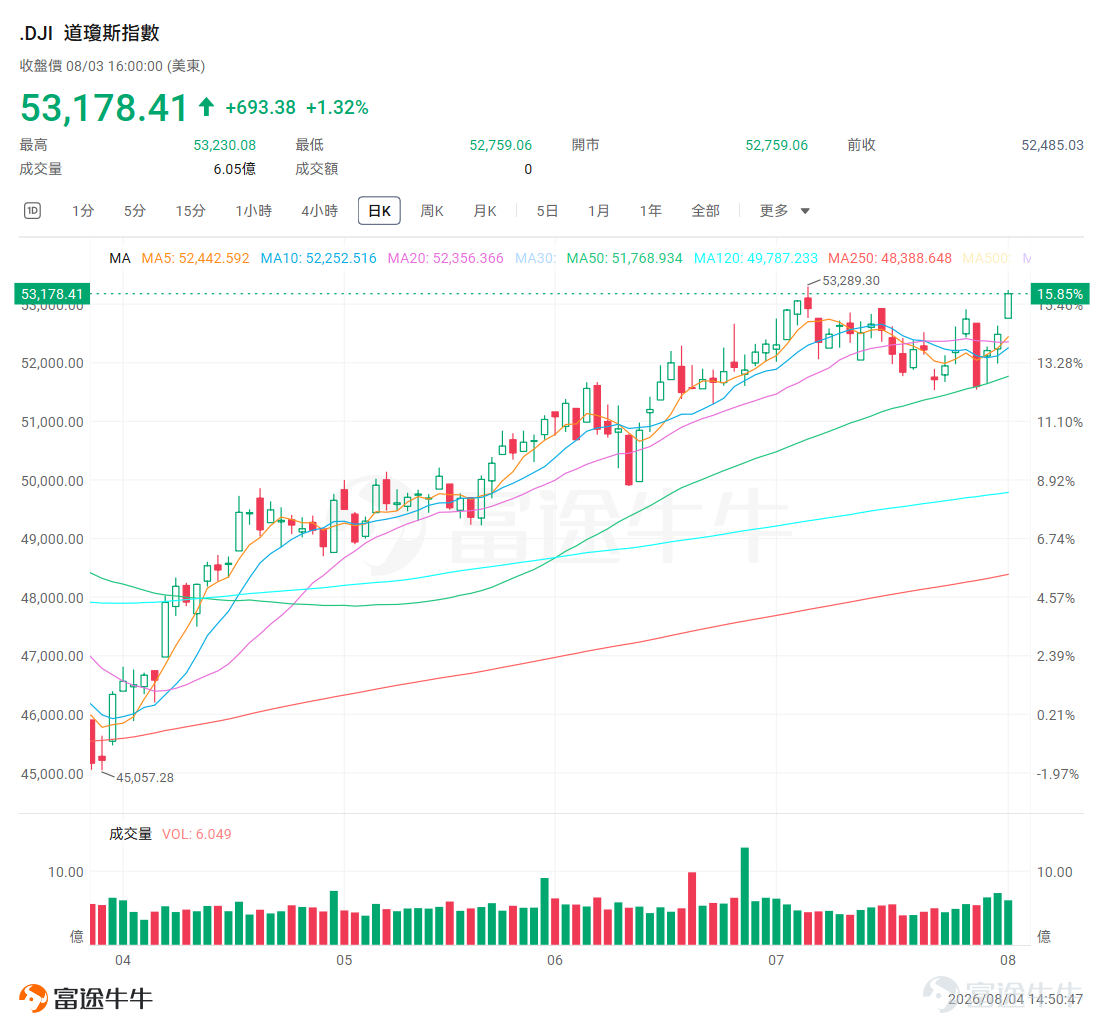
Last night (August 3), U.S. stocks kicked off August with a strong rally, once again getting many investors excited.All three major indices soared, $Dow Jones Industrial Average (.DJI.US)$ with one even setting a new all-time closing high.

For the average investor, watching the market approach yet another record high naturally raises questions: Why is the U.S. stock market so strong? Is it still a good time to get in? Why does my portfolio feel underwhelming despite the rally? And how should I respond? We’ll break it down for you.
How strong was yesterday’s rebound? All three major indices approached or retested record highs.
Overnight, U.S. stock markets continued the strong rebound trend seen at the end of July, with tech stocks leading gains across the board and all three major indexes closing higher.
Specifically, $S&P 500 Index (.SPX.US)$ It surged 1.48%, closing at 7,600.48 points, just a hair's breadth away from its all-time high.。The Dow Jones Industrial Average rose 1.32%, setting a new record for its highest closing level ever.。 $Nasdaq Composite Index (.IXIC.US)$ It even jumped sharply by 2.13%,,continuing its robust rebound momentum.
Two immediate catalysts drove this latest rally:
First,Geopolitical tensions in the Middle East showed signs of easing,as U.S. President Trump canceled a planned strike against Iran and indicated that both sides would enter into negotiations. This news significantly reduced market risk aversion, sending international oil prices plunging by more than 5%. The drop in oil prices alleviated concerns about a resurgence of inflation, $U.S. 10-Year Treasury Notes Yield (US10Y.BD)$ causing yields to retreat to around 4.68%, providing support for equity valuations.
Second,Corporate earnings reports continue to deliver positive surprises.The three cloud computing giants— $Amazon (AMZN.US)$ 、 $Microsoft (MSFT.US)$ and $Alphabet-A (GOOGL.US)$ recently reported strong growth in their cloud businesses, driving their stock prices to surge collectively.Overnight, the Mag 7 rose sharply by 3.6% as a group, marking their best single-day performance since March 31.Among them, Amazon jumped 4.6%, pushing its market cap above the $3 trillion mark; Google rose over 4%, briefly surpassing Apple to become the world’s second-most valuable company; Microsoft and $Meta Platforms (META.US)$ also posted gains of around 5%.
Resilience amid July volatility: As the AI hype cools, who’s propping up the market?
Looking back at the just-concluded month of July, US equities did not have an easy ride. In mid-July, concerns emerged over whether massive capital expenditures on AI hardware would deliver returns, triggering a sharp selloff in the semiconductor sector, $PHLX Semiconductor Index (.SOX.US)$ which declined by more than 20% over the month. Yet, the broader US market showed remarkable resilience and avoided a one-sided crash.

The key behind this resilience lies inhealthy sector rotationWhen the AI hardware and semiconductor sectors were hit, capital did not exit the stock market but instead rotated intofinancials ( $Financial Select Sector SPDR Fund (XLF.US)$), healthcare ( $The Health Care Select Sector SPDR® Fund (XLV.US)$) and other defensive and value-oriented sectors.These sectors performed strongly in July, successfully cushioning the broader market from downside risks.
By the end of July, the situation reversed again.Better-than-expected earnings reports from tech giants like Microsoft and Amazon reignited market confidence in the commercialization prospects of AI. Coupled with the completion of deleveraging in AI hardware, the semiconductor sector staged an 'epic' rebound, driving the Nasdaq sharply higher. Goldman Sachs noted that the rally on the first trading day of August showed clear signs of broadening: the worst-performing stocks over the past 12 months, software stocks, and the Mag 7 all ranked among the top gainers, indicating a recovery in market breadth.
US Stocks vs. Korean Stocks: Why 'Concentration' Could Be a Risk, While 'Breadth' Is an Advantage?
When examining global markets, we observe that US and Asian markets (such as South Korea) have exhibited starkly different characteristics during this market cycle.
South Korea’s market dilemma: Over-concentration leading to 'running naked'
Korea performed particularly weakly in July. Were it not foran 'epic rebound' $Korea Composite Index (.KOSPI.KR)$with a single-day surge of nearly 18%,the entire month's performance could only be described as 'utterly disastrous.'
However, on August 3, the KOSPI plunged again by more than 5%, once again triggering the circuit-breaker mechanism. The core reason lies in the Korean stock market’s excessive reliance on $Samsung Electronics (005930.KR)$ and $SK Hynix (000660.KR)$$SK hynix (SKHY.US)$ a handful of memory chip giants.When rotation occurs within U.S. tech stocks—shifting capital from memory-related names toward cloud and CSP (Cloud Service Providers)—the rebound in Korean equities loses its support.
Advantage of the U.S. equity market: Broad market depth and sector rotation
In contrast, the U.S. equity market spans an extremely wide range of sectors and boasts exceptional market depth.From technology, financials, and healthcare to consumer staples, media, and homebuilders, all sectors thrive simultaneously. This dynamic of 'sector rotation,' where strength in one area offsets weakness in another, is precisely the key driver behind the U.S. market’s ability to continually reach new highs.
Let’s illustrate this with a scenario closer to real market conditions:
Suppose in June this year, you noticed the AI hardware and memory chip theme gaining momentum, with the Philadelphia Semiconductor Index climbing steadily, $Micron Technology (MU.US)$ 、 $SanDisk (SNDK.US)$ and memory-related stocks surging ahead of the pack, prompting you to concentrate a large portion of your capital on just a few semiconductor stocks or $Roundhill Memory ETF (DRAM.US)$ sector-specific ETFs.
However, entering July, the market began questioning whether the massive AI-related capital expenditures would materialize, triggering a sharp sell-off in semiconductors—especially in the memory segment.
Meanwhile, capital didn’t flee the equity market altogether; instead, it quickly rotated into defensive sectors like financials and healthcare, and by late July even shifted toward cloud computing and CSPs, driving a collective surge in giants like Amazon, Microsoft, and Google.Your holdings in memory chips became misaligned with the prevailing market flow—you watched as major indices approached all-time highs while your account remained underwater. This is the classic pitfall of chasing a single hot sector.
From a medium- to long-term perspective, Wall Street remains bullish on the broader US market. JPMorgan forecasts the S&P 500 to reach around 8,200 by mid-next year,and expects US equities to deliver double-digit returns again in 2026.Citadel Securities also emphasized that with corporate earnings continuing to deliver upside surprises and share buyback demand accelerating post the earnings quiet period, the forces driving US stocks to new highs remain solid.
How to use Futubull for portfolio allocation?
For retail investors, in a market environment characterized by accelerating sector rotation and increasing stock divergence,Rather than exhaust yourself 'searching for a needle in a haystack,' it's better to 'buy the entire haystack.' This famous quote from John Bogle, the godfather of index funds, is especially relevant today.Through Futubull's ETF hub, investors can easily achieve one-click portfolio allocation, avoiding the dilemma of missing out or chasing overvalued single sectors.
(1) Steady Wins: Broad-market ETFs
If you remain bullish on the long-term trends of the U.S. economy and technological innovation but wish to avoid the risk of picking the wrong sector,broad-market ETFs are the ideal core holding for dollar-cost averaging.These ETFs cover the most representative blue-chip companies in the U.S. with high diversification, allowing investors to fully benefit from the overall gains driven by sector rotation.
Tracking the S&P 500 IndexThe S&P 500 Index spans all major sectors—including technology, finance, and healthcare—and serves as the best benchmark for overall market performance. $Vanguard S&P 500 ETF (VOO.US)$ 、 $iShares Core S&P 500 ETF (IVV.US)$ 、 $SPDR S&P 500 ETF (SPY.US)$ These ETFs all effectively track the S&P 500, differing mainly in expense ratios and assets under management.
Tracks the Nasdaq-100 IndexIf you're more focused on technology growth stocks but want broader diversification than just betting on semiconductors alone, $Invesco QQQ Trust (QQQ.US)$ it’s a solid middle-ground option.

(2) Strategy Tip: Stick to dollar-cost averaging (DCA) and don’t fear short-term volatility
Given the potential for heightened market volatility in the second half of the year,dollar-cost averaging (DCA) is the most investor-friendly strategy for retail investors.Through Futu’s DCA feature, you can set fixed amounts and frequencies to buy broad-market ETFs—acquiring more shares when the index drops (lowering your average cost) and enjoying unrealized gains when it rises. This approach effectively overcomes the human tendencies of 'fear and greed,' helping you stay calm and composed amid short-term market swings.

The strength of US equities isn't accidental—it stems from robust economic fundamentals, broad market participation, and the tailwinds of AI-driven industry trends. Rather than chasing volatile individual stocks, hold onto broad-market ETFs as your 'ace in the hole' and use disciplined DCA to navigate market cycles.Starting in August, may we all continue riding this tailwind and grow wealth steadily~
The Futu Wealth Creation Conference on August 8, 2026, is coming soon! Join thousands offline to explore investment opportunities for the next decade together.
This event will feature multiple top-tier investment experts, renowned economists, and million-follower financial KOLs sharing wealth creation opportunities in person.
Interested fellow investors canclick hereto register and claim your ticket >>. Seats are limited—first come, first served!

Risk Disclaimer: The above content only represents the author's view. It does not represent any position or investment advice of Futu. Futu makes no representation or warranty.Read more


Comments (3)
to post a comment
40
85