
AI computing demand is booming! Is Neocloud positioned to ride the wave?

Cloud providers and AI applications resonating on dual fronts: entering a new phase from hardware pullback to monetization validation
Global equity markets have recently been volatile, with major indices showing clear structural divergence. According to Bloomberg data, the Hang Seng Index $Hang Seng Index (800000.HK)$ surged over 13% in July and reclaimed the 26,000-point level on the first trading day of August; $Hang Seng TECH Index (800700.HK)$ it also recorded a gain of nearly 8% over the same period, prompting capital to refocus on Chinese tech stocks listed overseas. The U.S. market, however, showed greater divergence, $S&P 500 Index (.SPX.US)$ remained largely flat, $Dow Jones Industrial Average (.DJI.US)$ hit an all-time high in July, while $NASDAQ 100 Index (.NDX.US)$ declined by about 7% due to a semiconductor sector pullback.
Behind this divergence is a shift in market sentiment toward the AI theme. In recent months, investors heavily focused on the scale and pace of capital expenditures, worrying whether massive investments could be timely converted into returns—leading to significant valuation compression and capital outflows from the hardware segment. As supply and cost pressures in certain segments gradually ease, market sentiment is shifting from 'capex concerns' toanticipation of AI application adoptionEspecially as pressure from rising storage costs has eased, this is not purely bearish; instead, it creates room for capital to rotate from the highly crowded storage segment into other more resilient sectors, including cloud services, software applications, and semiconductor segments beyond storage.
Against this backdrop, the market has started re-evaluating the value across different parts of the AI supply chain, with capital increasingly favoring segments that can demonstrate tangible commercialization progress. The performance of cloud providers and AI application-layer companies is becoming a key window into observing this shift.
1. Why are narratives around cloud providers and AI applications gaining marginal strength?
$Microsoft (MSFT.US)$ Surged 15.5% in a single day after earnings, marking its largest one-day gain ever, $Amazon (AMZN.US)$ Jumped nearly 10% in after-hours trading and rose another 15% the next day—this quarter, cloud providers delivered there-accelerating revenue growth + stable marginscombination that has become central to market sentiment. Microsoft Azure surpassed $100 billion in annual revenue for the first time and guided for further acceleration next quarter, while AWS posted its fastest growth rate in 18 quarters, $Alphabet-C (GOOG.US)$ Google Cloud’s growth rate also surged significantly. More importantly, AI-related revenue contributions have now become quantifiable—addressing the market’s prior key concern about whether massive capex could translate into real revenue. $Palantir (PLTR.US)$ With quarterly revenue jumping 93% and its stock rising over 14% in after-hours trading, this marks the AI application layer’s transition from proof-of-concept to scalable monetization. These two narratives strengthened simultaneously during earnings season, creating a reinforcing effect.
(Source: Bloomberg, as of August 3)
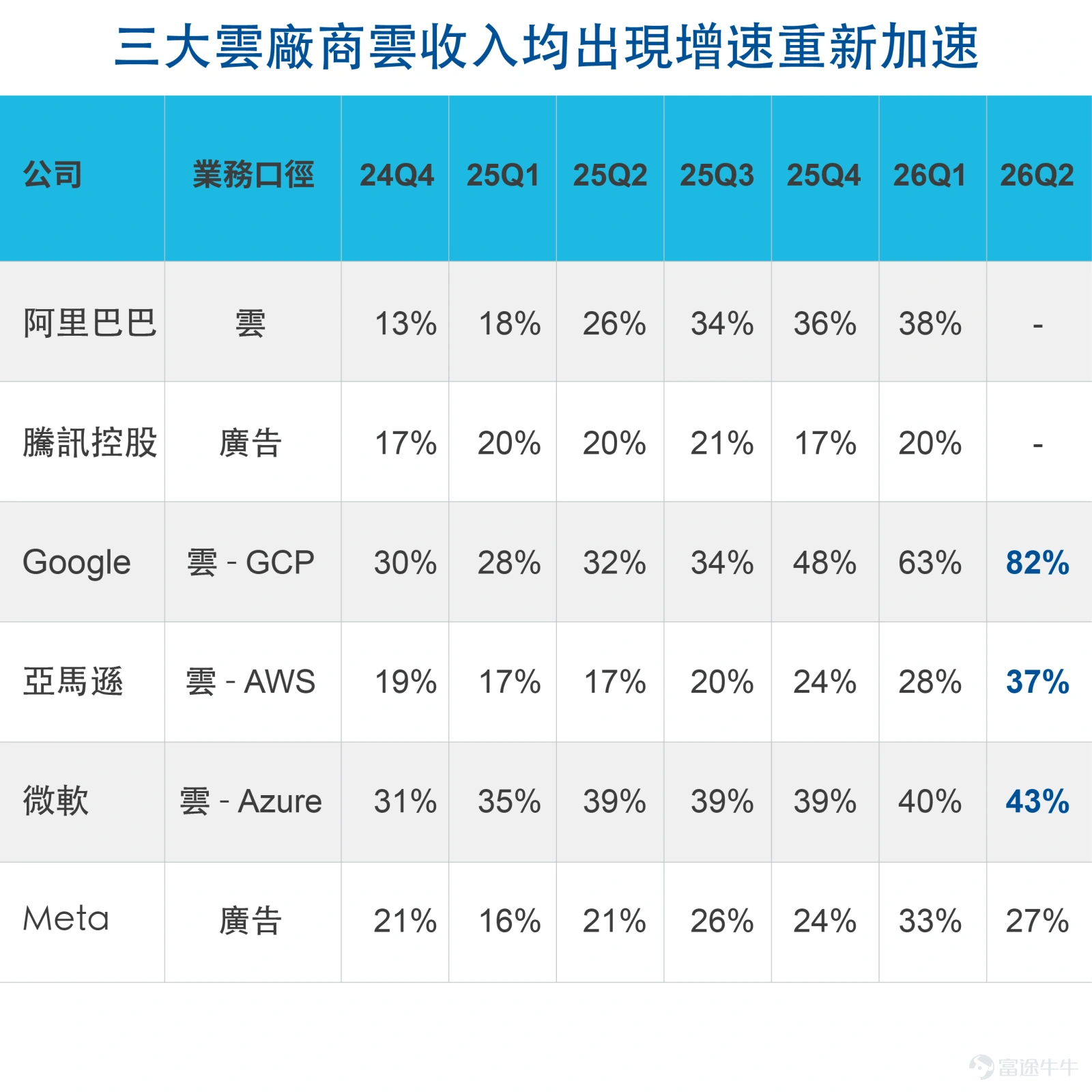
(Source: Company earnings as of July 2026)
2. Will strengthening cloud vendors suppress a rebound in compute hardware?
Quite the opposite—accelerating cloud revenue is a necessary precondition for a hardware rebound, not a suppressant. Without validation of capex returns, hardware valuations cannot be sustained. The core narrative facing hardware today is a clear deceleration in capex growth rate (from 81% down to 30%), rather than an absolute decline in spending levels. Historical experience shows that during periods of growth deceleration, as long as EPS continues to grow, it is sufficient to offset valuation compression. After a roughly 30% pullback, $PHLX Semiconductor Index (.SOX.US)$ forward P/E is around 21x, sitting at approximately the 60th percentile over the past decade, indicating valuations have entered a reasonable range. Combined with expectations that pricing and revenue growth in certain segments could re-accelerate in Q3–Q4, the hardware rebound remains underway.
(Source: Bloomberg, as of August 3)
3. What allocation tools should investors consider now?
$E Fund (HK) FTSE AI Select Index ETF (03489.HK)$ : Offers balanced exposure across compute hardware and cloud/applications, covering NVIDIA, Micron Technology, Microsoft, Palantir, Tencent, and Alibaba—ideal for the current phase of multi-segment synergy.
$E Fund HKEX Tech 100 ETF (03456.HK)$ : Focuses on six major Hong Kong tech sectors, including internet leaders Tencent and Alibaba, directly benefiting from valuation recovery in Hong Kong-listed cloud and application leaders.
$EFund A SEMICON ETF (03486.HK)$ : Concentrates on Asian semiconductor supply chains such as SK Hynix and Taiwan Semiconductor, offering higher elasticity and well-suited for capturing hardware rebound opportunities.
$NVIDIA (NVDA.US)$$Micron Technology (MU.US)$$Palantir (PLTR.US)$$Apple (AAPL.US)$$Nasdaq Composite Index (.IXIC.US)$$TENCENT (00700.HK)$$BABA-W (09988.HK)$$MEITUAN-W (03690.HK)$$HKEX Tech 100 Index (800666.HK)$$SK Hynix (000660.KR)$$SK hynix (SKHY.US)$$Taiwan Semiconductor (TSM.US)$$SMIC (00981.HK)$$HUA HONG GRACE (01347.HK)$$ASMPT (00522.HK)$
Important Notice
This material is issued by E Fund Asset Management (Hong Kong) Company Limited. This material is for reference only and does not constitute an offer or recommendation to invest in fund units. This material is for display purposes only and must not be shown to any person in any jurisdiction where such display would be unlawful. Investing involves risks, and you may lose a substantial portion of your principal. Prior to investing, investors should carefully read the relevant investment risks described in the offering documents (including the 'Risk Factors' section) of the fund. This material has not been reviewed by the Securities and Futures Commission of Hong Kong.
For detailed important notices and disclaimers regarding the above fund, please visit E Fund (Hong Kong)'s website:
Risk Disclaimer: The above content only represents the author's view. It does not represent any position or investment advice of Futu. Futu makes no representation or warranty.Read more

Comments
to post a comment
3
1