
Hong Kong stocks are rebounding—what sectors deserve attention?

HK Warrants & CBBC Notes | Hang Seng Index posts six straight gains, yet market strength remains selective: What truly matters is the emerging divergence between strong and weak stocks
On August 3, the Hang Seng Index rose another 0.48%, closing at 26,009 points—marking its sixth consecutive trading day of gains. The Hang Seng Tech Index also advanced 0.96%, extending its winning streak to two days. Judging solely by index performance, sentiment appears favorable. However, what deserves attention this time isn’t 'the Hang Seng finally breaking above 26,000 points,' but rather the growing divergence in individual stock performances behind the rally.
The Hang Seng Index remains above its key moving averages but is approaching the upper Bollinger Band; similarly, the Hang Seng Tech Index is nearing its 60-day moving average and the upper Bollinger Band. In other words, the broader market has moved beyond the initial rebound phase from recent lows and now faces a critical test of whether it can break through resistance levels.
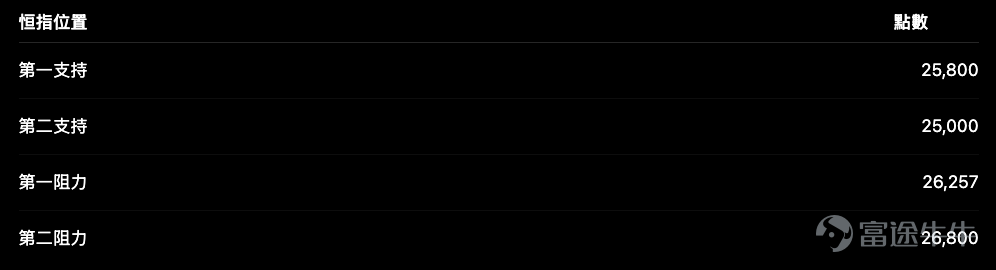
According to the 'Warrants & CBBC Product Overview,' the first resistance level for the Hang Seng Index stands at 26,257 points, while that for the Hang Seng Tech Index is at 4,907 points. Both levels are close to current prices, so entering new long positions at this stage requires more than just asking, 'Is the market trending upward?' One must also ask:
How much room remains before hitting resistance, and where should one place a stop-loss if a pullback occurs?
Hang Seng Index $Hang Seng Index (800000.HK)$ Trend remains strong, but upside room is starting to narrow
The Hang Seng Index is currently trading at 26,009 points, with an upside risk-reward score of 61, higher than the downside score of 45, indicating an overall upward bias.
Key levels to note for now include:

Meanwhile, street position data as of July 31 shows that the largest concentration of Hang Seng bear warrants lies between 26,100 and 26,299 points—precisely overlapping the first resistance zone—while the main cluster of bull warrants sits between 25,200 and 25,399 points.
This structure is quite interesting. If the Hang Seng Index rises a few hundred more points, it will simultaneously encounter technical resistance and a dense cluster of bear warrants; yet the more significant concentration of bull warrants sits far below, near the 25,200-point level.
Therefore, the most reasonable approach at this stage is not to blindly chase the rally, but to watch for two scenarios:
– Whether the market can hold steady after pulling back to 25,800;
– Whether the market can stabilize above 26,257 after a breakout, rather than just briefly piercing it intraday.
In terms of reference products, for bullish positions, consider UBS Group call warrants 29814, Guojun call warrants 13045, or UBS Group bull certificates 69450, HSBC bull certificates 69627; for bearish positions, compare UBS Group put warrants 13854, Guojun put warrants 15113, and Xunzheng bear certificates 58055Guotai Junan Bear Warrant 58074。
However, products are merely tools. If the Hang Seng Index breaks below 25,800 points, long positions should be scaled back first; if it further breaches 25,000 points, the current bullish strategy will need to be reassessed.
NetEase $NTES (09999.HK)$ Six consecutive gains, but around HK$208 has become an immediate support/resistance zone
In this rally, NetEase’s price action has actually been quite representative.
On August 3, NetEase rose only 0.1%, marking its sixth straight gain and closing above all major moving averages. However, call open interest has declined for five consecutive days, dropping another 20.81% in a single day; put open interest also fell by 17.73%, reflecting a reduction in positions on both sides. Bear warrant open interest, meanwhile, increased by 13.27% in a single day.
According to the 'Product Overview,' NetEase is currently trading at HK$208:
– Upside value-at-risk score: 58
– Downside value-at-risk score: 47
– Support levels: HK$207.8, HK$204.6
– Resistance levels: HK$208.2, HK$212.6
Most notably, the current price is almost touching the first resistance level at HK$208.2. This means that although NetEase has been rising consecutively, there is little 'unpriced upside' left in the short term.
If the HK$208.2 level is breached and held firmly, the stock would then be positioned to target HK$212.6 next; conversely, if it fails to hold even HK$207.8, the recent upward momentum may pause temporarily.
For bullish exposure, consider comparing UBS Group call warrants 27774, Citi call warrants 29681, or HSBC bull certificates 53730; for those wishing to retain bearish options, refer to Morgan Stanley put warrants 25654or UBS Group put warrants 28719。
The key point about NetEase isn’t 'it’s risen six days straight, so keep buying,' but rather:
Whether HK$208.2 can transition from resistance to support.
CATL $CATL (03750.HK)$ Four consecutive gains, yet still hasn't truly broken out of the volatile trading range
CATL rose 0.4%, marking its fourth consecutive gain and approaching the 120-day moving average (MA120). On the surface, this appears to signal stabilization, but according to the 'Product Overview,' the upside probability score is only 53, while the downside probability score is 54—nearly identical.
This suggests CATL is currently closer to 'choppy trading' rather than showing a clear upward trend.
Current price: RMB 625. Key levels are as follows:
– Support: RMB 622.5, RMB 612
– Resistance: RMB 626, RMB 637
At RMB 625, the stock is just one step away from the first resistance level at RMB 626. If it fails to break through RMB 626 again, the four-day rally may merely represent a rebound toward resistance. Only a sustained move above RMB 626 would create conditions to test RMB 637.
The major concentration zone for CATL's bull warrants lies between RMB 570 and RMB 574.5, while that for bear warrants is between RMB 685 and RMB 689.5—both relatively distant from the current price.
This actually indicates that, at this stage, technical levels are more important than warrant concentration zones in determining CATL’s direction.
For bullish exposure, consider Guotai (International) call warrants. 28831or HSBC bull certificates 64784; If resistance at RMB 626 holds again, bearish investors may consider comparing Bank of China put warrants 13969, or Huatai bear warrants 59710。
My view is that CATL isn't worth chasing just because of a 'four-session rally.' The narrow range between HK$622.5 and HK$626 is where the next directional decision will be made.
ICBC fell 0.2% on August 3, marking its second consecutive decline and slightly breaching the 5-day moving average (MA5). Call warrant open interest increased by 1.83% that day, while bull warrant open interest has declined for four straight days, and bear warrant open interest has dropped for three consecutive days.
According to the 'Product Overview,' ICBC’s upside reward-to-risk score is 63, and downside reward-to-risk score is 49, still slightly tilted upward.
Current price: HK$7.495:

This is a very tight short-term range. Even slight price movement will test support at HK$7.48 or resistance at HK$7.51.
Therefore, it's best to avoid chasing ICBC at the midpoint of this range for now. A clearer approach would be:
– If holding above HK$7.48, watch whether it can break through HK$7.51;
– If it breaks below HK$7.48, wait for HK$7.36;
– Only after breaking above HK$7.51 should we look up toward HK$7.64.
For upside exposure, consider BNP Paribas call warrants 26428, Huatai call warrants 26061, or HSBC bull certificates 59873; for downside protection, compare Citi put warrants 13197or UBS Group bear certificates 68112。
China Mobile $CHINA MOBILE (00941.HK)$ and Ping An $PING AN (02318.HK)$ Defensive stocks are also starting to show divergence
China Mobile fell 0.06%, marking its second consecutive decline and slightly breaching its 5-day moving average (MA5). Put warrant open interest has risen for three straight days, surging 140.47% in a single day, while bull warrant open interest has declined for 12 consecutive days.
China Mobile is trading at HK$83.60, with an upside risk-reward score of 56 and a downside score of 51—indicating little difference. The first support level is at HK$83.25, and the first resistance is at HK$83.65, placing it in a very narrow short-term trading range. Until it breaks above HK$83.65, it’s hard to say the stock has regained strength.
Ping An declined 0.34%, falling for two straight days and testing its 250-day moving average (MA250). Bull warrant open interest increased by 7.68%, while bear warrant open interest declined for two consecutive days.
Ping An is currently trading at HK$58.45, with support levels at HK$58.05 and HK$57.10, and resistance at HK$58.65 and HK$61.95. Its upside risk-reward score is 56, and the downside score is 52, showing no clear directional advantage.
In other words, this Hang Seng Index rally hasn’t been accompanied by synchronized strength across all heavyweight stocks. China Mobile and Ping An are still struggling within their own short-term ranges, which is why I wouldn’t interpret the 'Hang Seng’s six-day winning streak' as a signal that 'most stocks are suitable for chasing.'
The key takeaway from today's notes
A strong index does not mean individual stocks have all turned bullish; the market has moved from a broad-based rebound into a phase where each stock must individually confirm a breakout.
The Hang Seng Index and Hang Seng Tech Index are approaching resistance levels, while NetEase, CATL, ICBC, China Mobile, and Ping An each have their own narrow trading ranges for near-term support and resistance. At this stage, when selecting warrants or CBBCs, first assess the price position, then the direction, and only lastly compare leverage ratios.
The 'Warrants & CBBCs Product Overview' has consolidated additional support/resistance levels, risk-reward ratios, and representative products for major indices and individual stocks. Its purpose is not to predict daily market moves for investors, but to help avoid chasing high-leverage products solely based on recent gains without clear entry or invalidation criteria.
Risk Disclaimer: The above content only represents the author's view. It does not represent any position or investment advice of Futu. Futu makes no representation or warranty.Read more

Comments
to post a comment
3