US-Japan Intervene to Prop Up Yen — What's Next for US Stocks?

In-Depth Analysis | U.S. and Japan Join Forces to Support the Yen: Why This Defense Line Also Matters for U.S. Treasuries and U.S. Stocks?
U.S. President Trump recently stated that the United States participated last week in foreign exchange market intervention aimed at pushing up the yen.
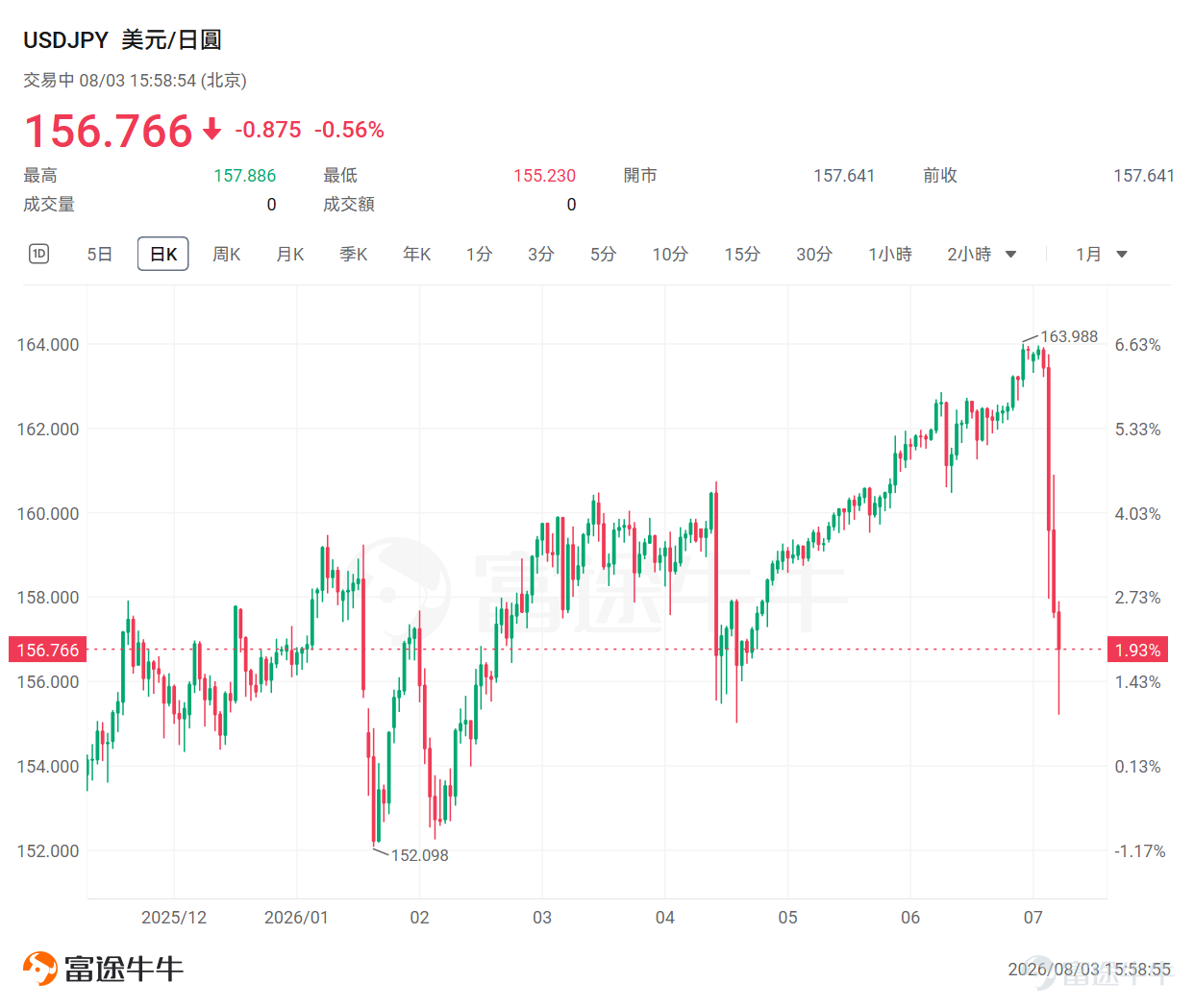
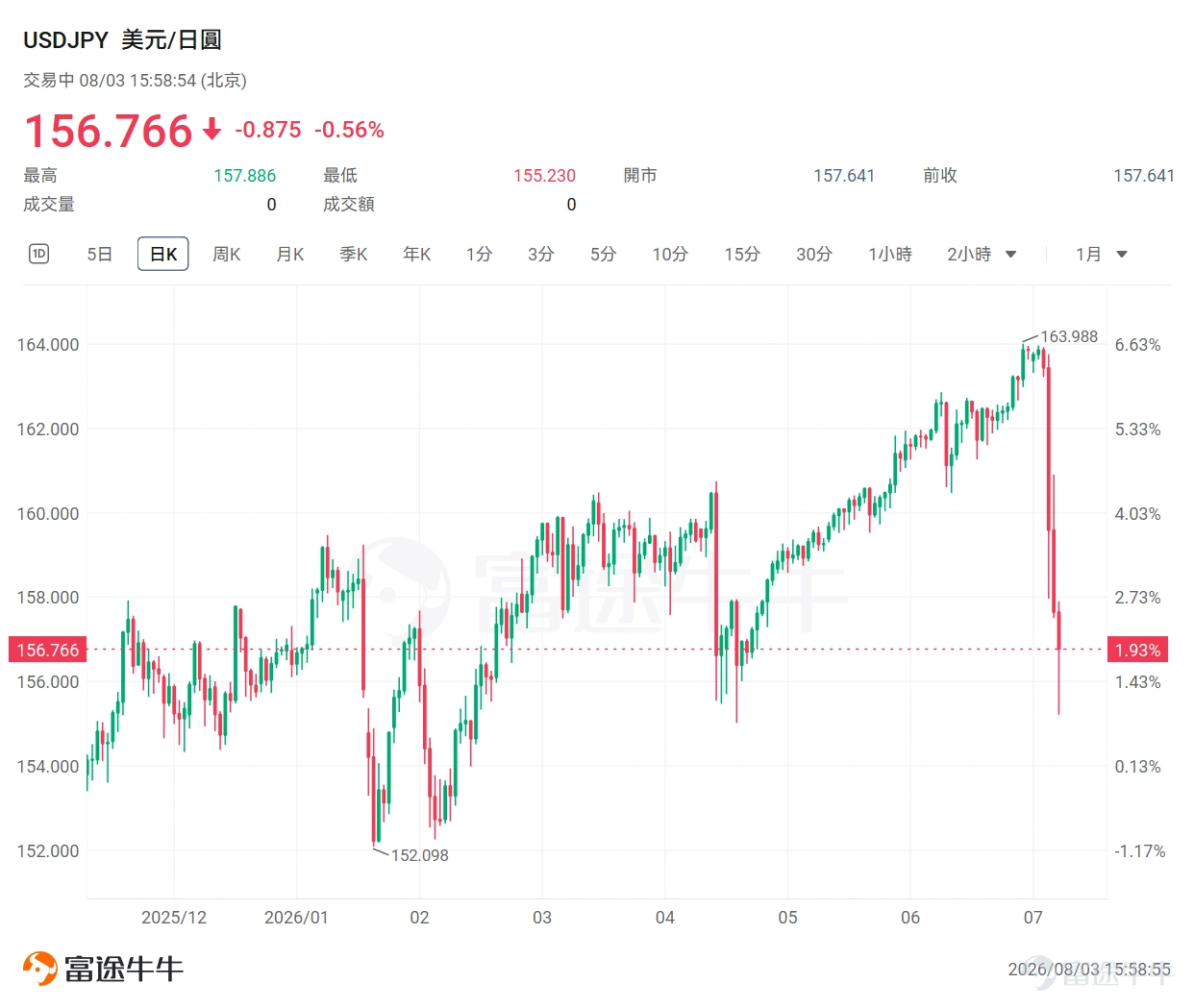
Shortly afterward, the U.S. and Japanese finance ministries jointly confirmed the intervention was genuine—marking the first such coordinated action in 15 years, intended to support the severely battered yen. Following news of the intervention, ... $USD/JPY (USDJPY.FX)$ it touched 156.766.
On the surface, this appears to be a 'yen defense operation,' but when viewed alongside recent unusual moves in long-end U.S. Treasury yields, it becomes clear the U.S. may have had another key motive: preventing Japan from selling large amounts of dollar-denominated assets to support the yen, which could further exacerbate pressure on the U.S. Treasury market.
This joint intervention concerns more than just the yen—it could also influence the next move in U.S. equities through its impact on Treasury yields and global carry trades.
Long-end U.S. Treasury yields have become the market's most sensitive red line.
At the July FOMC meeting, the Fed kept its policy rate unchanged at 3.50%–3.75%, though three officials advocated a 25-basis-point rate hike. New Fed Chair Waller repeatedly emphasized the necessity of bringing down inflation but offered no clear policy path forward.
This combination of 'hawkish rhetoric but wait-and-see action' has failed to reassure the bond market.
After the meeting, the U.S. Treasury yield curve steepened significantly: $U.S. 2-Year Treasury Notes Yield (US2Y.BD)$ short-term yields briefly declined, while 10-year and 30-year yields continued to rise. As of this writing, $U.S. 10-Year Treasury Notes Yield (US10Y.BD)$ the 10-year yield rose to 4.686%, $U.S. 30-Year Treasury Bonds Yield (US30Y.BD)$ and the 30-year yield climbed to 5.22%, the highest level since 2007.
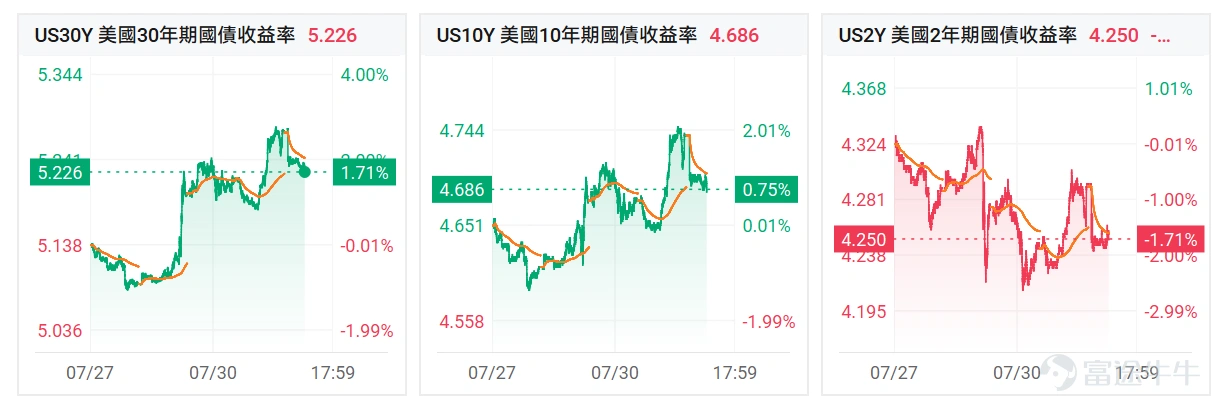
One market interpretation is that investors perceive a gap between the Federal Reserve’s rhetoric on controlling inflation and its actual actions, thus demanding higher compensation for long-term risk.
However, the rise in long-end yields reflects not only the Fed’s credibility but also multiple factors, including fiscal deficits, Treasury supply from bond issuance, energy prices, real interest rates, and term premiums.
Therefore, 'rate hikes' and 'declining long-end yields' are not necessarily contradictory.
If near-term rate hikes successfully re-anchor inflation expectations and bolster market confidence in the Fed, the inflation premium and term premium embedded in 10-year and 30-year U.S. Treasuries could actually decline.
However, this transmission mechanism is not guaranteed. If markets respond by raising terminal rate expectations, or if fiscal pressures and Treasury supply continue to dominate, long-end yields may remain elevated or even rise further.
Why has the U.S. suddenly become willing to help Japan?
In the past, the U.S. frequently criticized other countries for intervening in exchange rates, yet now it is actively assisting Japan in buying yen. One key consideration may be that a yen crisis could already be threatening to spill over into the U.S. Treasury market.
Japan's traditional foreign exchange intervention process isn't complicated: sell U.S. dollar-denominated assets to obtain dollars, then sell those dollars to buy yen.
The issue is that, as of the end of June, Japan held approximately $1.29 trillion in official reserves, of which about $928.6 billion was allocated to various securities.If the yen continues to depreciate, Japan may need to repeatedly conduct large-scale interventions, potentially forcing it to sell some U.S. Treasuries to raise dollars.
When U.S. Treasuries are already under multiple pressures—including inflation, fiscal deficits, issuance supply, and the Federal Reserve’s credibility—Japan’s concentrated selling of long-term U.S. Treasuries could further push up yields on 10-year and 30-year bonds.
What’s more troubling is that this could create a self-reinforcing cycle:Yen depreciation prompts Japan to sell dollar-denominated assets for intervention; U.S. Treasury prices come under pressure and yields rise; the interest rate differential between the U.S. and Japan remains high, strengthening the dollar further; the yen faces renewed depreciation pressure, forcing Japan into even larger-scale interventions.
Therefore, the U.S. move this time aims first to curb disorderly yen volatility, but objectively also reduces the likelihood of Japan engaging in concentrated U.S. Treasury sales.
FIMA Repo: Temporarily swap for dollars to alleviate pressure from concentrated Treasury sell-offs
In this episode, an important policy tool has come into market focus—the Federal Reserve's FIMA Repo Facility.
Masahiko Loo, Senior Macro Strategist at State Street Bank, noted that the Japanese Ministry of Finance’s announcement of plans to use the FIMA repo facility for future intervention actions sends a signal that 'may be more significant than the intervention itself.' He explained:The FIMA facility allows foreign central banks to obtain U.S. dollar liquidity without directly selling U.S. Treasuries, effectively signaling clearly to the market that Japan can secure intervention funding without offloading its U.S. Treasury holdings.
This essentially adds a new channel for Japan’s foreign exchange intervention:Previously, the process was 'sell U.S. Treasuries → obtain dollars → buy yen'; now it can become 'pledge U.S. Treasuries as collateral → borrow dollars → buy yen.'
This simultaneously achieves three objectives: the yen receives policy support; Japan avoids concentrated selling of U.S. Treasuries; and a potential upward risk to long-end U.S. yields is removed.
Impact on U.S. equities: Not necessarily bullish in the short term
U.S.-Japan joint intervention affects U.S. equities through two opposing channels.
First channel: Reducing U.S. Treasury sell-off risk eases valuation pressure on U.S. equities
If Japan can obtain U.S. dollars through the FIMA Repo facility or via coordination with the U.S., it will not need to sell large amounts of U.S. Treasuries to defend the yen.
The direct bullish impact on U.S. equities is that long-end U.S. Treasuries have one fewer potential major seller. If yields on 10-year and 30-year Treasuries stabilize or even decline as a result, the valuation pressure on U.S. stocks could ease.
Among them, tech stocks and the AI sector remain the most sensitive.
Most of the value of growth companies comes from future cash flows; the higher long-term rates are, the lower the present value of those future profits becomes. Therefore, a 30-year Treasury yield above 5% often exerts more pressure on highly valued tech stocks than whether the FOMC hikes rates by 25 basis points at a given meeting.
If coordinated intervention stabilizes the U.S. Treasury market without triggering widespread deleveraging, large-cap tech stocks, semiconductors, and AI infrastructure sectors could be the first to see valuation recovery.
However, such a recovery would primarily benefit industry leaders with real orders, profitability, and free cash flow. For companies still incurring losses, reliant on external financing, or whose valuations are largely based on distant future narratives, elevated long-end rates will continue to constrain valuations.
Second channel: A rapid appreciation of the yen could trigger unwinding of carry trades.
The yen has long been one of the world’s most important funding currencies.
In the past, substantial capital was borrowed in yen at relatively low cost and invested in U.S. equities, credit bonds, cryptocurrencies, and other high-yield assets. As long as the yen remained weak, these trades not only captured asset returns but also potentially benefited from currency gains.
However, U.S.-Japan coordinated intervention has altered the risk-reward profile of this trade.
If the yen appreciates rapidly, investors who borrowed yen would need to buy it back at a higher price to repay their debt, forcing some leveraged positions to unwind. This means that while U.S.-Japan joint support for the yen reduces the risk of direct Japanese selling of U.S. Treasuries, it could simultaneously trigger short-term liquidity shocks in U.S. equities through carry-trade unwinds.
Those most vulnerable are typically: high-valuation, high-volatility tech stocks; crowded trades in semiconductors, AI hardware, etc.; small-cap growth stocks; leveraged ETFs and options positions; cryptocurrencies and other high-beta assets.
So,A rising yen should not be simplistically interpreted as bullish for U.S. equities—the key lies in the pace at which the yen appreciates.
A moderate yen appreciation accompanied by a simultaneous decline in U.S. Treasury yields is the most favorable scenario for U.S. stocks; however, a sudden sharp yen rally coupled with widespread deleveraging could lead to rising Treasury prices alongside falling U.S. equities.
Which U.S. equity sectors may relatively outperform?
Under this environment, further divergence within U.S. equities is likely.
First, large-cap tech leaders with stable earnings, strong cash flows, and low debtmay perform better than small-cap growth stocks that rely on external financing. While both are affected by interest rates, the former possess stronger buyback capacity, balance sheets, and earnings visibility.
Second, consumer staples, healthcare, and value-oriented companies with low debt and high cash flow visibilitymay demonstrate relative resilience amid heightened market volatility.
However, not all high-dividend sectors should be viewed as beneficiaries. When long-end U.S. Treasury yields remain elevated, bonds become relatively more attractive, and certain rate-sensitive high-dividend sectors may still face downward pressure.
The impact on bank stocks is even more complex. An orderly steepening of the yield curve benefits some banks by improving net interest margins; however, if long-end yields rise too quickly, it could lead to losses on bond holdings, higher funding costs, and increased credit risk.
Therefore, bank stocks would prefer an 'orderly steepening' rather than a disorderly bond market.
In addition, for U.S. companies with significant revenue exposure to Japan, yen appreciation could bring some foreign exchange benefits; U.S. sectors like autos, which directly compete with Japanese exporters, might also see marginal improvement. However, compared to interest rates and global liquidity, these effects remain secondary.
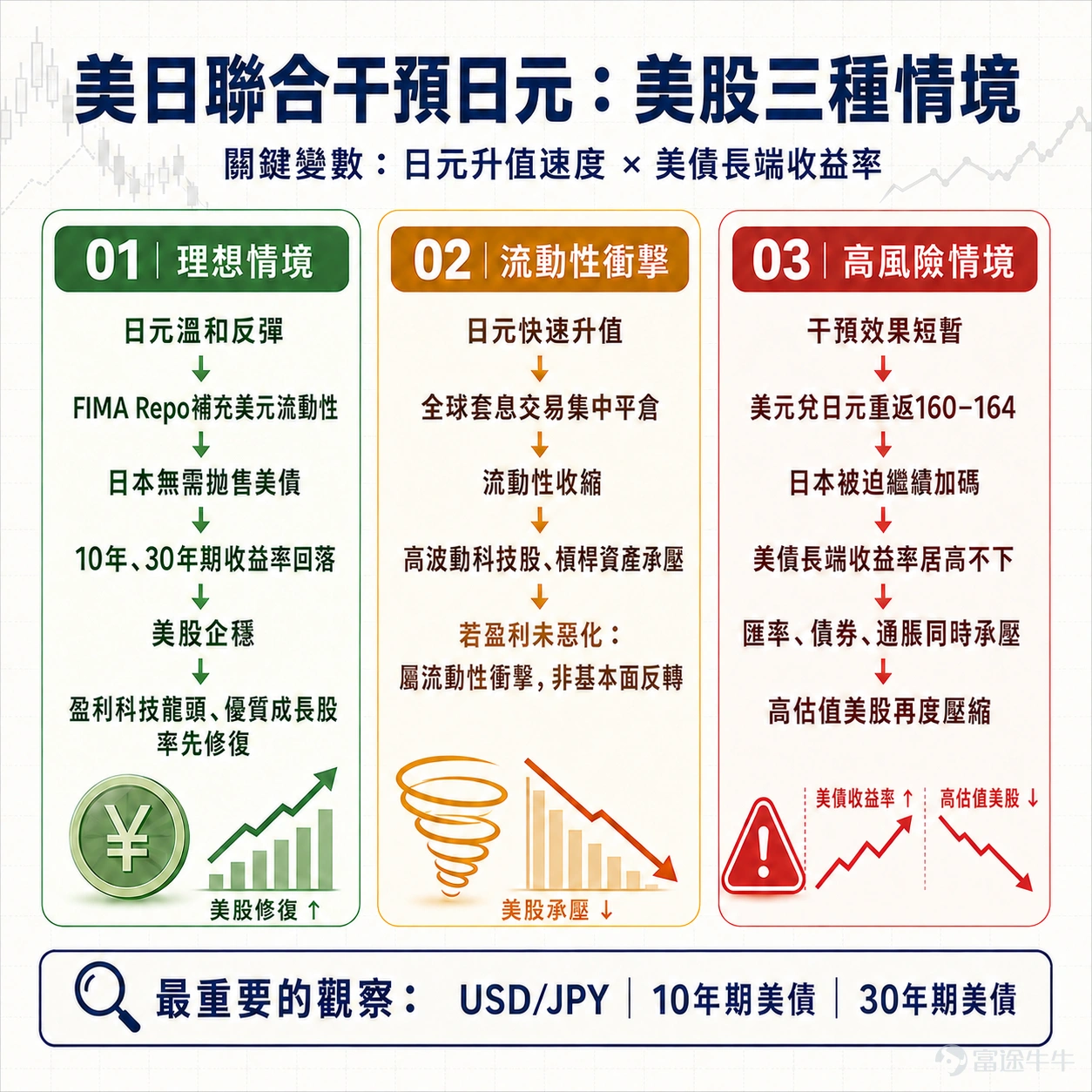
Three possible scenarios for U.S. equities
The first—and most favorable—scenario is a moderate rebound in the yen,with the U.S. and Japan jointly intervening and using the FIMA Repo facility to stabilize markets, allowing Japan to avoid selling U.S. Treasuries, and enabling 10-year and 30-year yields to gradually decline.
This would support overall stabilization in U.S. equities, with profitable tech leaders and high-quality growth stocks likely leading the recovery.
The second scenario involves a rapid yen appreciation triggering a concentrated unwinding of global carry trades.
In this case, even if Treasury yields fall, U.S. equities could still decline due to liquidity contraction, with high-volatility tech stocks and leveraged assets hit hardest. However, as long as corporate earnings do not deteriorate simultaneously, such a decline would reflect a liquidity-driven shock rather than a fundamental reversal.
The third—and riskiest—scenario is that joint intervention only temporarily lifts the yen,The USD/JPY is quickly approaching the 160–164 range again, forcing Japan to continue escalating its intervention, while long-end U.S. yields remain elevated.
This means exchange rate pressure, long-end yield pressure, and inflation concerns are all intensifying simultaneously, putting high-valuation U.S. equities at risk of another round of valuation compression.
What should we watch closely next?
The market should monitor three key signals:
First, whether USD/JPY continues an orderly decline or rebounds back toward the 160–164 range.This range is not an officially announced intervention threshold, but it serves as an important reference for gauging market stress.
Second, whether the U.S. 10-year yield can fall and stabilize below 4.75%, and whether the 30-year yield can drop below 5.20% again.If yields continue to decline, it would indicate that coordinated intervention is effectively reducing the risk of U.S. Treasury sell-offs.
Third, whether abnormal selling emerges in Nasdaq, semiconductors, cryptocurrencies, and other high-beta assets during JPY appreciation.If JPY strength and risk-asset declines accelerate simultaneously, caution is warranted as it may signal widening unwinding of carry trades.
If the yen stabilizes in an orderly manner, Japan avoids concentrated sales of U.S. Treasuries, long-end U.S. yields subsequently decline, and there is no large-scale unwinding of carry trades, this joint intervention will have successfully defused a potential risk point in global markets, providing tangible support to U.S. equities.
However, if the yen surges sharply in the short term, triggering leveraged capital outflows, U.S. stocks could first experience a liquidity shock; if the intervention ultimately fails and Treasury yields continue rising, high-valuation tech stocks will remain the most vulnerable segment.
Therefore,What truly merits attention about this U.S. move isn’t just how much the yen has appreciated.
The more significant signal it sends is this: once the 30-year Treasury yield rises above 5%, long-end funding costs have become a constraint on U.S. financial markets that can no longer be ignored. Any external risk that could exacerbate Treasury selling and push long-end yields higher will now attract greater attention from U.S. authorities.
The U.S.–Japan joint intervention in the yen market aims first and foremost to stabilize exchange rates, but it also objectively adds a layer of liquidity protection for the U.S. Treasury market.
Whether this buffer can further support U.S. equities ultimately hinges on two variables: whether Treasury yields can genuinely retreat, and whether yen appreciation triggers another round of global deleveraging.
Risk Disclaimer: The above content only represents the author's view. It does not represent any position or investment advice of Futu. Futu makes no representation or warranty.Read more


Comments (19)
to post a comment
158
339