
Mid-2026 Review: How to Identify the Key Themes Amidst Changing Market Dynamics?

Hang Seng Index reclaims 26,000! Is this the final rally marking the end of the rebound, or the start of a new market trend? How robust is the August 'red start'?
Hong Kong Stock Market Recap and Analysis – August 3, 2026
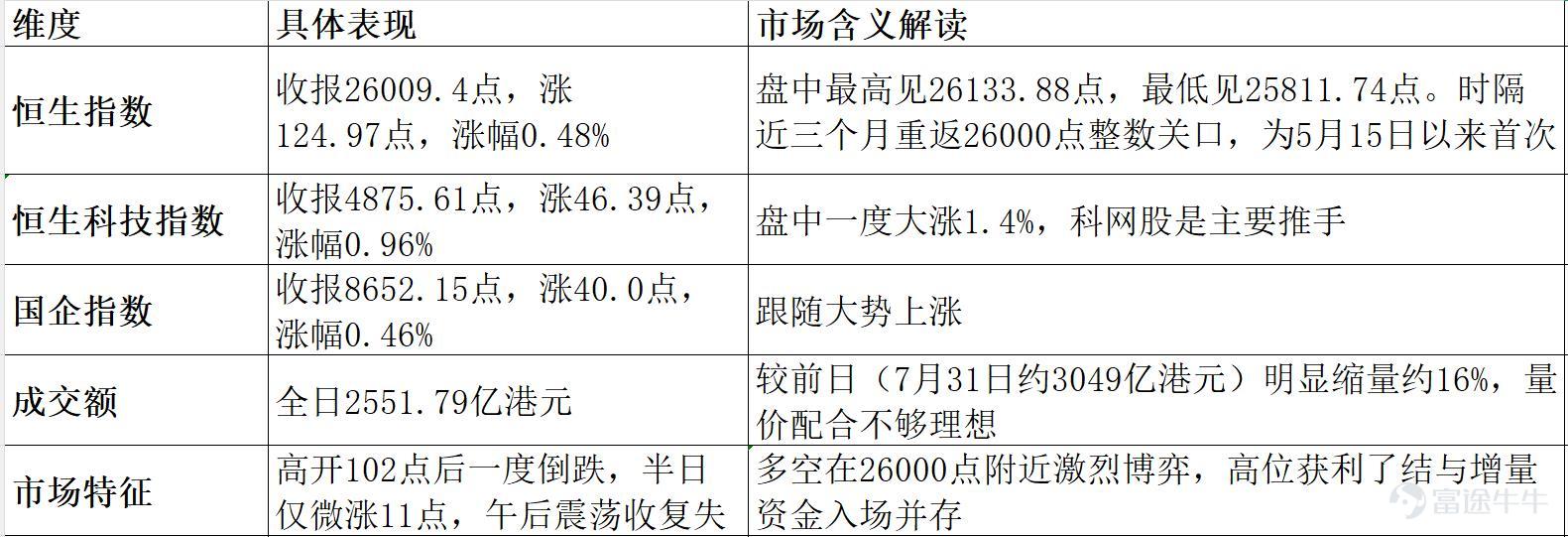
Key takeaway: Hong Kong stocks kicked off August with a strong start. Despite external headwinds, the Hang Seng Index experienced sharp intraday volatility—surging early, then pulling back and briefly turning negative—before ultimately closing up 0.48%, reclaiming the 26,000-point mark for the first time in nearly three months. Tech and internet stocks, along with solar photovoltaic (PV) names, led the rally as dual growth engines, while memory semiconductor stocks extended their losses, and the two leading AI large-model plays diverged sharply. On the funding front, southbound capital reversed last week’s consecutive net outflows, recording a substantial net inflow exceeding HK$7 billion today. Technically, the Hang Seng Index’s daily Williams %R remains in overbought territory, with RSI also nearing overbought levels, warranting caution against short-term chasing of highs.
I. Overall Market Performance
Hong Kong equities staged a roller-coaster session today, characterized by 'a high open, a sharp surge, a rapid pullback, and a choppy recovery.'

Market characteristics: Opened 102 points higher, briefly turned negative, and was up only 11 points at midday; recovered losses in the afternoon amid choppy trading. Bulls and bears fiercely contested around the 26,000 level, with profit-taking from elevated positions coexisting alongside fresh capital inflows.
Opening context:Japan’s stock market plunged more than 1,600 points this morning, and South Korea’s benchmark index tumbled over 4%. Against this backdrop, Hong Kong stocks moved higher, demonstrating notable resilience—a move directly tied to coordinated weekend interventions by the U.S., Japan, and South Korea to stabilize Asian financial markets via foreign exchange measures.
II. Sector Rotation Analysis
Today’s market displayed a three-pronged structure: tech/internet and solar PV stocks led gains, memory semiconductors remained under pressure, and AI large-model leaders showed extreme divergence.
Strong-performing sectors
1. Solar PV Sector – Today’s strongest theme
Xinyi Solar (0968): Soared 13.41%, topping the Hang Seng Index constituents, with turnover of HK$416 million
Catalyst: Concord New Energy announced it signed three long-term power purchase agreements with Tesla for U.S. solar projects, totaling approximately 469 megawatts in capacity, significantly boosting confidence across the entire solar PV supply chain.
2. Tech & Internet Stocks – Broad-based rally led by Alibaba

Major tech stocks rallied collectively today:
Drivers: ① News of Alibaba launching a new AI model continues to gain traction; ② Market rumors suggest Alibaba is collaborating with MiniMax; ③ XunCe (3317), dubbed the 'first tokenomics stock,' issued a profit warning, reporting a 388.76% year-over-year surge in first-half revenue and a return to profitability, boosting sentiment across the AI application sector.
3. AI Application Segment – MiniMax Stands Out
MiniMaxW (0100): Surged over 7%, becoming the top gainer among Hang Seng Tech Index constituents
Weak Sectors
1. Memory Semiconductor Concept – Continues to Plummet
The memory chip sector extended Friday’s losses, with declines widening further today:

Reasons for the decline:
① Sentiment spillover from U.S. memory chip stocks (SanDisk, Micron), which plunged over 5% last Friday
② Growing market concerns over a peak in the memory chip cycle
③ SK Hynix remains under pressure in the Korean stock market.
2. AI Foundation Models – Extreme Divergence Between the Two Leaders
Zhipu AI (2513): Plunged nearly 5%, in stark contrast to MiniMax’s gain of over 7%
Divergence rationale: Market rumors suggest Alibaba is collaborating with Moonshot AI (MiniMax), while Zhipu AI faces concerns over a worsening competitive landscape
3. Other weak sectors
Non-ferrous metals:China Hongqiao Group (1378) tumbled 6.44%, marking the largest decline among Hang Seng Index constituents
Auto stocks:Li Auto-W (2015) fell 2.90%, and Xiaomi Group-W (1810) dropped 2.85%
Pharmaceuticals, banking, and other sectors also posted varying degrees of declines
Sector rotation summary:Capital is rapidly rotating out of previously hot or cyclical sectors—such as memory semiconductors, non-ferrous metals, and autos—and pouring into three key areas: photovoltaics, tech-internet stocks, and AI application plays. Compared to last Friday’s pattern of 'a violent semiconductor rebound and weakness in mainland China banks,' today’s flows show further concentration into AI applications and photovoltaics, while memory semiconductors have become the new 'hardest-hit' segment, reflecting extremely rapid sector rotation.
III. Market Capital Flow Characteristics
1. Southbound capital:Shifted from continuous net outflows to substantial net inflows
Last week (July 27–31), southbound capital recorded net outflows for five consecutive trading days, totaling nearly HK$24 billion—the longest streak of continuous outflows in nearly four years. Today, a significant reversal occurred in capital flows:
Southbound funds posted net purchases exceeding HK$7 billion for the full day, including over HK$3.317 billion via Shanghai-HK Connect and over HK$3.686 billion via Shenzhen-HK Connect
Sustained net buying occurred across multiple intraday periods:Net purchases exceeded HK$4 billion by 11:26 AM, further expanding to over HK$7 billion
Interpretation of capital flows:
"Strong start to August" effect:Domestic investors resumed positioning at the beginning of the month, ending the streak of continuous net outflows
Buying tech leaders on dips:Alibaba saw trading volume reach HK$23.9 billion, while Tencent recorded HK$18.8 billion, indicating both domestic and foreign capital are focusing on major internet and tech giants
Avoidance of memory semiconductor stocks:Despite strong overall net inflows, the memory semiconductor sector was still abandoned by investors
2. Trading Structure Characteristics
Total market turnover amounted to HK$255.179 billion, significantly lower than the approximately HK$304.9 billion recorded on July 31
The combination of rising prices and declining volume suggests: ① reduced willingness to chase gains at elevated levels; ② the movement is primarily driven by existing capital reallocating positions rather than large-scale new money entering the market
Alibaba alone accounted for HK$23.9 billion in trading volume, representing nearly 9.4% of total market turnover, indicating highly concentrated capital activity
IV. Technical Analysis: Dual Confirmation from Williams %R and RSI
Williams %R Analysis
The Williams %R (WR) ranges from 0 to 100:
0 to 20:Overbought zone, suggesting a potential short-term pullback
80 to 100:Oversold territory; a short-term rebound is possible
Hang Seng Index Futures Williams %R:Approximately 1.085
Analysis:
The Williams %R reading is 1.085, indicating an extremely overbought condition (range of 0 to 20).
1. Overbought pressure continues to build: Although the Hang Seng Index rose only 0.48% today, the Williams %R remains near its extreme, suggesting prices are trading close to recent highs. Bullish momentum remains strong but has already been fully expressed.
2. Comparison with last Friday: On last Friday (July 31), the Williams %R was approximately 1.944; it has slightly increased today to 1.085, further intensifying overbought conditions and amplifying rather than easing adjustment pressures.
3. Short-term risk alert: In an extremely overbought state, any negative news could trigger profit-taking. Today, the index pulled back from an intraday high of 26,133 to close at 26,009, already showing signs of a failed breakout.
Relative Strength Index (RSI) Analysis
The RSI (Relative Strength Index) ranges from 0 to 100:
RSI > 70: Overbought territory, increasing the likelihood of a price correction
RSI < 30: Oversold zone, increasing likelihood of a price rebound
RSI 30–70: Normal range
Hang Seng Index futures RSI(14): Approximately 56.408
Analysis:
RSI(14) stands at 56.408, within the normal range but on the stronger side (upper-middle part of the 30–70 band).
1. Not yet overbought: RSI at 56.4 remains below the overbought threshold of 70, indicating the medium-term trend has not overheated.
2. Divergence with Williams %R: Williams %R shows extreme overbought conditions (1.085), while RSI only indicates relatively strong momentum (56.4). This indicator divergence warrants attention—Williams %R is more sensitive to short-term price fluctuations, whereas RSI reflects broader medium-term momentum.
3. Integrated interpretation: Significant short-term (daily chart) overbought pressure exists, but medium-term (weekly chart) momentum has not yet weakened. The market may require short-term consolidation to correct Williams %R, but the medium-term uptrend is unlikely to reverse immediately.
Conclusion from dual-indicator confluence

Overall assessment:
The extreme overbought reading in Williams %R (1.085) signals non-negligible short-term pullback risk, especially as today already saw a rally followed by a retreat (high of 26,133 → close at 26,009).
RSI (56.4) has not entered overbought territory, suggesting medium-term trends still have underlying support. The correction is more likely a time-consuming consolidation rather than a trend reversal.
Combining both indicators: short-term pullback risks should be monitored, but the medium-term trend remains intact.
V. Comprehensive Trading Strategy Recommendations
Based on the core assessment that 'the index has returned to 26,000 but retreated after an intraday high, the Williams %R is extremely overbought, RSI remains strong but not overbought, and sector performance is highly divergent':

VI. Key Observations for Tomorrow
1. Whether the 26,000 level holds: The Hang Seng Index closed above 26,000 for the first time in nearly three months. Whether it can hold above this level for a second consecutive day will be key to confirming the validity of the breakout.
2. Williams %R correction: Monitor whether the Williams %R retreats from its overbought level of 1.085, which will determine the extent of near-term pullback pressure.
3. Whether trading volume expands: Today’s turnover of HK$255.1 billion was lower than the previous day. If volume fails to expand beyond HK$280 billion tomorrow, upward momentum may weaken.
4. HSBC earnings: HSBC (0005) will release its interim results tomorrow. As a major financial heavyweight, its earnings will influence overall market sentiment.
5. Whether memory semiconductors stabilize: After CSOP Twox Leveraged LONG Hynix ETF dropped more than 16% in a single day, further sharp declines could drag down sentiment across the entire tech sector.
6. Whether southbound capital continues net inflows: Today marked the end of a five-day streak of net outflows. Whether net inflows continue for a second straight day will be critical in determining if domestic investors have genuinely shifted their stance.
Risk Disclaimer: The above content only represents the author's view. It does not represent any position or investment advice of Futu. Futu makes no representation or warranty.Read more


Comments (5)
to post a comment
12