Apple and Amazon reported starkly contrasting earnings— which one are you bullish on?

Daily Options Yield Strategy | AWS Posts Its Fastest Growth in 18 Quarters! AMZN Surges 15% in a Day, Nearing Its Previous High—How Should Traders Navigate the Validation Phase of AI Cloud Giants' Returns?
I. Market Indicator
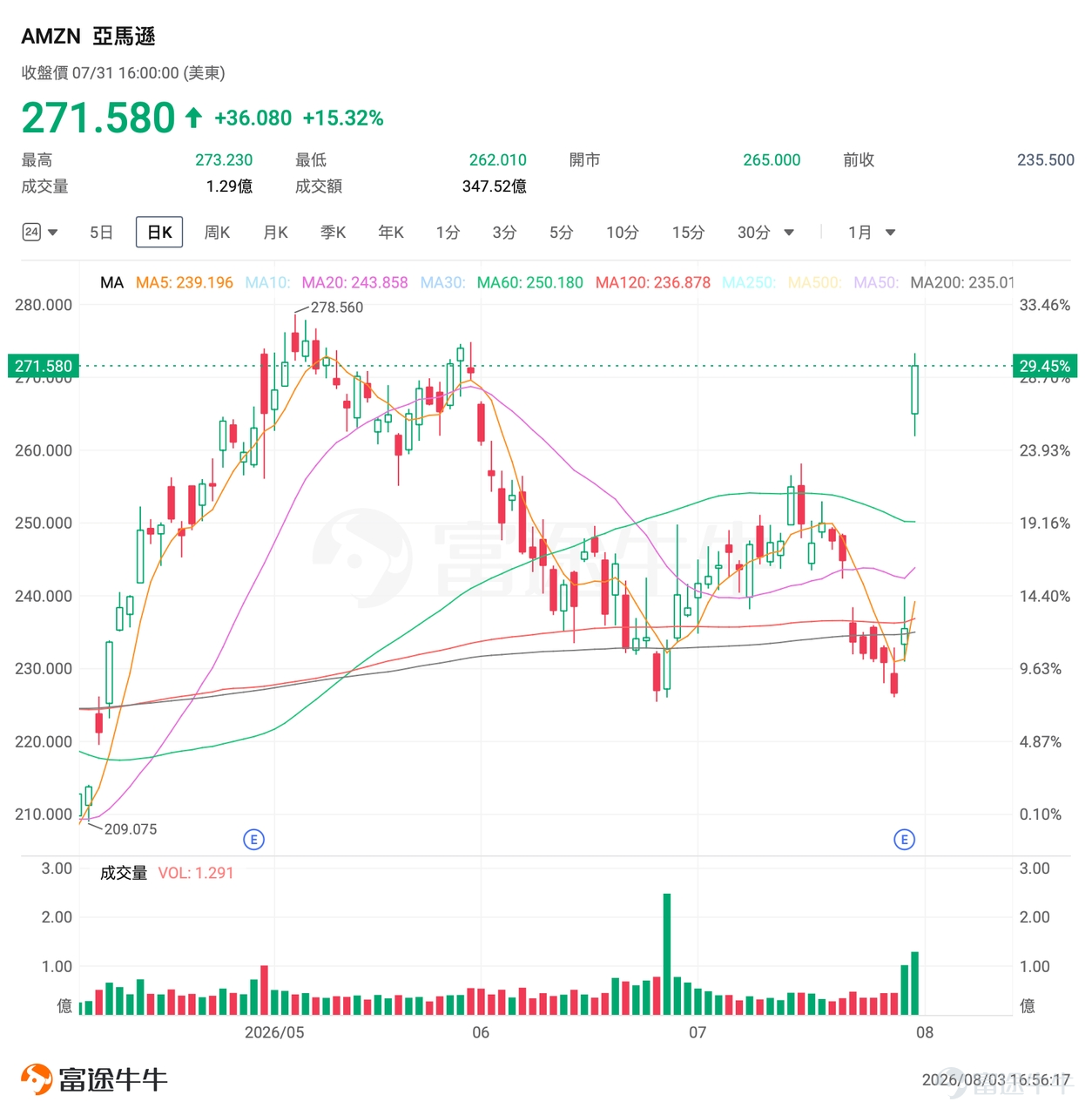
On the previous trading day, all three major U.S. stock indexes surged, with tech stocks reversing their earlier sentiment.$Amazon (AMZN.US)$In Q2, revenue surpassed the US$200 billion mark for the first time, with AWS cloud services posting a 36.7% year-over-year growth—the fastest pace in 18 quarters—and the stock surged 15.32% in a single day to US$271.58. The narrative shift toward an "extraction phase" in AI investment has created a window of high premiums for options-selling strategies.
II. Popular Targeted Attention
AMZN: AWS growth hits an 18-quarter high, with both its AI and chip businesses surpassing $25 billion in annualized revenue.
$Amazon (AMZN.US)$On the previous trading day (July 31), the stock closed up 15.32% at $271.58, with an intraday high of $273.23. Trading volume surged significantly above its average level.

From a technical perspective, the company's current price action is in an earnings-driven breakout phase. On July 31, the stock decisively broke above its previous trading range, with the closing price of $271.58 now above all major moving averages. Volume has accompanied the price move, signaling strong short-term momentum, while the year-to-date high serves as a key resistance level.
The primary catalyst behind the stock's sharp intraday surge was the company's newly released financial report:
AWS's growth hit an 18-quarter high.Amazon's Q2 net sales reached $200.6 billion (up 20% year over year), and operating profit hit $27.5 billion (up 43% year over year), both beating expectations. AWS revenue totaled $42.23 billion (up 37% year over year), marking its fastest growth in 18 quarters and accelerating for the fifth consecutive quarter—far surpassing Wall Street's forecast of 31%. AWS posted an operating margin of 39.4%, with operating profit reaching $16.6 billion (up 64% year over year).
More importantly, management disclosed that AWS's AI business and its in-house chip business both have annualized revenue run rates exceeding $25 billion, with year-over-year growth in the triple-digit range.AWS's backlog has reached $496 billion, hitting a record high and reflecting customers' long-term commitment to future computing power. Evercore ISI analysts described it as "the breakthrough quarter Amazon needed," noting that AWS is accelerating growth while simultaneously improving its profit margins.
Capital expenditures have been raised to US$220 billion, and free cash flow has turned negative.The company also announced that it is raising its 2026 cash capital expenditure forecast from approximately $200 billion to approximately $220 billion.The CEO stated that even at this level, it would still fall short of meeting all demand by 2026.Supply is expected to remain tight in 2027, with demand already substantial in 2028. High capital expenditures have turned free cash flow into a net outflow of $7.6 billion over the past 12 months (compared with a $18.2 billion inflow in the same period last year). However, unlike in the past, the market has adopted an optimistic interpretation this time around.AWS's accelerating growth and the quantifiable revenue generated by its AI business have led investors to view current cash outflows as a "transient cost" in the AI infrastructure-building process, rather than an endless drain.
Subsequent observation variables includeWhether AWS's growth can sustain above 30%, the year-over-year revenue growth trend of its AI and chip businesses, the actual realization of the third-quarter guidance (revenue of $197–202 billion, implying 9%–12% growth), and the pace of free cash flow recovery.
III. Option-Based Rental Income Strategy
1. Cash Secured Put
Sold 1 AMZN contract with strike 260P expiring on August 5, 2026; estimated margin requirement (for reference only): $26,000.

Opportunity Logic:
For investors who recognize the long-term value of Amazon's AI cloud but have yet to establish positions, the stock has already surged 15% to $271 on the back of the Q2 earnings report, increasing short-term upside risks. However, AWS's growth rate hitting an 18-quarter high provides solid fundamental support.
By selling put options, investors can capture the premium in a high‑IV environment if the stock price consolidates at its current elevated levels or continues to climb; and should the stock pull back due to short‑term profit-taking or weaker third‑quarter guidance, they also have the opportunity to establish positions at more attractive prices.
2. Covered Call
Hold 100 shares, sell 1 contract of AMZN 260810 290C.

Opportunity Logic:
For investors who already hold Amazon shares, the stock price has risen sharply in the short term, boosted by earnings reports, but faces technical resistance around the $270–$290 range. AWS's AI-driven returns are starting to materialize, yet capital expenditures of $220 billion and negative free cash flow indicate that investment is still being ramped up.
If investors are optimistic about AWS's long-term growth and the continued expansion of its AI business, but concerned about profit-taking pressure following a sharp near-term rally, they can sell call options. Should the stock price consolidate amid volatility, the premium income can help lower the cost basis; and if AWS subsequently exceeds expectations, pushing the share price above around $290 and triggering the option's exercise, that would effectively lock in a partial profit at a key technical level.
IV. Risk Control Reminder
Although the seller's strategy has a high win rate, investors still need to practice proper risk management:
– Position management is the soul.The greatest risk in a seller's strategy lies in black‑swan events. It is advisable that margin exposure to any single underlying asset not exceed 20% of your total capital. Never, driven by greed for premium income, sell options beyond your capacity to fulfill.
– Covered Call and Time-Spread (Rolling)When a covered call is deeply in‑the‑money (with the stock price far above the strike), and you remain bullish on the underlying stock, you should decisively "roll" your position—close out the current option while simultaneously selling a longer‑dated option with a higher strike—to avoid having the stock forcibly liquidated at a low price.
– Cash‑collateralized put options: Beware of "left‑tail risk"For cash‑collateralized puts, if the stock price plunges due to deteriorating fundamentals—rather than a normal pullback—don't hold on stubbornly. At that point, cut your losses and exit, or use a "downward roll" strategy to buy time while waiting for volatility to normalize.
Make the most of the options seller section, explore downside-hedging strategies, and earn.Option premium!

Options Risk Warning
An option is a contract that grants the holder the right, but not the obligation, to buy or sell an asset at a specified price on or before a particular date. The price of an option is influenced by several factors, including the current price of the underlying asset, the strike price, the time to expiration, and the implied volatility. Implied volatility reflects the market's expectations of future price fluctuations over the option's remaining life; it is derived from the Black–Scholes pricing model and is generally regarded as an indicator of market sentiment. When investors anticipate greater volatility, they may be willing to pay a higher premium for options to hedge against risk, resulting in higher implied volatility. Traders and investors use implied volatility to assess the attractiveness of option prices, identify potential mispricings, and manage their risk exposures.
Disclaimer
This content does not constitute an offer, solicitation, recommendation, opinion, or any guarantee with respect to any securities, financial products, or instruments. The risk of loss in options trading can be substantial. In certain circumstances, your losses may exceed the initial margin you posted. Even if you place stop-loss or limit orders, such instructions may not prevent losses, as market conditions could render them unexecutable. You may also be required to post additional margin within a short period. Failure to provide the required funds by the specified deadline could result in the liquidation of your open positions; however, you would remain liable for any resulting shortfall in your account. Accordingly, before engaging in options trading, you should thoroughly research and understand options, and carefully assess whether such trading is suitable for you based on your financial situation and investment objectives. If you trade options, you should familiarize yourself with the procedures for exercising options and handling option expirations, as well as your rights and obligations in these contexts. Options trading carries a very high level of risk and is not appropriate for all investors. Before participating in any options-trading strategy, investors should carefully review the "Characteristics and Risks of Standardized Options."
Risk Disclaimer: The above content only represents the author's view. It does not represent any position or investment advice of Futu. Futu makes no representation or warranty.Read more
Comments
to post a comment
4