
SpaceX's second wave of lock-up expirations is here; how should investors position themselves in spa

Earnings & Options Strategy | SpaceX Earnings Release Imminent: Starlink Profitability, AI Compute Growth, and Lock-up Expiry Risks
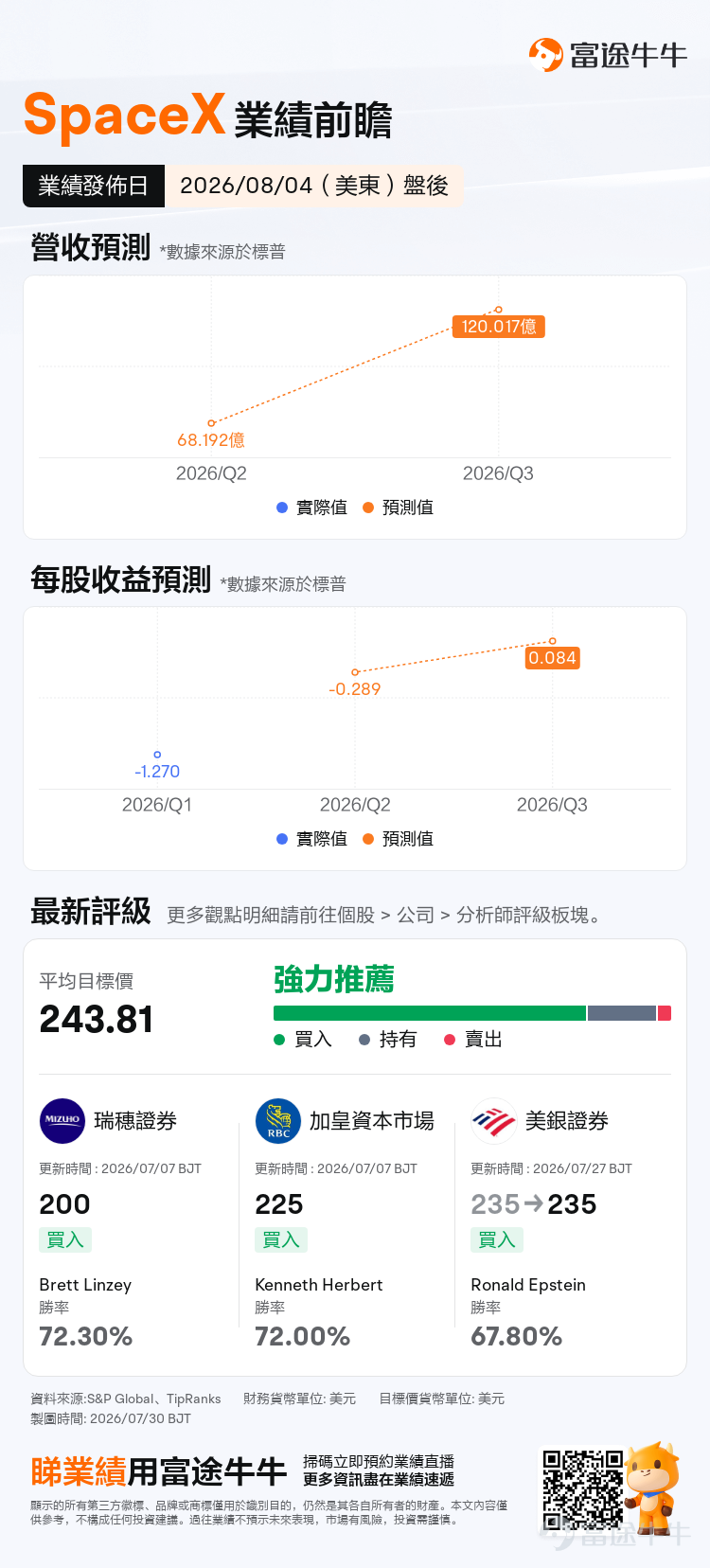
$SpaceX (SPCX.US)$ will report its Q2 2026 earnings after the U.S. market closes on August 4. This will be the company's first quarterly earnings report since its IPO and the first comprehensive assessment by capital markets of the growth quality of its three core businesses: space, connectivity, and artificial intelligence.
While this quarter’s revenue and earnings per share are certainly important, what the market is truly waiting for is management’s commentary on the second half of the year. Meanwhile,approximately 912 million shares will become eligible for public trading on August 6, with an additional approximately 319 million shares set to be unlocked within about a week thereafter.Current full-year forecasts imply a rather steep growth curve,Starlink’s steady expansion alone may no longer be sufficient to meet this target. Whether AI computing lease contracts can be deployed and recognized as revenue on schedule could directly determine the stock’s post-earnings direction.
I. The Real Pressure Lies in the Second Half
Current S&P Global Market Intelligence consensus estimates expectsecond-quarter revenue of approximately $6.9 billion, primarily driven by growth in the Starlink business.
There is significant divergence in the market regarding profitability,S&P Global's reported EPS forecast range spans from a loss of $1.26 per share to earnings of $0.33 per share. UBS Group expects a loss per diluted share of US$0.12, better than the US$0.25 consensus market loss, while Morgan Stanley is more cautious, forecasting a loss of US$0.35,reflecting substantial differences among institutions in their assumptions about AI and space business costs as well as accounting treatments.

Based on approximately $4.69 billion in revenue for Q1 and market expectations of around $6.87 billion for Q2, SpaceX’s first-half revenue totals roughly $11.56 billion. To meet full-year forecasts, the company would still need to generate between $26.6 billion and $34.2 billion in revenue in the second half of the year, equivalent to $13.3 billion to $17.1 billion per quarter.
This implies that second-half quarterly revenue would need to increase by approximately 94% to 149% compared to Q2.Such a pronounced acceleration would be difficult to achieve through organic Starlink subscriber growth alone,The market is effectively betting that large-scale AI computing contracts will begin contributing meaningfully to revenue.
2. Can Starlink maintain its position as the profit engine?
Currently, SpaceX’s most mature and profitable segment remains the Connectivity division, which includes Starlink.
According to sell-side consensus, the Connectivity segment’s operating margin was approximately 35.9% in Q2; by Q3, segment revenue is expected to grow over 50% year-over-year to roughly $4.7 billion, with operating margin further improving to 37.5%.The high profitability of this segment is currently offsetting losses from the AI and Space segments.
Therefore, this earnings call warrants close attention to five key metrics: net new subscribers, ARPU, churn rate, the proportion of enterprise and government customers, and the official deployment timeline for Starlink V3 satellites.
Subscriber growth remains important, but the market has entered a phase of evaluating growth quality.。If new subscriber additions rely primarily on terminal subsidies or price reductions, the quality of revenue growth would be undermined; conversely, a higher share of enterprise, aviation, maritime, and government customers would help improve ARPU and network utilization efficiency.
The V3 satellites are also critical. Higher per-satellite capacity is expected to alleviate network congestion in certain regions and support direct-to-cellphone connectivity and high-value enterprise services. However, investors still need to see a decline in cost per unit of capacity; otherwise, an increase in satellite count will simultaneously drive up launch and refresh expenditures.
Third, compute leasing could determine the revenue trajectory in the second half of the year.
Following its acquisition of xAI, SpaceX’s AI business now encompasses Grok, the X platform, data center infrastructure, and compute capacity leasing to third parties.The most immediate revenue catalyst currently comes from compute leasing contracts with Anthropic, Alphabet, and other AI companies.
According to public information, Anthropic can utilize SpaceX’s Colossus I and Colossus II data centers in Tennessee, with contract rates reportedly reaching as high as $1.25 billion per month at one point; Alphabet has also signed a compute leasing arrangement worth approximately $920 million per month. Once these facilities are powered up and capacity is delivered, revenue recognition could jump sharply.
This also explains why some institutions are so optimistic about second-half growth. Starlink revenue typically scales gradually with user growth and capacity expansion, whereas large-scale compute contracts could rapidly add billions of dollars in revenue within a single quarter.
The risks lie in contract duration and customer concentration.
The Anthropic agreement includes relatively flexible termination clauses, allowing either party to cancel with 90 days’ notice after the initial term. Alphabet’s demand may also evolve as its own in-house compute capacity comes online. While SpaceX can rely on high-priced contracts to boost near-term revenue, it must ultimately demonstrate its ability to sustain customer acquisition, control power costs, and maintain healthy profit margins over the long term.
Management should disclose key metrics including contracted and powered-up compute capacity, contract durations, revenue per watt, cost per watt, customer concentration, and the impact of third-party leasing on internal compute demand for training Grok and Cursor.
SpaceX’s AI segment remains unprofitable, and the market is increasingly cautious about whether its substantial infrastructure investments will yield reasonable returns.。The company's total capital expenditure is expected to rise from $48.7 billion in 2026 to $118.4 billion in 2028, and future cash flow pressure cannot be ignored.
4. Thirteenth Test Flight Reduces Deployment Risk; Full Reusability Still Unproven
Starship’s 13th test flight achieved several key milestones.
Ship 40 successfully deployed 20 Starlink V3 satellites, reignited its in-space engine, and executed a controlled soft splashdown after atmospheric re-entry. These satellites briefly connected to the Starlink network before deorbiting and burning up in the atmosphere as planned for this suborbital mission.
This test flight demonstrated that Starship now has the basic capability to deploy V3 satellites.For Starlink, the official operational timeline for V3 could be accelerated, as satellite deployment no longer needs to wait until the rocket achieves full reusability.
However, booster recovery remains incomplete. Five engines on Super Heavy failed to relight during its return, causing it to impact the Gulf of Mexico at a higher-than-expected velocity. While SpaceX has proven upper-stage performance and payload deployment capabilities, it still has some way to go before achieving a low-cost, high-frequency, airline-like rapid turnaround model.
During this earnings call, management’s guidance on V3 deployment timing, upcoming test flights, launch tower catch operations, and annual launch cadence may attract more market attention than traditional launch revenue for the quarter.
5. Lock-up Expiry Could Amplify Post-Earnings Volatility
Beyond fundamentals, SpaceX will also face significant share supply pressure from its first major post-IPO lock-up expiration.
Publicly available data shows thatapproximately 912 million shares will become eligible for trading on August 6, with an additional approximately 319 million shares unlocked within about a week thereafter.The actual selling volume will depend on the willingness of early investors, employees, and other shareholders to sell, but the potential increase in supply already presents a clear trading risk.
The current near-term supply outlook is not particularly favorable. HSBC estimates that 912 million shares could become eligible for sale starting August 6,while the current number of freely tradable shares is approximately 640 million.This would raise the free-float ratio from 4.9% to 11.8%, meaning that even strong earnings performance could be met with post-earnings supply pressure.
6. Options Strategy
Based on the latest quote as of July 31, $SpaceX (SPCX.US)$ the price is approximately $108. Current implied volatility (115%) is significantly higher than the one-month historical volatility (50%), indicating that the options market is pricing in far greater expected future volatility than recent actual volatility, resulting in elevated option premiums.

Currently in a negative gamma environment, when the stock price is below the gamma flip point of $122, market makers may need to adjust their hedges in the direction of the price movement, further amplifying short-term volatility. $100 is a critical defensive level—if the put wall at $100 is breached, selling pressure and hedging activity could reinforce each other; if earnings drive the stock back above $122, the negative gamma impact could diminish. These levels shift rapidly with changes in stock price, implied volatility, and open interest, so they should be refreshed ahead of the earnings announcement—do not treat the current snapshot as fixed support or resistance.

Strategically,the market has already priced in very high volatility expectations for the earnings report, making outright options purchases expensive; structured trades that take advantage of high IV are more suitable.
1. Strategy One: Bear Put Spread
Suitable for investors whobelieve SPCX’s earnings may fall short of market expectations, are concerned about underperformance in AI computing revenue realization, slowing Starlink growth, or potential downside pressure from the lock-up expiration on August 6.
Strategy Overview:Buy a put with a higher strike price while simultaneously selling a put with a lower strike price, creating a bearish vertical spread. This strategy leverages SPCX’s elevated implied volatility environment by selling the lower-strike put to reduce the overall option cost.
If the stock price drops sharply after earnings and especially breaks below the key support level of $100, the value of the put rises, and the strategy generates a profit; if the stock price remains range-bound or rises, the maximum loss is limited to the premium paid when establishing the spread.
(The chart below illustrates the simulated profit/loss profile of this strategy at expiration. The displayed graphic is for demonstration purposes only and does not constitute investment advice or guarantees; market conditions change rapidly, and the prices shown do not reflect real-time data.)

Strategy 2: Bull Call Spread
Suitable for investors:Investors who are bullish on SpaceX’s long-term growth thesis and believe the earnings report could validate Starlink’s growth and demand for AI computing capacity leasing, but do not wish to bear the high option costs driven by the current 115% implied volatility.
Strategy overview: Buy a call option with a lower strike price while simultaneously selling a call option with a higher strike price to create a bull call spread. Selling the higher-strike call reduces the overall option cost while preserving upside potential if the stock rises. If SPCX increases post-earnings, the strategy captures gains from the upward move; if the stock fails to break through key resistance levels, the maximum loss is limited to the net premium paid.
(The chart below illustrates the simulated profit/loss profile of this strategy at expiration. The displayed graphic is for demonstration purposes only and does not constitute investment advice or guarantees; market conditions change rapidly, and the prices shown do not reflect real-time data.)

Summary: What does the earnings report really need to address?
SpaceX’s Q2 figures are just the starting point. The market is more focused on three key questions.
Can Starlink sustain its high growth and high margins to continue funding other business segments with cash flow? Can computing capacity leasing contracts be delivered on schedule to drive a significant acceleration in second-half revenue? Can Starship’s technical progress translate into lower satellite deployment costs and higher launch frequency?
Combined with the lock-up expiration window on August 6, this earnings release is likely to exhibit a pricing dynamic that reflects both fundamental validation and share supply concerns. Even if results beat expectations, the stock price may not immediately embark on a one-sided rally; rather, the strength of forward guidance, the quality of computing capacity contracts, and actual selling behavior by lock-up expiring shareholders will be critical to sustaining any post-earnings momentum.
Finally, Options Sir has a small giveaway for fellow investors—feel free to claim it!Options Starter Pack
*This promotion is exclusively available to invited Hong Kong users. Click to learn more.Detailed terms and conditions of the promotion >>
Market conditions are complex and ever-changing,Options strategiesToo many choices and unsure how to proceed? Let Futubull help you build a strategy in three simple stepsOptions strategies, making investing simple and efficient!

Options Risk Disclosure:An option is a contract that grants the holder the right—but not the obligation—to buy or sell an underlying asset at a predetermined price on or before a specified date. Option prices are influenced by multiple factors, including the current price of the underlying asset, the strike price, time to expiration, and implied volatility. Implied volatility reflects the market’s expectation of future price fluctuations over the life of the option; it is derived by reverse-engineering the Black-Scholes pricing model and is commonly viewed as an indicator of market sentiment. When investors anticipate higher volatility, they may be willing to pay more for options to hedge their risk, resulting in higher implied volatility. Traders and investors use implied volatility to assess the attractiveness of option prices, identify potential mispricings, and manage their risk exposure.
Disclaimer:This content does not constitute an offer, solicitation, recommendation, opinion, or any form of guarantee regarding any securities, financial products, or instruments. The risk of loss in trading options can be substantial. In certain circumstances, your losses may exceed the initial margin deposit. Even if you place contingent orders such as 'stop-loss' or 'limit' orders, there is no assurance that losses will be avoided, as market conditions may prevent execution of these orders. You may be required to deposit additional margin on short notice. If you fail to meet such margin calls within the stipulated time, your open positions may be liquidated. You remain fully liable for any resulting deficit in your account. Therefore, prior to trading options, you should thoroughly research and understand how options work and carefully consider whether such trading aligns with your financial situation and investment objectives. If you trade options, you should become familiar with the procedures for exercising options and handling expiration, as well as your rights and obligations upon exercise or expiration. Options trading involves significant risk and is not suitable for all investors. Investors should carefully read"Characteristics and Risks of Standardized Options"。
Risk Disclaimer: The above content only represents the author's view. It does not represent any position or investment advice of Futu. Futu makes no representation or warranty.Read more


Comment (1)
to post a comment
62
82