
US launches "economic offensive" against Iran; will oil prices see renewed volatility?

Gaozhan Weekly Interest Rate Analysis | Sharp Oil Price Decline and Widening Hawkish Dissent: Why Has the Fed's September Rate Hike Path Once Again Become Divisive?

Issue #202620
In last week’s column, we unpackedCooling CPI vs. Soaring Rate Hike Probabilitythe polarized market pricing, noting that the market has priced inthe 'Wasserman Era'June’s inflation cooldown as"transitory", without adjusting expectations for a September rate hike.
Building on this, this week’s analysis further examines how the sharp oil price drop and internal FOMC disagreements are reshaping market pricing logic.
During the past week, $Crude Oil Futures (OCT6) (CLmain.US)$ dropped 4.06% in a single day to $86.80, $Brent Last Day Financial Futures (DEC6) (BZmain.US)$ simultaneously declined 2.96% to $83.55, $Gold Futures (DEC6) (GCmain.US)$ while rose 1.06% against the trend to $4,098.6, showing the rare divergence of 'weak oil, strong gold,'a rare divergence.
The market has priced the decline in oil prices as a marginal easing of inflationary pressures, but remains highly divided on the path of future rate hikes.
▌FedWatch Data Quick View
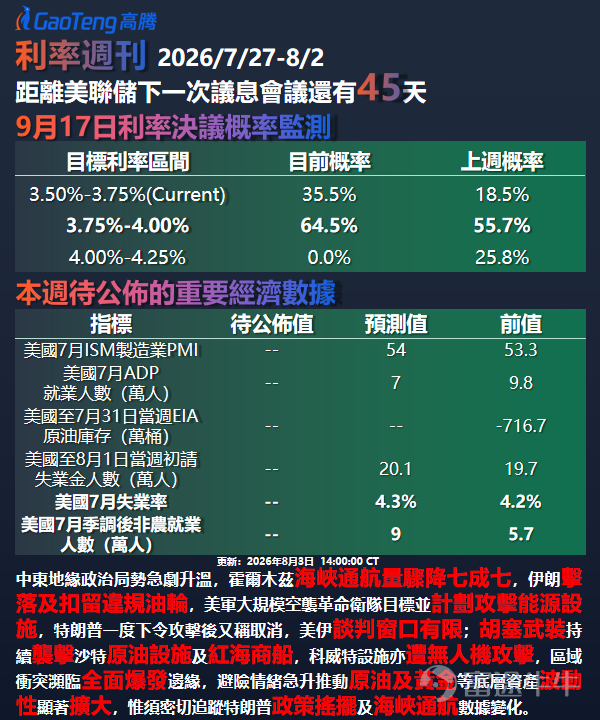
According to CME FedWatch data (as of August 3, 2026), there are 21 days left until the next FOMC meeting, and the market currently prices in a federal funds rate range of 3.50%–3.75%The probability of no change is35.5%, and the probability of a 25-basis-point rate hike to3.75%–4.00%is64.5%. Compared to one month ago (45.9%), rate hike expectations have risen by 18.6 percentage points.
The key drivers are the widening dissent among hawkish officials and upward pressure on long-end yields, which marginally lifted term premiums and risk-neutral probabilities.
▌ Sharp oil price drop diverges from rate hike expectations
Last week, oil prices sharply retraced, yet market rate hike expectations did not cool off correspondingly, indicating that pricing dynamics have shifted away from“supply shock dominance”Shift in direction"Inflation stickiness dominates"。
WTI crude oil futures volume expanded to1.4239 million contracts, indicating a rapid unwinding of Middle East risk premium in the market, but $U.S. 10-Year Treasury Notes Yield (US10Y.BD)$ still closed at4.739%, up 10.9 basis points from last week, highlighting persistent pricing of inflation stickiness into long-end rates.
▌ Inflation Stickiness and Policy Constraints
June PCE YoY declined to3.7%(BLS), yet remains well above the 2% target and has exceeded it for 64 consecutive months; the market prices this as"inflation stickiness"Rather thantrend-driven pullback。
The FOMC voted9 to 3to keep rates unchanged, with Waller, Kashkari, and Logan dissenting—the first time since 2016 that three members cast aligned dissents. The market priced this asa strengthening internal consensus toward tightening。
as Federal Reserve ChairKevin WarshProposals were made to reduce the frequency of FOMC meetings and to 'outsource' the tightening function via U.S. Treasuries'outsource'to the market, weakening forward guidance and significantly increasing market pricing volatility.
▌ Fed Watch: Hawkish Signals Amid a Hold
The July FOMC held rates steady3.5%–3.75%Unchanged, but statement removed"Employment risks have increased"Stated, upgraded economic assessment to"Solid"。
WallerEmphasized"Inflation issues cannot be resolved within nine weeks", and noted that rising nominal and real yields reflect the market pricing in long-term inflation expectations, with the policy stance shifting from"data-dependent"Shift in direction"inflation target rigidity"。
▌ Internal Divergence: Focus of the Hawk-Dove Debate
Hawkish:President of the Cleveland FedHammackbelieves policy is not sufficiently restrictive and inflation is unlikely to return to 2% on its own;President of the Dallas FedLogannotes that the labor market remains strong and interest rates are not yet sufficiently restrictive. Their comments prompted the market to raise term premiums by 8–10 basis points.
Dovish:President of the Minneapolis FedKashkarifavors a gradual tightening approach but has not publicly opposed rate hikes, leading the market to price him as"cautiously supportive of tightening"。
Centrists:Fed GovernorWallerhas not yet made a public statement, but voted in favor of maintaining rates, reflecting"data-dependent stance"as the prevailing tone.
The current FOMC voting member composition shows that hawks account for 25% of the committee, which the market has priced in as"increased risk of an upward revision to the rate hike path", though this is not the base case scenario.
▌ Yield curve structure: Bear steepening intensifies
last week $U.S. 30-Year Treasury Bonds Yield (US30Y.BD)$ Upward11.3 basis pointsto5.276%, the highest level since 2007; $U.S. 5-Year Treasury Notes Yield (US5Y.BD)$ Upward1.5 basis pointsto4.454%。
The short end reflects near-term policy expectations, while the long end is driven by term premium and AI-related capital expenditure. The bear steepening of the curve reflects the market's pricing of"high inflation + stable growth"scenario.
The 2s10s spreadhas widened to69.4 basis points,Historical experience shows that bear steepening often occurs around the midpoint of a hiking cycle, implying upside risk to the terminal rate.
▌ Historical Perspective: Parallels with the 2018 Hiking Cycle
In Q3 2018, oil prices declined but the Fed continued raising rates, driven by sticky core PCE inflation and a tight labor market. At the time, the 10-year yield rose to 3.2%, and the bear steepening persisted through year-end.
Current pricing patterns closely resemble those in 2018, leading the market to map this scenario asExtended rate hike cycleexpectations.
▌ Scenario Analysis: Two Possible Rate Hike Paths
Scenario 1 (Persistent Inflation):If August PCE exceeds3.8%, the market will increase the probability of a September rate hike, pushing the 10-year yield above4.8%, pressuring gold down to$3,900。
Scenario 2 (Continued Decline in Oil Prices):If WTI falls below80 dollars, the market has reduced the probability of rate hikes, the yield curve has shifted to a bull flattener, and gold has rebounded$4,200。
The current market is pricing in Scenario One.
▌ Quick Snapshot of Market Sentiment
Investors' concerns are focused on"the unpredictability of Waller's policy"and"the normalization of hawkish dissents", leading to higher pricing volatility.
CFTC datashows net bullish bets on the U.S. dollar have risen to$49.23 billion, the highest since 2014, reflecting market pricing in of tightening policies and rising safe-haven demand.
▌ Other major central bank activities
People's Bank of China:Held its second-half work conference, maintaining a moderately accommodative stance, with the 7-day reverse repo rate1.40%, and conducted CNY 600 billion in overnight reverse repos, with narrowing onshore-offshore interest rate differentials limiting RMB exchange rate volatility.
European Central Bank:Governing Council member Kazimir stated at least one more rate hike is needed; markets are pricing in a 25-basis-point hike in September, supporting EUR/USD on interest rate differentials.
Bank of England:The MPC voted6 to 3to hold rates steady3.75%Unchanged; three committee members supported a rate hike, leading the market to revise down its expectation for rate hikes within the year to35 basis points。
Bank of Japan:Maintains target interest rate1%unchanged, but implements¥8.45 trillionin FX intervention, causing the USD/JPY to plunge sharply in a single week3.79%to157.642, with narrowing U.S.-Japan yield differentials weighing on the dollar.
▌ Market Reaction: Cross-asset pricing chain
Declining oil prices → marginal easing of inflation expectations → but hawkish dissent reinforces rate hike expectations → real rates remain elevated → gold gains safe-haven premium but is capped by high real rates → dollar weakens due to narrowing U.S.-Japan yield differentials.
▌ Closing Remarks
The core market contradiction this period lies in"falling oil prices"and"spreading hawkish dissent"The pricing divergence reflects that inflation stickiness has become the dominant narrative.
Investors should closely monitorAugust PCE dataandSeptember FOMC meeting. If inflation comes in hotter than expected, the market will reassess the rate hike path to 50 basis points; if the data cools, the curve could shift toward a bull flattener.
Historical experience suggests that the bear steepening phase during a hiking cycle is often accompanied by rising asset volatility, warranting caution against further expansion of term premiums.

$GaoTeng WeInvest Money Market Fund (HK0000478930.MF)$ $GaoTeng WeValue USD Money Market Fund (HK0000584752.MF)$ $GaoTeng WeFund-GaoTeng Asian Income Fund (HK0000447943.MF)$ $Global Multi-asset ETF Quant Strategy- Active (GTHK005.US)$ $Nasdaq Composite Index (.IXIC.US)$ $S&P 500 Index (.SPX.US)$ $Dow Jones Industrial Average (.DJI.US)$ $USD (USDindex.FX)$ $Hang Seng Index (800000.HK)$ $Hang Seng TECH Index (800700.HK)$
Risk Disclaimer: The above content only represents the author's view. It does not represent any position or investment advice of Futu. Futu makes no representation or warranty.Read more


Comments
to post a comment
8
1