
Robots are being widely deployed—have automakers unlocked a second growth curve?

Automakers flocking into the robotics industry: leveraging shared technologies and closed-loop scenarios to build cross-sector advantages | In-depth Analysis | Research Report | AI Sector | Humanoid Robots
The humanoid robotics industry has reached an inflection point. Leading automakers BYD, XPeng, and Li Auto have recently disclosed significant progress: BYD’s first humanoid robot, 'Xiao Di,' will debut in August at Di Space; XPeng’s IRON has already entered small-batch trial production at its Guangzhou factory; Li Auto plans to launch its two-wheeled robot this year while simultaneously developing a bipedal model—marking a full transition from concept validation to mass-production implementation for Chinese automakers entering this space. Over 70% of core technologies in perception, decision-making, and execution are shared between intelligent vehicles and humanoid robots. Key components such as the triple-electric systems (e-motor, battery, and power electronics), sensor fusion, and motion control algorithms can be directly reused. Combined with mature automotive-grade supply chains and experience scaling to million-unit production volumes, automakers aren’t starting from scratch—they’re extending and ‘downgrading’ existing capabilities. Moreover, automakers inherently possess dual deployment scenarios: industrial settings in their own factories and commercial environments in retail stores, enabling them to iterate technology and validate commercialization without relying on external clients. This gives them stronger error tolerance and greater potential for scalable replication compared to pure-play robotics startups. From an investment perspective, near-term opportunities hinge on thematic catalysts, mid-term prospects depend on mass production ramp-up, and long-term gains will stem from supply chain dividends. The sector is still in the early stages of its growth trajectory, with OEM valuations showing higher elasticity for now. As production scales, upstream core components—including servo motors, reducers, and sensors—will gradually realize earnings visibility. The long-term outlook for the sector remains positive, though full commercialization will likely require a 3–5-year horizon.
Automakers flocking into the robotics industry: leveraging shared technologies and closed-loop scenarios to build cross-sector advantages
Chinese automakers are accelerating their push into humanoid robotics. From traditional OEM giants to new-energy vehicle startups, the industry-wide shift from 'four wheels' to 'two legs' has fully entered the implementation phase. Leading automakers BYD, XPeng, and Li Auto have recently disclosed key milestones: BYD’s first humanoid robot, 'Xiao Di,' will debut in August at Di Space; XPeng’s IRON has already entered small-batch trial production at its Guangzhou factory; Li Auto plans to launch its two-wheeled robot this year while simultaneously developing a bipedal model—signaling that domestic automakers have officially moved past concept validation and into the critical mass-production phase for humanoid robots. The core driver behind this trend lies in technological synergy:Intelligent vehicles and humanoid robots share over 70% technological overlap across the three core layers: perception, decision-making, and execution. Key components such as the triple-electric (3E) systems, multi-sensor fusion, vision-language-action (VLA) foundation models, and motion control algorithms can be directly reused. Combined with automakers’ mature automotive-grade supply chains and mass-production experience at a million-unit scale, their entry into this field is not a ground-up diversification but rather an extension and ‘downgraded’ application of their existing, proven capabilities.
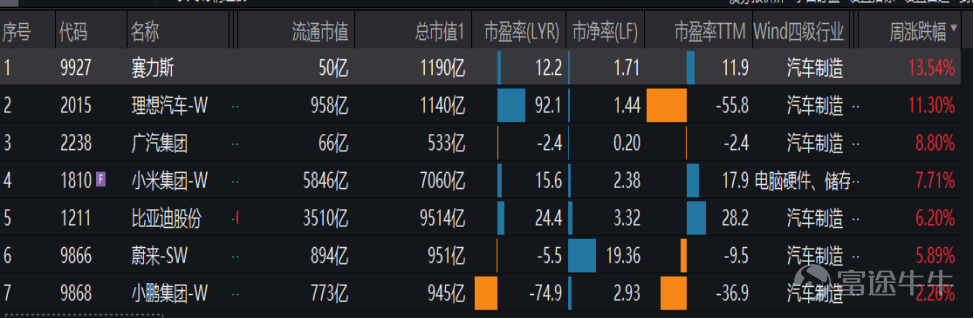
Boosted by positive industry catalysts, Hong Kong-listed new energy vehicle (NEV) stocks collectively rose last week. $LI AUTO-W (02015.HK)$ rose more than 11% last week, $SERES (09927.HK)$ gained over 12% last week, $GAC GROUP (02238.HK)$ climbed more than 8% last week, $BYD COMPANY (01211.HK)$、 $NIO-SW (09866.HK)$ 、 $XPENG-W (09868.HK)$ and other related stocks followed suit with gains.
Figure 1: Weekly gains of major Hong Kong-listed auto companies

Source: Wind
Event Summary: Three automakers intensify efforts, accelerating the shift from 'making cars' to 'making humanoids'
* BYD: Unveils first physical prototype in August, debuting in retail store scenarios
BYD has officially confirmed that its first self-developed humanoid robot (codenamed 'Xiao Di') will be unveiled in August at the 'Di Space' in Zhengzhou—marking the company's first official public display of a physical prototype. Designed specifically for in-store service scenarios, the robot will, upon launch, be deployed at Di Space locations to handle tasks including customer greeting, vehicle introductions, feature demonstrations, and interactive engagement to drive foot traffic.
Based on specifications, 'Xiao Di' stands 1.61 meters tall and weighs 58.5 kilograms, featuring 31 degrees of freedom for motion and hand positioning accuracy of ±1 mm, enabling complex tasks such as organizing and retrieving objects. On the intelligence front, it supports real-time mutual translation of six Chinese dialects and six foreign languages, and is equipped with a 360° surround-view system plus triple recognition capabilities for faces, lip movements, and gestures—tailored to serve diverse customer groups in offline retail stores. The company has a clear long-term roadmap: it plans to deploy the robot in bulk across over 30,000 global dealership outlets, with 2–3 units per store, and gradually expand into industrial assistance and home service scenarios. Li Ke, Executive Vice President of BYD, stated,AI capabilities developed for automobiles share inherent synergies with robotics, and the dealer network will naturally become a sales and service channel for robots.
Figure 2: Specifications of BYD’s robot

Source: BYD Company Announcement, CaiLianShe
*XPeng: IRON enters trial production phase, aiming for mass production by year-end
XPeng’s humanoid robot IRON officially commenced small-batch trial production on July 24 at its Guangzhou factory. Its dedicated mass-production line is now in the final integration and tuning phase, marking the prelude to the mass-production sprint. The company has clearly outlined its production timeline: formal mass production targeted for end-2026 with a monthly capacity goal exceeding 1,000 units; deployment in domestic offline stores in Q1 2027, followed by large-scale overseas rollout in the second half; gradual entry into household scenarios by 2028. In terms of hardware, IRON stands 178 cm tall and weighs 70 kg, with over 62 active degrees of freedom throughout its body and 22 degrees of freedom in each hand, closely replicating human hand dexterity. It is powered by XPeng’s self-developed Turing AI chip and the second-generation VLA (Vision-Language-Action) large model, leveraging the company’s autonomous driving expertise in pure-vision perception and end-to-end decision-making, resulting in outstanding walking stability and environmental adaptability.On the organizational front, XPeng Chairman He Xiaopeng has personally taken on the role of CEO of the robotics business, elevating robotics to a company-level strategic priority. This move integrates hardware, AI large models, supply chain, and global channel capabilities, systematically reusing XPeng’s accumulated experience in intelligent manufacturing and quality control from its automotive operations.
Figure 3: XPeng’s IRON robot undergoing training in an automotive factory setting

Source: Nanfang Daily
*Li Auto: Pursuing dual-track development with wheeled and bipedal robots, prioritizing factory applications
$LI AUTO-W (02015.HK)$Adopting a 'pragmatic, phased implementation' strategy, the internal Nexus team is simultaneously developing two robot products: a two-wheeled robot and a bipedal humanoid robot. The two-wheeled robot is progressing faster and is scheduled for public release in 2026, primarily targeting factory manufacturing scenarios for tasks such as material transport along production lines, auxiliary operations, and inspections. It features higher technological maturity and a shorter time-to-market. The bipedal humanoid robot remains in early-stage R&D, focusing on improving control precision and durability of the hardware platform. In terms of R&D investment, Li Auto plans a total R&D budget of RMB 12 billion for 2026, with approximately 50% allocated to AI-related initiatives. The company has restructured its intelligent technology division into three dedicated teams—humanoid robots, software platforms, and foundation models—to concurrently advance embodied intelligence in both the 'first half' (autonomous driving) and the 'second half' (general-purpose humanoid robots). The company views vehicles fundamentally as 'wheeled spatial robots,' noting that VLA foundation models, environmental perception, and motion control technologies developed through intelligent driving can be seamlessly transferred to the humanoid robotics domain.
Underlying Logic: Why Are Automakers Collectively Entering the Humanoid Robot Space?
New energy vehicle (NEV) manufacturers are flocking to develop humanoid robots—not as a short-term speculative trend, but as an inevitable strategic move driven by converging technological, commercial, and industrial logic.
*Shared Technological Foundation: Over 70% of technologies are reusable, making cross-industry entry significantly easier than expected
Intelligent vehicles and humanoid robots are both essentially 'mobile intelligent agents'—either wheeled or legged—with highly overlapping core technology stacks. The industry widely estimates that over 70% of their underlying technologies are interchangeable: multi-sensor fusion solutions at the perception layer—including cameras, LiDAR, and millimeter-wave radar—as well as environmental perception, object recognition, and obstacle-avoidance algorithms, can be directly transferred from intelligent driving systems to robots; at the decision-making layer, end-to-end foundation models, Vision-Language-Action (VLA) models, and multimodal interaction algorithms share identical foundational logic, allowing automakers to rapidly repurpose their large-model training experience from automotive applications; at the execution layer, core components such as motors, electronic controls, batteries, thermal management systems, wiring harnesses, and precision sensors rely on largely shared supply chains, and automotive-grade reliability standards can directly enhance robot hardware durability; at the system layer, in-vehicle operating systems, OTA update capabilities, and functional safety frameworks can all be adapted for robotic products. Thus, automakers entering the humanoid robot space aren’t starting from scratch—they’re extending their mature intelligent capabilities into a new form factor, achieving exceptionally high marginal returns on R&D investment. The extensive reuse across these four core technology pillars—perception, decision-making, execution, and systems—means every RMB 1 invested in R&D simultaneously empowers both automotive and robotic product lines.This is especially true for high-investment areas like VLA foundation models and motion control algorithms, where a single development effort yields dual applications—significantly amortizing R&D costs and accelerating technology iteration cycles. For example, XPeng’s IRON robot leverages a pure-vision perception system and an end-to-end decision-making model directly derived from the technical foundation of its XNGP intelligent driving system, eliminating the need to build an algorithm framework from scratch and cutting development timelines by more than 50% compared to startups.
Figure 4: XPeng’s IRON Robot and Its Vehicles Share a Common AI Origin

Source: XPeng Tech Day
*Commercial Viability: Owned Scenarios Provide a Safety Net, Solving the Industry’s ‘Deployment Challenge’
The humanoid robotics industry has long struggled with a core dilemma: 'prototype-ready technology, but no clear application scenarios.' Without real-world operational feedback, technological iteration stalls, and scalable commercialization remains elusive. Automakers entering this space, however, naturally possess ready-made industrial and commercial deployment environments, enabling them to quickly establish a complete commercial closed loop. On the industrial side, automakers’ own vehicle assembly plants serve as ideal testbeds. Standardized, repetitive workstations—such as welding, material handling, assembly, and inspection—can be among the first to deploy industrial humanoid robots. This not only addresses rising labor costs by replacing human workers and boosting production line efficiency but also exposes the robots to authentic production conditions, rapidly revealing weaknesses and enabling swift technological iteration. The resulting massive volume of real-world operational data feeds back into algorithm optimization, creating a virtuous cycle of 'use–iterate–optimize.'
On the commercial side, automakers can deploy service-oriented humanoid robots at scale across their nationwide and even global networks of tens of thousands of offline stores to handle standardized tasks such as greeting customers, product demonstrations, and in-store tours. This not only reinforces the brand’s technological identity and enhances the in-store user experience but also validates the B2B operational cost model and commercial viability in real-world service scenarios.
This approach—first validating and refining internally before expanding and replicating externally—offers higher implementation efficiency and lower trial-and-error costs compared to pure robotics startups that start from scratch to find customers and lack stable testing environments. This constitutes the core differentiated competitive advantage for automakers entering the humanoid robotics space.
*Industry Strategy: Securing the Next-Generation Intelligent Terminal and Creating a Second Growth Curve
Amid intensifying competition in the automotive industry, persistent price wars, and the gradual exhaustion of electrification and intelligent-driving tailwinds, overall industry profitability is under pressure. In this zero-sum environment, leading automakers are actively seeking a second growth curve capable of supporting long-term scale. Humanoid robots are widely viewed across the industry as the next-generation general-purpose intelligent terminal following smartphones and smart cars, with a potential global market size reaching trillions of dollars in the long run. This makes it one of the few new sectors large enough to absorb automakers’ massive production capacity and advanced technological capabilities, thus becoming a shared strategic focus among top automakers. Following Tesla’s dual-engine strategy of 'cars + robots,' domestic automakers are accelerating their humanoid robot initiatives—not only as a defensive move against industry disruption but also as an offensive play to capture new growth opportunities. Moreover, humanoid robotics is a capital-intensive, long-cycle赛道 requiring sustained investment over 5–10 years to achieve technological maturity and commercialization. Startups commonly face cash flow constraints, whereas leading automakers—with annual revenues in the tens of billions of dollars and robust operating cash flows—can better withstand prolonged R&D investments and near-term unprofitability, giving them significantly stronger risk resilience. In the short term, the cutting-edge technological profile of robotics can reinforce a company’s intelligent-brand positioning and boost its valuation expectations in capital markets; over the medium to long term,as the technology matures and costs decline, humanoid robots are expected to gradually emerge as an independent revenue and profit pillar, enabling automakers to transform from single-focus 'automobile manufacturers' into 'intelligent hardware tech companies' serving multiple scenarios—and ultimately reshaping their corporate value and valuation frameworks.
Shortcomings and Challenges: Dual Tests of Technology and Commercialization
*Insufficient accumulation in core motion control algorithms; reliance on external suppliers for high-end critical components
Automotive intelligence focuses on 'wheeled mobility,' whereas the core challenge of humanoid robots lies in 'bipedal balance, adaptive gait, and full-body coordinated control'—an area where automakers lack deep expertise. Core algorithms related to human-like gait control, torque feedback, complex terrain adaptation, and fall protection require years of data training and technical refinement, making it difficult for automakers to achieve a shortcut breakthrough in the short term. Currently, most automaker solutions are limited to low-speed, flat-surface scenarios and remain far from the agile mobility required for general-purpose humanoid robots. As a result, they still heavily rely on external partnerships or talent acquisition for core algorithms.
Additionally, while automakers have strengths in electric powertrains (e-motors, batteries, and electronics), key components essential for humanoid robots—such as high-precision harmonic drives, planetary gearboxes, torque sensors, and dexterous hand joints—are outside their traditional supply chain scope and remain highly dependent on specialized vendors. In particular, China still lags behind global leaders in high-end reducers, and limitations in cost and performance are constraining mass production timelines.Furthermore, automakers are mostly in the early stages when it comes to robot-specific chips and embodied AI operating systems—the foundational hardware and software layers—and their depth of full-stack in-house development remains limited, leaving room to enhance their influence across the robotics supply chain.
* The commercialization path is long, and pursuing multiple fronts simultaneously may dilute focus on the core business.
Humanoid robots are still in the early stages of industrial development. Even in the most mature industrial settings, they can only replace certain simple, repetitive tasks and have not yet achieved cost-effectiveness that universally surpasses human labor. In household scenarios, adoption is further constrained by cost, safety, and limited functionality, making large-scale penetration unlikely within the next five years.
For automakers, robot-related businesses currently represent primarily R&D investments that cannot meaningfully contribute to revenue or profits in the short term. Over-investment or overly aggressive timelines could instead drag down profitability in their core automotive operations. The market should maintain realistic expectations regarding commercialization progress and avoid excessive optimism.
Moreover, the auto industry is currently locked in intense competition characterized by normalized price wars and rapid technological iteration. Automakers must simultaneously solidify their EV foundations, ramp up investment in intelligent driving core technologies, advance global expansion strategies, and manage supply chain cost volatility. Under such circumstances—with multiple strategic priorities running in parallel—their R&D budgets, key talent, and executive bandwidth are already stretched thin, requiring sustained heavy resource allocation just to defend competitiveness in their core business. Humanoid robotics, as a trillion-dollar emerging赛道 still in its infancy, demands not only substantial long-term R&D funding but also top-tier talent in fields like motion control, precision mechanics, and embodied AI algorithms. It also consumes significant management resources to build supply chains and refine real-world deployment scenarios—all while offering little prospect of scalable profitability in the near term.If automakers fail to prioritize strategically and allocate resources appropriately, over-committing to new ventures could weaken product iteration and market investment in their core automotive business, leading to loss of existing market share. Conversely, under-investing would hinder the technological breakthroughs and mass production needed for robotics initiatives, ultimately dragging down overall operational performance and valuation.
Overall, the three automakers have adopted distinctly different approaches to humanoid robot development—each with unique strengths, capabilities, and varying potential and timelines for realization: XPeng currently leads in both technical depth and production readiness, with He Xiaopeng personally serving as CEO of its robotics division, elevating humanoid robots to the company’s highest strategic priority; BYD’s advantage lies in its vertically integrated ecosystem and cost-control capabilities, making it the most likely among the three to achieve breakeven in robotics first. Leveraging extreme cost efficiency and abundant in-house deployment scenarios, BYD can rapidly execute deployments at the 10,000-unit scale, creating a virtuous cycle of 'scenario-driven technology iteration and cost reduction through scale,' giving it the highest medium-term commercialization certainty; Li Auto’s program lags behind overall, with its bipedal humanoid robot still in early R&D phases. Its strength lies in pragmatic strategy and foundational R&D reserves, granting it higher long-term tolerance for setbacks. Overall, we remain bullish on the long-term industrial value of automakers entering the humanoid robotics space, primarily because automakers—among all cross-industry entrants—offer the highest degree of technology reuse, strongest manufacturing capabilities, clearest deployment scenarios, and most robust capital and channel resources, significantly increasing their probability of success compared to pure startups. However, realism is essential:Industry development won’t happen overnight—technological iteration, cost reduction, and scenario expansion all require time. Automakers adopting a pragmatic roadmap—'from industrial to commercial applications, from wheeled to bipedal platforms, and from closed to open environments'—are more likely to ultimately succeed. Companies overly focused on hype or blindly targeting general-purpose home scenarios will likely face disappointing real-world deployment outcomes.
Disclaimer: Any investment or potential transaction referenced in or related to the information provided herein is subject to the laws and regulations applicable in your jurisdiction, and you alone are responsible for ensuring compliance with such laws and regulations. This report is for reference purposes only and does not constitute investment advice. While every effort has been made to ensure the accuracy of the financial information provided, the company assumes no responsibility or liability for the accuracy, completeness, or validity of any part or all of the content. The company shall not be held liable for any errors or omissions. Please also note that prices of securities and virtual assets may rise or fall, and virtual assets in particular carry extremely high risk. Investors should exercise caution and bear all investment risks independently.
———————————————————————
About the author:
Victory Securities – Hong Kong’s Leading Virtual Asset Broker
Victory Securities (HKEX: 08540), rooted in Hong Kong for over 50 years, is a fully licensed, integrated brokerage offering comprehensive financial services. It provides four core business lines—wealth management, asset management, virtual assets, and capital markets—to individual investors, institutional clients, high-net-worth individuals, and corporations, earning numerous awards and essential operating licenses across the Asia-Pacific region. In 2023, Victory Securities became the first Hong Kong broker to hold SFC licenses for virtual asset trading, advisory, and asset management services, and received SFC approval to offer virtual asset trading and advisory services to retail investors, providing a one-stop compliant platform for Bitcoin and Ethereum trading, conversion, and fiat on/off-ramps.
Risk Disclaimer: The above content only represents the author's view. It does not represent any position or investment advice of Futu. Futu makes no representation or warranty.Read more
Comments
to post a comment