
SpaceX's second wave of lock-up expirations is here; how should investors position themselves in spa

[Comment to Earn Points] SpaceX Earnings Drop: Starlink, Starship, and the Space Economy—Which Will Support Valuation Expectations?
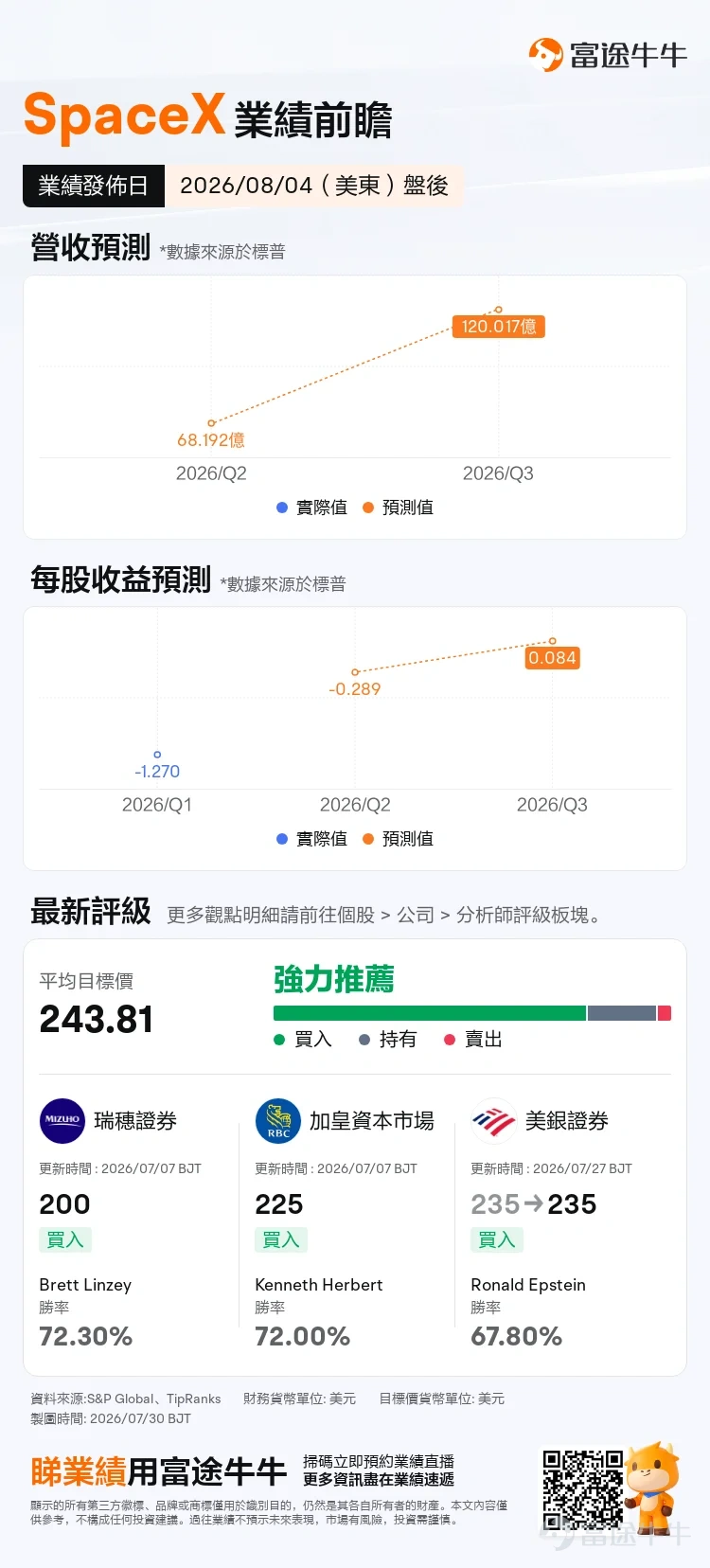
If the core keywords for SpaceX over the past few years were 'rocket reusability' and 'launch cost reduction,' the market is now reassessing another layer of its value: SpaceX may not just be a rocket company, but is building an integrated commercial system encompassing launch services, satellite internet, defense contracts, deep space missions, and future space infrastructure. As SpaceX prepares to release its Q2 2026 financial report,institutional expectations$SpaceX (SPCX.US)$Q2 2026 revenue is expected to reach $6.819 billion, with an expected EPS of -$0.289.Market focus is no longer solely on 'how many rockets were launched again,' but on more practical questions: Can the launch business continue improving efficiency? Can Starlink generate more stable cash flow?
As SpaceX prepares to release its Q2 2026 financial report,institutional expectations$SpaceX (SPCX.US)$Q2 2026 revenue is expected to reach $6.819 billion, with an expected EPS of -$0.289.Market focus is no longer solely on 'how many rockets were launched again,' but on more practical questions: Can the launch business continue improving efficiency? Can Starlink generate more stable cash flow?![If the past few years were defined by SpaceX’s core keywords—'rocket reusability' and 'launch cost reduction'—the market is now reassessing another dimension of its value: SpaceX may no longer be just a rocket company, but rather one building an integrated commercial ecosystem spanning launch services, satellite internet, defense contracts, deep-space missions, and future space infrastructure.[Wow]As SpaceX prepares to release its Q2 2026 earnings report,Institutional expectations$SpaceX (SPCX.US)$Q2 2026 revenue is expected to reach $6.819 billion, with an expected EPS of -$0.289.Market focus has shifted beyond just 'how many rockets were launched again' to more practical questions: Can launch operations continue improving efficiency? Can Starlink generate more stable cash flow?[Let Me See] 🔎 This time, our focus on SpaceX centers on three key questions: First, can rocket reusability further reduce costs?After SpaceX releases its Q2 2026 earnings report, how do you think the related space economy stocks will perform? SpaceX’s biggest moat still stems from the Falcon 9’s high launch cadence and reusability. Traditional aerospace resembles 'single-use consumption,' whereas SpaceX aims to build a 'reusable space transportation network.' If Q2 maintains a strong launch pace and reusability efficiency improves further, commercial...](https://nnqimage.futunn.com/sns_client_feed/999982/20260803/web-1785721452775-02V0w3jiEX.webp/big?area=2&is_public=true&imageMogr2/ignore-error/1/format/webp)
🔎 This spotlight on SpaceX centers on three key questions:
First, can rocket reusability continue driving down costs?After SpaceX releases its Q2 2026 earnings report, how do you think the related space economy stocks will perform?
SpaceX’s biggest moat still comes from the Falcon 9’s high launch cadence and reusability. Traditional aerospace operates more like a 'single-use consumable' model, whereas SpaceX aims to build a 'reusable space transportation network.' If Q2 maintains a strong launch cadence, further improves reuse efficiency, and achieves a healthier mix among commercial customers, NASA/government clients, and internal Starlink launches, then the launch business could remain SpaceX’s foundational pillar. For the market, this segment isn’t just a revenue source—it’s the underlying capability supporting future Starlink deployment, Starship testing, and expansion of space infrastructure.
Second, can Starlink become a true cash flow engine?
If rockets solve the problem of 'how to get to space,' Starlink addresses 'how to make money once you’re there.' Compared to one-time launch revenues, a satellite network resembles a recurring subscription-based business. Its upside lies in user growth, global coverage, enterprise clients, aviation and maritime applications, and government/defense demand. In the Q2 earnings report, the market will likely scrutinize whether Starlink’s subscriber base continues expanding, whether ARPU and margins are improving, and whether the share of high-value customers is rising. If Starlink can consistently contribute cash flow
Third, can Starship transition from a technological narrative to a commercial closed loop?
Starship is the most imaginative—and also the most controversial—component of SpaceX’s valuation. It represents not just a larger rocket, but a capability for low-cost, heavy-payload transportation, and serves as the gateway to future lunar and Martian missions, ultra-heavy launches, and even space infrastructure development. However, markets won’t pay for dreams alone. After the earnings release, investors are more concerned about whether test progress is steady, if key technologies have achieved phased breakthroughs, whether the commercialization timeline has become clearer, and if capital expenditure pressure remains manageable. If Starship enters a more mature reusability phase, SpaceX’s cost curve and business boundaries could be repriced; but if progress falls short of expectations, it could become a near-term drag on profits and cash flow.
What should we really focus on in this earnings report?
What should we really focus on in this earnings report?This time, the market may care less about how strong SpaceX’s Q2 results are, and more about whether the company can continue demonstrating that rocket reusability is delivering cost advantages, that Starlink is becoming the core of its cash flow, and that Starship is approaching a commercial inflection point. If Falcon 9 is SpaceX’s 'launch engine,' and Starlink is its 'cash flow network,' then Starship is its 'super gateway' to the Moon, Mars, and broader commercial opportunities. Now, it all hinges on whether this Q2 2026 earnings report can convince the market that SpaceX’s story isn’t just about exploring the stars and oceans of space—but about building a viable commercial closed loop behind that grand vision.
🏆 Activity 1: Bull Circle Insight Champion ✨
SpaceX will release its first earnings report since going public. Can it deliver impressive revenue growth? Will billions of dollars spent on Starship iteration and massive AI computing infrastructure investments weigh down profits? Can it maintain a dynamic balance in free cash flow? And after the report is released and lock-up shares become tradable, will they be met with strong investor demand or trigger a sell-off?
Share your thoughts in the comments below:
✅ At least 30 characters ✅ Original viewpoint ✅ Complies with community guidelines
Meet the requirements to participate and split 10,000 points equally!
🏆 Activity 2: Options Strategy Exchange ✨
Stock volatility tends to intensify around earnings announcements—creating a strategic window for options positioning.How do you plan to trade? Share your options strategy in the comments below!Write at least 30 characters with sound reasoning to earn 66 points(Points stack on top of those from Activity 1)
Note: All activities above will conclude at 4:00 AM Beijing Time on August 5; rewards are stackable; and all rewards will be distributed collectively after this earnings season ends.
Click to reserve:
Click to reserve:‘Earnings Express’: Futubull AI decodes key insights—build your options strategy in three steps!![If the past few years were defined by SpaceX’s core keywords—'rocket reusability' and 'launch cost reduction'—the market is now reassessing another dimension of its value: SpaceX may no longer be just a rocket company, but rather one building an integrated commercial ecosystem spanning launch services, satellite internet, defense contracts, deep-space missions, and future space infrastructure.[Wow]As SpaceX prepares to release its Q2 2026 earnings report,Institutional expectations$SpaceX (SPCX.US)$Q2 2026 revenue is expected to reach $6.819 billion, with an expected EPS of -$0.289.Market focus has shifted beyond just 'how many rockets were launched again' to more practical questions: Can launch operations continue improving efficiency? Can Starlink generate more stable cash flow?[Let Me See] 🔎 This time, our focus on SpaceX centers on three key questions: First, can rocket reusability further reduce costs?After SpaceX releases its Q2 2026 earnings report, how do you think the related space economy stocks will perform? SpaceX’s biggest moat still stems from the Falcon 9’s high launch cadence and reusability. Traditional aerospace resembles 'single-use consumption,' whereas SpaceX aims to build a 'reusable space transportation network.' If Q2 maintains a strong launch pace and reusability efficiency improves further, commercial...](https://nnqimage.futunn.com/sns_client_feed/999982/20260731/web-1785480324659-zehLTjeTH4.webp/big?area=2&is_public=true&imageMogr2/ignore-error/1/format/webp) Futubull AI Get instant answers to your questions, use intelligent stock selection to target promising upward momentum, and analyze your holdings to seize opportunities and avoid risks!
Futubull AI Get instant answers to your questions, use intelligent stock selection to target promising upward momentum, and analyze your holdings to seize opportunities and avoid risks!![If the past few years were defined by SpaceX’s core keywords—'rocket reusability' and 'launch cost reduction'—the market is now reassessing another dimension of its value: SpaceX may no longer be just a rocket company, but rather one building an integrated commercial ecosystem spanning launch services, satellite internet, defense contracts, deep-space missions, and future space infrastructure.[Wow]As SpaceX prepares to release its Q2 2026 earnings report,Institutional expectations$SpaceX (SPCX.US)$Q2 2026 revenue is expected to reach $6.819 billion, with an expected EPS of -$0.289.Market focus has shifted beyond just 'how many rockets were launched again' to more practical questions: Can launch operations continue improving efficiency? Can Starlink generate more stable cash flow?[Let Me See] 🔎 This time, our focus on SpaceX centers on three key questions: First, can rocket reusability further reduce costs?After SpaceX releases its Q2 2026 earnings report, how do you think the related space economy stocks will perform? SpaceX’s biggest moat still stems from the Falcon 9’s high launch cadence and reusability. Traditional aerospace resembles 'single-use consumption,' whereas SpaceX aims to build a 'reusable space transportation network.' If Q2 maintains a strong launch pace and reusability efficiency improves further, commercial...](https://nnqimage.futunn.com/sns_client_feed/999982/20260731/web-1785480376069-eTrvTezVKK.webp/big?area=2&is_public=true&imageMogr2/ignore-error/1/format/webp)
Risk Disclaimer: The above content only represents the author's view. It does not represent any position or investment advice of Futu. Futu makes no representation or warranty.Read more


Comments (111)
to post a comment
38
10