
Mid-2026 Review: How to Identify the Key Themes Amidst Changing Market Dynamics?

Three dissenting votes against holding rates steady triggered a sell-off in U.S. Treasuries, sending the 30-year yield to its highest level since 2007! Hong Kong stocks face a 'triple threat' on Monday.
Summary of key overseas market developments and Federal Reserve news over the weekend (August 1–2)
Overseas market sentiment over the weekend was generally negative. The combination of growing divisions within the Federal Reserve, escalating tensions in the Middle East, and a sharp rise in U.S. Treasury yields is expected to weigh on the Hong Kong market at Monday’s open.
I. Federal Reserve: Holds rates steady for the fifth consecutive meeting, but reveals its largest internal split in a decade
Rate Decision: At its July FOMC meeting, the Federal Reserve voted 9–3 to keep the target range for the federal funds rate unchanged at 3.50% to 3.75%. This marks the fifth consecutive meeting with no change in rates.
Three dissenting officials: Cleveland Fed President Hammack, Minneapolis Fed President Kashkari, and Dallas Fed President Logan voted against holding rates steady, advocating instead for an immediate 25-basis-point rate hike. This marks the first time in a decade that three Fed officials have simultaneously dissented, highlighting openly divergent views within the committee.
Dissenting officials' core rationale:
Harker:Inflation has persistently remained above 2% for over five years; delaying action against inflation will force more aggressive policy measures in the future.
Kashkari:Historical lessons from the 1970s Great Inflation show that external shocks can, over time, evolve into permanently elevated inflation.
Logan:Current monetary policy is unable to exert any downward pressure on inflation; a modest, incremental rate hike in the near term could reduce the likelihood of being forced into a significantly tighter stance later.
Fed Chair Waller stated: maintaining a neutral-to-hawkish stance, clearly affirming that the 2% inflation target remains unchanged, rejecting any increase in inflation tolerance, emphasizing that a single month of favorable inflation data is insufficient to confirm a sustained downward trend, and keeping the option of further rate hikes open. Additionally, Waller is considering reducing the number of annual FOMC meetings, breaking a 45-year precedent.
II. U.S. Treasury yields surge: 30-year yield hits highest level since 2007
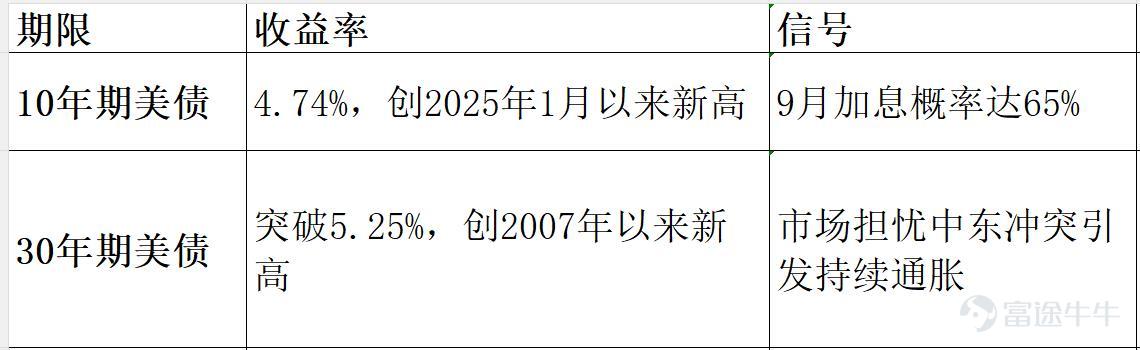
Driven by the Fed’s policy decision and diverging views among officials, long-end U.S. Treasury yields have surged sharply:

Wall Street institutions believe the Treasury sell-off reflects a clear 'credibility gap' perceived by the market—Warsh repeatedly asserts that the Fed will achieve price stability, yet policymakers have so far failed to take concrete action.Citigroup’s global chief economist stated bluntly: 'The market wants to see real action.'
III. Middle East tensions escalate again: Trump orders new round of strikes on Iran
Key development: U.S. officials say Trump has ordered a new round of strikes on Iran aimed at forcing Tehran to surrender, with operations potentially beginning as early as this weekend and lasting several days.
Key details:
Power plants and refineries could become targets
U.S. senior officials discussed the possibility of cutting off Tehran’s electricity supply
Officials previously discussed aiming to conclude the operation before global financial markets open on August 3 to minimize impact on the global economy
Strait of Hormuz: Iran’s 'Strait of Hormuz Administration' announced the waterway is no longer operating normally; data shows vessel traffic dropped to 5 ships on July 30 from 22 the previous day, a decline of 77%.
IV. U.S., Japan, and South Korea jointly intervene in currency markets: largest coordinated action in nearly three decades
The United States, Japan, and South Korea jointly carried out the largest coordinated foreign exchange intervention in nearly three decades this week:
Japan:On July 30, it deployed approximately JPY 8.45 trillion (about USD 52.8 billion) in a single day to intervene in the foreign exchange market
United States:Through the New York Fed, it instructed Goldman Sachs and Morgan Stanley to sell euros and buy yen—the first time in nearly 30 years that the U.S. has directly participated in yen intervention
South Korea:On the same day, its foreign exchange authorities entered the market to sell U.S. dollars, driving the Korean won to appreciate by 2% in a single day
Background:Equity markets in Japan and South Korea continued to face pressure, with South Korea's KOSDAQ Index falling to its lowest level since October 2022, and technology stocks undergoing significant corrections. This U.S. intervention is seen as a critical move to stabilize Japanese and South Korean financial markets and prevent risks from spilling over into the technology supply chain and U.S. markets.
V. Performance of European and U.S. Equity Markets
U.S. stocks on Friday, August 1:
Dow Jonesrose 0.53% to close at 52,485.03
S&P 500gained 0.70% to close at 7,489.72
Nasdaqclimbed 1.00% to close at 25,373.85 (staging a V-shaped reversal)
Tech stocks diverged:Amazon surged over 15% (marking its biggest single-day gain since 2012), Google rose more than 6%, Microsoft and Meta gained over 3%, and NVIDIA climbed nearly 3%; Apple dropped more than 7%.
Major European indices moved mixed: Germany's DAX rose 0.26%, France's CAC 40 gained 0.59%, and the UK's FTSE 100 fell 0.19%.
VI. Crude Oil and Gold
WTI crude oil:Closed up 3.84% at $86.80 per barrel
Brent crude oil:Surged 4.79% to $91.04 per barrel
COMEX gold:Fell 1.49% to $4,098.60 per ounce
VII. Potential impact on Monday's Hong Kong market open
Based on weekend news flow, bearish factors dominate:
1. Rising expectations of a Fed rate hike:Probability of a September rate hike has risen to 65%, signaling tighter global liquidity expectations
2. U.S. Treasury yields surge:The 10-year yield breaks above 4.74%, weighing on high-valuation tech stocks
3. Escalating tensions in the Middle East:A potential U.S.-Iran conflict could further drive up oil prices and intensify inflationary pressures
4. U.S., Japan, and South Korea intervene in currency markets:The yen and won rebound sharply, potentially affecting capital flows in Asian markets
5. The semiconductor sector remains under pressure:Most memory chip stocks closed lower, with SanDisk and Micron plunging more than 5%
Potential offsetting factors:U.S. equities staged a V-shaped rebound to close higher on Friday, and better-than-expected earnings from tech giants like Amazon boosted confidence in AI.
Risk Disclaimer: The above content only represents the author's view. It does not represent any position or investment advice of Futu. Futu makes no representation or warranty.Read more


Comment (1)
to post a comment
9
1