

"AI Bottleneck Trade" Ignites Upstream Sector—Who’s Raking in the Profits?

Profit forecast surges by 7,430%! This company expects CNY 57 billion in earnings, as electronics industry profits accelerate toward this segment
By Li Zhuang, Edited by Cheng Cheng
The surge in AI computing power is reshaping the global electronics manufacturing capacity landscape and accelerating the concentration of profits in the memory supply chain.
Leading chip design firms such as Qualcomm and MediaTek have recently announced price hikes across their entire product portfolios. This move reflects severe capacity shortages in core segments of the global semiconductor supply chain. Against the backdrop of booming AI infrastructure demand, global electronics manufacturing capacity planning is being restructured, with capacity previously dedicated to consumer electronics continuously shifting toward high-margin AI computing applications.
Among them, the memory supply chain is benefiting comprehensively from AI infrastructure build-out. According to the first-half 2026 earnings guidance released by A-share electronics companies,10 of the top 20 companies by upper-end net profit forecast are memory chip and module manufacturers or suppliers serving the memory supply chain., and their combined upper-end net profit forecast accounts for 64.89% of the total projected profits for the entire electronics sector. Among them, Changxin Technology leads the ranking with an upper-end net profit forecast of RMB 57 billion.

Qualcomm and MediaTek successively raise prices
AI computing power reshapes the global capacity map
The 'price hike wave' sweeping the global semiconductor industry has now spread from upstream manufacturing to leading chip designers. According to Bloomberg on July 25, chip giant Qualcomm has officially notified its global customers of a price adjustment, announcing double-digit percentage increases across its entire chip portfolio effective September 1, 2026. This adjustment will significantly impact markets for smartphones, PCs, and wearable devices such as AI glasses and smartwatches.
According to market research firm Counterpoint, MediaTek ranked first in global smartphone SoC (system-on-chip) shipments in Q1 2026, with a market share of 32%. Qualcomm, Apple, Unisoc, Samsung Electronics, and HiSilicon held market shares of 23%, 19%, 14%, 7%, and 4%, respectively. Overall,global smartphone SoC shipments in Q1 2026 declined by 8% year-over-year, primarily due to persistent memory supply shortages.
Prior to Qualcomm's recent price increase, MediaTek signaled its intention to adjust pricing during its earnings call in February this year and formally issued price hike notifications to customers in late June. In the letter, MediaTek noted that the global semiconductor supply chain faces multiple challenges—including component shortages, constrained capacity, extended lead times, and rising costs for raw materials and logistics—resulting in significantly higher supply costs. This move marks one of the rare instances in recent years where MediaTek has formally initiated a price adjustment mechanism through an official letter.
The successive price hikes by these two leading chip design firms signal the beginning of a new round of price adjustments in the IC (integrated circuit) design industry.
As a typical fabless chip design company, Qualcomm relies entirely on external suppliers for chip manufacturing, packaging, and testing. According to Bloomberg, Qualcomm is one of Taiwan Semiconductor’s most important customers. However, amid current capacity constraints, tech giants such as Qualcomm, Apple, and NVIDIA are fiercely competing for access to Taiwan Semiconductor’s advanced process capacity. In its fiscal year 2025 annual report, Qualcomm acknowledged that during periods of tight capacity, suppliers might prioritize allocating manufacturing capacity to other customers, thereby limiting supply availability for Qualcomm.
It should be noted that against the backdrop of faster-than-expected growth in artificial intelligence (AI) infrastructure investment, chip fabrication, packaging, and testing capacity continues to shift toward AI-related applications. For instance, major memory manufacturers like Samsung Electronics and SK Hynix have redirected much of their capacity toward higher-margin products such as HBM (High Bandwidth Memory) for AI servers, severely squeezing the production capacity available for conventional DRAM (Dynamic Random-Access Memory) used in smartphones.
Amid dual pressures from supply chain bottlenecks and a sluggish consumer electronics market, Qualcomm’s core smartphone chip business is facing significant challenges. According to Qualcomm’s financial results for the second quarter of fiscal year 2026 (ended March 31, 2026), the company reported total revenue of $10.6 billion, down 3% year-over-year. Revenue from its smartphone chips declined 13% year-over-year to $6.024 billion.
Wall Street analysts expect thatQualcomm’s supply constraints could persist through 2027.
Starting in May 2026, Samsung Electro-Mechanics signed large-scale, long-term supply agreements for three consecutive months: first a 1.5 trillion KRW silicon capacitor contract, followed by a 450 billion KRW order for MLCCs (multilayer ceramic capacitors) for AI servers, and then in July another 295.12 billion KRW contract for full-year 2027 MLCC supply. The total disclosed value of long-term contracts for core AI server components this year has already exceeded 2.25 trillion KRW (approximately $1.5 billion). These moves are directly accelerating the MLCC industry—which traditionally relied on general-purpose electronic components and short-cycle orders—into a new 'long-term agreement era.' Leading manufacturers are increasingly allocating substantial capacity toward high-margin AI infrastructure applications, which is expected to further tighten the spot supply of mid-to-high-end MLCCs for consumer electronics.
It is understood that dozens to over a hundred MLCCs typically accompany a single smartphone main chip, with some AI-enabled 5G flagship smartphones using nearly 1,500 MLCCs per unit.
In a research report, Everbright Securities pointed out thatMajor customers have locked in capacity for 2027 in advance, signaling that the strategic importance of high-end MLCCs has shifted from short-term procurement security to medium- to long-term supply chain resilience.The competitive dynamics in the high-end MLCC market are expected to evolve beyond cost and price competition toward technological reliability, stable supply capability, and long-term capacity assurance. This shift is likely to enhance order visibility, product premium pricing, and supplier bargaining power. China Everbright Securities believes that as AI computing infrastructure continues to expand and leading manufacturers maintain high utilization rates of their high-end capacity, industry leaders with server-grade product portfolios, certifications from top-tier customers, scalable delivery capabilities, and effective pricing pass-through mechanisms will be best positioned to benefit first. Meanwhile, the reallocation of capacity toward high-end segments is also expected to tighten effective supply for other MLCC products. The firm recommends monitoring Sanhuan Group, Fenghua Advanced Technology, Hongyuan Electronics, Yunzhuang Tech, Sinocera Materials, BroadTech New Materials, and Jiemay Technology.
Underlying this trend, the explosive growth of AI computing infrastructure is fundamentally reshaping global electronics manufacturing capacity planning—core capacity previously allocated to consumer electronics is being continuously diverted elsewhere. Power over scarce production bottlenecks is rapidly consolidating among leading players, and Qualcomm’s recent across-the-board price increases essentially represent a top-down transmission of upstream cost pressures throughout the semiconductor supply chain.
Upstream cost restructuring forces industry consolidation
Premiumization becomes key to breaking through
For the A-share electronic components sector, 'price hikes' have become the defining theme of 2026. Multiple manufacturers—from wafer foundries and passive components to chip design firms—have announced price increases, including Shiyun Circuit and KBT Laminates.
Shiyun Circuit (SHA: 603920) is a company focused on the research, development, manufacturing, and sales of printed circuit boards (PCBs). Its core product portfolio includes high-layer-count rigid boards, high-density interconnect (HDI) boards, flexible printed circuits (FPCs), rigid-flex PCBs, and metal-core boards. These products are widely used in automotive electronics, artificial intelligence, high-end consumer electronics, renewable energy and energy storage systems, data centers, industrial control, telecommunications, and medical devices, with automotive electronics representing the largest segment and serving as the company’s foundational business.
Shiyun Circuit recently issued its 2026 interim earnings guidance, forecasting attributable net profit of RMB 67 million to RMB 100 million, a year-over-year decline of 73.97% to 82.56%; and adjusted attributable net profit of RMB 37 million to RMB 55 million, down 84.57% to 89.62% year-over-year. The earnings decline was primarily driven by external factors, including sharp increases in commodity prices—particularly for key raw materials such as copper, gold, resins, and fiberglass cloth—which significantly raised material costs, as well as delays in passing these costs through to customers due to production and delivery lead times.
In its earnings guidance, Shiyun Circuit also explicitly noted: 'During the reporting period, the renminbi appreciated steadily against the U.S. dollar. Since the company’s export sales are primarily denominated in U.S. dollars while raw material procurement is mainly settled in renminbi, temporary exchange rate fluctuations resulted in foreign exchange losses for the period.'In response to these challenges, the company has recently formulated its third price increase plan for the year, which began implementation in July and is expected to significantly boost its operating performance in the second half of the year.
According to open market trading data, from July 2025 to July 22 of this year, the domestic Shanghai copper front-month futures contract price has risen by more than 100%; the average price of investment-grade gold bars offered by major domestic banks has increased by approximately 20%; and silver prices have climbed over 30%.
Among upstream PCB industry suppliers, Kingboard Laminates (1888.HK), a leading copper-clad laminate manufacturer, issued a price increase notice on July 6: 'Due to persistently rising market demand, core raw materials such as glass fabric and copper foil are in tight supply and experiencing sharp price increases. Effective immediately for all new orders, the company will implement new pricing across its entire product line: FR-4 (thickness above 1.3mm) prices will rise by 15%; CEM-1/22F laminates will increase by 10%; PP prepreg prices will go up by 15%; and copper foil processing fees will include an additional charge of RMB 5 per kg for specifications below 1.5oz and RMB 8 per kg for specifications above 2oz.'This marks the company's sixth round of price hikes this year.
Shengquan Group (605589.SH), a leading PCB resin producer, also followed suit with a price adjustment in July. On July 6, the company announced a product price adjustment notice, stating that effective July 13, 2026, it would raise prices for its polyphenylene oxide (PPO) series products—including PPO, PPE, OPE, and MPPO oligomers—by a range of 15% to 20% overall.
In contrast to Siyue Circuit, whose earnings have declined due to rising input costs,leading PCB manufacturers such as Dongshan Precision, Wus Printed Circuit, Shennan Circuits, and Shengyi Technology have achieved steady earnings growth by either passing on costs or actively expanding their high-end AI-related product lines.(See Table 1).
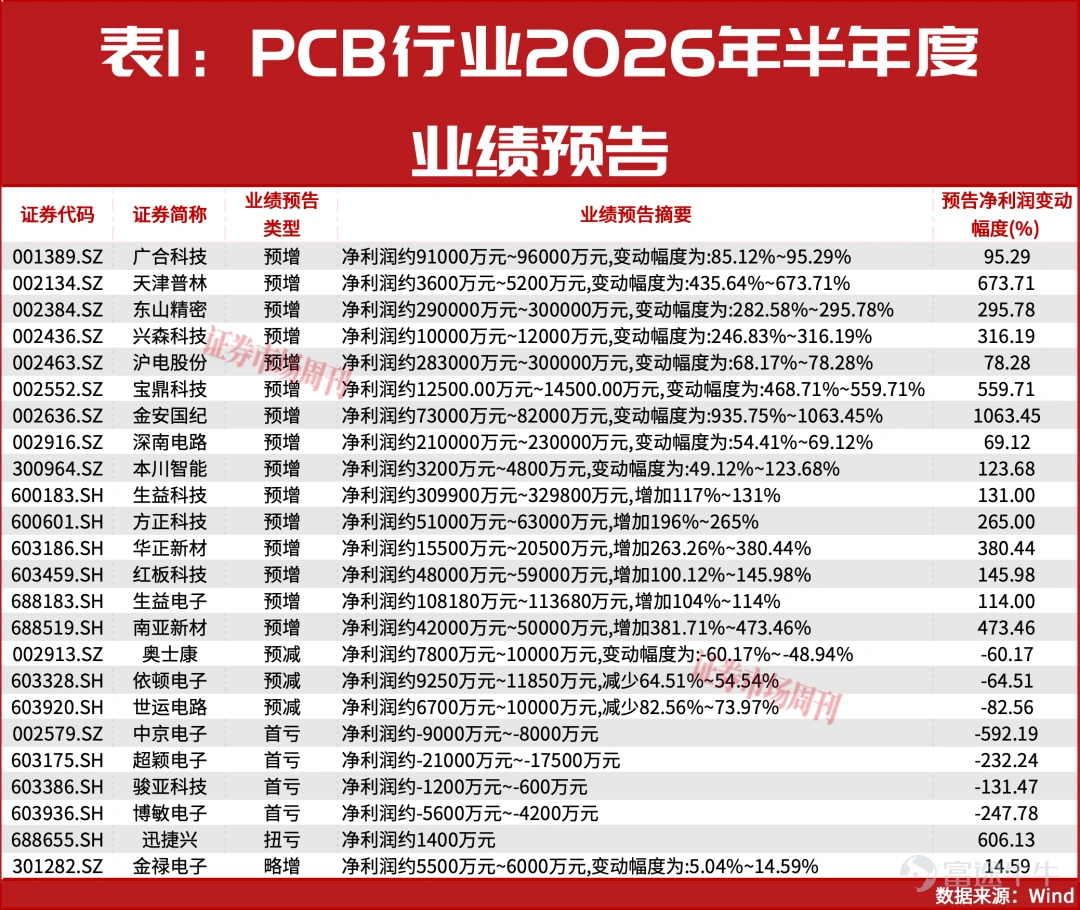
Dongshan Precision (002384.SZ) forecasts that its attributable net profit for the first half of this year will reach RMB 2.9 billion to RMB 3.0 billion, representing a year-over-year increase of 282.58% to 295.78%. In its earnings commentary, the company stated: 'Our traditional core businesses in consumer electronics and automotive components remain solidly grounded, delivering steady performance improvements that underpin our stable profitability base. The integration effect of our optical module business is beginning to materialize, with ramp-up of new capacity and onboarding of new customers progressing as expected, driving significant revenue and profit growth. Additionally, returns from our earlier strategic investments in data center–related businesses are gradually contributing to our overall profits for the period.'
Compared with Dongshan Precision, Shengyi Technology (600183.SH)—whose primary business covers copper-clad laminates—is expecting its first-half earnings this year to double. The company noted that during the reporting period, in its copper-clad laminate segment, it proactively adjusted and optimized its product sales mix and accelerated the release of expanded production capacity in response to rising raw material costs and sustained high growth in demand for high-end products. This drove higher sales volumes, increased revenues and gross margins from copper-clad laminates, and consequently boosted profitability. In its printed circuit board segment, its subsidiary Shengyi Electronics benefited from robust downstream demand in AI computing and high-speed communications, continuously focusing on structural growth opportunities in the high-end market, optimizing its product portfolio, and steadily advancing capacity expansion projects—particularly the high-layer-count, high-density interconnect PCB project for intelligent computing centers, which has been efficiently implemented according to plan and is rapidly generating returns.
The divergence in PCB sector performance, driven by upstream raw material price hikes, is similarly evident in certain semiconductor sub-sectors.This trend is clearly reflected in successive price increases by multiple manufacturers. For example, at the beginning of 2026, Goke Microelectronics was among the first to announce a price adjustment, with some memory products seeing price hikes of up to 80%. Subsequently, several power semiconductor companies—including China Resources Microelectronics, New Sharp Energy, and Jiejie Microelectronics—followed suit, raising prices of core products such as MOSFETs by 10% to 50%. In Q2, industry leaders like Yangjie Technology and Silan Microelectronics continued to pass cost pressures downstream by raising product quotations through distributor channels.
Profits in the electronics sector are accelerating toward concentration in memory storage.
ChangXin Technology tops the market capitalization ranking.
Looking at the performance of various sub-sectors within the A-share electronics industry, there is a clear trend of industry profits consolidating into memory storage. According to the 2026 interim earnings forecasts for the electronics sector,10 out of the top 20 companies by upper-end net profit forecasts are from memory chip and module manufacturers or supporting firms in the memory supply chain.(see Table 2).
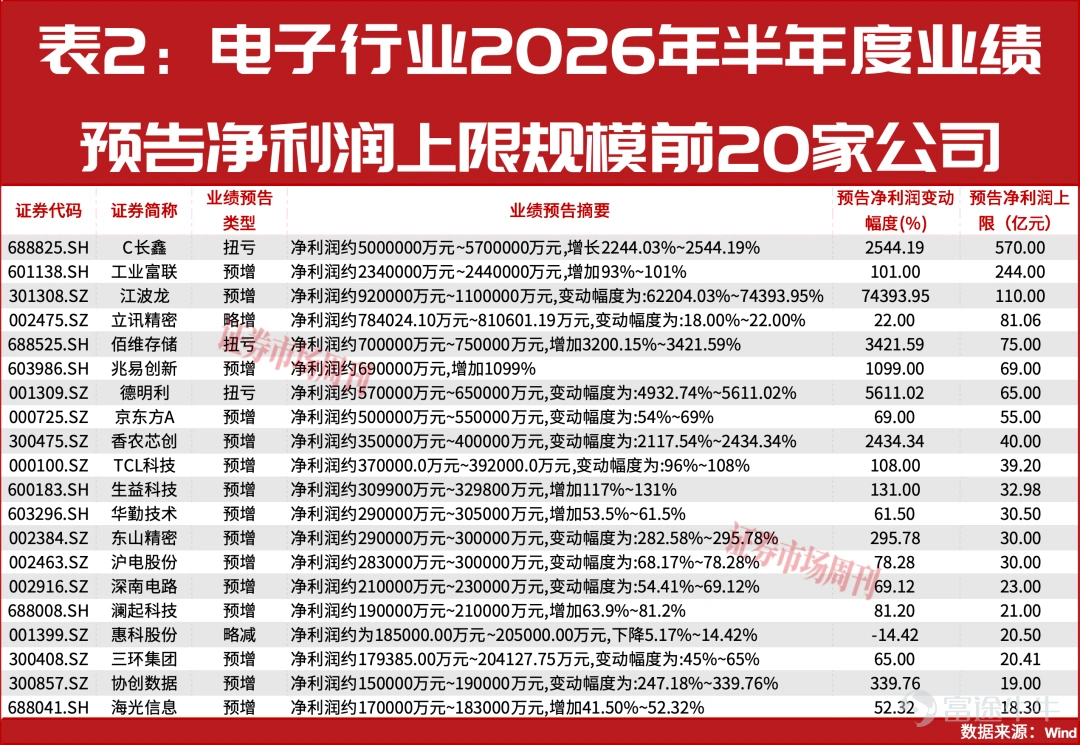
Among them, ChangXin Technology (stock code: 688825.SH), whose products cover DDR and LPDDR series, is China's leading memory chip manufacturer. GigaDevice is China’s premier memory chip design company; Xiechuang Data is among China’s first manufacturers of DDR memory for servers and desktops and a globally leading smart storage device maker; Longsys is one of China’s largest independent semiconductor memory brands; Biwin Storage and Demingli are storage solution providers; Shannon芯创 serves as an authorized distributor for original equipment manufacturers like SK Hynix and also operates its own brand, 'HaiPu Storage.' Supporting firms in the memory supply chain include Montage Technology, Foxconn Industrial Internet, and Hygon Information.
According to statistics, the combined upper-end net profit forecast for these 10 memory-related and supply chain companies for the first half of this year totals RMB 123.13 billion, accounting for 64.89% of the electronics sector’s total projected profit of RMB 189.747 billion. Among them,ChangXin Technology leads the electronics sector with an upper-end net profit forecast of RMB 57 billion.
In terms of earnings growth, core memory companies—including ChangXin Technology, GigaDevice, Xiechuang Data, Longsys, Biwin Storage, Demingli, and Shannon芯创—are all projected to achieve either double-digit or even dozens-of-fold year-over-year increases in the first half of this year. Notably, Longsys forecasts parent-company net profit between RMB 9.2 billion and RMB 11 billion, representing year-over-year growth of 62,204.03% to 74,393.95%.
Notably, ChangXin Technology began trading on the A-share market on July 27. Its share price surged by over 535% intraday and closed up 465.82% at RMB 49 per share, giving it a total market capitalization of RMB 3.28 trillion—surpassing ICBC to become the most valuable company on the A-share market.
A recent research report from AJ Securities noted that ChangXin Technology’s IPO aims to raise RMB 29.5 billion, with proceeds primarily allocated to capacity expansion of its 12-inch memory wafer fabrication facility, R&D for advanced memory process technologies, and core technology development for HBM high-bandwidth memory. These initiatives will further strengthen China’s domestic DRAM supply foundation. 'The company’s significant earnings recovery is fundamentally driven by AI computing demand boosting memory chip consumption, industry-wide supply constraints pushing DRAM prices higher, and its own steady ramp-up in production capacity coupled with continuous yield improvements—creating a powerful synergy of volume and pricing that drives robust earnings growth. We recommend paying attention to investment opportunities across the domestic memory chip supply chain. Current surging AI computing demand is significantly lifting server-side DRAM and HBM requirements, while constrained supply continues to support rising memory product prices, making the dual drivers of volume and pricing in the memory segment highly compelling.'Changxin Technology is the only domestic leader to have achieved scaled mass production of 12-inch DRAM. As capacity continues to ramp up and manufacturing yields steadily improve, it stands to benefit significantly from the current upcycle in the memory market.”
In fact, as of now, all core memory companies—and even all firms classified under the Shennan digital chip design sector—have forecast profitable performance for the first half of this year. In contrast, companies in related Shennan sub-sectors such as display panels and optical components are projecting losses or continued losses, weighed down by weak consumer electronics demand.
According to China Merchants Securities, as of the morning of July 15, approximately 30.1% of A-share companies (around 1,665 firms) have released their 2026 interim earnings guidance, flash reports, or full reports. The electronics sector features prominently among industries with high shares of companies reporting positive earnings trends, above-median industry earnings growth, strong Q2 earnings acceleration, and a high proportion of stocks exceeding earnings expectations. China Merchants Securities notes that sectors demonstrating sustained high growth or marginal improvement are concentrated in the TMT price-increase chain—including semiconductors, components, electronic chemicals, communications equipment, consumer electronics, and computer hardware. This TMT pricing chain benefits from ongoing global expansion of AI computing infrastructure and the memory 'super cycle,' driving persistent supply shortages and spreading price increases across upstream segments such as memory chips, electronic components, and optical communications, leading to concentrated earnings realization across mid- and upstream players.
(This article was published in the August 1 issue of Securities Market Weekly. Stocks mentioned herein are for illustrative purposes only and do not constitute investment advice.)
Risk Disclaimer: The above content only represents the author's view. It does not represent any position or investment advice of Futu. Futu makes no representation or warranty.Read more

Comments
to post a comment
1
2