
WorkBuddy has made Tencent proud
(This article was written by Lanmeihui and published by TMTPost with authorization)
By Lan Media, author: Ye Er, editor: Wei Xiao
Two months ago, a live conversation went viral across the entire AI industry.
At Tencent Cloud’s AI Industry Application Conference at the time, Tang Daosheng, Senior Executive Vice President of Tencent, posed a pointed question to Yao Shunyu, Chief AI Scientist: “Do you really think Tencent’s AI is slow?”
Yao Shunyu deftly replied, “I think that’s a question I should be asking you.”
At that time, whether it was foundational large models or consumer-facing AI products, Tencent had yet to deliver a single offering that met market expectations, and narratives about “Tencent falling behind in AI” were growing louder by the day.
Many pinned their hopes on Yao Shunyu to turn things around. Yet this exchange had already foreshadowed a twist: the person who first needed to break through Tencent’s AI development pace was none other than Tang Daosheng himself.
WorkBuddy, launched under his leadership at Tencent Cloud, is now leading the pack in the AI-powered workplace productivity segment.
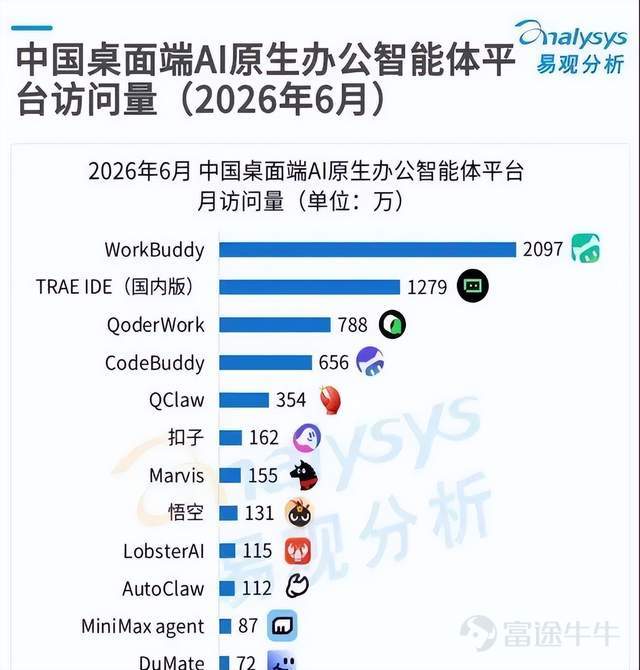
According to a report released by Analysys, in Q2, Tencent WorkBuddy ranked first among intelligent workplace agent platforms with 20.97 million monthly visits—surpassing the combined total of ByteDance’s Trae (second place) and Alibaba’s QoderWork (third place). In terms of daily active users, reports indicate that as of July, WorkBuddy has already surpassed 13 million.

This remarkable user penetration has not only enabled Tencent to become the first to successfully commercialize and scale AI agent applications as the market anticipated, but it has also fundamentally reshaped the competitive dynamics among China’s leading tech giants in AI.
A clearly visible trend is that, spurred by WorkBuddy’s explosive popularity, both Alibaba and ByteDance have felt palpable pressure and are actively adjusting their AI strategies, significantly increasing their focus on AI-powered workplace tools.
When rivals shift their strategies, it serves as the strongest validation. Thanks to WorkBuddy, Tencent AI—once labeled a 'laggard'—now stands firmly at the forefront of the race.
WorkBuddy continues to undergo iterative updates.
On July 30, Tencent launched version 5.3.5 of WorkBuddy, with the key update being the introduction of a 'human-AI co-writing' feature in collaboration with Tencent Docs—bringing a full-featured document editing interface directly alongside the AI chat window.
As a result, AI is no longer a standalone 'content generator' detached from the workflow but instead collaborates with users in real time within the same document. Users can manually draft text, highlight a section, and issue commands, prompting the AI to instantly rewrite, expand, or generate charts right in place—with all changes taking effect immediately.

"You could say WorkBuddy has already entered its second phase of iteration," an internal Tencent source told AI Lanmeihui. In the first phase, WorkBuddy addressed whether AI-powered office tools could actually get work done—leveraging desktop agent capabilities to access local files and automate multi-step tasks, quickly amassing a large user base thanks to its low barrier to entry and achieving significant scale.
Now, in the second phase, the focus shifts to solving core pain points inherent to 'AI-powered office work'—fully integrating AI into end-to-end office workflows and eliminating the inefficiencies caused by the traditional disconnect between AI Q&A and actual content creation, which previously required constant switching and copying between applications.
The source revealed that this 'human-AI co-writing' feature, jointly developed by WorkBuddy and Tencent Docs, goes beyond mere interdepartmental coordination—it represents deep integration of talent and resources. Several core team members from Tencent Docs have been directly reassigned to the WorkBuddy team to lead efforts in merging document collaboration with AI agent capabilities.
Public data shows that Tencent officially launched the desktop version of WorkBuddy, its AI-powered office assistant, on March 9 this year. Popularity surged rapidly after launch: monthly PC visits reached 8.85 million in the debut month and climbed to over 20.97 million by June—a 2.4-fold increase in just three months.
Moreover, this is currently the only consumer-facing AI product across Tencent's entire portfolio that has achieved organic, rapid growth without relying on traffic redirection or aggressive marketing campaigns—driven entirely by genuine user demand.
Given these impressive results, the aforementioned Tencent insider noted that the product now receives considerable internal attention, with many employees voluntarily using WorkBuddy in their daily work, significantly boosting morale around AI initiatives within the company.
Market sources also indicate that WorkBuddy has become Tencent’s internal 'mega-project,' receiving significant attention from Pony Ma, who rarely misses any product meetings.
In its Q1 earnings report this year, Pony Ma specifically mentioned WorkBuddy, calling it the most widely used AI-powered productivity agent in China today.
It’s worth noting that in previous quarters, Tencent’s commentary on its AI business was largely confined to preparatory statements about technological investment and foundational R&D, with rare explicit endorsements or high-profile praise for specific products—until now, when Ma has clearly taken a stand.
Over the past two years, Tencent has been under considerable pressure.
On the large model foundation front, HunYuan failed to break into the top tier; on the consumer-facing AI assistant side, Yuanbao—the company-wide bet backed by Tencent’s full resources—has generated little buzz to date. Compared to Alibaba and ByteDance’s strong presence in the AI space, Tencent’s voice has not only been faint but at times even faced significant skepticism.
But clearly, times have changed.
Thanks to WorkBuddy’s breakout success, Tencent has secured an early seat on the AI-powered office assistant bandwagon.
An industry insider told AI Blue Media that currently, there are only two AI application scenarios showing clear productivity gains: one is programming, and the other is office work. WorkBuddy is the first to successfully integrate large-model capabilities into white-collar daily workflows and achieve a commercially viable closed loop.
Why Tencent?

This is, first and foremost, naturally attributable to Tencent's accumulated strengths in application scenarios.
According to the aforementioned Tencent source, unlike the common market perception that younger developers hold an edge in AI, WorkBuddy was actually developed by a team of seasoned industry veterans with years of experience refining products. 'Ultimately, Tencent still holds a clear advantage—and deep expertise—in translating technology into practical, scalable product applications.'
On the other hand, it also stems from Tencent's aggressive approach.
In fact, Alibaba and ByteDance had previously continued pouring substantial resources into consumer-facing conversational assistants like Qwen and Doubao, whereas Tencent, as a laggard, has acted very aggressively when confronting potential opportunities on other fronts.
The earlier viral surge of 'Lobster' saw multiple Tencent departments racing internally in a horse-race format to stake their positions—a vivid illustration of this aggressiveness. In that wave of 'Lobster' mania, WorkBuddy emerged as the winner.
These factors have collectively established Tencent’s current leadership position in AI-powered workplace productivity tools.
However, its rivals have now caught on.
Alibaba has shifted decisively from its previous fragmented strategy, undertaking a comprehensive consolidation of its operations. It merged three workplace AI agent products—QoderWork, Wukong, and MuleRun—into a single flagship offering named 'Qwen Office,' which is now being spearheaded directly by DingTalk’s newly appointed CEO. This move concentrates resources to capture the AI-powered workplace segment and address Alibaba’s previous shortcomings in application deployment. ByteDance’s restructuring went even further: it completely overhauled its existing business architecture and executed a major organizational upgrade on July 30, integrating the entire Feishu product team into the Doubao ecosystem. This integration unifies large-model capabilities with workplace collaboration scenarios, leveraging Feishu’s mature enterprise workplace ecosystem and Doubao’s AI technology to build an integrated AI workplace solution, with a clear focus on capturing the government and enterprise office market.
With these two leading competitors simultaneously pivoting their strategies and concentrating resources to challenge Tencent in the AI workplace segment, the window during which WorkBuddy could exclusively enjoy the sector’s early-mover advantages has now closed.
Next up, it’s time for real, head-to-head combat.
Given that there is currently no significant gap among them in terms of ecosystem, capabilities, or synergy, the core dimension of competition still comes down to the underlying model architecture.
Notably, on WorkBuddy, the HY3 model is currently available free of charge for a limited time, while using other models such as Zhipu or Kimi consumes credits.
In other words, on the question of 'Is Tencent AI really slow?', Tang Daosheng has already provided his answer through WorkBuddy—and this time, Yao Shunyu can no longer avoid addressing it.
Risk Disclaimer: The above content only represents the author's view. It does not represent any position or investment advice of Futu. Futu makes no representation or warranty.Read more

Comments
to post a comment
6
1