
Robots are being widely deployed—have automakers unlocked a second growth curve?

July reshuffle among EV upstarts: Leapmotor alone surpasses 100,000 units, while Nio, XPeng, Li Auto, and Xiaomi remain stuck in the 30,000-unit range
(This article was written by Dingjiao One and published by TMTPost with authorization.)
By Dingjiao One; Author: Jin Yufan; Editor: Wei Jia
On August 1, as usual, EV startups released their July delivery figures.
July is traditionally a slow season for China’s auto market. The China Passenger Car Association (CPCA) estimates that domestic retail sales of passenger vehicles totaled approximately 1.52 million units last month, down 16.8% year-over-year. As the overall market declines, divergence among EV startups has become even more pronounced.

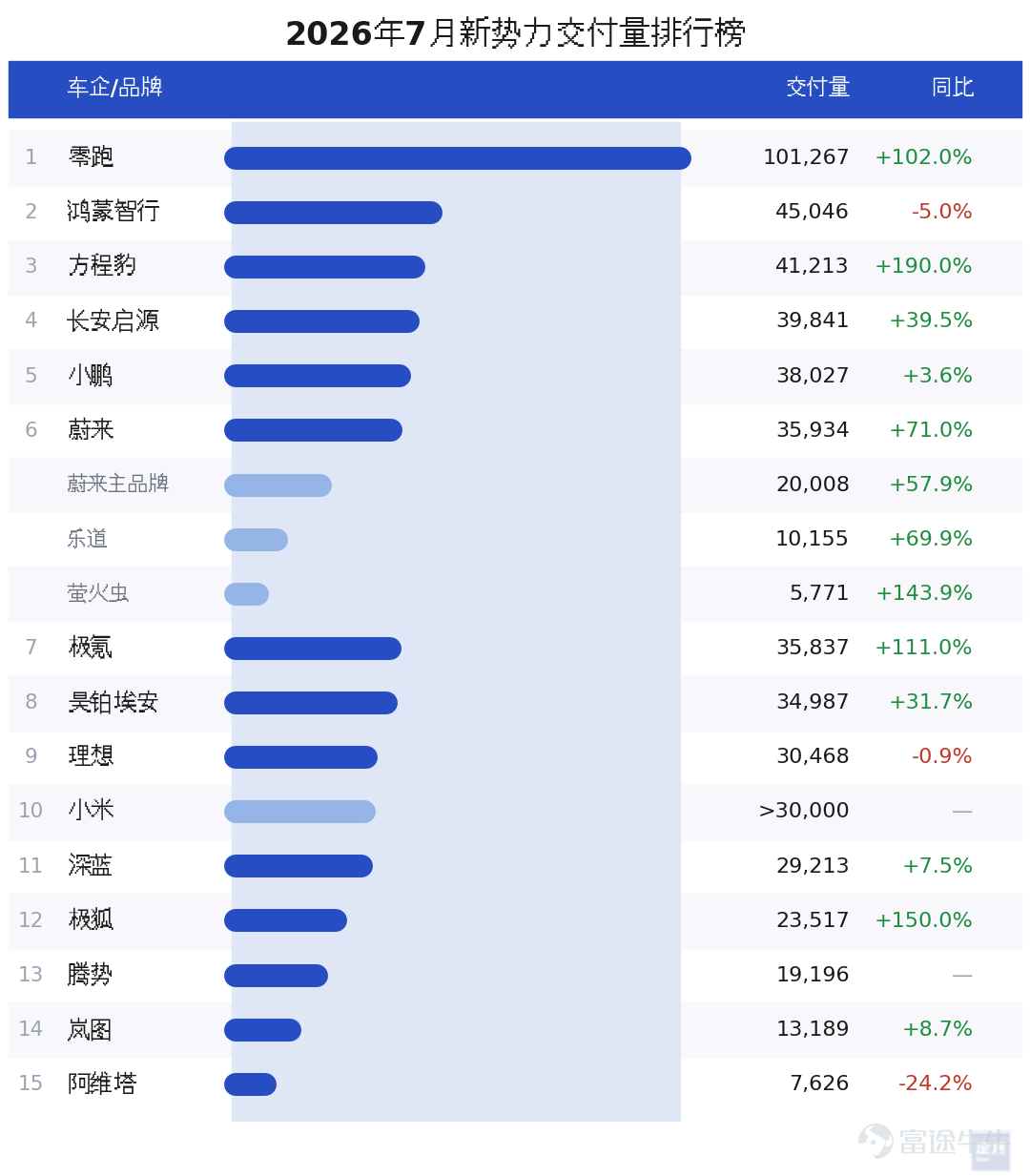
Leapmotor delivered 101,000 vehicles, up 102% year-over-year, becoming the first Chinese EV startup to surpass 100,000 monthly deliveries and standing alone in the top tier. Huawei’s AITO (Harmony Intelligent Mobility Alliance) delivered 45,000 units, ranking second, though its deliveries have declined year-over-year for the second consecutive month. Four automakers cluster in the third tier: XPeng at 38,000 units, Nio at 36,000, Li Auto just over 30,000, and Xiaomi exceeding 30,000.
Among traditional automakers, the gap between leading players is also widening.
BYD reported total sales of nearly 420,000 vehicles in July, up 22% year-over-year, with exports reaching nearly 180,000 units, surging 124.3% year-over-year. Its Fangchengbao brand delivered 41,000 units, up 190% year-over-year—a scale now approaching that of AITO. Denza delivered nearly 20,000 units for the month.
Chery Group sold 277,000 vehicles in July, up 23% year-over-year, including 203,000 units exported overseas, an increase of 70.1% year-over-year, marking its fifth consecutive month setting a new record for China’s single-month auto exports.
Geely sold just over 250,000 vehicles in July, with overseas exports exceeding 100,000 units for the second straight month, up 202% year-over-year—a new monthly export record. Its premium EV brand Zeekr delivered 36,000 units, up 111% year-over-year, setting an all-time high.
Elsewhere, the three brands under Changan showed divergent performances: Qiyuan delivered nearly 40,000 units (up 39.5% year-over-year), Deepal 29,000 units (up 7.5%), and Avatr 7,626 units (down 24.2%). GAC’s Hyper and Aion brands combined for 35,000 units (up 31.7%), BAIC’s Arcfox sold 23,500 units (up 150%), and Dongfeng’s Voyah delivered 13,000 units (up 8.7%).
This year’s trend shows that brands spun off from traditional automakers are increasingly occupying the middle of the rankings, while the sales gap among NEV startups will only widen further. Competition is intensifying: on July 16, six brands—including Li Auto, XPeng, and Leapmotor—launched seven new models within two and a half hours, with prices ranging from RMB 120,000 to RMB 350,000. Deliveries of these new models will begin in August, likely reshuffling the current rankings once again.
In July’s delivery rankings, the top two spots remained unchanged, but their trajectories diverged—Leapmotor surpassed 100,000 units, while Harmony Intelligent Mobility saw year-over-year declines for two consecutive months.
Leapmotor: First time breaking 100,000, yet still facing sales pressure
Leapmotor delivered 101,267 vehicles in July. How did it achieve over 100,000 deliveries during the traditional off-season? Domestically, new models and promotional campaigns drove volume, while overseas markets contributed additional growth.
Starting in June, Leapmotor aggressively launched new models, with volumes concentrated in July: the C-series trio received upgraded cabin chips and an 800V platform, while the B01 and B10 entered the sub-¥100,000 segment. Concurrently, the company introduced its 'Summer Pricing' incentives and four lifetime warranties, further lowering the purchase decision barrier for consumers.
Regarding sales mix, Leapmotor specifically highlighted that its premium D19 model delivered 10,043 units that month—a monthly milestone exceeding 10,000 indeed signals progress in brand elevation, though it accounted for less than 10% of total deliveries.
The real backbone of scale remains its mass-market product portfolio:The A10, launched at the end of March, delivered 28,593 units in July, accounting for nearly 30% of total deliveries; the B and C series aim to broaden mid-tier market coverage by bringing 800V fast charging, zero-gravity seats, and AR-HUD down to the ¥100,000 price point—essentially continuing its 'high-spec, low-price' strategy to attract buyers.

Source / Leapmotor official website
Overseas markets have further amplified Leapmotor's scale. The company disclosed that it sold nearly 100,000 vehicles overseas in the first half of the year, exceeding its full-year total for last year; industry estimates put the figure at approximately 96,300 units. Of this, exports accounted for more than 20% in the second quarter.Against the backdrop of a shrinking overall market, among the six new-energy vehicle startups, only Leapmotor has achieved this level of overseas sales volume.
However, Leapmotor still faces significant sales pressure, with capacity constraints being the primary bottleneck. Deliveries totaled approximately 457,000 units in the first seven months, representing a completion rate of about 44% against its annual target of 1.05 million vehicles.To meet its target, Leapmotor must average monthly deliveries of 118,000 units over the remaining five months—about 17,000 units higher than its July delivery volume.Cao Li, Senior Vice President of Leapmotor, mentioned during the launches of the B01 and B10 models that his greater concern was factories continuously demanding more vehicles, noting that a single factory’s monthly production capacity is only around 30,000 units. Selling consistently above 100,000 units per month,Leapmotor must not only maintain stable sales of its existing models but also ensure new models continue to contribute incremental volume, all while avoiding any disruptions in its supply chain or quality control.
Harmony Intelligent Mobility: Year-over-year declines for two consecutive months; August hinges on the M9
In second place is Harmony Intelligent Mobility, which delivered 45,046 vehicles in July, marking its second consecutive month of year-over-year decline. Unlike single automakers such as Leapmotor and XPeng, Harmony Intelligent Mobility reports consolidated figures across multiple partners, encompassing brands like Aito, Stelato, and Luxeed.
Last month, it also released brand-level sales figures for Aito and Stelato, as well as model-specific data for the Luxeed S7. As of July, however, it has not yet disclosed brand-level breakdowns, only noting that Stelato V9 deliveries surpassed 10,000 units; Seres has also not issued an official announcement.
Data-wise, Harmony Intelligent Mobility indeed faced pressure in July, with deliveries down 11% month-over-month and 5% year-over-year. The reason for the decline is straightforward: June marked the end of the first half of the year, during which Harmony Intelligent Mobility, along with the broader industry, pushed hard to boost deliveries—hitting over 50,000 units, a year-to-date high—and thereby pulled forward some demand.July saw no new vehicle launches or promotions.It was also the traditional off-season, so deliveries naturally declined. More importantly, model launch timing played a key role: the biggest volume driver in the first half was the Aito M6, which surpassed 30,000 deliveries within just 54 days of launch. However, by July, those initial orders were largely fulfilled, causing incremental growth to taper off. Meanwhile, the Aito M9’s monthly sales remained limited, and the next high-volume model had not yet arrived to fill the gap.

The decision not to offer promotions also reflects strategic considerations. According to Huachuang Securities, industry-wide discount rates in late July remained flat compared to the prior month. After six months of intense price competition, the market has entered a stalemate. In July, Harmony Intelligent Mobility focused its efforts on software: at month-end, it rolled out a summer OTA update, delivering 34 new features across ADS 5.0 and the Harmony Cockpit. Additionally, the Luxeed G9 secured Beijing’s L3 road-testing license. However, Ryan, a channel expert who follows new energy vehicle makers, noted that industry practice typically requires several months to complete validation and certification after receiving an L3 road-test permit, making it unlikely the G9 will begin deliveries in August.
Moreover, Harmony Intelligent Mobility announced at the end of July that small-scale reservations for its first FUV (a ‘crossover multi-purpose vehicle’)—the Zhiji RX—would open in August. According to automotive bloggers, the Zhiji RX has already begun road testing. Given that there is usually a significant lead time between road testing and official deliveries, it is also unlikely the RX will enter mass delivery in August.
Ryan believes whether Harmony Intelligent Mobility can rebound in August hinges on whether the Aito M9 can significantly scale up deliveries.
XPeng and Nio ranked third and fourth, respectively, with a gap of just over 2,000 units. The former saw year-over-year growth of only 3.6%, while the latter surged 71% year-over-year.
XPeng: Strong Orders, Lagging Deliveries
XPeng delivered 38,027 vehicles in July., down 5.2% from June and up slightly by 3.6% year-over-year. Summary of XPeng’s performance this month:In a transition period between old and new models, the new car has generated strong interest, but deliveries have not kept pace.
In mid-July, XPeng launched the MONA L03 with an official price of RMB 123,800—RMB 20,000 lower than the pre-sale price. Initial orders were strong, but the model contributed almost nothing to July deliveries due to production ramp-up bottlenecks. Some customers planning to buy the current model are now holding off. Citi’s survey noted that some customers have started comparing competing models.
XPeng stated officially that it will accelerate nationwide deliveries of the L03 in August. Citi expects the L03 to deliver between 8,000 and 10,000 units in August and around 15,000 units in September.
Therefore, XPeng’s July deliveries relied mainly on older models, and its premium lineup encountered some issues.

Source: XPeng official website
The bulk of deliveries still came from the MONA M03, P7+, G6, and G7. According to Ryan’s analysis, the launch of the L03 caused a slight dip in MONA M03 monthly sales. As the SUV variant of the MONA series, the L03 overlaps with the M03 in pricing, creating internal competition between the two models.
Premium models GX and X9 made limited contributions: GX production capacity improved somewhat, but delivery pace remains constrained; the X9 experienced a high-temperature air suspension failure in July, prompting XPeng to recall 33,473 units.
In the first seven months of this year, XPeng delivered 204,000 vehicles,To meet its annual target of 550,000 to 600,000 vehicles, XPeng needs to average 70,000 to 80,000 deliveries per month over the remaining five months., roughly double the delivery volume in July. Expectations are largely pinned on the L03; for orders to remain hot, production capacity must keep up.
Nio: Volume growth pulled back as price hikes protected gross margins
Nio, ranked fourth, presents a different scenario.It delivered 35,934 vehicles in July, up 71.0% year-over-year—the highest among the six automakers. In the first seven months of the year, Nio delivered a cumulative total of 227,057 vehicles, a 68.0% year-over-year increase. In terms of total volume, Nio has clearly emerged from last year’s trough and returned to a high-growth trajectory, achieving 46.4% to 49.8% of its annual target (456,000 to 489,000 vehicles).
However, Nio’s overall deliveries declined 11.5% month-over-month, marking its first significant pullback since February this year.
All brands saw a month-over-month decline. The main Nio brand delivered 20,008 vehicles (down 8.7% MoM), Onvo delivered 10,155 vehicles (down 13.5% MoM), and Firefly delivered 5,771 vehicles (down 16.9% MoM).
Priced between RMB 150,000 and RMB 300,000, Onvo and Firefly together accounted for 44% of deliveries in July, genuinely helping Nio expand its scale. But this month,the three brands failed to offset each other’s declines。
Nio did take action in July. On July 9, the five-seat ES8, with a starting price of RMB 382,800, was launched and began deliveries the next day. Normally, a new model launch would provide some boost to volumes. However, results showed that the main brand not only failed to grow but actually dropped by 8.7%. The five-seat ES8 had only about 20 days of deliveries in July, as production capacity had not yet fully ramped up. Meanwhile, the BaaS (Battery-as-a-Service) option lowered the entry price to RMB 274,800, attracting new customers but also inevitably drawing some buyers who originally intended to purchase the ES6 or six-seat ES8 over to the five-seat version—effectively shifting demand internally rather than generating net new sales.
It’s worth noting Nio’s pricing strategy. While rivals like Leapmotor rolled out limited-time incentives worth tens of thousands of yuan in July to grab orders, Nio not only refrained from following suit but actually raised prices on some of its core models by RMB 5,000 to 10,000. At a mid-July briefing, Li Bin stated that costs for aluminum, copper, and lithium carbonate were all rising, pushing the per-unit cost of the ES8 up by nearly RMB 20,000.Under cost pressure, Nio chose to protect its gross margins.
However, it remains to be seen whether this price-hike strategy will work. Ryan’s view is that the key will be August and September—after the larger five-seater ES8 ramps up volume—to see if Onvo and Firefly can maintain sales momentum without cutting prices.
The fifth and sixth-ranked automakers both delivered just over 30,000 units. Li Auto is caught in a transition between old and new models; Xiaomi has remained at this level for the fourth consecutive month, although its reported figures have consistently been slightly below actual insurance registration data in recent months.
Li Auto: The only brand with double-digit declines, awaiting a new model to turn things around
Li Auto delivered 30,468 vehicles in July, down 0.9% year-over-year and 1.4% month-over-month—the only leading EV startup showing declines on both fronts. Although the drop narrowed compared to June (which saw a 14.8% year-over-year decline), cumulative deliveries for the first seven months totaled 223,940 units, down 4.6% year-over-year, indicating Li Auto is still in a difficult phase. Against a backdrop where most top EV startups posted strong year-over-year growth this year, Li Auto is one of the few brands experiencing negative growth.
Li Auto’s July performance can be summarized in two points:
First, the generational transition of models. The former volume leader, the L6, completed its model refresh. The new L6 launched with a fixed price of RMB 249,800, sharing the same platform and chip architecture as the RMB 500,000-class L9. CLSA believes this pricing is highly attractive within its segment. However, since the launch occurred mid-month, its contribution to July deliveries was limited. The real test will come in August, the first full month of deliveries for the new L6.
Second, the main BEV model unexpectedly suffered a production hiccup. In mid-to-late July, the i6 saw production cut by approximately 4,000 units due to issues with headlight supply. The company officially clarified on July 27 that both supply and production had returned to normal.

Source: Li Auto official website
Supply chain volatility was one reason behind the weak July sales figures, indirectly highlighting Li Auto's excessive reliance on a single model.Alex, an investor focused on new energy vehicle startups, also noted that Li Auto’s L-series refresh this year mainly involved configuration upgrades. He believes Li Xiang’s attention has already shifted away from current models, with his strategic focus now on the next three to five years.
In early July, Morgan Stanley lowered its sales forecasts for Li Auto for 2026 to 2028 by 8%. Capital markets have already cast their votes—the stock has declined 46% year-to-date, and the company itself repurchased shares in July.
Based on its annual target of approximately 488,000 vehicles, Li Auto needs to sell roughly 53,000 units per month over the remaining five months to hit its goal. Ryan believes that once the new L6 and new L8 ramp up production, returning to 40,000 monthly deliveries is feasible. However, even reaching 40,000 would still fall short of the required 53,000 average—making it essential for the new L6 to become the next i6-level blockbuster.
Xiaomi: Stepped-up promotions, still around 30,000 units
Xiaomi delivered over 30,000 vehicles in July.This month, Xiaomi rolled out several promotional initiatives. The new SU7 offers a financing plan starting at a down payment of RMB 49,900 and monthly installments as low as RMB 538, along with limited-time purchase incentives worth up to RMB 61,000. On July 14, the company also released a small batch of ready-to-deliver vehicles, enabling delivery in as little as two hours.
According to Alex, the initial order backlog built up since launch has largely been depleted. The core objective of July’s promotional campaign was to accelerate conversion of existing orders and stabilize delivery volumes ahead of new model launches. Going forward, monthly deliveries will depend more heavily on newly generated orders during the period.
If Xiaomi sticks to its full-year target of 550,000 vehicles, and subtracts the cumulative deliveries of approximately 215,000 units for the first seven months (estimated using a conservative July figure of 30,000 units),it will need to deliver nearly 67,000 vehicles per month on average over the remaining five months.
This means Xiaomi cannot remain in the 'comfort zone' of 30,000 monthly deliveries—it must more than double its output in a short period.
Can the current lineup of just two models—the SU7 and YU7—support a monthly volume of 67,000 units? That would be extremely difficult. This explains why Xiaomi launched its new extended-range SUV series, 'Xiaomi Pengcheng' (Sky Nomad), at the end of July and immediately opened pre-orders for the N70 Max and N90 Max.
However, the Pengcheng models won’t begin deliveries until September, and ramping up production will take another one to two months, leaving only the fourth quarter as the real window for scaling volume.For the next two months, Xiaomi will likely remain at around 30,000 units per month.
Monthly rankings are highly sensitive to delivery timing. Comparing the combined January–July deliveries of these six automakers with their projected year-end 2025 standings already reveals a shifting landscape.
The projected top six for full-year 2025 is Leapmotor, Harmony Intelligent Mobility Alliance, XPeng, Li Auto, Xiaomi, and Nio. After seven months, the gap between the top two has widened to 170,000 units—making the leader’s position virtually unassailable. The middle tier has been reshuffled: Nio has climbed from sixth place in 2024 to third, while Li Auto and Xiaomi hold fourth and fifth, respectively, and XPeng has slipped from third to last.

In terms of annual target completion rates, Nio is in the most comfortable position—it only needs to average over 46,000 monthly deliveries in the second half to meet its goal. Leapmotor has the highest target, requiring nearly 120,000 units per month. XPeng, Xiaomi, and Li Auto need to average 70,000–80,000, 67,000, and 53,000 units per month, respectively—all far exceeding their July levels of just over 30,000 units.
These six companies have now formed distinct tiers, with product portfolio structure serving as the key dividing line. Leapmotor and Nio, which are moving upward, both generate volume across multiple product lines—one through four vehicle series plus overseas sales, the other through three brands. In contrast, the three automakers stagnating or slipping—XPeng, Xiaomi, and Li Auto—are all constrained by overreliance on a single model or a single product cycle. All three are pinning their hopes on new models that have yet to achieve scale deliveries. Production capacity, supply chain stability, and delivery timelines will determine the final rankings in the second half.
Risk Disclaimer: The above content only represents the author's view. It does not represent any position or investment advice of Futu. Futu makes no representation or warranty.Read more
Comment (1)
to post a comment
1