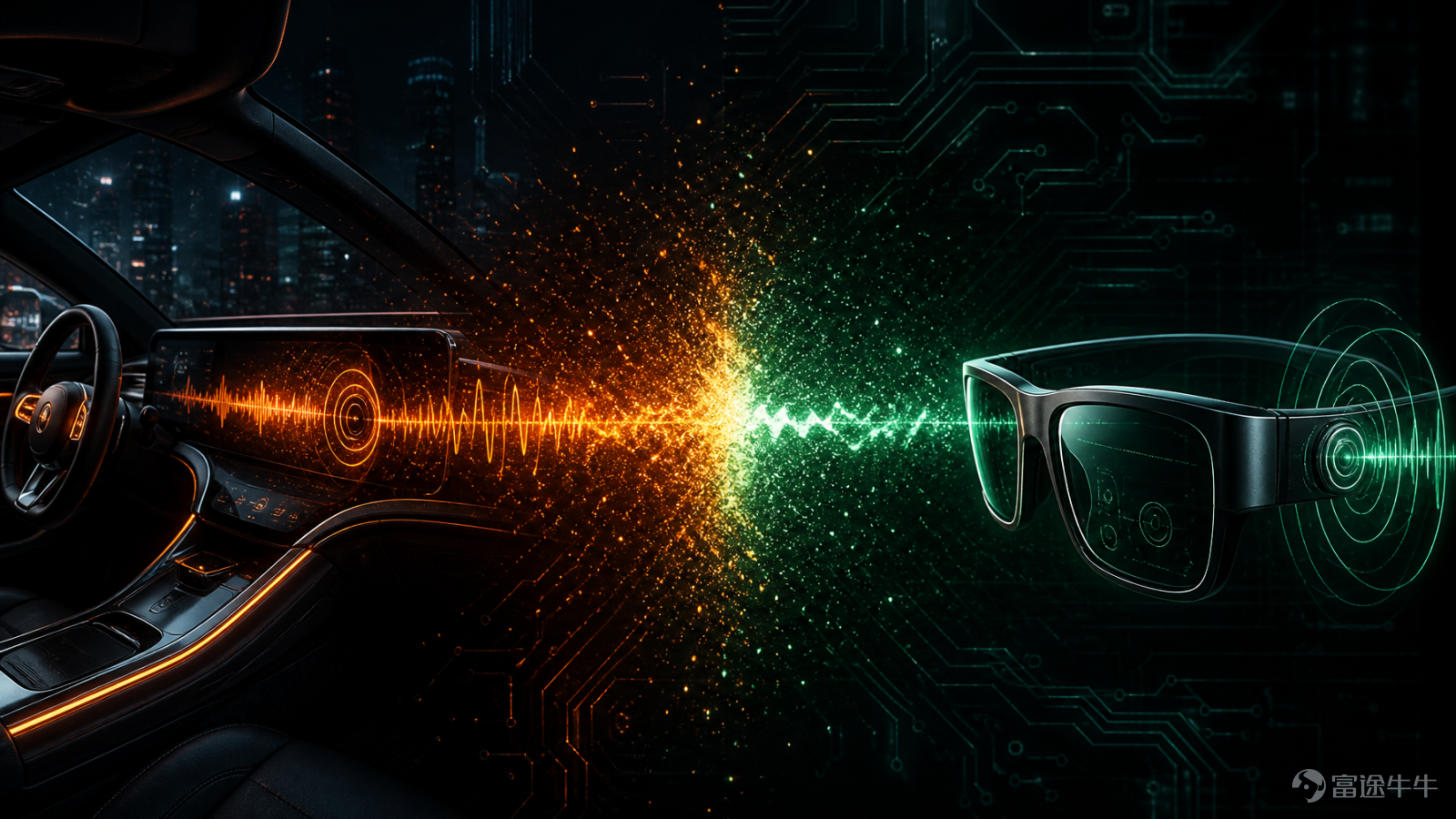

Global large voice models are vying for the microphone behind the steering wheel

The battle for voice AI has already moved from text chat boxes into automotive cockpits, smart glasses, and wireless earbuds.
In July, multiple signal flares erupted on the real-time voice agent battlefield.
On July 23, Anthropic rolled out a major upgrade to Claude Voice. Voice mode is no longer limited to the lightweight Haiku model—Opus and Sonnet now power voice inference—and it has integrated with applications like Gmail, Calendar, and Slack. On July 24,AmazonAmazon upgraded Alexa+, enabling seamless multi-turn conversations across Echo devices, mobile apps, in-car systems, and web browsers, powered by a hybrid routing architecture combining Nova and Anthropic’s Claude models.
On July 28, Alibaba Cloud’s Qwen Audio 3.0 Realtime Plus set a new record on Artificial Analysis’s Big Bench Audio benchmark with a score of 99.2%, claiming the top spot on the global voice reasoning leaderboard—but its average time-to-first-audio (TTFA) latency was as high as 4.02 seconds. On July 29,SpaceXAI (formerly xAI) launched Grok Voice Think Fast 2.0, reducing TTFA latency to just 0.70 seconds and achieving a Big Bench Audio score of 97.2%. On the τ-Voice benchmark—which measures an agent’s autonomous execution capability—it led decisively with 56.5%, compared to GPT-Realtime-2.1 High at 45.7% and Gemini 3.1 Flash High at 37.7%. Earlier, on July 6, OpenAI had also released GPT-Realtime-2.1.

SpaceXAI, OpenAI, Anthropic, Amazon, Alibaba Cloud, Google—this is no longer a localized skirmish in a niche segment but an all-out battle spanning APIs to hardware endpoints, from consumer electronics to intelligent vehicle cockpits.
Over the past six months, the real-time voice agent space has witnessed intense head-to-head competition. Victory is judged by three hard metrics: time-to-first-audio latency, speech recognition accuracy, and invocation cost.
Take SpaceXAI first. Grok Voice Think Fast 2.0 delivers a TTFA of 0.70 seconds—responding between the moment a user finishes speaking and before most people even notice the gap. By comparison, v1.0 had a TTFA of 1.25 seconds; GPT-Realtime-2 in high-inference mode clocks in at 2.33 seconds; Gemini 3.1 Flash High at 2.98 seconds; and Qwen Audio 3.0 Realtime Plus at 4.02 seconds. In Vapi Humanness Index TTS latency tests, Grok TTS achieved a streaming-mode TTFA of just 285 milliseconds and 460 milliseconds in standard mode. Version 2.0 further optimized inference efficiency: inference tokens were reduced by 60%, and tool calls can begin executing even before the user finishes their first utterance.
xAI designed its voice pipeline as a unified system from the start—developing its own voice activity detection, proprietary audio tokenizer, and end-to-end speech model—collapsing the traditional three-stage pipeline of ASR → LLM → TTS into a single model. That’s the physics behind the 285-millisecond latency: every middleware layer bypassed eliminates one layer of delay and one source of error.
On Artificial Analysis’s comprehensive voice quality index, Think Fast 2.0 scored 82.9% overall—up 9.5% from v1.0’s 75.7%—surpassing GPT-Realtime-2.1’s 79.1% and Gemini 3.1 Flash’s 69.5%. Its Full Duplex Bench score jumped from 77.8% to 95.1%, approaching GPT-Realtime-2.1’s 95.7%. Transcription accuracy in noisy environments improved by an order of magnitude—tenfold over the previous generation—and far exceeds that of specialized transcription models.
But Alibaba Cloud disrupted this landscape on July 28. Qwen Audio 3.0 Realtime Plus set a new Big Bench Audio record with a score of 99.2%, surpassing Grok Voice Think Fast 2.0 at 97.2%, Step-Audio R1.1 at 97.6%, and GPT-Realtime-2.1 High at 96.0%. It also led in conversational dynamics and agent execution dimensions, scoring 98.4% and 54.6%, respectively. The trade-off was an average time-to-first-audio (TTFA) latency of 4.02 seconds. Qwen Audio’s dual-version strategy—Plus and Flash—is precisely tailored to different scenarios: Flash targets real-time interaction (with first-packet latency in the 300-millisecond range), while Plus focuses on high-quality audio generation. However, in latency-sensitive contexts like in-car systems, wearables, and voice calls, a 4-second delay renders the feature effectively unusable.
This contradiction highlights an unavoidable trade-off in today’s technology race: models pushing for ultimate inference accuracy often pay the price in latency. Qwen’s Big Bench Audio TTFA is 5.7 times that of Grok. In real-time voice applications, latency is a physical ceiling—delays under 0.5 seconds feel like natural conversation, around 1.5 seconds starts to feel like 'waiting,'Robotand by 4 seconds, users simply think 'this feature is broken.'
OpenAI has taken a different path. After launching GPT-Realtime-2.1 on July 6, its flagship model charges $32 per million input tokens and $64 per million output tokens for audio; the mini version costs $10 and $20, respectively. Theoretically, this translates to roughly $0.05 per minute, but independent developers’ real-world tests quickly diverge from these estimates. For example, a real estate tour AI averaged about $0.07 per minute in practice, with worst-case scenarios reaching $0.146 per minute. Cost inflation under token-based billing in long conversations remains a fundamental challenge for OpenAI’s voice model commercialization.
Google’s Gemini 3.1 Flash Live, launched in March, initially drew attention on ComplexFuncBench Audio with a 90.8% function-calling accuracy rate and support for over 90 languages. However, persistent developer forum complaints about increasing latency—some model versions jumping from 500 milliseconds to 1,800 milliseconds or even waiting times exceeding 10 seconds—have exposed stability risks in large-scale deployment. For automakers and wearable device manufacturers, such instability is far more critical than mere slowness.
Zooming out further, two other heavyweight players had already made their moves well before July.
MicrosoftAt its Build conference in June, Microsoft officially moved its Voice Live API into general availability (GA). This API bundles STT, LLM, TTS, noise suppression, echo cancellation, interruption handling, and avatar rendering into a unified interface, eliminating the need for developers to manually assemble voice pipelines. More importantly, Microsoft plays a dual role: it hosts OpenAI’s GPT-Realtime-2.1 models on Azure for enterprise clients while simultaneously promoting its own proprietary Azure-Realtime model. Voice Live is already integrated with Foundry Agent Service and supports low-latency WebSocket and WebRTC connections, embedding directly into end-to-end enterprise agent development workflows. Microsoft is pursuing a ‘platform-as-a-barrier’ strategy—once customers deploy voice agents on Azure, migration costs become significantly higher than merely switching an API endpoint.
Meta, meanwhile, dropped a major bombshell on the open-source front. In April, Meta released Llama-Voice under the Apache 2.0 license—a 7-billion-parameter TTS foundation model supporting 52 languages, capable of zero-shot voice cloning from just 10 seconds of audio and running in real time on consumer-grade GPUs. It surpassed 800,000 downloads within 48 hours of launch, rapidly spawning dozens of community fine-tuned variants for podcasting, audiobooks, and game NPC voiceovers. Meta also holds SeamlessStreaming v2, which enables real-time speech translation across over 100 languages with approximately 2 seconds of latency. Combined with the Ray-Ban Meta Gen 2 smart glasses—already on sale—Meta now controls a complete pipeline from open-source models to consumer hardware, a gap notably absent in OpenAI’s portfolio.
SpaceXAI, OpenAI, Alibaba Cloud, and Google are all grouped under the same ‘real-time voice’ label, yet their underlying architectures fundamentally shape their divergence in latency, inference depth, and cost structures. Adding Anthropic and Amazon into the mix reveals at least four distinctly different technical approaches.
The most radical approach is Grok Voice's native end-to-end pipeline: audio input and audio output are handled entirely by a single model. The boldest aspect of this architecture is its direct processing of raw audio signals over WebSocket connections—bypassing ASR-based transcription to text and TTS-based synthesis altogether. This is indirectly confirmed by a 60% reduction in inference tokens: Grok 2.0 no longer needs to decompose every user utterance into detailed textual form before reasoning; instead, the model performs 'understanding' directly within the audio semantic space. Grok TTS achieves a phone entity recognition error rate of just 5.0% on the Vapi Humanness Index, compared to 12.0% for ElevenLabs and 13.5% for Deepgram.
In contrast, although OpenAI’s Realtime API nominally supports end-to-end functionality, its cost structure and latency profile resemble more closely a 'multimodal ChatGPT paired with a real-time audio codec.' It charges per token, making longer contexts increasingly expensive, and while caching mechanisms (at $0.40 per million input tokens for the flagship tier) partially offset costs, actual deployment sees pricing fluctuate between $0.05 and $0.15 per minute—meaning each user follow-up quietly inflates the bill.
Anthropic and Amazon, meanwhile, have carved out hybrid approaches distinct from both Grok and OpenAI.
Anthropic opts for a turn-based architecture (listen → think → speak) rather than full-duplex interaction, trading real-time fluidity for deeper reasoning and tool accuracy. Claude Voice’s Opus mode can help users rehearse client proposals and identify logical gaps, while integrating with applications like Gmail, Calendar, and Slack—requiring explicit user confirmation before each action. The core philosophy is that voice should not merely serve as an interface but actively drive real workflows. The trade-off is a less natural conversational rhythm compared to full-duplex systems, yet in scenarios demanding careful deliberation, the depth offered by turn-based interaction outweighs the fluency of full-duplex.
Amazon employs a multi-model routing strategy, leveraging its Bedrock platform to assign Nova to rapid tasks and Anthropic’s Claude to complex reasoning—each model playing to its strengths. With 600 million Echo devices forming Alexa’s installed base, the July upgrade signaled something even more significant: Alexa+ has now expanded beyond hardware into browsers, mobile apps, and in-car systems. Simultaneously, Amazon is advancing its Moonraker Agent project, investing over $100 million in GPU compute capacity with the goal of enabling multi-task interactive coordination—though this high cost has already sparked internal debate.
Both companies share a common conviction: 'Don’t sacrifice other capabilities for the sake of full-duplex.' In most productivity scenarios, users prioritize reliable outcomes over a chat partner who can be interrupted at any moment.
At the opposite end of the spectrum, traditional speech specialists like Deepgram and AssemblyAI continue refining their three-stage pipeline through highly optimized specialized models to mitigate weaknesses. AssemblyAI achieves a 16.7% error rate on alphanumeric recognition tasks—lower than OpenAI’s 23.3% and Deepgram’s 25.5%. Deepgram offers an all-inclusive flat rate of $4.50 per hour for the entire pipeline. However, the ceiling of this 'modular' architecture is clear: each additional intermediate step introduces another layer of latency. For automotive and wearable use cases, traditional pipelines top out at roughly 600–1,500 milliseconds, whereas end-to-end solutions have already dipped below 300 milliseconds.
Beyond these four approaches, another critical variable is emerging: on-device inference. Collaborations like Liquid AI’s partnership with MERCEDES-BENZ GROUP AG UNSP ADR EACH REP 0.25 ORD SHS and Meta’s Llama-Voice running in real time on consumer-grade GPUs point toward a future where voice inference occurs entirely on the device. This path currently faces constraints in compute power and model compression, pendingQualcomm、Applethe completion of custom chip iterations with automakers, after which on-device voice inference could enter mainstream production between 2027 and 2028. At that point, the business model of cloud-based voice APIs will face fundamental disruption.
From a pricing strategy perspective, SpaceXAI’s strategic intent is very clear.
Grok Voice Think Fast 1.0 is priced at $0.05 per minute. Version 2.0 increased to $0.08 per minute, but this comes with significant improvements: Time-to-First-Acknowledgment (TTFA) reduced from 1.25 seconds to 0.70 seconds, transcription performance in noisy environments improved tenfold, inference speed doubled, and a substantial leap in agent execution capability. More importantly, the grok-voice-latest endpoint will automatically migrate from 1.0 to 2.0 on August 5. Most developers have no reason to stick with the older version just to save $0.03.
OpenAI’s GPT-Realtime-2.1 costs approximately $0.05 to $0.15 per minute when converted. Google uses a similar token-based billing model. Qwen Audio 3.0 Realtime Plus has an input cost of about $4.42 per hour—60% cheaper than GPT-Realtime-2.1’s $10.75 per hour, but nearly twice as expensive as Grok Voice.
Viewed in isolation, a few cents per minute difference seems negligible. But translated into commercial scenarios: for a large customer service center handling 100,000 minutes of calls per month—a common volume—the monthly cost would be $8,000 with Grok Voice 2.0 versus $7,000 to $15,000 with OpenAI. If it’sTeslaa fleet of one million vehicles generating millions of minutes of voice interactions daily, the cost difference would amount to millions of dollars.
But what truly reveals strategic ambition is xAI’s separate pricing for its STT (Speech-to-Text) and TTS (Text-to-Speech) APIs. Grok STT is priced at $0.10 per hour for batch processing and $0.20 per hour for streaming—less than one-thirtieth of Deepgram’s comparable offerings. Grok TTS costs $4.20 per million characters, which is 86% lower than OpenAI’s roughly $30 and over 90% lower than ElevenLabs’ approximately $50. This near-'cost-price dumping' strategy only makes commercial sense when Elon Musk simultaneously controls Tesla (end devices), Starlink (network infrastructure), and X (data and distribution). The voice API can operate at razor-thin margins or even at a loss, because other parts of the ecosystem will recoup those losses many times over.
This logic—using pricing pressure to force industry consolidation, then locking in customers through ecosystem effects—is strikingly similar to how AWS once overwhelmed traditional IDCs.
Tesla currently operates the world’s largest-scale real-time voice agent deployment in production. Grok Voice is already live across millions of vehicles. This summer’s vehicle software update introduced 'Hey Grok' as a wake-word-free trigger, extending voice control beyond navigation to functions like making calls, playing music, adjusting climate settings, and opening the glove compartment. It can read vehicle status, plan routes, and invoke search and tools. This real-world integration is far more compelling than any API pricing dashboard or developer demo—every conversation serves as both an A/B test and a training data point.
The rapid expansion of the in-vehicle voice market supports this assessment. According to Global Market Insights, the global in-vehicle voice assistant market was valued at approximately $8.4 billion in 2025 and is projected to grow at a 9.7% compound annual growth rate (CAGR) to reach $21.3 billion by 2035. Meanwhile, the smart cockpit market is growing at an 11.8% CAGR, rising from $8.2 billion in 2025 to $25 billion by 2035. MERCEDES-BENZ GROUP AG UNSP ADR EACH REP 0.25 ORD SHS has partnered with Liquid AI and plans to integrate on-device voice AI into its MB.OS operating system in the second half of the year. Lucid has chosen SoundHound. Every automaker is betting on the same thesis: as autonomous driving gradually frees drivers’ hands, voice will become the primary interaction channel within the cabin.
Wearable devices are advancing even further. Ray-Ban Meta Gen 2 has already integrated cameras, microphones, and an AI voice assistant into frames indistinguishable from ordinary sunglasses; Rokid Glasses selected MiniMax Speech as their underlying voice engine. Users can perform voice searches, translations, photo capture, and navigation. Meta has not disclosed the supplier of the voice model for its AI glasses, but given Meta’s competitive relationship with SpaceXAI and OpenAI’s tight integration with Microsoft, this fact alone speaks volumes: hardware manufacturers have no brand loyalty—only the calculus of 'who is faster and cheaper.' Once a voice model achieves decisive advantages in speed and cost, hardware vendors will switch—it’s merely a matter of time.
The competitive landscape of real-time voice technology in China is far more dynamic than what just one or two companies could create.
Alibaba Cloud’s Qwen Audio 3.0 Realtime Plus and Flash dual versions now cover the full spectrum of use cases—from high-accuracy to ultra-low-latency scenarios. Yet across the entire sector, at least five other domestic companies are making substantial investments in the same direction.
ByteDance is the most formidable among them. Its AI assistant Doubao features the Seeduplex end-to-end voice architecture, already deployed in over 7 million mass-produced vehicles spanning more than 50 automotive brands. In April 2026, Seeduplex completed a new round of upgrades and began offering real-time voice capabilities to enterprise clients via Volcano Engine. ByteDance’s edge lies in its dual leverage of ‘models plus distribution channels’—it not only develops proprietary models but also commands the massive reach of Douyin and Volcano Engine.
MiniMax has taken a different path: building foundational voice infrastructure and expanding its business globally. Its Speech 2.6 model achieves end-to-end latency under 250 milliseconds and supports over 40 languages. It’s already adopted by leading international voice platforms such as LiveKit (the tech stack behind ChatGPT’s Advanced Voice Mode), Pipecat, and Vapi. On the smart hardware side, devices like Haivivi Bubble Pal, Fuzozo, and Rokid Glasses all integrate MiniMax Speech. MiniMax’s strategy is clear: rather than directly competing with OpenAI or SpaceXAI on general-purpose large models, it aims to embed itself deeply into the voice layer so that ‘everyone’s pipeline includes us.’
iFLYTEKiFLYTEK is a veteran in the voice domain, with far deeper roots in the domestic market than its peers. According to IDC data, iFLYTEK holds a 15.6% share of the speech and language understanding market—the largest in China. In February 2026, it launched the Spark X2 large model trained entirely on domestically produced computing resources. By June, it rolled out four enterprise-grade AI applications, all highlighting real-time voice interaction as a core feature. iFLYTEK’s competitive moat doesn’t come from benchmark scores on general tasks, but from deep penetration into vertical scenarios: spoken English assessment in education, voice-enabled medical documentation, intelligent government hotline agents, and in-car voice systems—each requiring hard-won industry-specific expertise.
BaiduBaidu’s investment in voice-focused large models also deserves attention. In January 2026, Baidu unveiled the industry’s first end-to-end voice-language large model based on Cross-Attention architecture, achieving a response latency of just 412 milliseconds. During the May Day holiday period, Baidu Maps’ AI co-pilot served over 200 million users, leveraging the Wenxin large model to deliver the industry’s only full-duplex voice conversation capability. Baidu also controls the entire lineup of Xiaodu smart hardware and maintains an extensive network of partnerships with automakers (BYDincluding Geely and 11 other automakers that have integrated the Xiaodu in-car system). In the ‘model plus terminal’ dimension, Baidu stands as one of the very few Chinese companies capable of rivaling ByteDance.
ZhipuZhipu AI’s GLM-4-Voice launched in October 2024 was among China’s earliest end-to-end voice large models, earning a strong reputation for Chinese semantic understanding and long-task execution. Tencent HunYuan embeds voice AI across its ecosystem through multiple products: AI-powered dialogue on the TRTC real-time audio-video platform, AI voice input in Sogou Input Method (achieving 98% accuracy and a 30% improvement in dialect recognition), and character-based voice calls in Tencent Video.
These six Chinese companies, together with Alibaba Cloud, form the ‘Seven Powers’ of China’s real-time voice sector. Each approaches the market from a distinct angle, leverages unique strengths, and targets different battlegrounds—but they all converge sharply on one key customer segment: automakers.China's new energyThe race to intelligent vehicles has already reached voice assistants, yet most users don’t realize the latency gap behind the phrase 'supports real-time voice.' A difference of mere milliseconds can be worlds apart.
The battle over real-time voice agents has sent three clear signals.
Speed is the moat. In text-based large language models, a one-percentage-point benchmark gap may not translate into a noticeable user experience difference. But in voice interaction, a 100-millisecond latency gap becomes perceptible through users’ subconscious reactions. Qwen leads significantly in inference accuracy, but its 4-second latency means it’s temporarily out of contention for in-car and wearable scenarios. At 0.70 seconds versus 4.02 seconds, this isn’t just a matter of fast versus slow—it’s the difference between usable and unusable.
This physical ceiling points clearly toward an endgame: end-to-end native architectures will gradually replace three-stage pipelines. Yet Anthropic’s presence highlights another truth—speed isn’t the only standard. In scenarios requiring deep reasoning and reliable execution, 'slow but dependable' holds more value than 'fast but flaky.' The finish line may not belong to any single approach; instead, end-to-end, turn-based, and hybrid routing architectures could each occupy distinct ecological niches.
Hardware determines the endgame. Pure API model companies are confronting a reality: without proprietary hardware endpoints, the commercial ceiling for voice AI remains limited to API billing. SpaceXAI leverages Tesla, Amazon uses Echo, Meta integrates with Ray-Ban, and Baidu partners on Xiaodu smart speakers and automotive solutions. Any company with hardware distribution channels gains a natural extra life in the race for voice entry points.
If OpenAI and Anthropic fail to enter the hardware space soon—either through partnerships or in-house development—they’ll find themselves at a disadvantage in the next phase. In China, a parallel battle is unfolding with different weapons: iFlytek, ByteDance, Baidu, and Alibaba are vying for positions within automotive supply chains, replicating the same logic. The competition for voice entry points ultimately boils down to securing the default interaction interface pre-installed at the factory. Tesla owners won’t swap out their car’s Grok just because OpenAI releases a faster model. If Ray-Ban Meta or Rokid Glasses are tied to a specific voice model, switching incurs high migration costs that make replacement economically unattractive. Once set as the default, the transaction cost of changing it becomes so high that most users simply tolerate it.
Pricing is just the starting point. Grok TTS is priced 90% lower than ElevenLabs, Llama-Voice is open-sourced and free, and MiniMax delivers 250-millisecond latency service to global platforms. Voice infrastructure pricing is being flattened across the board—but that’s only surface-level. SpaceXAI benefits from ecosystem synergies (Tesla, Starlink, X), Meta builds distribution pipelines through open-source initiatives, Microsoft locks in enterprise customers via its platform, and Amazon bundles Echo devices with Prime memberships. Voice API pricing alone can no longer sustain a standalone business model; real profits lie elsewhere in the ecosystem.
Developers and hardware manufacturers now face a critical decision: commit to a single model or adopt multi-model redundancy? The former minimizes costs but maximizes lock-in risk; the latter drastically increases complexity in latency management and user experience optimization. Whichever path is chosen, waiting on the sidelines with a 'wait-and-see' attitude is no longer viable. The window of opportunity for voice entry points won’t stay open for more than 18 months.
Voice isn’t just an add-on feature for large models—it’s the first real chance for large models to directly embed themselves into the sensory fabric of the physical world. And once you sign a lease on those senses, it’s far harder to terminate than any API contract.(This article was first published on TMTPost App. Author | AGI-Signal; Editor | Qin Conghui)
Risk Disclaimer: The above content only represents the author's view. It does not represent any position or investment advice of Futu. Futu makes no representation or warranty.Read more
Comments
to post a comment