
English
Back
Open Account
ME News
wrote a column · Aug 2 13:16

Overnight, everyone inside Anthropic started working on 'agent graphs'!

Article author, source: New Intelligence Source
Memory ultimately became a folder.
Lamis opened with a bold move:Intelligence alone does not generate compounding returns.
No matter how powerful a model is, it won’t know what ‘getting things done’ even means in your organization right out of the box. Someone has to feed it that knowledge—and make sure it sticks.
Over the past year, Anthropic has been figuring out exactly how to feed it, iterating through four generations of approaches.
The first generation was CLAUDE.md.A markdown file readable by humans and writable by agents, placed at the start of each conversation—delivering results so good they seemed unreasonable. The trade-off? It kept growing longer and longer.
The second generation introduced a memory tool.They simply delegated control: let the agent decide when to read, when to write, and when to update.
The third generation was Skills, built around the core idea of progressive disclosure.
Lamis used a bookshelf analogy: if someone speaks to me in French, I pull out my French dictionary to respond—I don’t need to have memorized seven years of French lessons upfront. Similarly, an agent only reads the top few lines of a file summary to decide whether to load it, but the skill itself can contain arbitrarily deep detail.
The fourth generation—the approach they now endorse—is building memory directly into a file system.The reasoning is straightforward: agents naturally know how to browse files and search for keywords; you just need to index them properly.
The idea sounds great in theory, but falls apart in real-world environments. Thousands of agents simultaneously modifying the same memory—who gets the final say? If one agent makes a mistake, that incorrect information instantly spreads to everyone.
Anthropic's solution is to implement four guardrails:Rollback capability and collision prevention(If someone else submits their work before you finish writing yours, your version is discarded and you have to start over),Permission-based access(Global knowledge is read-only; agents can only write to their own draft pads),Portability
An audience member immediately posed a pointed question on the spot:Isn’t this just reinventing the database?Lamis smiled and replied: 'Yes, it really does boil down to those old-school software engineering principles—just reimagined in a way that works for agents.'
It's also very easy to use—just five minutes to get it done:Create a new CLAUDE.md file and clearly define what constitutes acceptable work. Every time you encounter a new pitfall, come back and add a line.
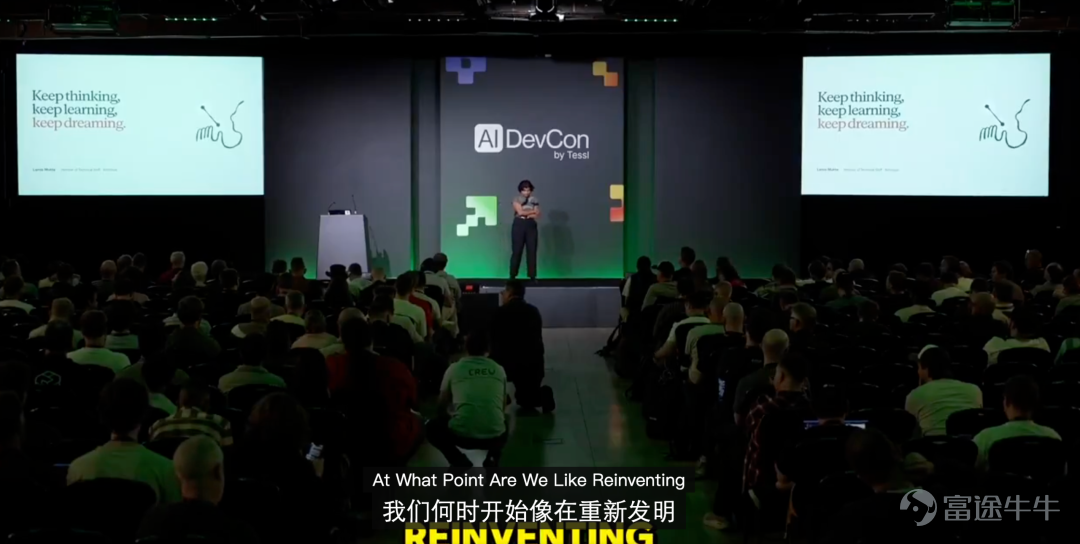
Anthropic engineer Lamis shared an internal method at the London AI Native DevCon that makes AI smarter with use. Article author, source: New Intelligence Source   Memory ultimately became a folder Lamis opened with a big move:Intelligence alone does not generate compounding returns.  Even the most powerful model, straight out of the box, doesn’t know what constitutes success within your organization. Someone has to feed it that knowledge—and ensure it remembers.  Over the past year, Anthropic has been figuring out how to feed it, iterating through four generations of approaches.  The first generation was CLAUDE.md.A markdown file readable by humans and writable by agents, placed at the start of each session—it worked 'unreasonably well,' but grew longer and longer over time.  The second generation consists of memory tools.Just delegate control outright: let the agent itself decide when to read, when to write, and when to update.  The third generation is Skills, whose core concept is called progressive disclosure.  Lamis used a bookshelf as a metaphor: if someone speaks to me in French, I pull out my French dictionary to respond—there's no need to memorize seven years' worth of French lessons in advance. Similarly, an agent only reads the few sentences at the top of a file to decide whether to load it, but the skill itself can contain arbitrarily deep details.  The fourth generation—and their current approach—is to build memory directly into a file system.The reasoning is simple—age...
Let the AI dream: the principal grading every student’s exam papers late at night
All of the above is done by the agent casually while working. But there are two ceilings here.
First is distraction—You’re asking it to complete tasks while simultaneously spending computational resources writing documentation.
Second is limited visibility—It can only see what happens within the current session. You watch helplessly as it repeats the same mistake over and over, but it has no awareness of it.
Because each session is a blank slate for it—the mistakes from last time simply don’t exist. Multiple agents running separately in different environments have no visibility into the pitfalls each other has encountered.
In short: writing memory shouldn’t compete with doing the actual work, and you shouldn’t make an agent work blindfolded. Someone needs to step back, review everything holistically, and conduct a unified post-mortem afterward.
Thus came 'dreaming'—dreaming.
The approach is simple and direct: once all agents have finished their tasks, spin up a dedicated 'retrospective' agent. Lay out the memory bank and a large batch of historical conversation logs, identify recurring errors, and propose specific revision suggestions—one by one—along with details like 'in which conversations the issue occurred and how many times.' Finally, hand it over to humans for final approval.
Lamis uses a school as an analogy:Students submit exams, teachers grade them, and the principal conducts a holistic review.
Students turn in homework every day, and teachers grade it daily—but no one looks at the big picture. Until the principal spreads out all the exam papers from the entire school and notices that every student got the same geography question wrong. Why? Checking the textbook reveals that this concept was never taught. The principal adds it to the curriculum, and the next day, everyone naturally gets it right.
Sounds like it would cost extra? Lamis says quite the opposite—once the memory bank is clean, agents are more likely to succeed on the first try, make fewer mistakes, and ultimately reduce costs.This is true compounding.
You don’t have to wait for Anthropic to productize this system—you can run it yourself weekly: start a new session, feed this week’s chat logs to the AI, let it pinpoint where you keep getting stuck, and directly add those insights to your CLAUDE.md file.
Anthropic engineer Lamis shared an internal method at the London AI Native DevCon that makes AI smarter with use. Article author, source: New Intelligence Source   Memory ultimately became a folder Lamis opened with a big move:Intelligence alone does not generate compounding returns.  Even the most powerful model, straight out of the box, doesn’t know what constitutes success within your organization. Someone has to feed it that knowledge—and ensure it remembers.  Over the past year, Anthropic has been figuring out how to feed it, iterating through four generations of approaches.  The first generation was CLAUDE.md.A markdown file readable by humans and writable by agents, placed at the start of each session—it worked 'unreasonably well,' but grew longer and longer over time.  The second generation consists of memory tools.Just delegate control outright: let the agent itself decide when to read, when to write, and when to update.  The third generation is Skills, whose core concept is called progressive disclosure.  Lamis used a bookshelf as a metaphor: if someone speaks to me in French, I pull out my French dictionary to respond—there's no need to memorize seven years' worth of French lessons in advance. Similarly, an agent only reads the few sentences at the top of a file to decide whether to load it, but the skill itself can contain arbitrarily deep details.  The fourth generation—and their current approach—is to build memory directly into a file system.The reasoning is simple—age...
The workflow you’re holding is a badly overworked sketch.
Memory manages time: it enables agents to accumulate experience across sessions. The other half she describes manages structure:Within a single task, how exactly should the steps be sequenced?
Accompanying the lecture was also a graph-based workflow guide, whose core idea can be summed up in one sentence:Your workflow is already a graph—it’s just drawn poorly.
Anthropic engineer Lamis shared an internal method at the London AI Native DevCon that makes AI smarter with use. Article author, source: New Intelligence Source   Memory ultimately became a folder Lamis opened with a big move:Intelligence alone does not generate compounding returns.  Even the most powerful model, straight out of the box, doesn’t know what constitutes success within your organization. Someone has to feed it that knowledge—and ensure it remembers.  Over the past year, Anthropic has been figuring out how to feed it, iterating through four generations of approaches.  The first generation was CLAUDE.md.A markdown file readable by humans and writable by agents, placed at the start of each session—it worked 'unreasonably well,' but grew longer and longer over time.  The second generation consists of memory tools.Just delegate control outright: let the agent itself decide when to read, when to write, and when to update.  The third generation is Skills, whose core concept is called progressive disclosure.  Lamis used a bookshelf as a metaphor: if someone speaks to me in French, I pull out my French dictionary to respond—there's no need to memorize seven years' worth of French lessons in advance. Similarly, an agent only reads the few sentences at the top of a file to decide whether to load it, but the skill itself can contain arbitrarily deep details.  The fourth generation—and their current approach—is to build memory directly into a file system.The reasoning is simple—age...
For example, 'research first, then summarize, then draft'—three steps arranged linearly, with each step waiting for the previous one to finish. But does each step really have to wait?
The guide offers a method calledFake Edge Testing:For every arrow in your workflow, ask: Does this step actually use the output of the prior step? Does data truly flow across it? If not, that arrow is fake, and the waiting is entirely wasted.
Anthropic engineer Lamis shared an internal method at the London AI Native DevCon that makes AI smarter with use. Article author, source: New Intelligence Source   Memory ultimately became a folder Lamis opened with a big move:Intelligence alone does not generate compounding returns.  Even the most powerful model, straight out of the box, doesn’t know what constitutes success within your organization. Someone has to feed it that knowledge—and ensure it remembers.  Over the past year, Anthropic has been figuring out how to feed it, iterating through four generations of approaches.  The first generation was CLAUDE.md.A markdown file readable by humans and writable by agents, placed at the start of each session—it worked 'unreasonably well,' but grew longer and longer over time.  The second generation consists of memory tools.Just delegate control outright: let the agent itself decide when to read, when to write, and when to update.  The third generation is Skills, whose core concept is called progressive disclosure.  Lamis used a bookshelf as a metaphor: if someone speaks to me in French, I pull out my French dictionary to respond—there's no need to memorize seven years' worth of French lessons in advance. Similarly, an agent only reads the few sentences at the top of a file to decide whether to load it, but the skill itself can contain arbitrarily deep details.  The fourth generation—and their current approach—is to build memory directly into a file system.The reasoning is simple—age...
After removing fake arrows, the most common resulting shape is calledDiamond: One step completes, then branches into multiple parallel paths that run simultaneously, before converging again at a single point for consolidation.The time you wait is determined by the slowest path, not the sum of several paths.
Anthropic engineer Lamis shared an internal method at the London AI Native DevCon that makes AI smarter with use. Article author, source: New Intelligence Source   Memory ultimately became a folder Lamis opened with a big move:Intelligence alone does not generate compounding returns.  Even the most powerful model, straight out of the box, doesn’t know what constitutes success within your organization. Someone has to feed it that knowledge—and ensure it remembers.  Over the past year, Anthropic has been figuring out how to feed it, iterating through four generations of approaches.  The first generation was CLAUDE.md.A markdown file readable by humans and writable by agents, placed at the start of each session—it worked 'unreasonably well,' but grew longer and longer over time.  The second generation consists of memory tools.Just delegate control outright: let the agent itself decide when to read, when to write, and when to update.  The third generation is Skills, whose core concept is called progressive disclosure.  Lamis used a bookshelf as a metaphor: if someone speaks to me in French, I pull out my French dictionary to respond—there's no need to memorize seven years' worth of French lessons in advance. Similarly, an agent only reads the few sentences at the top of a file to decide whether to load it, but the skill itself can contain arbitrarily deep details.  The fourth generation—and their current approach—is to build memory directly into a file system.The reasoning is simple—age...
But running them simultaneously also carries risk—if one path produces garbage, it can silently contaminate the final output. So before merging, add a quality check: Is this output usable? Only proceed if it passes.
Anthropic engineer Lamis shared an internal method at the London AI Native DevCon that makes AI smarter with use. Article author, source: New Intelligence Source   Memory ultimately became a folder Lamis opened with a big move:Intelligence alone does not generate compounding returns.  Even the most powerful model, straight out of the box, doesn’t know what constitutes success within your organization. Someone has to feed it that knowledge—and ensure it remembers.  Over the past year, Anthropic has been figuring out how to feed it, iterating through four generations of approaches.  The first generation was CLAUDE.md.A markdown file readable by humans and writable by agents, placed at the start of each session—it worked 'unreasonably well,' but grew longer and longer over time.  The second generation consists of memory tools.Just delegate control outright: let the agent itself decide when to read, when to write, and when to update.  The third generation is Skills, whose core concept is called progressive disclosure.  Lamis used a bookshelf as a metaphor: if someone speaks to me in French, I pull out my French dictionary to respond—there's no need to memorize seven years' worth of French lessons in advance. Similarly, an agent only reads the few sentences at the top of a file to decide whether to load it, but the skill itself can contain arbitrarily deep details.  The fourth generation—and their current approach—is to build memory directly into a file system.The reasoning is simple—age...
Why is this considered a turning point?
Prompts have a fundamental flaw:Improvements don’t accumulate.
You fine-tune a prompt until it’s perfect, and it performs brilliantly this time. But with the next task, you start from scratch again. All that effort stays trapped in the chat window—nothing remains the next day.
Diagrams and memory serve the same purpose—to preserve the effort. Diagrams encode structure into files; memory encodes experience into files; dreaming lets the AI fill in the gaps itself.
The human role shifts accordingly: from someone feeding instructions line by line to someone who simply nods or shakes their head the next morning.
Keep thinking, keep learning, and keep dreaming.
Risk Disclaimer: The above content only represents the author's view. It does not represent any position or investment advice of Futu. Futu makes no representation or warranty.Read more
218 Views
Report
Comments
Write a Comment...