
How to make yourself irreplaceable by artificial intelligence—forever
Article author, source: 36kr
Editor’s note: Instead of lamenting on social media about your job being replaced by AI, become an 'unemployable' super individual—use content to turn the tables outside others’ games. This article is adapted from a translation.
Unfortunately, it feels as if all jobs will vanish within the next five seconds.
At least, that’s how it seems if you take too seriously the alarmist voices dominating social media.
You might even adopt an 'anti-AI' ideology as your new identity, shouting 'Screw AI!' to feel like you’re changing the world. Yet in reality, you’ve made no behavioral changes—you haven’t expanded your skill set or adapted to this new world. After all, if you can just stick to the status quo and cry about how victimized you are, why bother making the effort to change?
Artificial intelligence isn’t the threat you imagine it to be.
The real threat remains the same as always:
For your survival and well-being, you depend on everyone but yourself. Your employers and governments have their own survival concerns to address, and when something threatens those interests, their thinking narrows—they quickly move to neutralize the threat. It’s human nature. You can argue they 'should' care about your welfare, but if you blindly trust they’ll take full responsibility, you’re bound to end up profoundly, deeply disappointed.
The momentum behind artificial intelligence is simply too powerful—whining won’t give you control over it.
Posting on social media about how much you hate AI won’t stop your job from being replaced, nor will it halt the constant evolution of the skills required for success.
The purpose of this article is to offer you a new perspective—and a potential solution (one that has existed since ancient times).
I have four points I’d like to share with you, covering wage slavery, becoming a highly autonomous individual, and why none of these ideas will matter unless you fundamentally transform yourself.
At the end of the article, I’ve also prepared a brief exercise with six questions that might just open the door to an entirely new way of living—even if it seems deceptively simple.
I’m not opposed to having a job.
I believe work is a valuable stepping stone for gaining hands-on experience and mastering skills.
But whenever I describe jobs in somewhat harsh terms, some people inevitably jump in saying, “You idiot! I actually love my job!”
That’s great. But I’m not talking to you (and to some extent, I think you’re lying—to avoid confronting your own potential—without even realizing it yourself).
I’m speaking to those who understand the psychology of true happiness and can’t bear the following image: spending over 40 years—roughly one-third of life—doing work they didn’t voluntarily choose, another third mentally exhausted and incapable of doing anything meaningful, and the remaining third asleep…
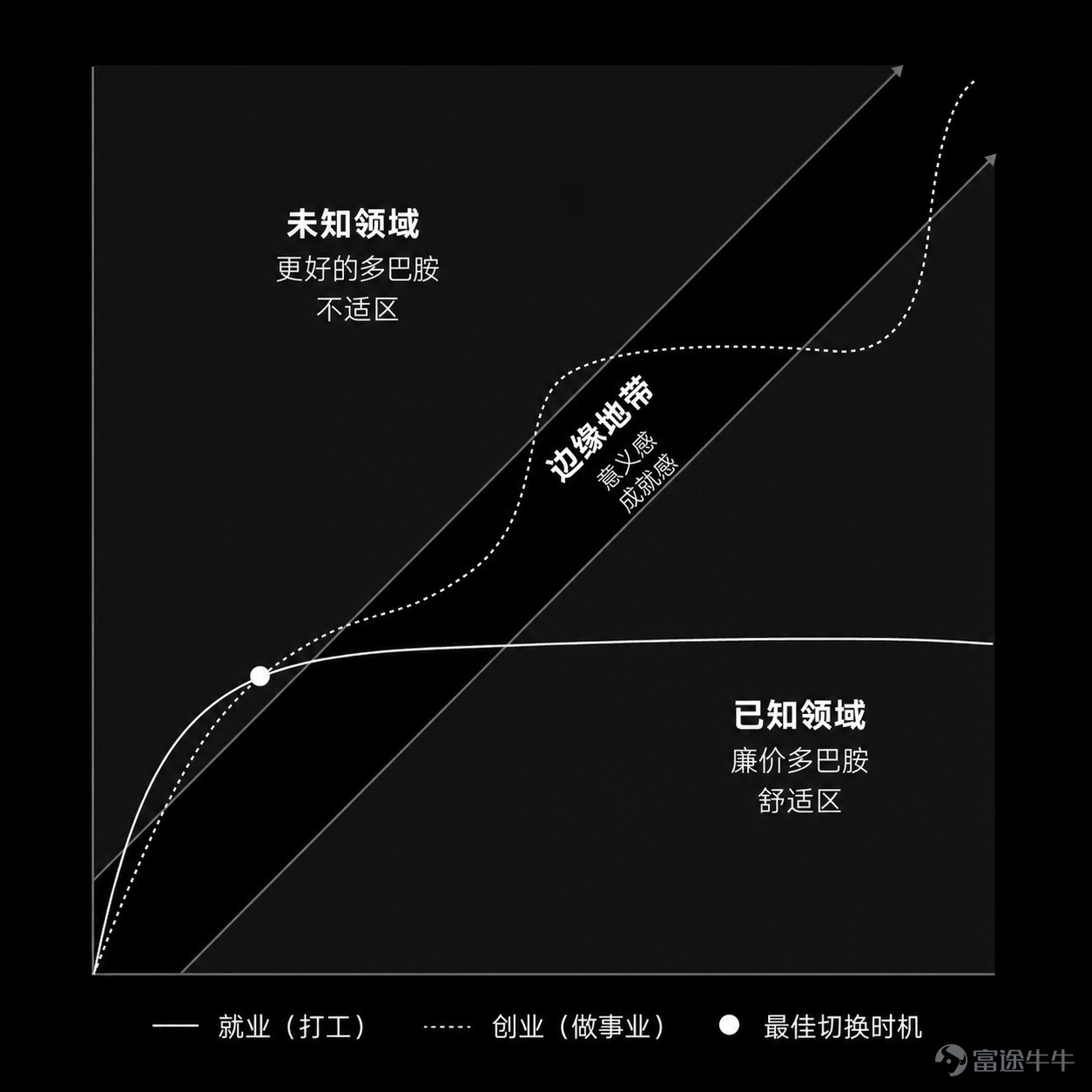
You see, happiness, meaning, and a sense of accomplishment come from pushing the limits of your abilities. This has been thoroughly researched. No, I won’t cite academic papers. Happiness arises from pursuing a challenge just slightly beyond your current skill level—it shouldn’t be so difficult that it causes anxiety, nor so easy that it induces boredom. Video games exploit this principle: the next task is usually calibrated perfectly, because if you send a level-1 character to tackle a level-100 mission, you’ll die instantly and hate the game. This optimal balance is the single biggest driver of entering a flow state. If you can structure your life to increase the likelihood of triggering flow, happiness will follow continuously.
The problem with most jobs is that, after a few months, you’ve already learned everything you need to know. You just clock in, complete tasks, and clock out. Boredom sets in. This goes against your nature—you can feel it. Your attention is no longer immersed in the task; instead, it shifts toward: ‘What else can I do to feel good?’ For most people, that ‘something else’ lacks any meaningful goal. It usually just means picking up your phone and letting your brain shut down. Very few jobs require you to continually develop new skills to meet increasingly complex challenges.
Climbing the corporate ladder might help somewhat, but again, you don’t control the level of challenge. You’re not working on your own projects. Curiosity, passion, a sense of purpose, autonomy, and mastery—the five key drivers of flow—are inevitably missing.
What does this have to do with wage slavery?
One could argue that human civilization was built on tribes enslaving other tribes. That dynamic never disappeared—it simply evolved into employment relationships, laws, and cultural norms. Society has essentially become a Ponzi scheme (a pyramid game). There will always be more people at the bottom than at the top, and mathematically speaking, it’s impossible for everyone to reach the summit. One boss, many employees—the employees depend on the boss just to survive.
Most of us were raised under the indoctrination of industrial-era standards.
Become an expert. Drill deep into one field. Land a high-paying job so my friends will think my son or daughter is successful. Precisely because you followed this path yourself, you remain blind to how most of the system actually works. You mastered only the narrow skill needed to perform your assigned role, never attempting to understand the broader system that pays your salary. You didn’t invest time in other domains, so you don’t know how to build your own business. All you know is how to be a pawn in someone else’s game.
Unbeknownst to you, your capacity for independent thought has been stifled—even if you were once considered 'smart' within the narrow skill you chose. You earn a respectable salary yet feel no financial security, trapping you in a chaotic cycle of stress. Stress narrows your perspective, making it even harder to envision a life where you genuinely create something of your own.
You don’t have the capital to do what you want. You don’t have time to develop yourself. And you’re probably too exhausted—mentally, not physically—to go back to school or retrain, because most of your waking life has been spent building someone else’s vision.
By the way, this is exactly how you survive a massive upheaval: by going all-in on your own venture.
The problem is that slaves don’t realize they’re slaves.
This goes far beyond wage slavery. In some sense, we’re all enslaved—usually trapped within certain ideologies and belief systems.
Slavery is often associated with coercion, and when we hear the word, we think of physical confinement. But wage slavery is financial confinement. If not showing up to work would lead to catastrophe—and you lack any skills to generate alternative income—then regardless of how you might emotionally deny it, you fit the definition of a slave perfectly.
Worse still, if you’ve already fused your identity with your job, you might take this as a direct attack on yourself. You’ll become defensive. You’ll want to argue with me—and that’s fine—but it only further confirms my point.
You get what I’m saying.
It’s terrible. Just thinking about it makes me feel disgusted.
So now let’s talk about what possibilities exist right now—and what you can actually do about it.
Most people spend the majority of their lives being trained to learn things they don’t want to learn, so they can get jobs they don’t care about, working for people they’d never otherwise choose to associate with in daily life.
While I believe artificial intelligence, technology, and social media have accelerated our awareness—helping us realize that school and traditional employment aren’t the only paths forward—I also think people are simply exhausted by the profound emptiness and meaninglessness of the world around them.
For those tired of the conventional path, there are five key elements that can make you indispensable and enable you to do meaningful work—even if every traditional job is automated:
Agency—the ability to 'just go do it' without needing permission. Spotting opportunities and acting decisively, even when no one has asked you to.
Taste—the discernment, built through experience, to know what is truly worth presenting to the world.
Persuasion—the skill of getting people to pay attention to and value what you’re doing, which differs fundamentally from manipulation or coercion.
Persistence—the deep understanding that making mistakes doesn’t equate to failure, and that errors are an essential part of the journey.
Iteration—the process of continuously correcting course based on feedback and moving toward your goal (if something isn’t working, learn from it, pivot, and keep going until you succeed).
Right now, everyone is obsessed with becoming a 'high-agency' individual.
I get it. This is important. You need the ability to proactively initiate actions that move toward a specific goal. This is one of the core distinctions between entrepreneurs and ordinary employees. Entrepreneurs are the people who bring into the world things no one has ever asked for.
But this is just one piece of the entrepreneurial puzzle.
The five elements mentioned above can actually be distilled into two core competencies: problem-solving ability and the experience to know what to do.
— Strauss Zelnick
Now anyone can build anything, which means the barrier to entrepreneurship—the antidote to wage slavery—is continuously lowering. But that actually isn’t that important:

You can go develop an app right now, immediately.
You don’t need to build the next Notion—just a manageable, focused app or tool that genuinely benefits people. Something that doesn’t need to become a massive hit but is still highly valuable.
I actually strongly recommend doing this. I believe software will become the next 'information product.' What I mean is that building software will become the default go-to for creators, solopreneurs, and other one-person businesses. Information products have been so popular for so long precisely because anyone can make them—of course, that doesn’t mean everyone succeeds.
The problem lies precisely in the scene described above (the current situation).
You can build anything, but that doesn’t mean: (1) it’s worth building; (2) people will care; or (3) you have the capacity to iterate based on feedback and persist long enough to turn it into something truly worth building—and that people actually care about.
If you truly internalize this statement, you’ll live very well.
The second issue is that autonomy, taste, persuasiveness, perseverance, and iteration aren’t the kind of typical ‘high-value skills’ you can just pick up by casually watching YouTube videos.
Spouting theories and tweeting incessantly about how to become a highly autonomous individual won’t make you more autonomous.
The only way to practice these qualities is to start building something of your own.
I still remember the day I landed my first web design client.
I recall they paid me $300 for a static website I coded myself—it was hideously ugly. It was for a local mattress company that simply wanted a webpage where people could see their mattresses.
That was it.
$300.
It was right at that moment that I suddenly had a breakthrough. I realized that if I could replicate, improve, and continuously iterate the actions I had just used to earn that money, I could somehow gain greater control over my future lifestyle and destiny. That made me 'unemployable.' It planted a deep-seated belief in my heart: I could never go back to working a regular job—I had to fight for my own survival!
But the figure '$300' alone cannot explain all the preceding factors that led to that pivotal moment—the shift in identity and the self-suggestion from day one that this could actually work. Nor can it encompass everything I’ve learned over the following seven years.
I want to give you two things: a catalyst to kickstart your identity transformation, turning you into someone who genuinely is unwilling—and unable—to be employed, not just someone who merely 'likes the idea'; and an action plan that anyone can execute in their own unique way.
Behavioral change = identity change.
You might try dieting to lose 30 pounds, but unless you fundamentally become someone who deeply values health and genuinely enjoys a healthy lifestyle, you’ll always feel like you’re swimming upstream. Unless you transform your core identity, you’ll eventually regain all the weight you lost, just like most people do.
What should you do?
First, it helps to understand how you became who you are today.
You were born into a family and cultural context with specific values.
You were instilled with these values, even if your parents never explicitly imposed them on you.
You attended a school imbued with certain values and were taught by educators who held their own specific sets of values.
You’ve been exposed to an overwhelming flood of information, which may have subtly pushed your values toward rebellion, laziness, and a victim mentality.
You got a smartphone, and thanks to the amplifying effect of social media—and our primal, inherently impulsive 'monkey brain' that lacks self-control—this subtle conditioning process began accelerating exponentially.
Of course, there’s much more detail to this process, but you get my main point.
In fact, this isn’t necessarily a bad thing—in some ways, it’s essential.
I’ve heard many guys who pride themselves on being their 'true selves' say they deeply dislike imitation or copying others—but they still walk on two feet and speak English, because that’s simply how humans grow up. You have to imitate; that’s called learning.
But when your behaviors start getting in the way of the life you truly desire deep down—that quiet voice inside whispering, 'You’re meant for more than this'—then it becomes a problem.
To begin this process of reconditioning and reshaping yourself, you must first start with your environment.
You must remain acutely aware of every external stimulus, as each one is subtly shaping who you are right now.
What you need to do is:
Cut off the old switch overnight.
When you wake up tomorrow, at least for that day, do nothing that repeats what you’ve done before.
Set your alarm for a completely different time. Precisely plan every step you’ll take after waking up. Eat different food. Talk to different people. Consume different content. Change everything.
As we go deeper, you’ll gradually understand which direction you should deliberately shape your surroundings toward.
The most dangerous way to live is to completely disconnect from continuous trial and error.
Removing yourself from the process of error correction means you’re disconnecting from challenge, from exploration, and from hard-won wisdom—the very wisdom that drives growth and, in turn, brings a sense of achievement.
This applies not only to jobs where tasks quickly become mundane once you master them, but also to business and entrepreneurship—even to those who carry an 'employee mindset' into their ventures: always needing someone to tell them what to do or requiring an employee handbook to move forward with confidence.
I'd like to ask you a question:
Before the internet existed, how did people find their way? Before the era of exhaustive step-by-step tutorials and hand-holding guides, how was the first rocket ever built?
They tried. They faced failure head-on. But they didn’t let failure convince them it was impossible, nor did they let it throw them off course into indulgence in instant gratification. Instead, they adjusted their direction based on real-world feedback—and eventually found that needle in the ocean.
They were wise.
Because a hallmark of an intelligent system is its ability to continuously correct its course based on feedback. They had a lighthouse in their hearts, and when storms blew them off track, they never gave up.
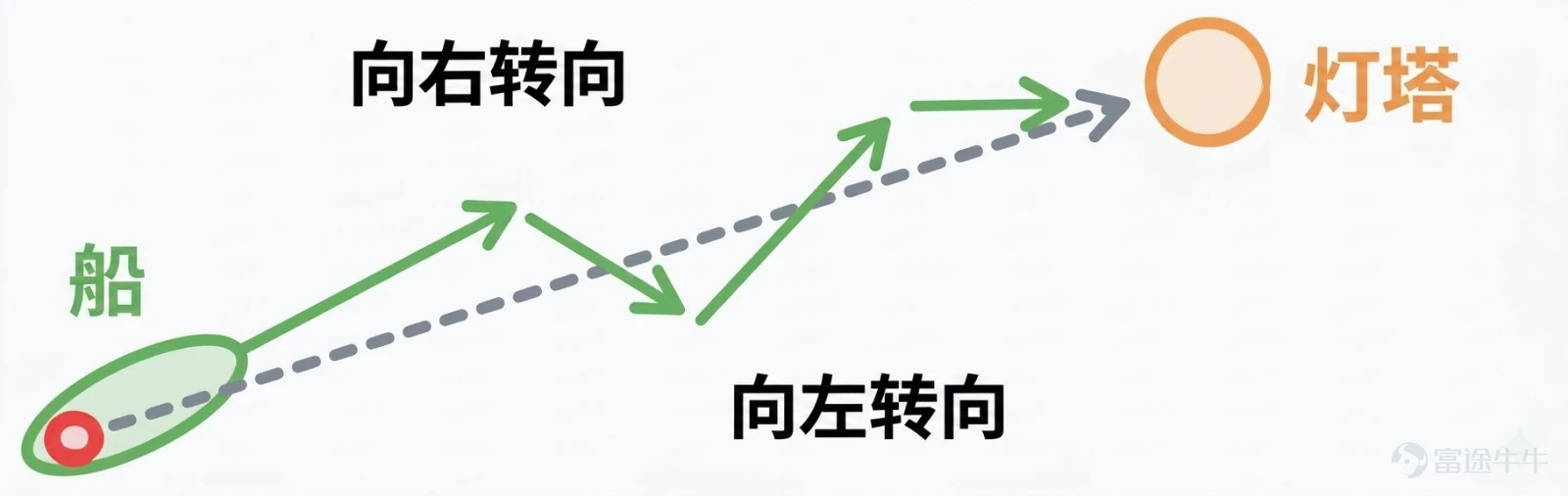
Whenever I talk about entrepreneurship, this is what I truly mean.
I mean returning yourself to the most natural state—immersing yourself in creation and pursuing goals so unknown that they can only be achieved through failure.
This is the one trait common to nearly all successful people.
For them, failure is never a negative concept—it’s an essential, everyday part of a meaningful life.
All of this sounds fantastic—but in today’s world, how exactly do we put it into practice?
— Naval
As a beginner, as an independent individual, you have no idea how much leverage you already hold—especially with the加持 of artificial intelligence.
I’m not talking about low-level AI usage—like casually asking ChatGPT questions as a hobbyist, or artists who get furious because AI 'stole' their work.
I’m referring to a higher-order understanding: realizing you can build almost anything, because AI has thrust you into a flood of rapid iteration and immediate feedback. Of course, most of your initial outputs may be subpar—but if you possess autonomy, understand iteration, persist long enough, and gradually develop taste, you can build nearly anything. And over time, it only gets easier. Then, if you can persuade others, what you’ve built will generate continuous returns for you—even while you sleep.
Of course, all this was possible even before AI existed. The core issue is that most people don’t realize that given enough time and if you possess these five elements of success, anything is achievable. AI simply lets you do more, faster—and grants capabilities you previously couldn’t access, such as software development and an almost superhuman ability to learn and conduct research.
That said, I believe media is more important than code.
And when we talk about media, we really mean content.
A single post, video, podcast, or article you publish can be seen by thousands—or even millions—of people. In my view, this is the most valuable core skill to master, especially at a time when more and more people are trying to rely entirely on AI for all their creative output.
Because when creating content, you must instantly recognize what is truly 'good.'
You still need the aesthetic sense and judgment that artificial intelligence cannot directly give you, because you haven’t yet embarked on your own journey of trial and error. You don’t even know what questions to ask.
The value of content is subjective. Every person who reads any sentence within it will interpret it differently. In other words, there is never just one correct path to achieving results.
By contrast, the value of code is relatively objective. As long as it produces the desired output, how exactly you write it matters far less. As we’ve seen earlier, the number of mobile gaming apps has reached an all-time high, yet their downloads and actual usage rates have declined.
Why?
Because they lack distribution channels. They simply don’t understand media or content. They can’t attract people to use their products, let alone get them to care enough to pay for them.
As JK Molina put it: Likes don’t convert into cash.
Truly smart content creators operate on a far bigger scale than chasing likes and followers by posting clickbait or deliberately inflammatory posts.
Also, you’ve probably already guessed that to successfully shift your identity, you must immerse yourself in environments filled with triggers—people, places, and habits—that strongly align with the life you aspire to. This is also a crucial part of the process.
You have already changed your environment.
You have already chosen your medium.
You understand that media trumps code, because the value of content depends entirely on the audience's subjective perception. This causes AI-generated content to quickly become homogenized and commoditized—precisely because it becomes ubiquitous so fast—thereby creating enormous space for genuinely creative talent to thrive wildly, regardless of whether they use AI or not. Because, let me reiterate, AI itself has never been the problem.
Now, you need to answer the only truly important question:
What is your life’s work?
That is exactly what we are here to build: a life’s work worth dedicating yourself to—not some cold, calculated 'personal brand.'
Peterson, Huberman, Watts—they all have what people call a 'personal brand,' but these brands are deeply aligned with their life missions. They know clearly what they want and treat social media as a tool to achieve their goals. In today’s landscape, this is the most effective technological means for an individual, especially one starting from scratch and leveraging AI, to amplify their impact. Without it, breaking through via television, radio, or traditional publishers would be extremely difficult.
(Of course, Alan Watts never deliberately cultivated a 'personal brand' back in his day, yet one emerged organically around him—so the point still holds completely true.)
Their personal brands are simply their authentic selves, brought to life.
That is their identity.
Most people are deeply drawn to this path, but they quickly hit a wall. They crave instant dopamine hits too much—spending all day searching online for 'the most profitable niche to make six figures from content creation'—instead of digging into the incredibly valuable wealth of experience and stories they’ve accumulated over years. Because these experiences feel so ordinary to them, they mistakenly assume they hold no value.
The raw material you need for your life’s work has long been buried deep within you, obscured over the years by rigid admonitions like 'become a specialist,' 'be more practical,' and 'stop asking so many why questions.' This process of exploration isn’t about injecting you with some wildly novel or eccentric ideas. On the contrary, it’s meant to reveal the treasure you already possess.
Please take this seriously.
Close all browser tabs. Open a blank document. Set a 15-minute timer. Answer the following questions in writing, one by one. Remember: do not skip any question that makes you uncomfortable.
Most of the qualities that make you genuinely interesting have already been stamped out during your upbringing and education. Your curiosity was once dismissed as distraction or lack of focus. Your wide-ranging interests were labeled as signs of poor concentration. After all, that outdated system only needed obedient cogs in the machine.
The only way for your content to truly resonate is if it stems from authentic material that is uniquely yours.
Please answer the following questions. If you don’t have an immediate answer, skip ahead for now—but let the question simmer in your subconscious.
What knowledge do you understand so thoroughly that it couldn’t possibly be accidental? What topic have you researched obsessively for years—even without anyone paying you—reading countless materials and diving deep purely out of passion?
What problem have you solved for yourself that you previously assumed everyone else had already figured out? What comes so naturally to you that it seems effortless, yet consistently trips up everyone around you?
What 'unconventional' thing did you get criticized for as a child that was actually just the early sprout of your unique taste? Before anyone jumped in to tell you 'that’s unrealistic,' what were you deeply obsessed with?
Now, circle one answer—the one that truly makes your heart flutter and sends ripples through your core. That is your foundational raw material.
Don’t worry about operational jargon like niche focus or content pillars. Focus instead on the intrinsic value of your core perspective—because in the end, winning comes down to the depth of your thinking.
The world doesn’t need yet another person repackaging common sense or mindlessly regurgitating clichés. Your content must offer a unique insight that only you can see—and that insight arises precisely from those truths you hold firmly, even though mainstream society gets them wrong.
Taste isn’t about knowing what’s good. It’s about instantly spotting what’s flawed or broken—and being unable to ignore it.
Please answer the following questions:
Which widely accepted pieces of career or life advice have actually thrown your life into chaos? To get back on track and regain your energy, which deeply ingrained beliefs did you have to 'uninstall'?
In your field of expertise, which ideas do you firmly believe in—even if so-called experts might dismiss them as naive—but that you simply cannot abandon?
What is the 'emperor’s new clothes' that everyone in your entire industry silently pretends not to see?
Take the answers you derived from Step One and Step Two and examine them together. Where they intersect and overlap is the direction in which you should move forward at full speed.
Your responses to these questions are precisely the perfect material for your very first post.
The world’s top-tier brands essentially reveal the inner world of a real, living person in its entirety—inviting the public to explore it freely.
This is a long-form piece, but not a comprehensive course covering every possible topic.
I wish I could lay out 20 detailed instructional modules for you here, but I can’t—because that’s what bootcamps are for.
The final element—use it as your official starting point to leave behind dependence on others’ handouts and step into a new era of financial independence—is to actually take action. And taking real action begins with publishing your first post.
Literally, you’ve already written down excellent post material in black and white in the step above.
Pick one.
Spend some time refining how to craft your opening sentence—the hook—to instantly grab attention.
Refine the wording of your main text carefully to maximize its impact and resonance.
Accept openly the fact that your first draft might be truly terrible—remember, you can't improve something that doesn't yet exist.
If you need a bit of help, here’s a quick tip or prompt to spark your brainstorming: switch perspectives and draft several versions so you can develop an intuitive feel for what truly constitutes 'excellent' content. All of these approaches are grounded in methodologies already validated by the market.
Your task is crystal clear.
Pick one answer from Step One and another from Step Two. Seamlessly merge them into a single, uniquely identifiable sentence—one only you could write. Then publish it tomorrow as your debut piece. It could be a post, a short video, or a long-form article. At this stage, the format simply doesn’t matter.
At this point, you’ll finally receive genuine feedback from the real world.
If it doesn’t make even a ripple, that’s great—it means you’ve got gaps to fill. You’ll need to study, analyze, and identify a persuasive strategy to test in your next post, or perhaps the one after that, until you fully master this skill. True mastery, after all, is built by continuously stacking tactical solutions each time you encounter a new challenge.
If you’re the type of person currently thinking, 'I wish this were more practical and actionable,' then you’re seriously mistaken. Because I’ve just handed you, without reservation, the ultimate foundational formula—the universal blueprint for executing and succeeding at anything.
And that complaint that just flashed through your mind is, in fact, a cognitive blind spot you failed to catch and correct in time.
Alright, that’s it for today. We’ll talk again next time.
Translator: boxi.
Risk Disclaimer: The above content only represents the author's view. It does not represent any position or investment advice of Futu. Futu makes no representation or warranty.Read more
Comments
to post a comment
1