
English
Back
Open Account
港股窩輪Jenny
wrote a column · Aug 2 12:38

HSBC hits a record high since listing; the easiest mistake to make isn't misjudging the direction, but choosing the wrong leverage

HSBC $HSBC HOLDINGS (00005.HK)$ On July 31, it rose another 2.25%, breaking above the upper Bollinger Band and setting a new all-time high. Open interest in call warrants increased by 1.10%, while bear warrant open interest has risen for two consecutive days, indicating that the market is both continuing to participate in the uptrend and beginning to position for a potential pullback from elevated levels.
From a technical perspective, HSBC shows no clear signs of weakening:
– Current price: HK$168.2;
– 13-day gain of approximately 8.3%;
– 5-day gain of approximately 5.9%;
– Upside risk-reward ratio: 85.5 points.
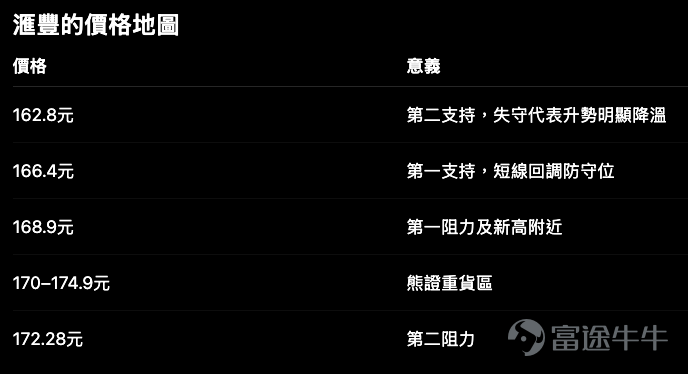
The issue now is that the current price is already approaching the first resistance level at HK$168.9, and the major concentration zone for bear warrants lies between HK$170 and HK$174.9.
Therefore, this is not simply a question of 'bullish or bearish,' but rather:
Even if the outlook remains bullish, should high leverage still be used near new highs?
HSBC $HSBC HOLDINGS (00005.HK)$ On July 31, it rose another 2.25%, breaking above the upper Bollinger Band and setting a new all-time high. Open interest in call warrants increased by 1.10%, while bear warrant open interest has risen for two consecutive days, indicating that the market is both continuing to participate in the uptrend and beginning to position for a potential pullback from elevated levels. From a technical perspective, HSBC shows no clear signs of weakening: – Current price: HK$168.2; – 13-day gain of approximately 8.3%; – 5-day gain of approximately 5.9%; – Upside risk-reward ratio: 85.5 points. The issue now is that the current price is already approaching the first resistance level at HK$168.9, and the major concentration zone for bear warrants lies between HK$170 and HK$174.9. Therefore, this is not simply a question of 'bullish or bearish,' but rather: Even if the outlook remains bullish, should high leverage still be used near new highs? As long as the price holds above HK$166.4, the short-term trend remains strong; however, the closer it gets to HK$170 or higher, the greater the cost of chasing the price and the risk of pullback become. Between the two call warrants: the one with higher leverage actually has a lower premium. 26250 has a deeper-in-the-money strike price, resulting in higher effective gearing and, paradoxically, a lower premium. Judging solely by terms, 26250 offers better efficiency. However, this doesn’t mean 26250 should always be chosen regardless of price level. HSBC is already trading above the upper Bollinger Band; if the share price consolidates around HK$168.9–170, the call warrant will still be eroded by time decay. A more reasonable approach: – If HSBC retests HK$166.4 and...
As long as the price holds above HK$166.4, the short-term trend remains strong; however, the closer it gets to HK$170 or higher, the greater the cost of chasing the price and the risk of pullback become.
Between the two call warrants: the one with higher leverage actually has a lower premium.
HSBC $HSBC HOLDINGS (00005.HK)$ On July 31, it rose another 2.25%, breaking above the upper Bollinger Band and setting a new all-time high. Open interest in call warrants increased by 1.10%, while bear warrant open interest has risen for two consecutive days, indicating that the market is both continuing to participate in the uptrend and beginning to position for a potential pullback from elevated levels. From a technical perspective, HSBC shows no clear signs of weakening: – Current price: HK$168.2; – 13-day gain of approximately 8.3%; – 5-day gain of approximately 5.9%; – Upside risk-reward ratio: 85.5 points. The issue now is that the current price is already approaching the first resistance level at HK$168.9, and the major concentration zone for bear warrants lies between HK$170 and HK$174.9. Therefore, this is not simply a question of 'bullish or bearish,' but rather: Even if the outlook remains bullish, should high leverage still be used near new highs? As long as the price holds above HK$166.4, the short-term trend remains strong; however, the closer it gets to HK$170 or higher, the greater the cost of chasing the price and the risk of pullback become. Between the two call warrants: the one with higher leverage actually has a lower premium. 26250 has a deeper-in-the-money strike price, resulting in higher effective gearing and, paradoxically, a lower premium. Judging solely by terms, 26250 offers better efficiency. However, this doesn’t mean 26250 should always be chosen regardless of price level. HSBC is already trading above the upper Bollinger Band; if the share price consolidates around HK$168.9–170, the call warrant will still be eroded by time decay. A more reasonable approach: – If HSBC retests HK$166.4 and...
26250 has a deeper-in-the-money strike price, resulting in higher effective gearing and, paradoxically, a lower premium. Judging solely by terms, 26250 offers better efficiency.
However, this doesn’t mean 26250 should always be chosen regardless of price level. HSBC is already trading above the upper Bollinger Band; if the share price consolidates around HK$168.9–170, the call warrant will still be eroded by time decay.
A more reasonable approach:
– If HSBC retraces to HK$166.40 and holds steady, consider 26250;
– If HSBC breaks above HK$168.90 and stabilizes there, you may go long using 29048 or 26250, but avoid placing your stop-loss too far away;
– If HSBC falls below HK$166.40, do not continue holding solely because the product has low premium.
Two bull certificates: a 1% difference in buffer is enough to change your holding strategy.
HSBC $HSBC HOLDINGS (00005.HK)$ On July 31, it rose another 2.25%, breaking above the upper Bollinger Band and setting a new all-time high. Open interest in call warrants increased by 1.10%, while bear warrant open interest has risen for two consecutive days, indicating that the market is both continuing to participate in the uptrend and beginning to position for a potential pullback from elevated levels. From a technical perspective, HSBC shows no clear signs of weakening: – Current price: HK$168.2; – 13-day gain of approximately 8.3%; – 5-day gain of approximately 5.9%; – Upside risk-reward ratio: 85.5 points. The issue now is that the current price is already approaching the first resistance level at HK$168.9, and the major concentration zone for bear warrants lies between HK$170 and HK$174.9. Therefore, this is not simply a question of 'bullish or bearish,' but rather: Even if the outlook remains bullish, should high leverage still be used near new highs? As long as the price holds above HK$166.4, the short-term trend remains strong; however, the closer it gets to HK$170 or higher, the greater the cost of chasing the price and the risk of pullback become. Between the two call warrants: the one with higher leverage actually has a lower premium. 26250 has a deeper-in-the-money strike price, resulting in higher effective gearing and, paradoxically, a lower premium. Judging solely by terms, 26250 offers better efficiency. However, this doesn’t mean 26250 should always be chosen regardless of price level. HSBC is already trading above the upper Bollinger Band; if the share price consolidates around HK$168.9–170, the call warrant will still be eroded by time decay. A more reasonable approach: – If HSBC retests HK$166.4 and...
67117 offers higher leverage but a narrower knock-out distance; 67515 has slightly lower leverage but can withstand approximately 1% more downside movement in the underlying stock.
Given that HSBC has reached a new high, a short-term pullback of 2% to 3% is not uncommon. At this stage, rather than chasing an extra multiple of leverage, consider whether the product can withstand a normal correction.
If you plan to trade intraday or over one to two days, 67117 offers higher sensitivity; if you expect to hold longer, 67515 provides a relatively more reasonable buffer.
Being bearish isn't out of the question, but you must first wait for a clear break in the trend.
Representative put warrants:
HSBC Put Warrant 15718
– Strike price: HK$152.88
– Effective leverage of 6.1x
– Implied volatility: 30.23%
– Premium: 14.1%
The strike price is relatively far from the current market price, and the premium is also not low. If HSBC merely pulls back from HK$168 to HK$165, this product may not deliver a direct return.
Representative bear certificates:
HSBC $HSBC HOLDINGS (00005.HK)$ On July 31, it rose another 2.25%, breaking above the upper Bollinger Band and setting a new all-time high. Open interest in call warrants increased by 1.10%, while bear warrant open interest has risen for two consecutive days, indicating that the market is both continuing to participate in the uptrend and beginning to position for a potential pullback from elevated levels. From a technical perspective, HSBC shows no clear signs of weakening: – Current price: HK$168.2; – 13-day gain of approximately 8.3%; – 5-day gain of approximately 5.9%; – Upside risk-reward ratio: 85.5 points. The issue now is that the current price is already approaching the first resistance level at HK$168.9, and the major concentration zone for bear warrants lies between HK$170 and HK$174.9. Therefore, this is not simply a question of 'bullish or bearish,' but rather: Even if the outlook remains bullish, should high leverage still be used near new highs? As long as the price holds above HK$166.4, the short-term trend remains strong; however, the closer it gets to HK$170 or higher, the greater the cost of chasing the price and the risk of pullback become. Between the two call warrants: the one with higher leverage actually has a lower premium. 26250 has a deeper-in-the-money strike price, resulting in higher effective gearing and, paradoxically, a lower premium. Judging solely by terms, 26250 offers better efficiency. However, this doesn’t mean 26250 should always be chosen regardless of price level. HSBC is already trading above the upper Bollinger Band; if the share price consolidates around HK$168.9–170, the call warrant will still be eroded by time decay. A more reasonable approach: – If HSBC retests HK$166.4 and...
Neither of the two bear certificates is positioned too close to the current price, and their call prices are above the heavily concentrated bear certificate zone of HK$170–174.9. However, HSBC remains in an uptrend making new highs, so buying bear certificates would be going against the trend.
A bearish outlook requires at least one of the following conditions:
– HSBC repeatedly fails to break above HK$170–172;
– HSBC breaks below HK$166.4.
Falling below HK$162.8 confirms a clear weakening of the short-term uptrend.
Until these conditions appear, bear warrants are only suitable for very short-term trades near resistance zones and should not be held for extended periods simply because the underlying asset has risen significantly.
Call warrants or bull warrants?
HSBC $HSBC HOLDINGS (00005.HK)$ On July 31, it rose another 2.25%, breaking above the upper Bollinger Band and setting a new all-time high. Open interest in call warrants increased by 1.10%, while bear warrant open interest has risen for two consecutive days, indicating that the market is both continuing to participate in the uptrend and beginning to position for a potential pullback from elevated levels. From a technical perspective, HSBC shows no clear signs of weakening: – Current price: HK$168.2; – 13-day gain of approximately 8.3%; – 5-day gain of approximately 5.9%; – Upside risk-reward ratio: 85.5 points. The issue now is that the current price is already approaching the first resistance level at HK$168.9, and the major concentration zone for bear warrants lies between HK$170 and HK$174.9. Therefore, this is not simply a question of 'bullish or bearish,' but rather: Even if the outlook remains bullish, should high leverage still be used near new highs? As long as the price holds above HK$166.4, the short-term trend remains strong; however, the closer it gets to HK$170 or higher, the greater the cost of chasing the price and the risk of pullback become. Between the two call warrants: the one with higher leverage actually has a lower premium. 26250 has a deeper-in-the-money strike price, resulting in higher effective gearing and, paradoxically, a lower premium. Judging solely by terms, 26250 offers better efficiency. However, this doesn’t mean 26250 should always be chosen regardless of price level. HSBC is already trading above the upper Bollinger Band; if the share price consolidates around HK$168.9–170, the call warrant will still be eroded by time decay. A more reasonable approach: – If HSBC retests HK$166.4 and...
Key points to remember
HSBC's biggest current risk is not a sudden shift from strength to weakness in trend, but rather using excessively aggressive leverage near new highs.
Being right on direction only completes half the judgment. The other half involves: whether your entry point is close to resistance, whether your product can withstand normal pullbacks, and whether you’re willing to exit when the trade proves invalid.
Risk Disclaimer: The above content only represents the author's view. It does not represent any position or investment advice of Futu. Futu makes no representation or warranty.Read more
Thumbs Up
1
14K Views
Report
Comments
Write a Comment...
1
1