
Why does ByteDance insist on spinning off Lark?
(This article was written by Ting Chao TI and published by TMTPost with authorization)
By Tingchao TI | Author: Xu Wenwen | Editor: Zhang Xiao
Feishu is undergoing a significant identity transformation.
On July 30, ByteDance initiated a new round of organizational restructuring focused on its AI business, splitting the Feishu team into two parts and integrating them with the Doubao and Volcano Engine teams, respectively.
Specifically:
The Feishu product team has been merged with the Doubao product team to form a new Doubao product team; meanwhile, Feishu’s GTM (Go-to-Market—covering marketing, sales, and customer service) team has been integrated with the Volcano Engine team to create a new To B organization called the 'Creativity Service Platform,' which will oversee market, sales, and customer service operations for ByteDance’s MaaS and SaaS cloud services.
ByteDance stated that following this reorganization, Feishu’s existing products and services will remain unchanged, and Feishu will also engage in deeper product collaboration with Doubao in productivity scenarios.
From the perspective of ByteDance’s organizational structure, Feishu has been downgraded.
After the company’s structural overhaul at the end of 2021, Feishu was positioned as one of six major business units (BUs), operating on equal footing with TikTok and Volcano Engine, with CEO Xie Xin reporting directly to Liang Rubo. However, after this latest round of adjustments, Xie Xin now reports to Zhao Qi, head of the newly formed Doubao product team.
But this doesn't mean Feishu has become unimportant.For ByteDance today, Doubao—which functions as both a model and a product and serves as nearly the sole AI-facing platform—has long been its top priority. Splitting off Feishu is essentially in service of Doubao and ByteDance's broader B2B strategy.
According to media reports, 'Doubao Enterprise Edition,' deeply co-developed by the Feishu product team, has already entered internal testing among Feishu clients. It offers general-purpose AI productivity tools and natively inherits Feishu’s ecosystem.
Viewed from this perspective, ByteDance’s latest reorganization is also a critical move to regain control of the AI-powered workplace entry point.
To understand why ByteDance felt it had no choice but to split Feishu, we first need to assess where the AI-powered workplace sector currently stands.
The first phase of AI in the workplace was the 'plugin era'—essentially using AI to patch legacy software.
After Microsoft embedded Copilot into its entire Office suite in 2023, AI implementation in workplace scenarios increasingly took the form of sidebars and dialog boxes layered onto Word and Excel to help users draft documents and create spreadsheets.
In the period that followed, domestic vendors quickly followed suit. For example, DingTalk integrated Tongyi Qianwen, allowing users to summon AI with a simple slash ('/'); Feishu launched 'Feishu Smart Partner'; and WPS introduced WPS AI.
At this stage, AI is a new feature within office software—a new button added to the menu bar. The product logic hasn't changed; only the feature list has grown longer.
This practice of 'adding AI' to products, in some ways, continued all the way into 2025.
Focusing specifically on the domestic market, the so-called 'big three' in collaborative office platforms—DingTalk, WeCom, and Feishu—were still largely concentrating their efforts at the product level, cautiously avoiding direct confrontation.
For example, in July, DingTalk launched AI-powered spreadsheets, and Feishu responded within 24 hours by upgrading its multidimensional tables—boosting single-table capacity from one million rows to ten million—and CEO Xie Xin publicly declared they were '12 months ahead of DingTalk,' while also announcing that multidimensional tables would now be available on DingTalk and WeCom, putting its rivals in an awkward position where accepting or rejecting the move was equally uncomfortable.
A month later, Wu Zhao, who had recently returned to lead DingTalk, unveiled DingTalk 8.0, introducing more than 10 AI products at once—including DingTalk ONE, AI Search & Ask, and AI Meeting Notes—dubbing it 'AI DingTalk 1.0' and vowing to 'rebuild DingTalk from scratch with a zero-based mindset.' In the same month, WeCom 5.0 rolled out three major AI features: intelligent search, intelligent summarization, and intelligent bots.
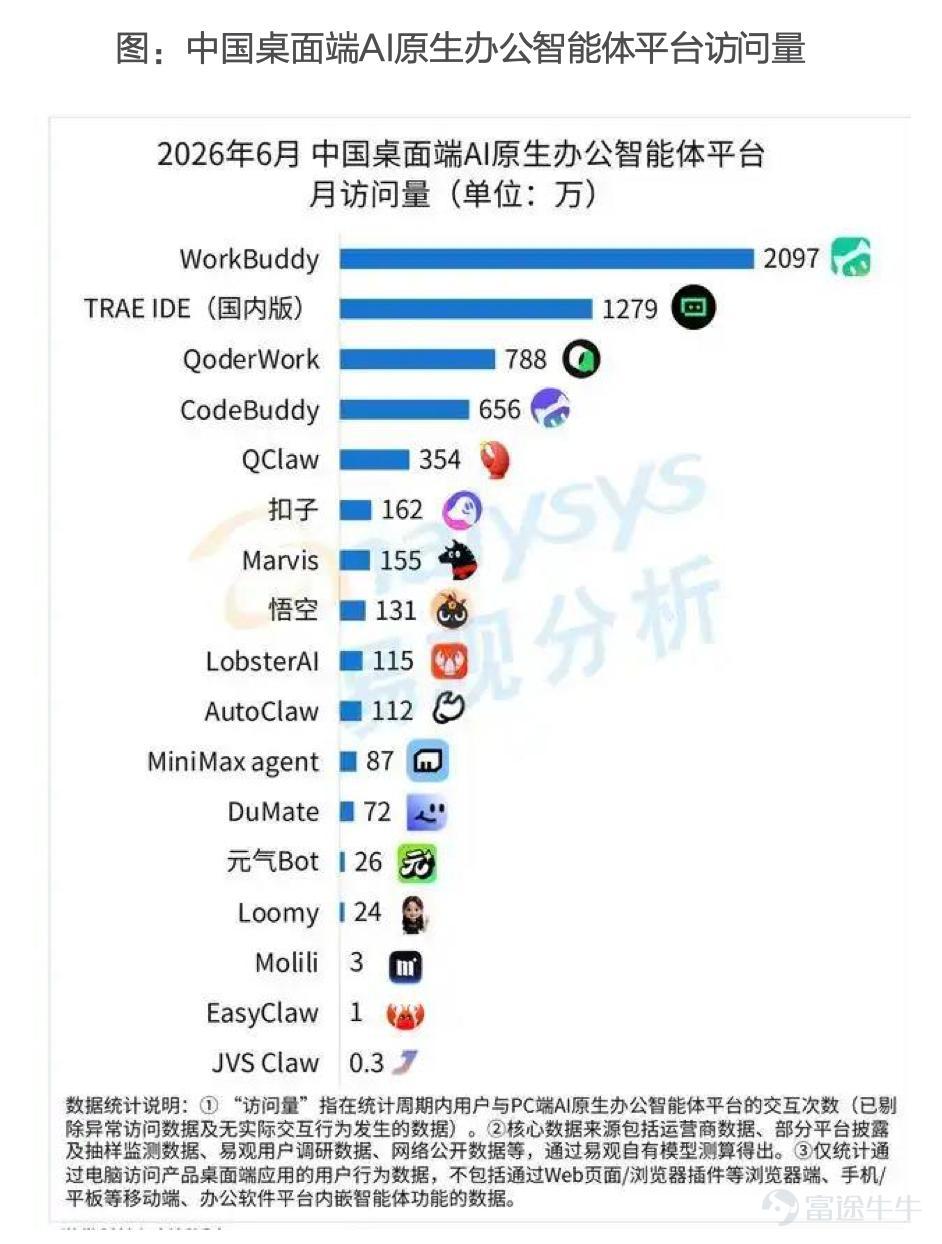
But by 2026, as large models gained the ability to evolve from simple search and chat functions to actual task execution and delivery, office scenarios quickly became a critical avenue for AI implementation and monetization.In a research report, CICC noted that enterprise office applications are expected to break away from previous patterns of low-frequency, lightweight, and exploratory interactions, shifting instead toward high-frequency and automated interaction models.

Figure/Tianfeng Securities
Industry consensus is also accelerating.
‘AI-powered office work unfolds in two phases. In the Copilot mode, although AI can save time and improve efficiency, users still need to manually perform tasks like adjusting formatting or sending emails. But in the AI-native phase, intelligent agents will deliver entire projects end-to-end,’ said Chen Yussen, Trusted CEO of DingTalk.
Zhang Qingyuan, CEO of Kingsoft Office, recently stated, 'In the future, only AI-native software will survive.'
Against this backdrop, the essence of the AI-powered office segment has clearly shifted—AI is no longer just a feature within an office suite; rather, office software must now serve as the foundational layer for AI capabilities. Documents, spreadsheets, meetings, and group chats are all tools for AI to invoke and contexts for it to process data. The entry point belongs to AI, while the suite becomes the infrastructure.
When the stakes of competition escalate from 'who has more features' to 'who owns the entry point,' incremental product tweaks are no longer sufficient.
This explains why, over the past six months, companies from Tencent to Alibaba and ByteDance have essentially been reorganizing resources and realigning their strategies around AI-powered office solutions.
In March, Tencent disbanded its AI Lab, which had operated for nearly a decade, integrating its research teams into the HunYuan system. On July 23, it further announced the merger of its HunYuan multimodal model division and large language model division into a single foundational model division, to be led uniformly by Chief AI Scientist Yao Shunyu. On the product side, QClaw was integrated into the desktop office assistant WorkBuddy ecosystem.
Alibaba has acted even more frequently—launching the Alibaba Token Hub in March, directly overseen by Eddie Wu, consolidating businesses such as models, MaaS, Qwen, and Wukong into a single business unit. In June, Wu Zhaowei stepped down as CEO of DingTalk, succeeded by Chen Yushen. In July, Alibaba further integrated three agent products—QoderWork, Wukong, and MuleRun—into an upgraded enterprise productivity solution branded 'Qwen Office,' also placed under Chen Yushen’s leadership.
ByteDance’s recent adjustments to Feishu are, to some extent, also an adaptation to this evolving competitive landscape.
Over the past few years, Feishu has been widely regarded as one of China’s most product-innovative office software platforms. It aimed to differentiate itself from traditional office suites by redesigning enterprise collaboration workflows.
However, competition in the enterprise market differs significantly from that in consumer internet—superior product experience does not necessarily translate into rapid growth. Enterprise customers care not only about whether a product is cutting-edge but also about ecosystem support, service capabilities, security frameworks, and long-term operational sustainability.
AI has given Feishu a new competitive variable, but it also presents longer-term challenges.
If Feishu previously sought to prove that 'new ways of collaboration can transform enterprise workflows,' it now faces a new wave of opportunities brought by AI agents and must demonstrate that 'AI can redefine enterprise productivity.'
As a consumer-facing AI assistant, Doubao has delivered impressive results. According to QuestMobile data, in June 2026, Doubao reached 382 million monthly active users, up 172.1% year-over-year, forming the leading tier of native AI applications alongside Qwen (167 million) and DeepSeek (130 million). Tencent’s Yuanbao ranked fourth with 48.84 million monthly active users.
However, success in monthly active users masks underlying anxieties around monetization.
Consumer-facing AI assistants remain a business that garners praise but struggles to generate revenue. Free users drive scale, while paid subscriptions contribute minimally. Doubao Pro offers monthly subscription tiers ranging from tens to hundreds of yuan—a revenue stream too small for a company of ByteDance’s scale to justify its massive AI investments.
The real money for large models lies in the enterprise market. According to data disclosed by ByteDance, based on average consumption in July, its large model business has already achieved an annualized recurring revenue (ARR) run rate of USD 4 billion—exceeding the combined total of all other domestic model companies.
Moreover, as of June this year, Doubao’s large model surpassed 180 trillion tokens in daily average usage. IDC data also shows that VolcEngine leads China’s public cloud MaaS market with a 49.5% share.
Overall, Doubao has become ByteDance’s primary AI outlet. However, on the consumer side, it currently offers only 'chat' functionality and lacks high-frequency, high-value, sticky productivity scenarios. Doubao Pro represents ByteDance’s attempt to address this gap, though its long-term viability remains to be seen.
By contrast, enterprise workplace software is precisely the ideal landing zone for AI—documents, spreadsheets, meetings, group chats, and knowledge bases are not only where enterprises accumulate the densest data but also where large model capabilities most readily translate into willingness to pay. Companies won’t pay for casual conversation, but they will pay for an automatically generated report or a fully automated workflow.
An industry insider previously told Caixin that AI-powered office tools can directly enhance efficiency across supply chain management, data analytics, and marketing operations. Moreover, from enterprises and teams down to individuals, AI delivers incremental value, resulting in stronger corporate willingness to adopt and pay for such solutions.
The missing piece in Doubao’s puzzle is precisely what Feishu already holds.
Integrating Feishu’s product team into Doubao and having Feishu’s original team deeply involved in developing Doubao Enterprise Edition essentially moves Doubao from a 'chat box' into 'workflows'—Doubao Enterprise Edition natively integrates with the Feishu ecosystem, enabling seamless connectivity across documents, spreadsheets, meetings, and group chats without additional deployment, and supports Q&A and content creation based on enterprises’ proprietary knowledge bases.
Of course, from Feishu’s perspective, the answer is equally clear: Feishu needs growth.
Feishu’s product reputation is widely acknowledged as the best among the three major collaborative office platforms, yet its commercialization challenges have persisted for a long time.
In March 2024, Xie Xin announced in an all-hands letter that the company would downsize by approximately 20%, stating candidly that 'our team is relatively large, but our organization isn’t lean enough, and efficiency is declining—we need to return to Day 1 startup mode.'
More troubling than losses is the fact that collaborative office software operates in a classic 'slow market.' Feishu’s strong product reputation alone struggles to win over more clients—especially to poach them from WeCom and DingTalk. WeCom leverages the connectivity of WeChat’s 750 million daily active users, while DingTalk benefits from Alibaba’s full-stack ecosystem of cloud computing, AI models, and e-commerce. Feishu, relying solely on product strength for a single-point breakthrough, faces an uphill battle.
Although Feishu’s situation has improved over the past two years—with high-profile companies like Seres, Unitree, and Luckin Coffee migrating from other platforms—what now determines Feishu’s fate is no longer about winning a few more clients, but about AI.
In other words, Feishu’s second growth curve doesn’t lie within 'Feishu' itself—it lies in AI.
Viewed in this light, Feishu’s current restructuring shouldn’t be simplistically labeled a 'demotion.' At the end of 2021, ByteDance designated Feishu as one of its six business units (BUs), giving it the chance to 'operate independently' and prove that ByteDance could succeed in B2B beyond consumer internet. By 2026, ByteDance is integrating Feishu into Doubao and Volcano Engine, effectively placing it within the 'main combat force.'
The consolidation of go-to-market (GTM) functions represents the other half of the same strategic logic. Volcano Engine, which commands nearly half of the public cloud MaaS market share, will now centrally manage ByteDance’s MaaS and SaaS marketing, sales, and customer service—avoiding redundant B2B sales infrastructure and presenting a unified client-facing interface spanning 'compute power–models–applications.'
Liang Rubo previously stated, 'Scaling the heights of AI is ByteDance’s most important priority right now.' As the entire company concentrates its resources on this single focal point—AI—the existence of Lark as an independent business unit has instead become a source of coordination overhead.
AI is reopening the imagination around productivity software, but for Lark, this is not merely an organizational reshuffle—it’s a fundamental revalidation of its business model.
Over the past few years, Lark has demonstrated its ability to build a productivity suite with a leading user experience. From online documents and multidimensional tables to knowledge bases and project management, Lark has continually sought to reimagine enterprise collaboration. It aims to solve the long-standing problem of information fragmentation in traditional office software by integrating communication, content, workflows, and organizational management into a single platform.
However, in the enterprise market, competition ultimately hinges on more than just product capabilities.
In the past, Lark had to answer the question: Why should enterprises choose a new office tool? But in the AI era, the question has shifted to: Why do enterprises need an AI-powered office platform?
The underlying business logic behind these two questions is entirely different.
The emergence of large models has indeed lowered the technical barrier for enterprises adopting AI. Previously, companies needed to invest heavily in building digital systems to achieve data management and process optimization; now, with large models, they can quickly gain capabilities such as intelligent Q&A, knowledge retrieval, and content generation.
However, AI has not altered the fundamental logic behind enterprise software procurement.
For individual users, a sufficiently powerful AI assistant may be compelling enough on its own. But for enterprises, purchasing decisions have never been driven solely by a single feature—they are determined by system reliability, data security, organizational permissions, industry-specific adaptability, and long-term service capabilities.
In other words, AI can redefine the capability boundaries of office software, but it cannot replace enterprise services themselves.
Microsoft has been able to rapidly advancethe commercialization of Copilot—not merely because of its access to OpenAI’s model capabilities, but more importantly because it already possesses decades of accumulated Office ecosystem strength, enterprise customer relationships, and a global sales infrastructure. Large models have amplified Microsoft’s existing advantages rather than creating an entirely new business system from scratch.
The same holds true for ByteDance and Feishu.

Doubao can provide model capabilities, but turning that capability into products enterprises are willing to pay for still requires Feishu to build out much more.
Over the past few years, a core challenge Feishu has faced is the gap between product value and commercial value. The market acknowledges Feishu’s product philosophy and its innovations in collaborative user experience, but whether enterprises are willing to overhaul their existing office systems for such innovations—and continue paying for them—is another matter entirely.
AI presents Feishu with its biggest opportunity yet. At the same time, it also introduces a new set of challenges that must be addressed.
ByteDance has historically excelled at product innovation and user growth in the consumer internet space, but the enterprise market demands a different set of capabilities—understanding industry-specific needs, building a sales infrastructure, delivering long-term services, and accompanying clients through their digital transformation journeys.
This is also why companies like Alibaba and Tencent have established strong moats in the enterprise market. DingTalk leverages Alibaba Cloud and Alibaba’s broader enterprise service ecosystem, while WeCom benefits from the WeChat ecosystem. Their entry into the enterprise market fundamentally relies on pre-existing infrastructure.
ByteDance, by contrast, needs to build an entirely new enterprise AI infrastructure from the ground up.
From this perspective, the spin-off of Feishu essentially reflects ByteDance’s desire to give Feishu a clearer commercial positioning, enabling it to compete more like a dedicated enterprise software company.
What it needs to demonstrate is not just that it can build an excellent product, but that it can establish a new business model centered around AI.
In the coming years, competition in the office software market will no longer be limited to software companies alone—it will evolve into a contest among large AI model providers, cloud service providers, and enterprise ecosystem players.
For ByteDance, Doubao needs Feishu to unlock the enterprise market; for Feishu, Doubao offers an opportunity to redefine its own value proposition.
Ultimately, victory will not be determined by who has the larger model, but by who can truly integrate AI into enterprises’ daily workflows.
In the past, Feishu sought to prove that better office software could transform enterprise collaboration. Now, it must demonstrate that AI can transform enterprise productivity—a question ByteDance must truly answer following Feishu’s spin-off.
Risk Disclaimer: The above content only represents the author's view. It does not represent any position or investment advice of Futu. Futu makes no representation or warranty.Read more
Comments
to post a comment