
Cyclical or growth stock? Coinbase's Q2 earnings reveal a 'valuation divergence'
Author: Golem, Odaily Planet Daily
On July 31, Coinbase released its Q2 2026 earnings report. In a post on X, Coinbase CEO Brian Armstrong summarized the quarter by saying, 'Although market conditions were extremely challenging in Q2, Coinbase continued to make steady progress amid various headwinds,' highlighting key achievements such as over 90% of custodied stablecoin trading volume being concentrated on Base; crypto trading market share reaching a record high of 10.3%; and prediction market revenue doubling, up 106% quarter-over-quarter.
As usual, Coinbase emphasized the positives while downplaying the negatives—a consistent pattern for the company—but the market isn’t playing along: Coinbase’s Q2 2026 revenue still fell short of expectations.
According to its financial report, Coinbase reported total revenue of $1.22 billion for Q2 2026, down 19% year-over-year and 14% quarter-over-quarter, missing market expectations of $1.29 billion. Trading revenue came in at $599 million, also below the expected $628 million. The company posted a net loss of $359 million, marking its third consecutive quarter of net losses.(Odaily Note: Net loss was $666.7 million in Q4 2025 and $394.1 million in Q1 2026.)。
Following this news, Coinbase (NASDAQ: COIN) fell more than 5% in after-hours trading.
During the Q2 earnings call, Coinbase notably avoided explaining the reasons behind this quarter's net loss, instead sidestepping key issues and focusing on questions unrelated to its crypto brokerage business. In Q1 2026, Coinbase attributed its losses to weak crypto market conditions and impairment charges on crypto assets, butOdaily Planet previously analyzed that the root cause of its net losses is persistent user attrition and a sharp decline in crypto trading revenue.(Related reading:Q1 Net Loss of $394.1 Million Leaves Coinbase Clinging to Circle for Support)
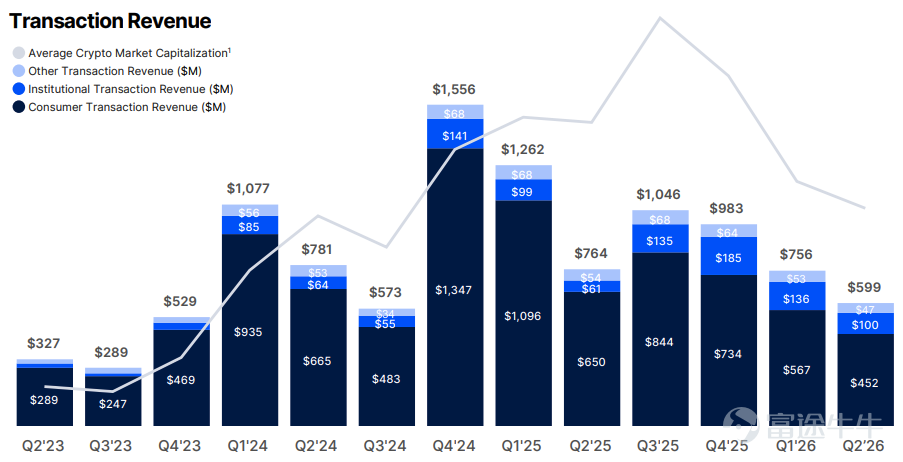
By Q2, the situation had not improved, with trading revenue continuing to decline. According to the earnings report, Coinbase’s total Q2 trading revenue amounted to $599 million, of which retail trading—the largest segment—contributed $452 million, down 30% year-over-year and 20% quarter-over-quarter, effectively reverting to 2023 revenue levels. The report also disclosed a 24% decline in retail spot cryptocurrency trading volume.

Coinbase Q2 2026 Trading Revenue
Even amid such dismal conditions, trading revenue from retail investors remained Coinbase’s largest revenue source this quarter, followed by stablecoin-related revenue, which reached USD 292 million.Given that the earnings report disclosed Coinbase’s crypto trading market share hit a record high of 10.3% in Q2, why is its trading revenue still sharply declining? Could it be, as some analysts suggest, that users haven’t left—but rather, weak crypto market conditions have dampened retail trading activity?
The truth, however, is that Coinbase played a bit of wordplay here. According to Coinbase’s methodology, this figure includes not only spot crypto trading but also newer products like derivatives trading, prediction markets, and tokenized stocks. Thus, the increase in Coinbase’s crypto trading market share—from 9.1% in Q1 to 10.3% now—was almost entirely driven by these new businesses.

Quarterly change in Coinbase’s crypto trading market share
According to the earnings report, growth in prediction markets has partially offset the revenue impact from declining retail spot crypto trading volumes. However, even though prediction market revenue more than doubled quarter-over-quarter compared to Q1, annualized revenue from this segment amounts to only USD 100 million—implying actual quarterly revenue may be less than USD 30 million. Therefore, its ability to offset lost retail trading revenue is nothing more than a drop in the bucket.
In summary, spot crypto trading remains the cornerstone of Coinbase’s revenue. Although Coinbase is aggressively expanding into other businesses to build its so-called 'exchange for everything' and has achieved some growth, the pace and scale of this growth have failed to satisfy the market and investors. In established markets such as prediction markets, crypto derivatives, and tokenized stock trading, Coinbase—as a newcomer—faces limited competitive advantage. Prospects for achieving substantial financial turnaround through these new businesses currently appear dim.
However, Coinbase’s current valuation ultimately depends on whether it is viewed as a cyclical stock or a growth stock.
If treated as a cyclical stock, Coinbase’s revenue is indeed constrained by the current crypto bear market cycle. Its new businesses have not yet freed it from this cyclicality, and user attrition along with declining competitiveness among exchanges are clear and present challenges.
From this perspective, the decline in Coinbase’s share price is justified. In fact, everything Coinbase is doing now seems aimed at surviving until the next bull market cycle. During the earnings call, Brian Armstrong stated, 'I believe Bitcoin will make a strong comeback—it has always gone through cycles like this, with prices inevitably rising and falling. But we must have a diversified revenue strategy; that’s core to how we operate an exchange.' The unspoken message is clear: once the bull market returns, everything will fall into place.
If Coinbase is viewed as a future growth stock, it may currently be undervalued.。
Starting with its revenue composition, although Coinbase has not yet achieved revenue diversification and crypto spot trading remains its primary source of revenue, signs of diversification are already emerging. According to its financial report, Coinbase’s revenue has already decoupled from Bitcoin transaction fees: 88% of its net revenue now comes from non-Bitcoin spot trading, compared to over 55% in 2020 that came from Bitcoin transaction fees. Additionally, subscription and services revenue this quarter reached $555 million, accounting for 48% of net revenue—nearly on par with transaction revenue of $599 million.

Coinbase’s share of Bitcoin transaction fee revenue versus quarterly subscription and services revenue growth
Moreover, this quarter Coinbase One reached a record high in paid users, with subscription revenue growing to $114 million. Crypto derivatives trading volume in Q2 did not decline but remained roughly flat compared to Q1, reaching $4.221 trillion. Coinbase has acquired Deribit and will soon offer crypto derivatives trading to international users, which could significantly boost market trading volumes.

Therefore, taking a forward-looking perspective, by Q3 2026 or Q1 2027, Coinbase’s total revenue from other businesses may surpass crypto spot trading to become the dominant contributor to its overall revenue. Coinbase’s vision of becoming an 'exchange for everything' does not mean it needs to lead in every segment—such as prediction markets, crypto derivatives, or tokenized equities—and most investors do not expect it to. Simply achieving profitability and diversified revenue streams would already meet expectations.
This is because investors primarily value Coinbase’s future potential in stablecoin operations and agency economics.
During the earnings call, CFO Alesia Haas reiterated that Coinbase’s revenue-sharing agreement with Circle will continue. Stablecoin revenue reached $292 million in Q2 2026, remaining Coinbase’s second-largest revenue stream. Additionally, USDC held across Coinbase’s platforms and products hit a new high, with over 30% of all circulating USDC now stored on Coinbase. The company also disclosed in its earnings report that over the past year, Coinbase captured 50% of USDC’s total economic value, and broader on-chain collaborations and product integrations are expected to further drive USDC adoption.
At the same time, Coinbase does not want to rely solely on USDC and is evolving into a multi-stablecoin platform. Coinbase is one of the founding members of OUSD, and the number of stablecoins supported on its platform continues to grow.
aroundIn terms of on-chain agency economics, Coinbase is a leader in the on-chain agent finance (AIFi) space.According to the earnings report, over 99% of on-chain agency transactions currently use USDC, and more than 90% of agency stablecoin transactions occur on Base, as of Q2 2026. Over 97% of on-chain agent transactions use Coinbase's x402 protocol.
Moreover, Base's leadership position in the agent economy will not be undermined by low-price competition from new market entrants, as it is already sufficiently cost-effective. During the earnings call, Brian Armstrong stated, 'Base settles transactions for less than $0.01, with settlement times under one second. From this perspective, it is highly competitive.'
Although Base’s current leadership in the agent economy has not yet made a significant contribution to Coinbase’s revenue, this segment holds substantial future commercial value. The agent economy is widely recognized as the optimal intersection of blockchain and AI. In the future, the agent economy will require payment settlement systems and identity infrastructure—precisely where Base and the x402 protocol come into play. According to Coinbase’s estimates, by 2030, agents will process $3–5 trillion in agent-related transactions. If Base captures 40% of this market and charges a fee of just one basis point (0.1%), its revenue would reach several billion dollars.
Although Coinbase’s current business situation is far from ideal, its future is not entirely bleak—it ultimately depends on investors’ perspectives and their investment time horizons.
Risk Disclaimer: The above content only represents the author's view. It does not represent any position or investment advice of Futu. Futu makes no representation or warranty.Read more

Comments
to post a comment
1
1