Taiwan Semiconductor's net profit surges nearly 70%! Can the AI boom continue?

Amazon Calculates the 'Three-Year Payback' Equation: After a Deep Correction in AI Infrastructure, Which Key Themes Still Deserve Attention?
Over the past few weeks, the AI infrastructure sector has undergone a sharp correction.
From chips, memory, and optical communications to Neocloud, data centers, and power-related stocks, nearly all high-beta segments have faced valuation compression. The market is starting to worry that tech giants are investing hundreds of billions of dollars into computing capacity, but AI revenue and free cash flow may not materialize at the same pace.
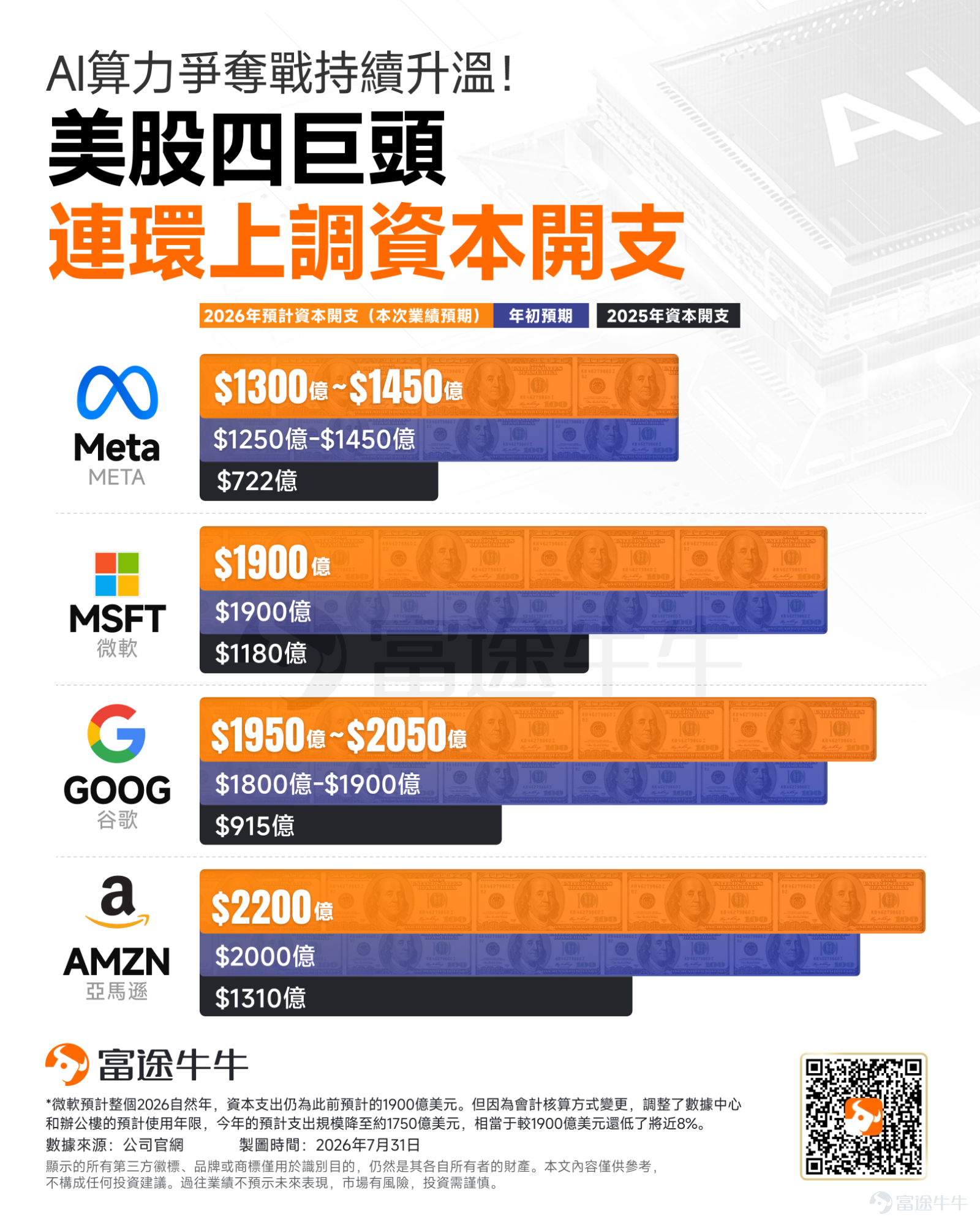
However, in stark contrast to the stock price pullback, capital spending by these tech giants has not slowed down—in fact, it continues to accelerate. According to the latest earnings guidance, $Meta Platforms (META.US)$ 、 $Microsoft (MSFT.US)$ 、 $Alphabet-C (GOOG.US)$ and $Amazon (AMZN.US)$ all four major tech giants have either further raised or maintained elevated capital expenditure forecasts.Using the upper end of their guidance ranges, combined capital expenditures for these four companies in 2026 will approach $750 billion, significantly higher than the approximately $455.8 billion actually spent in 2025.

--
--
--
Even as market sentiment has cooled rapidly, the tech giants’ commitment to investing in AI infrastructure remains fundamentally unchanged. This has made Wall Street’s biggest concern even more acute:How long will it take to recoup such massive AI capital expenditures?
Amazon has provided a very clear accounting—Payback in less than three years.
Amazon breaks down ROIC for the first time: an 'economic calculation' with payback in under three years
$Amazon (AMZN.US)$ It has also, for the first time, systematically outlined its ROIC framework for AI-related capital expenditures.
Management categorized AI infrastructure investments into two asset classes: the first includes servers and networking equipment, with a useful life of approximately 5 to 6 years; the second comprises data centers, land, buildings, and power infrastructure, which can last over 30 years.
Amazon stated that servers and networking equipment achieve breakeven in less than three years on average. This means that after recouping their costs, these assets still have two to three additional years of useful life during which they can generate substantial free cash flow.
Meanwhile, data centers with a lifespan exceeding 30 years can accommodate at least five to six generations of servers. In other words, data centers are not one-time AI investments but long-term assets that can be reused across multiple generations of chips.
Amazon also noted that the profit margins and returns it is seeing in AI are consistent with—and actually slightly ahead of—what it observed in its core business at a comparable stage of development.
This directly addresses the market's most fundamental concern:AI infrastructure faces not only depreciation and cash flow pressures; some investments already have the potential to recoup costs within three years.
Morgan Stanley estimates: AI investments could deliver a potential ROIC of 25% to 50%
Amazon has provided actual operational-level payback periods, while Morgan Stanley has analyzed—from a business model perspective—how tech companies can convert computing power into revenue and profits.
Morgan Stanley forecasts that cumulative capital expenditures by major hyperscale cloud providers could exceed $1.4 trillion, with available computing capacity projected to rise from approximately 30 GW in 2025 to about 120 GW in 2028. Concerns over ROIC stemming from these substantial investments have been a key factor recently weighing on valuations of tech giants and AI infrastructure.
However, Morgan Stanley’s analysis of three GenAI business models shows thatthe potential incremental ROIC for AI infrastructure could reach 25% to 50%.

Source: Morgan Stanley
Model 1: Renting out GPUs, ROIC ~31%
AWS, Azure, and Google Cloud can directly lease GPU computing power. Using a 1 GW GB300 data center as a benchmark, Morgan Stanley estimates that under a base case of 75% utilization and an hourly rental rate of $8.50, the incremental EBIT margin would be approximately 67%, yielding an ROIC of about 31%—broadly consistent with Amazon’s claim of a 'three-year payback.'
Model 2: Building proprietary compute capacity and selling model APIs, ROIC ~46%
Simultaneously controlling computing power, models, and application entry points yields higher returns. Morgan Stanley estimates that model companies offering APIs and AI applications via their own data centers could achieve incremental EBIT margins of 75% and ROIC of approximately 46%. Amazon, Microsoft, Google, and Meta can leverage the same computing infrastructure across cloud services, model APIs, advertising, and enterprise software, enabling multi-layer monetization.
Third scenario: Renting third-party computing power, with ROIC of approximately 25%
Model companies lacking in-house capabilities can rent computing power from hyperscale cloud providers or Neoclouds and resell APIs externally. While this approach avoids upfront capital expenditures, it requires paying for compute rental. Morgan Stanley estimates their incremental EBIT margin at around 30% and ROIC at approximately 25%.
Overall, owning computing power typically delivers higher returns, and platforms that simultaneously control computing power, models, products, and user entry points are better positioned to absorb substantial AI-related capital expenditures.
After a deep pullback, which areas still warrant attention?
Following this round of sharp correction, Morgan Stanley still identifies five key investment themes worth watching. The firm has also created a heatmap of the AI infrastructure supply chain, detailed as follows:

--
--
--
First, cloud giants with scale and monetization capabilities
Morgan Stanley remains bullish on $Meta Platforms (META.US)$ 、 $Alphabet-C (GOOG.US)$ 、 $Microsoft (MSFT.US)$ and $Amazon (AMZN.US)$ 。
not because they are 'spending the most,' but because these companies possess vast user entry points, enterprise customers, ecosystems, and in-house chip development capabilities—giving them greater potential to recoup capital expenditures through advertising, cloud services, enterprise software, and AI agents.
As the market begins questioning AI investment returns, what truly matters isn’t the CapEx figure itself, but whether newly deployed computing power can translate into cloud revenue, ad efficiency, user stickiness, and free cash flow.
Second, identify bottleneck assets related to 'power availability duration'
In AI data center development, the scarcest resource is no longer just land, but secured power capacity, grid interconnection rights, and rapidly deployable energy infrastructure.
Beneficiaries include fuel cells, natural gas turbines, energy storage, backup power solutions, and operators of 'powered shell' facilities—former Bitcoin mining sites repurposed into AI data centers.
Some mining sites already possess land, substations, and grid interconnection capabilities, enabling them to become operational sooner than newly built data centers. This allows $Cipher Digital (CIFR.US)$ 、 $TeraWulf (WULF.US)$ 、 $Hut 8 (HUT.US)$ 、 $Riot Platforms (RIOT.US)$ 、 $Applied Digital (APLD.US)$ and $Galaxy Digital (GLXY.US)$ companies like these to gradually shift from pure Bitcoin-related concepts toward AI infrastructure assets.
However, such companies tend to be highly volatile, with valuations heavily dependent on contract execution, financing costs, and construction timelines—making them unsuitable for investors chasing 'announcement-driven' rallies.
Third, the computing power manufacturing ecosystem remains the core investment theme
As long as computing supply continues to lag behind demand over the long term, semiconductor manufacturing, memory, advanced packaging, semiconductor equipment, PCBs, and optical communications will remain key beneficiaries.
Morgan Stanley closely monitors $NVIDIA (NVDA.US)$ 、 $Broadcom (AVGO.US)$ 、 $Micron Technology (MU.US)$ 、 $Taiwan Semiconductor (TSM.US)$ 、 $Samsung Electronics (005930.KR)$ 、 $SK hynix (SKHY.US)$ 、 $Kioxia Holdings (285A.JP)$ 、 $ASML Holding (ASML.US)$ and $Advantest (6857.JP)$ companies across this supply chain.
Among these, storage remains a segment relatively favored by Morgan Stanley. The research report notes that the data center procurement side has not yet seen a significant easing of storage shortages, and AI-driven demand for HBM, DRAM, and enterprise-grade SSDs could keep supply tight through 2027–2028.
However, this theme requires distinguishing between 'slowing demand' and 'slowing growth rate.' When the market has already priced in overly optimistic valuations, even if orders continue to grow, a decline in the growth slope could trigger a sharp correction.
Fourth, Chinese AI solution providers
The improving competitiveness of Chinese AI models is not only a risk factor for overseas semiconductor stocks but could also act as a valuation catalyst for Chinese AI companies.
Morgan Stanley believes that certain Chinese companies’ advantages in model capabilities, cost efficiency, and localized services have not yet been fully priced in by the market. Representative companies include $Alibaba (BABA.US)$ 、 $TENCENT (00700.HK)$ 、 $SMIC (00981.HK)$ 、 $LENOVO GROUP (00992.HK)$ and $GDS Holdings (GDS.US)$ etc.
The advantage of this theme lies in relatively lower valuations and further upside potential in AI commercialization; risks stem from regulation, chip supply constraints, and further fragmentation of the global AI ecosystem.
Fifth, energy security and power grid equipment
AI is elevating energy demand from a traditional utility concern to a core competitive factor for the tech industry.
Energy storage, power grids, transformers, gas-fired power generation, nuclear power, and data center power management equipment could all benefit from spillover effects of AI-related capital spending. Morgan Stanley mentions representative companies including $Bloom Energy (BE.US)$ 、 $GE Vernova (GEV.US)$、 $Vistra Energy (VST.US)$ and $Talen Energy (TLN.US)$ etc.
Compared with pure-play computing power concepts, these companies have more diversified demand drivers—they benefit not only from AI but also from energy security, grid modernization, and manufacturing reshoring.
Conclusion
Although the 'high investment, slow return' narrative has triggered a deep correction in the AI infrastructure sector, major players have revised their capital expenditure guidance upward, confirming that the sector’s fundamentals remain intact.
Against the backdrop of rising compute demand and persistent bottlenecks in storage and power supply, this round of adjustment is essentially a structural reset driven by valuation compression and portfolio reallocation.
Looking ahead, market performance in this sector will shift from 'broad-based gains' to 'structural differentiation.' Long-term, high-conviction investment opportunities will concentrate in segments with clear resource moats—including chip capacity, advanced storage, grid-connected power, data center assets, and end-user monetization channels.
As the market returns to rationality, investors will place greater emphasis on return on invested capital (ROIC) and cash flow realization. Future alpha will no longer stem from thematic speculation, but from companies’ ability to convert capital expenditures (CapEx) into sustainable commercial profits.
Risk Disclaimer: The above content only represents the author's view. It does not represent any position or investment advice of Futu. Futu makes no representation or warranty.Read more


Comments (7)
to post a comment
108
334