English
Back
Open Account
Options Hub: SpaceX's second wave of lock-up expiration takes effect today! How should options strat

Futubull Options Sir
joined discussion · Jul 31 18:01 ·

Earnings Options Strategy | Under external market pressure, can Circle maintain earnings resilience?

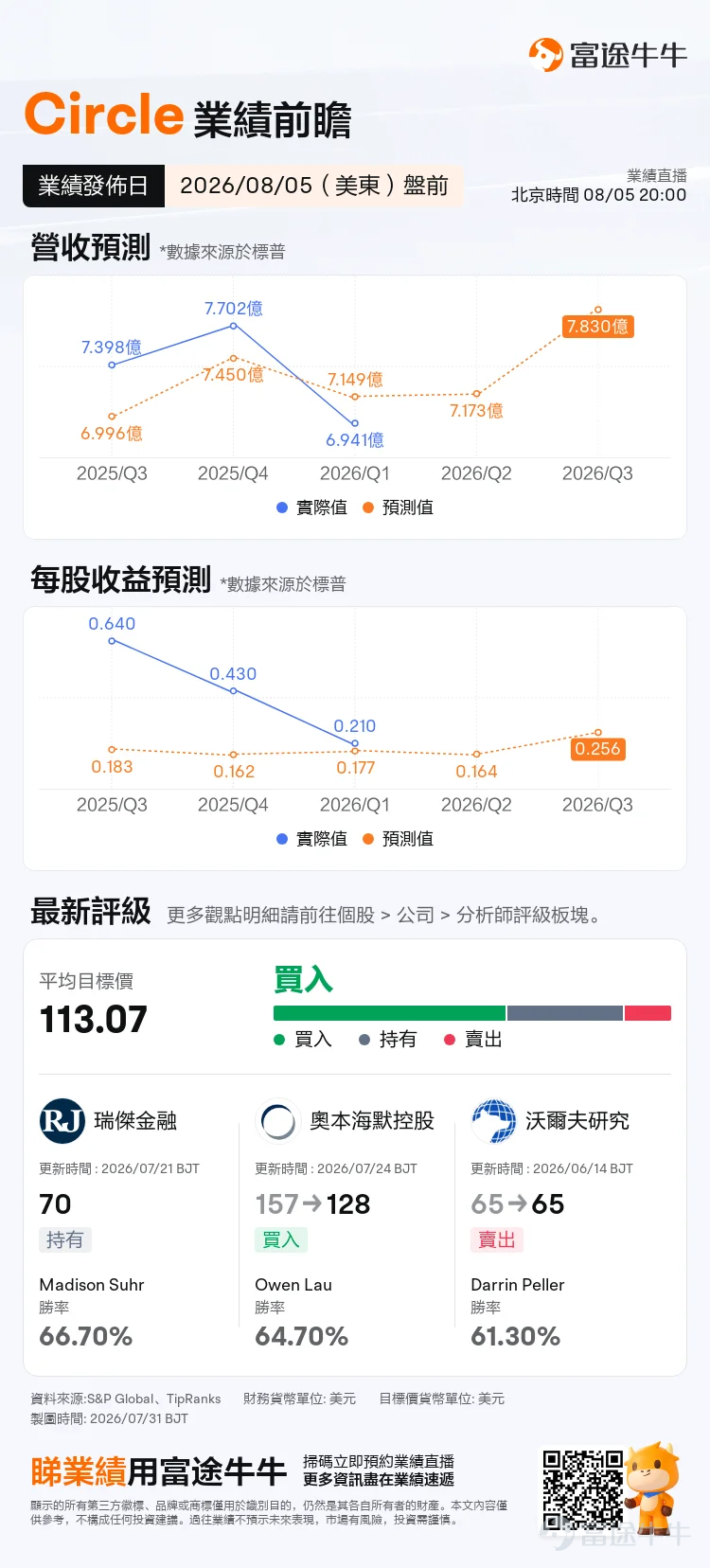
$Circle (CRCL.US)$ Will report earnings before the market opens on Wednesday, August 5. The market expects CRCL’s revenue to be $717 million, up 3.3% quarter-over-quarter; and EPS of $0.164, down 21.9% quarter-over-quarter.The crypto market has been weak over the past six months, $Bitcoin (BTC.CC)$ It has declined from a high of around RMB 97,900 at the beginning of the year to approximately RMB 64,000 recently. As a result, the market has set relatively conservative expectations: modest revenue growth with profit under pressure.
$Circle (CRCL.US)$ will release its earnings before the market opens on Wednesday, August 5. The market expects CRCL’s revenue to be $717 million, up 3.3% quarter-over-quarter; EPS is expected at $0.164, down 21.9% quarter-over-quarter.The crypto market has been sluggish over the past six months, $Bitcoin (BTC.CC)$ having declined from a peak of around RMB 97,900 at the beginning of the year to approximately RMB 64,000 recently. As a result, the market has adopted a relatively conservative outlook: modest revenue growth with profit under pressure. Circle’s primary revenue currently comes from interest income on stablecoin reserves such as USDC (accounting for about 94% of revenue) and platform infrastructure services (about 6%). 1. Reserve Income: Focus on USDC’s average daily circulation for the quarter Reserve income is Circle’s largest revenue source, primarily generated when users exchange fiat currency for stablecoins like USDC or EURC (Euro-denominated stablecoin), and Circle invests the reserved fiat in short-term U.S. Treasuries and money market funds to earn interest. In other words, the greater the amount of stablecoins circulating in the market, the more principal generates interest income for the company. Currently, this segment benefits from persistently high U.S. Treasury yields, which have risen to 4.242% by 2026. $U.S. 2-Year Treasury Notes Yield (US2Y.BD)$ has already risen to 4.242. However, due to low trading activity in the crypto market, USDC circulation could face downward pressure....
Currently, Circle’s primary revenue sources are interest income from stablecoin reserves (such as USDC, accounting for approximately 94% of revenue) and platform infrastructure services (approximately 6%).
1. Reserve Income: Focus on USDC’s average daily circulation for the quarter
Reserve income is Circle’s largest revenue source, primarily generated when users exchange fiat currency for stablecoins like USDC or EURC (Euro-denominated stablecoin), and Circle invests the reserved fiat into short-term U.S. Treasuries, money market funds, and other reserve assets to earn interest. In other words, the more stablecoins in circulation, the greater the principal base generating interest income for the company.
Currently, a positive factor for this revenue stream is the persistently high U.S. Treasury yields, which by 2026 $U.S. 2-Year Treasury Notes Yield (US2Y.BD)$ have already risen to 4.242%.
$Circle (CRCL.US)$ will release its earnings before the market opens on Wednesday, August 5. The market expects CRCL’s revenue to be $717 million, up 3.3% quarter-over-quarter; EPS is expected at $0.164, down 21.9% quarter-over-quarter.The crypto market has been sluggish over the past six months, $Bitcoin (BTC.CC)$ having declined from a peak of around RMB 97,900 at the beginning of the year to approximately RMB 64,000 recently. As a result, the market has adopted a relatively conservative outlook: modest revenue growth with profit under pressure. Circle’s primary revenue currently comes from interest income on stablecoin reserves such as USDC (accounting for about 94% of revenue) and platform infrastructure services (about 6%). 1. Reserve Income: Focus on USDC’s average daily circulation for the quarter Reserve income is Circle’s largest revenue source, primarily generated when users exchange fiat currency for stablecoins like USDC or EURC (Euro-denominated stablecoin), and Circle invests the reserved fiat in short-term U.S. Treasuries and money market funds to earn interest. In other words, the greater the amount of stablecoins circulating in the market, the more principal generates interest income for the company. Currently, this segment benefits from persistently high U.S. Treasury yields, which have risen to 4.242% by 2026. $U.S. 2-Year Treasury Notes Yield (US2Y.BD)$ has already risen to 4.242. However, due to low trading activity in the crypto market, USDC circulation could face downward pressure....
However, due to low trading activity in the crypto market, USDC circulation could face downward pressure.According to the company's financial report disclosure, USDC's average daily circulation has declined from $76.2 billion in Q4 2025 to $75.2 billion in Q1 2026. Currently, based on consensus forecasts from Wall Street and third-party institutions, the expected range for USDC’s average daily circulation in Q2 2026 is $72.5–74.0 billion.
Additionally, RLDC (Retained Liquidity Deposit Contribution) is another key metric closely watched by the market. This metric refers to the percentage of interest income retained by the company after sharing interest revenue with channel partners such as Coinbase, centralized exchanges, DEXs, and wallets. Management has guided that the full-year RLDC margin will be in the range of 38%–40%.A key focus of this earnings report will be whether RLDC falls below the ‘floor’ retention rate of 38%.
$Circle (CRCL.US)$ will release its earnings before the market opens on Wednesday, August 5. The market expects CRCL’s revenue to be $717 million, up 3.3% quarter-over-quarter; EPS is expected at $0.164, down 21.9% quarter-over-quarter.The crypto market has been sluggish over the past six months, $Bitcoin (BTC.CC)$ having declined from a peak of around RMB 97,900 at the beginning of the year to approximately RMB 64,000 recently. As a result, the market has adopted a relatively conservative outlook: modest revenue growth with profit under pressure. Circle’s primary revenue currently comes from interest income on stablecoin reserves such as USDC (accounting for about 94% of revenue) and platform infrastructure services (about 6%). 1. Reserve Income: Focus on USDC’s average daily circulation for the quarter Reserve income is Circle’s largest revenue source, primarily generated when users exchange fiat currency for stablecoins like USDC or EURC (Euro-denominated stablecoin), and Circle invests the reserved fiat in short-term U.S. Treasuries and money market funds to earn interest. In other words, the greater the amount of stablecoins circulating in the market, the more principal generates interest income for the company. Currently, this segment benefits from persistently high U.S. Treasury yields, which have risen to 4.242% by 2026. $U.S. 2-Year Treasury Notes Yield (US2Y.BD)$ has already risen to 4.242. However, due to low trading activity in the crypto market, USDC circulation could face downward pressure....
2. Other Revenue: Can B2B payment infrastructure expansion improve earnings guidance?
Circle’s other revenue primarily comes from cross-chain and cross-border transaction fees and custody service fees generated by CCTP (Cross-Chain Transfer Protocol) and CPN (Cross-Border Payments Network), which account for over 80% of other revenue, as well as on-chain foreign exchange transaction fees from StableFX, which represent approximately 15–20%.
This revenue stream is expected to partially offset risks associated with declining yields in the reserve income business, but it is unlikely to contribute significant profits in the near term. The key lies in whether subsequent management guidance can influence market valuation expectations.
Options Market: Will post-earnings volatility intensify?
Looking at the past three earnings releases, Circle’s post-earnings stock price volatility has consistently exceeded market pricing expectations. This time, implied volatility suggests an expected post-earnings stock price move of ±14.28%, slightly higher than the expectation ahead of the previous earnings release.
$Circle (CRCL.US)$ will release its earnings before the market opens on Wednesday, August 5. The market expects CRCL’s revenue to be $717 million, up 3.3% quarter-over-quarter; EPS is expected at $0.164, down 21.9% quarter-over-quarter.The crypto market has been sluggish over the past six months, $Bitcoin (BTC.CC)$ having declined from a peak of around RMB 97,900 at the beginning of the year to approximately RMB 64,000 recently. As a result, the market has adopted a relatively conservative outlook: modest revenue growth with profit under pressure. Circle’s primary revenue currently comes from interest income on stablecoin reserves such as USDC (accounting for about 94% of revenue) and platform infrastructure services (about 6%). 1. Reserve Income: Focus on USDC’s average daily circulation for the quarter Reserve income is Circle’s largest revenue source, primarily generated when users exchange fiat currency for stablecoins like USDC or EURC (Euro-denominated stablecoin), and Circle invests the reserved fiat in short-term U.S. Treasuries and money market funds to earn interest. In other words, the greater the amount of stablecoins circulating in the market, the more principal generates interest income for the company. Currently, this segment benefits from persistently high U.S. Treasury yields, which have risen to 4.242% by 2026. $U.S. 2-Year Treasury Notes Yield (US2Y.BD)$ has already risen to 4.242. However, due to low trading activity in the crypto market, USDC circulation could face downward pressure....
Currently, CRCL’s put/call options volume ratio stands at 0.78, and the open interest ratio is 0.71, indicating a neutral-to-bullish sentiment. Implied volatility (IV) is at 102.36%, with an IV percentile of 92%, reflecting historically high expected volatility and signaling that the market anticipates significant stock price movement following the earnings release.
$Circle (CRCL.US)$ will release its earnings before the market opens on Wednesday, August 5. The market expects CRCL’s revenue to be $717 million, up 3.3% quarter-over-quarter; EPS is expected at $0.164, down 21.9% quarter-over-quarter.The crypto market has been sluggish over the past six months, $Bitcoin (BTC.CC)$ having declined from a peak of around RMB 97,900 at the beginning of the year to approximately RMB 64,000 recently. As a result, the market has adopted a relatively conservative outlook: modest revenue growth with profit under pressure. Circle’s primary revenue currently comes from interest income on stablecoin reserves such as USDC (accounting for about 94% of revenue) and platform infrastructure services (about 6%). 1. Reserve Income: Focus on USDC’s average daily circulation for the quarter Reserve income is Circle’s largest revenue source, primarily generated when users exchange fiat currency for stablecoins like USDC or EURC (Euro-denominated stablecoin), and Circle invests the reserved fiat in short-term U.S. Treasuries and money market funds to earn interest. In other words, the greater the amount of stablecoins circulating in the market, the more principal generates interest income for the company. Currently, this segment benefits from persistently high U.S. Treasury yields, which have risen to 4.242% by 2026. $U.S. 2-Year Treasury Notes Yield (US2Y.BD)$ has already risen to 4.242. However, due to low trading activity in the crypto market, USDC circulation could face downward pressure....
Among options expiring after the earnings release, call options are concentrated in the $65–70 range, while put options cluster in the $50–60 range, establishing market-expected resistance and support levels.
$Circle (CRCL.US)$ will release its earnings before the market opens on Wednesday, August 5. The market expects CRCL’s revenue to be $717 million, up 3.3% quarter-over-quarter; EPS is expected at $0.164, down 21.9% quarter-over-quarter.The crypto market has been sluggish over the past six months, $Bitcoin (BTC.CC)$ having declined from a peak of around RMB 97,900 at the beginning of the year to approximately RMB 64,000 recently. As a result, the market has adopted a relatively conservative outlook: modest revenue growth with profit under pressure. Circle’s primary revenue currently comes from interest income on stablecoin reserves such as USDC (accounting for about 94% of revenue) and platform infrastructure services (about 6%). 1. Reserve Income: Focus on USDC’s average daily circulation for the quarter Reserve income is Circle’s largest revenue source, primarily generated when users exchange fiat currency for stablecoins like USDC or EURC (Euro-denominated stablecoin), and Circle invests the reserved fiat in short-term U.S. Treasuries and money market funds to earn interest. In other words, the greater the amount of stablecoins circulating in the market, the more principal generates interest income for the company. Currently, this segment benefits from persistently high U.S. Treasury yields, which have risen to 4.242% by 2026. $U.S. 2-Year Treasury Notes Yield (US2Y.BD)$ has already risen to 4.242. However, due to low trading activity in the crypto market, USDC circulation could face downward pressure....
1. If you are bullish on Circle over the long term but don’t want to chase the price at current levels,
This is suitable for investors willing to buy CRCL on a post-earnings pullback. Consider selling a put option (Sell Put). The core of this strategy is to collect higher premiums due to elevated implied volatility (IV). If CRCL doesn’t drop below the strike price after earnings, the option will likely benefit from time decay and a decline in IV. If the stock price pulls back into your target range, it’s effectively equivalent to acquiring shares at a lower cost. Note that CRCL’s expected post-earnings volatility is relatively high; selling a put with a strike further out provides a thicker cushion but yields lower returns.
(The chart below illustrates the simulated profit/loss profile of this strategy at expiration. The displayed graphic is for demonstration purposes only and does not constitute investment advice or guarantees; market conditions change rapidly, and the prices shown do not reflect real-time data.)
$Circle (CRCL.US)$ will release its earnings before the market opens on Wednesday, August 5. The market expects CRCL’s revenue to be $717 million, up 3.3% quarter-over-quarter; EPS is expected at $0.164, down 21.9% quarter-over-quarter.The crypto market has been sluggish over the past six months, $Bitcoin (BTC.CC)$ having declined from a peak of around RMB 97,900 at the beginning of the year to approximately RMB 64,000 recently. As a result, the market has adopted a relatively conservative outlook: modest revenue growth with profit under pressure. Circle’s primary revenue currently comes from interest income on stablecoin reserves such as USDC (accounting for about 94% of revenue) and platform infrastructure services (about 6%). 1. Reserve Income: Focus on USDC’s average daily circulation for the quarter Reserve income is Circle’s largest revenue source, primarily generated when users exchange fiat currency for stablecoins like USDC or EURC (Euro-denominated stablecoin), and Circle invests the reserved fiat in short-term U.S. Treasuries and money market funds to earn interest. In other words, the greater the amount of stablecoins circulating in the market, the more principal generates interest income for the company. Currently, this segment benefits from persistently high U.S. Treasury yields, which have risen to 4.242% by 2026. $U.S. 2-Year Treasury Notes Yield (US2Y.BD)$ has already risen to 4.242. However, due to low trading activity in the crypto market, USDC circulation could face downward pressure....
2. If you’re uncertain about the direction of the stock price after earnings but believe volatility will exceed expectations—as it has previously—
then you could use a long volatility strategy such as a long straddle or long strangle. This strategy involves buying one call and one put option. The intrinsic values of the call and put offset each other as the stock moves up or down, but if the stock experiences heightened volatility following the earnings release, the overall value of the position will rise, generating profit.
However, note that CRCL options currently exhibit high implied volatility (IV). If the market reacts tepidly to earnings, IV could collapse rapidly, causing a sharp erosion in option value—a phenomenon commonly known as 'IV Crush.' Buyers of options must also be mindful of time decay.
$Circle (CRCL.US)$ will release its earnings before the market opens on Wednesday, August 5. The market expects CRCL’s revenue to be $717 million, up 3.3% quarter-over-quarter; EPS is expected at $0.164, down 21.9% quarter-over-quarter.The crypto market has been sluggish over the past six months, $Bitcoin (BTC.CC)$ having declined from a peak of around RMB 97,900 at the beginning of the year to approximately RMB 64,000 recently. As a result, the market has adopted a relatively conservative outlook: modest revenue growth with profit under pressure. Circle’s primary revenue currently comes from interest income on stablecoin reserves such as USDC (accounting for about 94% of revenue) and platform infrastructure services (about 6%). 1. Reserve Income: Focus on USDC’s average daily circulation for the quarter Reserve income is Circle’s largest revenue source, primarily generated when users exchange fiat currency for stablecoins like USDC or EURC (Euro-denominated stablecoin), and Circle invests the reserved fiat in short-term U.S. Treasuries and money market funds to earn interest. In other words, the greater the amount of stablecoins circulating in the market, the more principal generates interest income for the company. Currently, this segment benefits from persistently high U.S. Treasury yields, which have risen to 4.242% by 2026. $U.S. 2-Year Treasury Notes Yield (US2Y.BD)$ has already risen to 4.242. However, due to low trading activity in the crypto market, USDC circulation could face downward pressure....
Finally, Options Sir has a small giveaway for fellow investors—feel free to claim it!Options Starter Pack
*This promotion is exclusively available to invited Hong Kong users. Click to learn more.Detailed terms and conditions of the promotion >>
Market conditions are complex and ever-changing,Options strategiesToo many choices and unsure how to proceed? Let Futubull help you build a strategy in three simple stepsOptions strategies, making investing simple and efficient!
$Circle (CRCL.US)$ will release its earnings before the market opens on Wednesday, August 5. The market expects CRCL’s revenue to be $717 million, up 3.3% quarter-over-quarter; EPS is expected at $0.164, down 21.9% quarter-over-quarter.The crypto market has been sluggish over the past six months, $Bitcoin (BTC.CC)$ having declined from a peak of around RMB 97,900 at the beginning of the year to approximately RMB 64,000 recently. As a result, the market has adopted a relatively conservative outlook: modest revenue growth with profit under pressure. Circle’s primary revenue currently comes from interest income on stablecoin reserves such as USDC (accounting for about 94% of revenue) and platform infrastructure services (about 6%). 1. Reserve Income: Focus on USDC’s average daily circulation for the quarter Reserve income is Circle’s largest revenue source, primarily generated when users exchange fiat currency for stablecoins like USDC or EURC (Euro-denominated stablecoin), and Circle invests the reserved fiat in short-term U.S. Treasuries and money market funds to earn interest. In other words, the greater the amount of stablecoins circulating in the market, the more principal generates interest income for the company. Currently, this segment benefits from persistently high U.S. Treasury yields, which have risen to 4.242% by 2026. $U.S. 2-Year Treasury Notes Yield (US2Y.BD)$ has already risen to 4.242. However, due to low trading activity in the crypto market, USDC circulation could face downward pressure....
Options Risk Disclosure:An option is a contract that grants the holder the right—but not the obligation—to buy or sell an underlying asset at a predetermined price on or before a specified date. Option prices are influenced by multiple factors, including the current price of the underlying asset, the strike price, time to expiration, and implied volatility. Implied volatility reflects the market’s expectation of future price fluctuations over the life of the option; it is derived by reverse-engineering the Black-Scholes pricing model and is commonly viewed as an indicator of market sentiment. When investors anticipate higher volatility, they may be willing to pay more for options to hedge their risk, resulting in higher implied volatility. Traders and investors use implied volatility to assess the attractiveness of option prices, identify potential mispricings, and manage their risk exposure.
Disclaimer:This content does not constitute an offer, solicitation, recommendation, opinion, or any form of guarantee regarding any securities, financial products, or instruments. The risk of loss in trading options can be substantial. In certain circumstances, your losses may exceed the initial margin deposit. Even if you place contingent orders such as 'stop-loss' or 'limit' orders, there is no assurance that losses will be avoided, as market conditions may prevent execution of these orders. You may be required to deposit additional margin on short notice. If you fail to meet such margin calls within the stipulated time, your open positions may be liquidated. You remain fully liable for any resulting deficit in your account. Therefore, prior to trading options, you should thoroughly research and understand how options work and carefully consider whether such trading aligns with your financial situation and investment objectives. If you trade options, you should become familiar with the procedures for exercising options and handling expiration, as well as your rights and obligations upon exercise or expiration. Options trading involves significant risk and is not suitable for all investors. Investors should carefully read"Characteristics and Risks of Standardized Options"
Risk Disclaimer: The above content only represents the author's view. It does not represent any position or investment advice of Futu. Futu makes no representation or warranty.Read more
Thumbs Up
22
Respect
1
Heart
1
669K Views
Report
Comments
Write a Comment...
24
36