
Earnings & Options Strategy | How to Analyze AMD's Q2 Results Amid Data Center Tailwinds and PC Market Concerns?
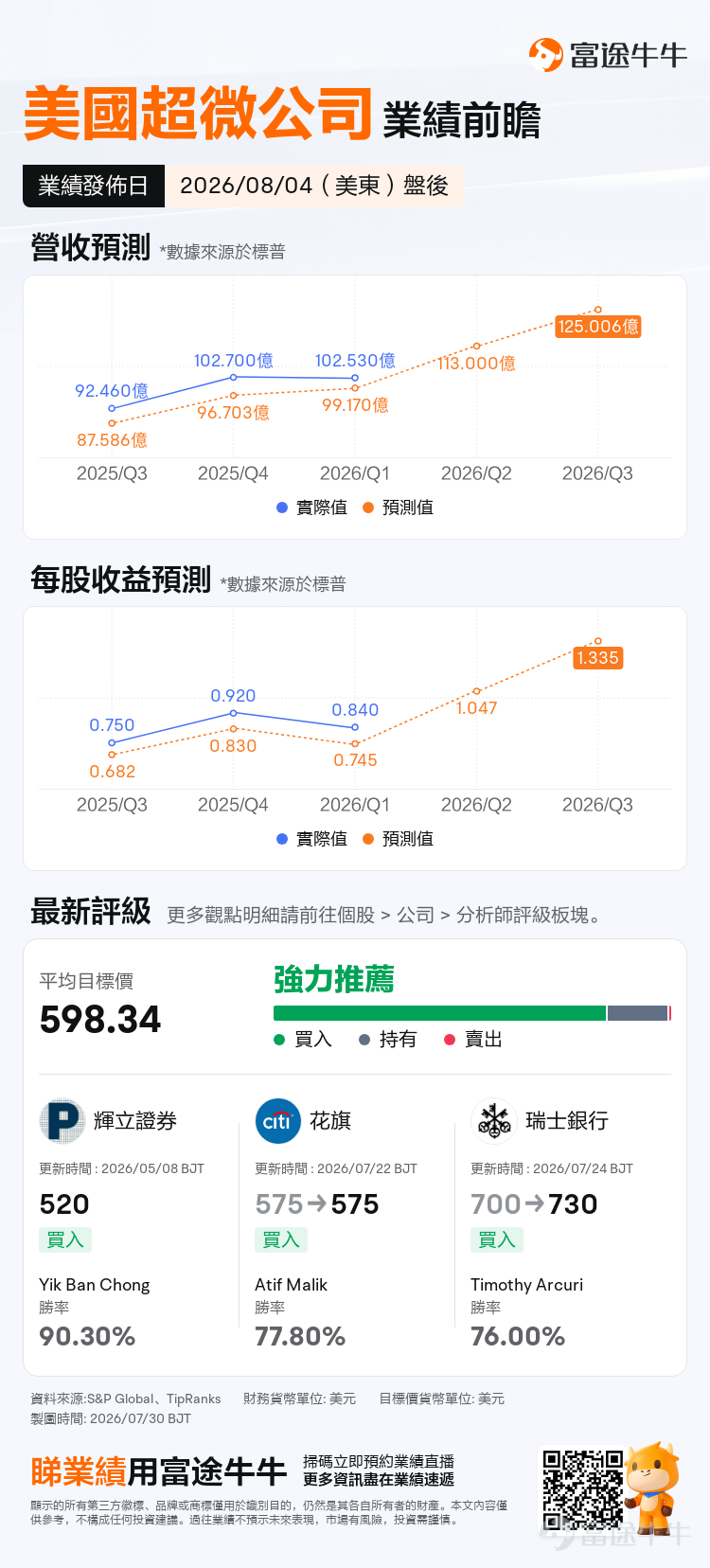
$Advanced Micro Devices (AMD.US)$Will officially release its Q2 FY2026 earnings on the morning of Wednesday, August 5, 2026, Beijing time, which corresponds to after U.S. market close on Tuesday, August 4, 2026, Eastern Time.
Wall Street’s consensus expectations for this quarter are:Revenue of approximately $11.3 billion, representing year-over-year growth of about 47%. Non-GAAP EPS consensus is around $1.61, with a Non-GAAP gross margin guidance of approximately 56%.Overall market sentiment is bullish, but expectations are already very high. Therefore, for AMD this quarter, the issue isn’t a lack of bullish narratives—it’s a lack of execution in the earnings report strong enough to justify current valuations.
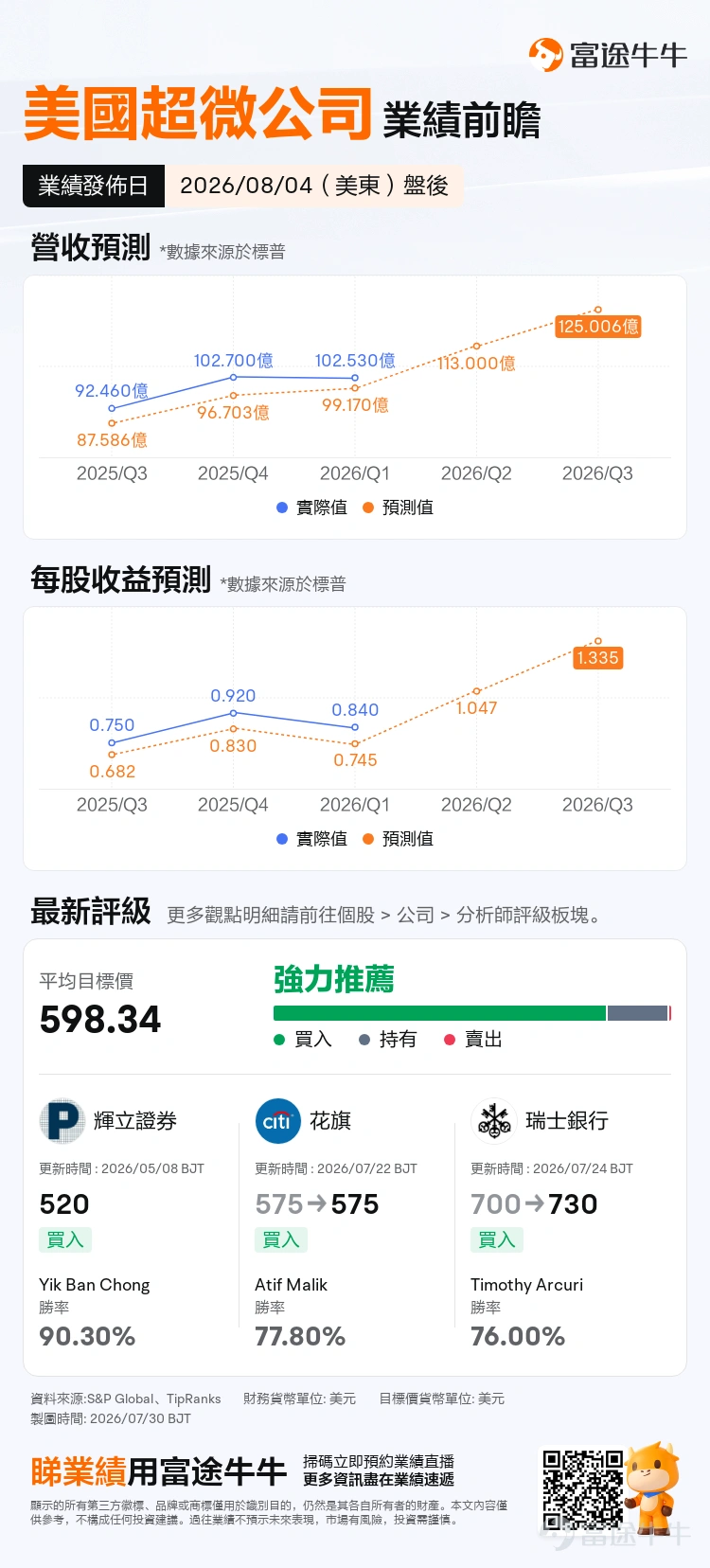
Key Earnings Focus Areas
1) Data Center Revenue
A critical reference metric has already been released: $Intel (INTC.US)$ Reported Q2 results on July 23, with its Data Center and AI (DCAI) segment generating $6.3 billion in revenue, up 59% year-over-year.
AMD’s EPYC server CPUs share the same demand pool as Intel’s. Both companies are benefiting from an ongoing structural shift: during the AI inference phase, demand is rapidly migrating from GPU-centric architectures toward CPU-GPU hybrid setups. Moreover, the incremental CPU demand driven by Agentic AI is significantly higher than previously anticipated by the market. Data center revenue reached $5.78 billion in Q1 2026 (up 57% YoY), and the Q2 guidance of 'double-digit sequential growth' implies a range of $6.4–6.8 billion.If the final figure exceeds $6.5 billion or even approaches $7 billion, it would signal that AMD’s data center growth is re-accelerating rather than plateauing.
2) Q3 Earnings and Capital Expenditure Guidance
Frankly speaking, what will truly drive AMD’s stock price either upward beyond current levels or downward through a correctionis management’s wording in their guidance for the third quarter.The backdrop is already clear enough: Helios racks were announced for full-scale mass production at the Advancing AI 2026 conference on July 23, with initial shipments expected by the end of Q3—OpenAI (6GW), Meta (6GW), and Anthropic (2GW). The first 1GW deliveries under these three massive orders are all slated for the second half of 2026. This means the Q3 guidance isn’t just a financial figure—it’s the anchor point determining whether the market will believe in the 'Helios mass-production debut year' narrative. Furthermore, if Helios begins contributing revenue in Q3,and gross margins show potential to expand toward 57–58%, the sustainability of this margin expansion trend will be one of the key variables institutional investors use to assess AMD’s valuation ceiling.
Additionally, management’s wording regarding the 'timing of Helios revenue recognition' also warrants close scrutiny—there is often a time lag between rack system shipments and final customer acceptance.If management proactively clarifies the revenue recognition timing, it would signal improved transparency—a positive development.
3) PC Market
Bernstein Research characterized AMD’s overall performance this quarter as‘early signs of data center recovery emerging, but concerns remain in the PC market,’a view backed by concrete data—global PC shipments declined 4–5% year-over-year in Q2, and ** ODMs’ notebook shipments in April fell 12% YoY. Intel also explicitly forecast flat sequential PC sales in its Q3 outlook, attributing this to memory shortages—a constraint that will similarly affect AMD’s Client & Gaming segment.
In Q1, AMD’s Client & Gaming segment reported $3.6 billion in revenue, up 23% YoY, with Q2 guidance calling for ‘modest sequential growth.’ If the actual result shows a sequential decline—even if offset by an upside surprise in data centers—the company could still meet overall revenue targets, but the segment mix may spark debate about the pace of PC demand recovery.
Recent stock price movement
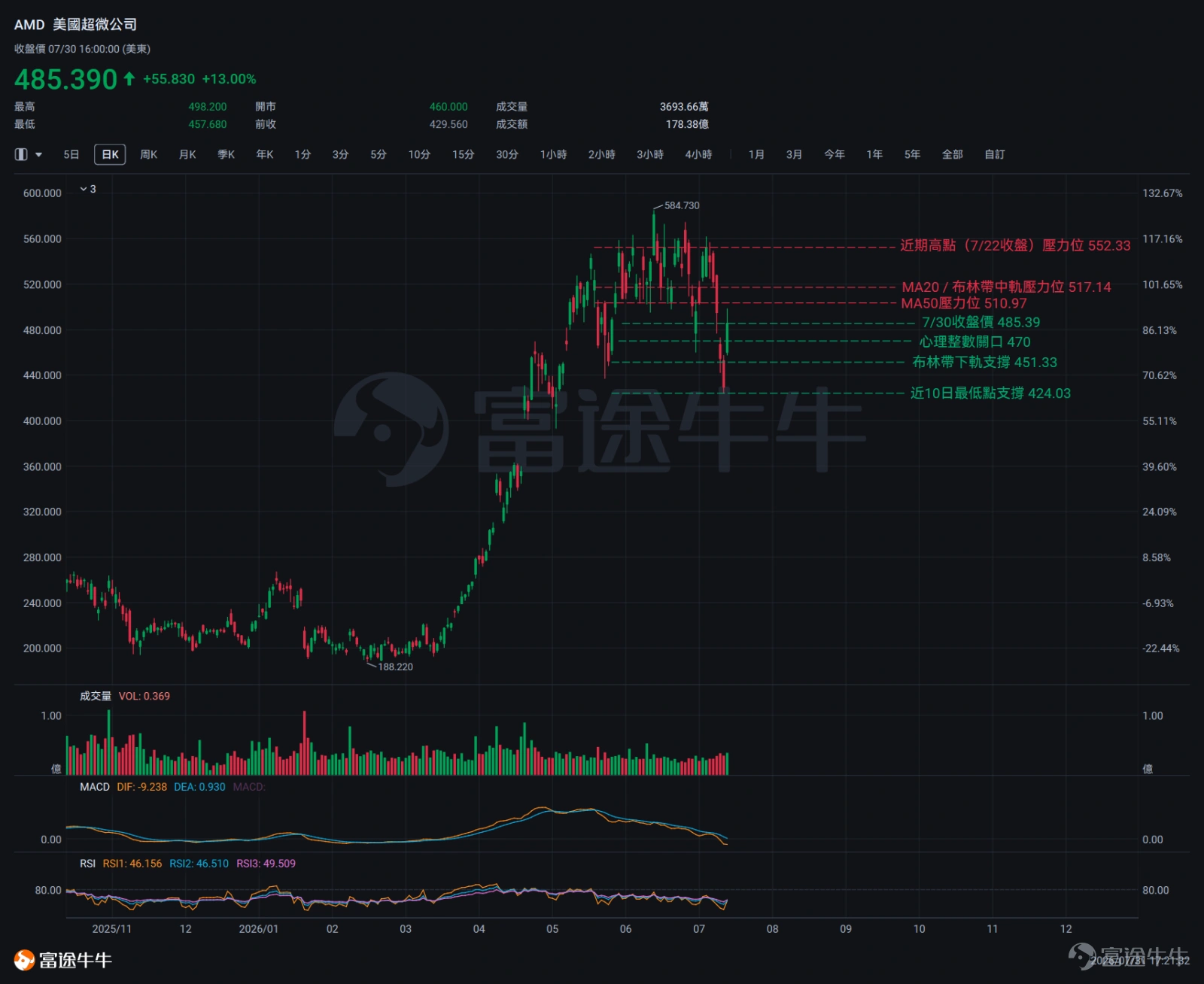
AMD’s share price began a sharp pullback on July 22, closing at $485.39 on July 30—a cumulative decline of approximately 12.8%.The moving average structure shows a classic bearish alignment.— The 20-day MA is at $517.14 and the 50-day MA at $510.97, both significantly above the current price, with the 20-day MA crossing below the 50-day MA to form a death cross,indicating clear downside pressure in the medium to short term.The stock price is trading between the Bollinger Band middle band ($517.14) and lower band ($451.33), with notably expanded volatility,keeping the overall short-term trend weak.
Support levels:The Bollinger Band lower band at $451.33 serves as a dynamic floating support;if this level is decisively breached, close attention must be paid tobuying interest around the next strong support zone at $424.03 (the extreme low from July 29).
Resistance levels:$498.20 (intraday high on July 30) serves as the nearest resistance;After a breakout, further observation is needed to see if the move can extend andstably hold above the key psychological level of $500;this is a critical reference indicator for short-term momentum shift;$510.97 (50-day moving average) and $517.14 (20-day moving average and middle Bollinger Band) form a dual moving-average resistance zone. Whether price can effectively reclaim $517.14 is the pivotal point for determining if the short-term trend has officially reversed.
Options Market Analysis
An IV percentile of 93% indicates thatthe current AMD options prices are at a level higher than 93% of trading days over the past year, offering exceptionally rich time value in premiums.Even if implied volatility (IV) is slightly discounted relative to historical volatility (HV), the absolute level remains sufficiently high to provide option sellers with ample time-value income,making this a reasonable window to collect risk premium.
Reference Strategy 1: Cash-Secured Put
Options strategy reference:Sell AMD Aug 7, 2026 $435 Put
Target audience: Suitable for investors who are confident in AMD's post-earnings price performance or are willing to buy/add to their position at a lower price if the stock declines after earnings.
Reference strike price: $435 (approximately 10% below the current stock price, with a buffer zone below the lower Bollinger Band)
Reference premium: Approximately $905 per contract (equivalent to reducing the holding cost by about $9.05 per share)
(Note: The options strategies presented here are for reference only and do not constitute investment advice or guarantees; market conditions change frequently, and the quoted option prices may not reflect real-time values.)
Rationale: If earnings significantly beat expectations, the put option will likely expire worthless, allowing the option seller to keep the full premium. If earnings meet expectations or slightly miss but the stock price decline is limited, the put will also likely expire worthless due to implied volatility contraction (IV crush) and time decay. If earnings substantially miss expectations, the investor can choose to close the position early to limit losses and avoid being assigned the underlying shares.
Reference Strategy 2: Covered Call
Options strategy reference: Hold 100 shares of AMD stock and sell the AMD Aug 7, 2026 $550 Call
Target audience: Suitable for investors who already hold AMD shares, expect limited upside after earnings, and are willing to cap some potential upside in exchange for downside protection and reduced holding cost.
Reference strike price: $550 (anchored above the confluence resistance of the 20-day and 50-day moving averages; near the upper Bollinger Band)
Reference premium: approximately $787.5 per contract (equivalent to a reduction in holding cost of about $7.875 per share)
(Note: The options strategies presented here are for reference only and do not constitute investment advice or guarantees; market conditions change frequently, and the quoted option prices may not reflect real-time values.)
Logic analysis: The premium currently collectible from selling out-of-the-money (OTM) calls significantly exceeds normal levels. If the stock price rises moderately or remains range-bound after earnings release, the entire premium will be retained. If the stock price surges above the strike price, the underlying shares will be sold at that strike price for a profit, and the premium serves as additional compensation, resulting in an effective sale price higher than the strike price alone. The only trade-off for the investor is forfeiting any upside beyond the strike price.
Finally, we have a small gift for our fellow investors—feel free to claim it!Options Starter Pack
*This promotion is exclusively available to invited HK users. Click to learn more.Detailed terms and conditions of the promotion >>
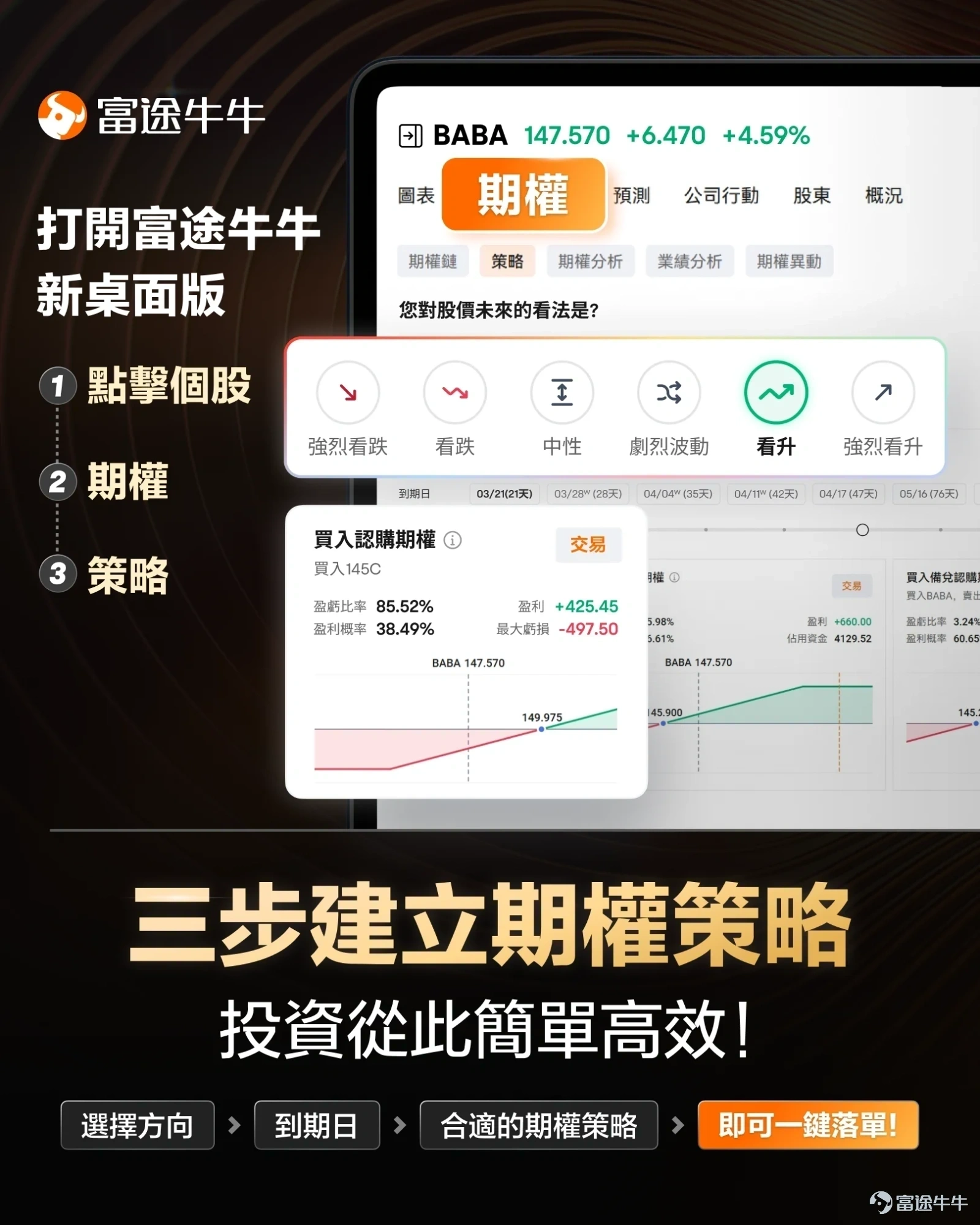
Market conditions are complex and ever-changing,Options strategiesToo many choices and unsure how to decide? Futubull helps you build yourOptions strategies, making investing simple and efficient from now on!
Options Risk Disclosure:An option is a contract that gives the holder the right—but not the obligation—to buy or sell an underlying asset at a predetermined price on or before a specific date. Option prices are influenced by multiple factors, including the current price of the underlying asset, the strike price, time to expiration, and implied volatility. Implied volatility reflects the market’s expectation of future price fluctuations over the option's life and is derived by reversing the Black-Scholes option pricing model. It is commonly viewed as a gauge of market sentiment. When investors anticipate greater volatility, they may be willing to pay higher premiums for options to hedge their risk, resulting in higher implied volatility. Traders and investors use implied volatility to assess the attractiveness of option prices, identify potential mispricings, and manage risk exposure.
Disclaimer:This content does not constitute an offer, solicitation, recommendation, advice, opinion, or any guarantee regarding any securities, financial products, or instruments. The risk of loss in trading options can be substantial. In certain circumstances, your losses may exceed the initial margin deposit. Even if you set contingent orders such as 'stop-loss' or 'limit' orders, there is no assurance these will prevent losses. Market conditions may render such orders unexecutable. You may be required to deposit additional margin on short notice. If you fail to meet the margin call within the specified timeframe, your open positions may be liquidated. You remain fully liable for any deficit balance in your account resulting from such liquidation. Therefore, prior to trading options, you should thoroughly research and understand options and carefully consider whether such trading aligns with your financial situation and investment objectives. If you trade options, you should be familiar with the procedures for exercising options and handling expiration, as well as your rights and obligations upon exercise or expiration. Options trading involves substantial risk and is not suitable for all investors. Investors should carefully read"Characteristics and Risks of Standardized Options"。
Risk Disclaimer: The above content only represents the author's view. It does not represent any position or investment advice of Futu. Futu makes no representation or warranty.Read more


Comments (5)
to post a comment
39
49