Welcome Zone | Claim your 100,000 anniversary reward and kickstart your investment journey!

ETF Showdown | Where Did the Money Go When Tech Stocks Dropped? 4 ETFs Reveal Recent 'Safe-Haven' Trends
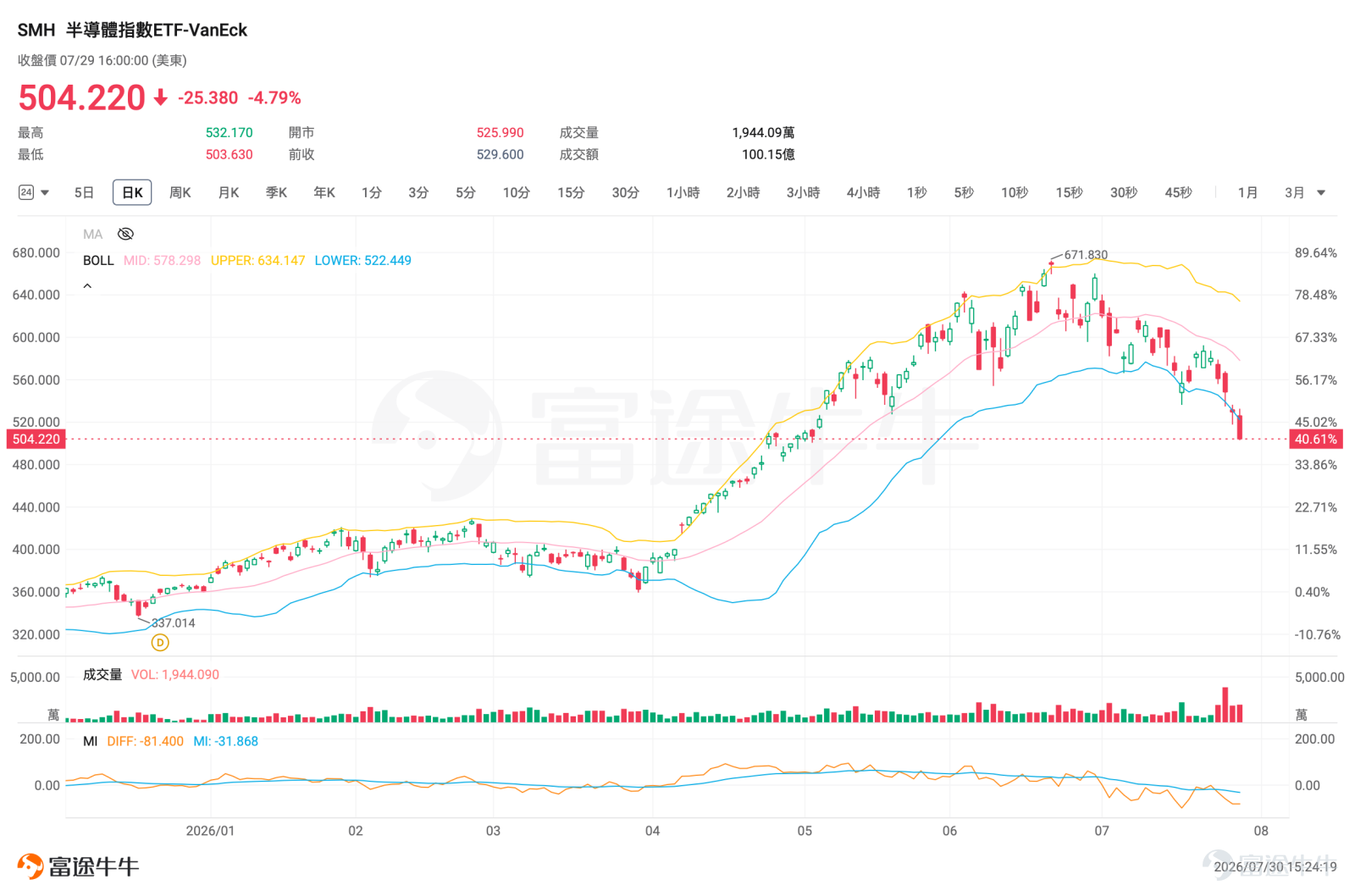
Hello fellow investors—recently, those investing in U.S. equities may have noticed one clear trend:AI and semiconductor stocks have dropped sharply, yet the broader market hasn’t collapsed; major indices have only seen a modest short-term pullback.
As the market reassesses AI-related capital spending, tech valuations, and the pace of earnings realization, some capital has rotated out of the previously overcrowded tech sector into sectors like healthcare, consumer staples, and energy—industries with different sources of earnings.
This recent sector rotation also reminds us of one crucial point:True diversification isn't just about buying more stocks—it's about ensuring your portfolio includes exposure to different sectors and sources of returns.
Buying five tech stocks may still expose you to only one type of risk.
Holding positions in semiconductors, memory, servers, cloud computing, and electric vehicles may appear to represent investments across multiple distinct companies.
However, these assets may still be jointly influenced by AI-related capital spending, tech stock valuations, long-end interest rates, and market risk appetite. Therefore, when the broader tech theme weakens, multiple tech stocks could still decline simultaneously.
True diversification depends not only on the number of holdings but also on whether these companies'sectors, business models, and price drivers differ meaningfully.。
A downturn in tech doesn't mean all sectors are falling.
Recent market performance has vividly illustrated this divergence.
Since late June,$VanEck Semiconductor ETF (SMH.US)$ the Mag 7 have pulled back more than 20% from their highs, yet over the same period, the healthcare and consumer staples sectors have trended upward, and the materials sector has also posted gains. By the end of July, the Mag 7 had collectively declined over 8% from their June highs, while eight S&P 500 sectors recorded gains during the same timeframe, and the equal-weighted S&P 500 index actually rose nearly 4%.
Since July, oil prices have surged sharply due to escalating tensions in the Middle East, making energy another strong-performing sector recently.
The extreme market divergence over the past month does not mean the long-term growth thesis for tech stocks has ended; rather, it indicates that:Even if the broader market index appears relatively unchanged, capital may still be rotating rapidly across different sectors.

For investors, the appeal of these non-tech sectors stems primarily from three factors:
– Earnings are less tied to AI and tech-related capital expenditures,with lower correlation;
– Demand in certain sectors is relatively stable,and less affected by economic cycles;
– Sectors such as energy can offer exposure tooil prices, inflation, and geopolitical risksdifferent risk exposures to hedge the overall portfolio risk.
Here's the question: if you don't want to pick individual stocks one by one, how can you more easily gain exposure to different sectors?
The S&P 500 can be broken down into 11 sectors.
The S&P 500 is not an indivisible whole.
Under the Global Industry Classification Standard (GICS), S&P 500 companies are categorized into 11 major sectors, including Information Technology, Financials, Health Care, Industrials, Energy, Consumer Staples, Utilities, and others.
SPDR’s Select Sector series divides the S&P 500 constituents into corresponding sector ETFs based on these 11 sectors. Together, these 11 Select Sector indices cover all companies in the S&P 500.
In simple terms:
– Broad-market ETFs: hold multiple sectors at once, serving as the core of an investment portfolio;
– Industry ETF: increase allocation to a specific sector to adjust the portfolio’s risk and return profile.
Therefore, sector ETFs don’t necessarily need to replace broad-market ETFs.
A more common approach is:Broad-market ETFs capture overall market growth, while sector ETFs adjust the defensive or offensive characteristics of your portfolio.
Aside from broad-market ETFs, how should you select sector ETFs?
Before choosing a sector ETF, ask yourself two questions first.
1. Do you want to increase defensiveness or add aggressiveness?
Different sectors serve distinct functions. Refer to the chart below—sectors vary significantly in their roles and market behavior:

2. What do you already hold in your portfolio?
If your portfolio is already concentrated in AI, semiconductors, and large-cap tech stocks, adding a technology sector ETF may not provide true diversification.
Conversely, adding sectors driven by different earnings catalysts can help reduce your portfolio’s reliance on a single tech-driven theme.
The following four SPDR sector ETFs represent several recently popular 'non-tech' allocation strategies.
XLP: Consumer Staples, focused on stable demand
$Consumer Staples Select Sector SPDR Fund (XLP.US)$ Primarily holds consumer staples companies within the S&P 500, covering businesses such as food, beverages, household products, personal care, and essential retail.
Its defensive logic is deeply rooted in everyday life:You can delay buying an AI server by six months, but toothpaste, food, and household essentials usually can’t go unbought for long—you still need to drink your cola.
Therefore, compared to corporate tech spending or discretionary consumption, demand for consumer staples tends to be more stable, and company earnings are relatively easier to forecast.

However, 'essential' doesn’t mean 'immune to declines.' If raw material and labor costs rise, companies’ pricing power weakens, or sector valuations become too high, XLP can still experience drawdowns.
XLP’s return stability deserves attention; according to official performance data, as of June 30, 2026, XLP’s net asset value delivered an annualized return of approximately over the past 10 years7.02%。
XLV: Healthcare demand doesn’t vanish just because the stock market dips
$The Health Care Select Sector SPDR® Fund (XLV.US)$ Covers pharmaceuticals, biotechnology, medical devices, healthcare services, and life science tools.
The healthcare sector’s appeal lies in the fact that its demand isn’t fully synchronized with technology or corporate capital expenditure cycles.

Demand for many pharmaceuticals, medical devices, and healthcare services will not disappear simply because the Nasdaq falls. Moreover, healthcare is not solely defensive in nature. Aging populations, new drug development, advances in medical technology, and industry consolidation may also provide medium- to long-term growth drivers.
According to official performance data, as of June 30, 2026, XLV’s net asset value delivered an annualized return of approximately10.09%。
It should be noted that the healthcare sector still faces risks such as drug pricing policies, regulatory scrutiny, clinical trial failures for new drugs, and patent expirations.
XLU: Utilities, seeking relatively stable cash flows
$Utilities Select Sector SPDR Fund (XLU.US)$ Primarily invests in electric, natural gas, and other utility companies within the S&P 500.
Water, electricity, and natural gas are essential daily necessities, and revenues and cash flows of related companies are typically stable; thus, utilities are often viewed as a traditional defensive sector.
Some utility companies also exhibit relatively stable dividend characteristics, making them somewhat attractive to investors who prioritize cash flow.

According to official performance data, as of June 30, 2026, XLU’s net asset value delivered an annualized return of approximately9.00%。
However, utilities typically rely heavily on borrowing to fund infrastructure investments and are therefore sensitive to interest rate changes. When bond yields rise, financing costs increase, which may also diminish the relative appeal of high-dividend utility stocks.
Therefore, XLU’s 'defensive' nature does not mean its price is immune to volatility, but rather that its earnings model differs from that of high-growth tech companies.
XLE: Energy has been strong recently, but it is not a pure defensive play.
$Energy Select Sector SPDR Fund (XLE.US)$ It primarily invests in large-cap oil, natural gas, and energy equipment companies within the S&P 500.
Energy does not follow the same logic as consumer staples, healthcare, or utilities.
XLP, XLV, and XLU are closer to traditional defensive sectors with relatively stable demand or cash flows; XLE, by contrast, is more akin to:Cyclical assets + oil price exposure + trades on inflation and geopolitical risk.
When oil prices rise, supply tightens, or geopolitical tensions escalate, earnings expectations for energy companies may improve; however, if oil prices drop sharply or global demand weakens, energy stocks could also experience significant declines.
As of June 30, 2026, XLE’s net asset value (NAV) delivered an annualized return of approximately8.82%; however, for Q2 2026 alone, its NAV return declined by about 12.55%, reflecting the sector's pronounced cyclicality.
Therefore, XLE can provide portfolio exposure driven by price factors distinct from technology stocks, but it may not be appropriate to view it simplistically as a 'safe asset.'

Don’t turn sector allocation into another form of chasing momentum.
Tech stocks have dropped—immediately shift everything into energy; once energy has rallied, chase healthcare next. This may look like constant sector rotation, but in reality, it could still just be chasing short-term gains.
When adjusting your portfolio using sector ETFs, it’s more worthwhile to consider:
1. Whether your current holdings are overly concentrated in a single sector;
2. Whether you aim to add defensive exposure, growth potential, or inflation and cyclical sensitivity;
3. Whether you can withstand the sector-specific risks and drawdowns inherent to that industry.
For fellow investors just starting out, it’s better to first build a broadly diversified core portfolio using broad-market ETFs, and treat sector ETFs as fine-tuning tools—not as instruments to chase the strongest-performing sector daily with your entire portfolio.
True 'risk mitigation' means ensuring your portfolio doesn’t rely solely on one dominant theme.
With the recent tech sector pullback, what truly deserves our attention isn’t just which sectors are temporarily outperforming.
More importantly, you should re-examine:Whether nearly all of your portfolio assets are driven by the same tech and AI investment thesis.
Technology may still be a key source of growth in the future, and defensive sectors do not guarantee profits.
Broad-market ETFs can help us hold the overall market, while sector ETFs allow us to add defensive, cyclical, or aggressive exposure as needed.
Market leadership always rotates. More important than correctly predicting the next strongest sector every time is ensuring that even if one theme temporarily loses steam, other parts of the portfolio continue to provide support.
Investing doesn’t require you to always be the fastest, but you should avoid having only one path forward.
Risk Disclaimer: The above content only represents the author's view. It does not represent any position or investment advice of Futu. Futu makes no representation or warranty.Read more


Comment (1)
to post a comment
73
125