
What's the Talk on US Stocks | A Quiet Week, but Are US Treasuries Poised for Turmoil?

Bitget UEX Daily Report | Trump says U.S. military will deliver a heavy blow to Iran; Fed holds rates steady, Waller reaffirms 2% inflation target; Microsoft earnings beat expectations, Meta sharply increases capex (July 30, 2026)


I. Key Headlines
Federal Reserve Updates
The Federal Reserve holds rates steady; Waller reiterates 2% inflation target and downplays forward guidance
The Federal Reserve kept interest rates unchanged. Chair Waller explicitly reaffirmed at the start of his press conference that the Committee remains firmly committed to achieving its 2% year-over-year inflation target, emphasizing there is no 'soft target' or any other implicit objective.
Waller stated that refraining from providing forward guidance is a prudent approach in the current environment of high uncertainty; markets have already priced in expectations of tighter monetary policy, and while the Fed will closely monitor developments, it will not passively follow market pricing.
Following the decision,CMEdata show the probability of holding rates steady in September has risen to 36.8%, while the probability of a cumulative 25-basis-point rate hike stands at 63.2%. Market impact: Policy path remains uncertain, with hawkish signals coexisting alongside the hold decision—providing short-term support for the dollar, pressuring risk asset valuations, and intensifying market pricing of persistent inflation.
Trump says U.S. will strike Iran hard; U.S. military drafts air strike plan lasting up to two weeks
At the White House, Trump said the U.S. 'will deliver a heavy blow to Iran' and 'it’s America’s turn to retaliate,' citing Iran’s missile attacks on U.S. forces in the Middle East. He added that Iran has already asked the U.S. not to carry out strikes.
According to U.S. media reports, U.S. Central Command has prepared a punitive, intensive air strike plan lasting 10–14 days, aimed at disabling Iran’s missile capabilities, pending Trump’s final decision; military officials also warned that air defense munitions inventories are running critically low.
Trump is also seeking to include provisions authorizing tariffs on Iran in related sanctions legislation. Market impact: Renewed escalation fears in geopolitical tensions have rapidly driven upCrude oilrisk premiums, with oil prices rebounding sharply, further complicating the interplay between inflation dynamics and Fed policy—keeping market sentiment highly sensitive.
The Treasury may delay adjusting its Treasury issuance guidance, driven by political considerations
JPMorgan strategists believe the U.S. Treasury is likely to refrain from adjusting its wording in next week’s quarterly refunding announcement to avoid unsettling bond markets ahead of the midterm elections, thereby delaying any signal of increased Treasury issuance.
The U.S. could face a funding gap of approximately $3.7 trillion over the next four fiscal years, but political considerations may take precedence over debt management objectives. Market impact: Long-end Treasury yields have neared highs not seen since Trump took office, with policy and political factors intertwining to heighten volatility in both fixed-income and risk assets.
Spot gold: Approximately $4,081 per ounce, +0.37%
Spot silver: Approximately $58 per ounce, +1.55%
WTI Crude Oil: Approximately $84 per barrel, +0.06%
Brent crude: Approximately $83 per barrel, significantly up over the past 24 hours
US Dollar Index (DXY): Approximately 100.9, +0.08%
Driver Analysis: Trump’s remarks about 'hitting Iran hard' and the disclosure of U.S. military airstrike plans rapidly boosted geopolitical risk premiums, driving a notable rebound in crude oil. Gold and silver diverged in performance amid rising oil prices and mixed signals following the Fed’s decision, reflecting limited overall safe-haven demand. The relatively resilient dollar indicates persistent policy uncertainty. Asset linkages are clear: renewed geopolitical escalation → higher oil prices → heightened inflation concerns → sustained elevated probability of a hawkish Fed stance. Near-term commodity volatility will heavily depend on developments in the Iran situation and upcoming economic data.
BTC: Approximately $63,718, -0.17%
ETH: Approximately USD 1,900, down 0.52%
Total cryptocurrency market capitalization: Approximately USD 2.28 trillion, down 0.1%
Market liquidation situation: Total liquidations in the past 24 hours amounted to USD 389 million, with long positions accounting for USD 270 million.
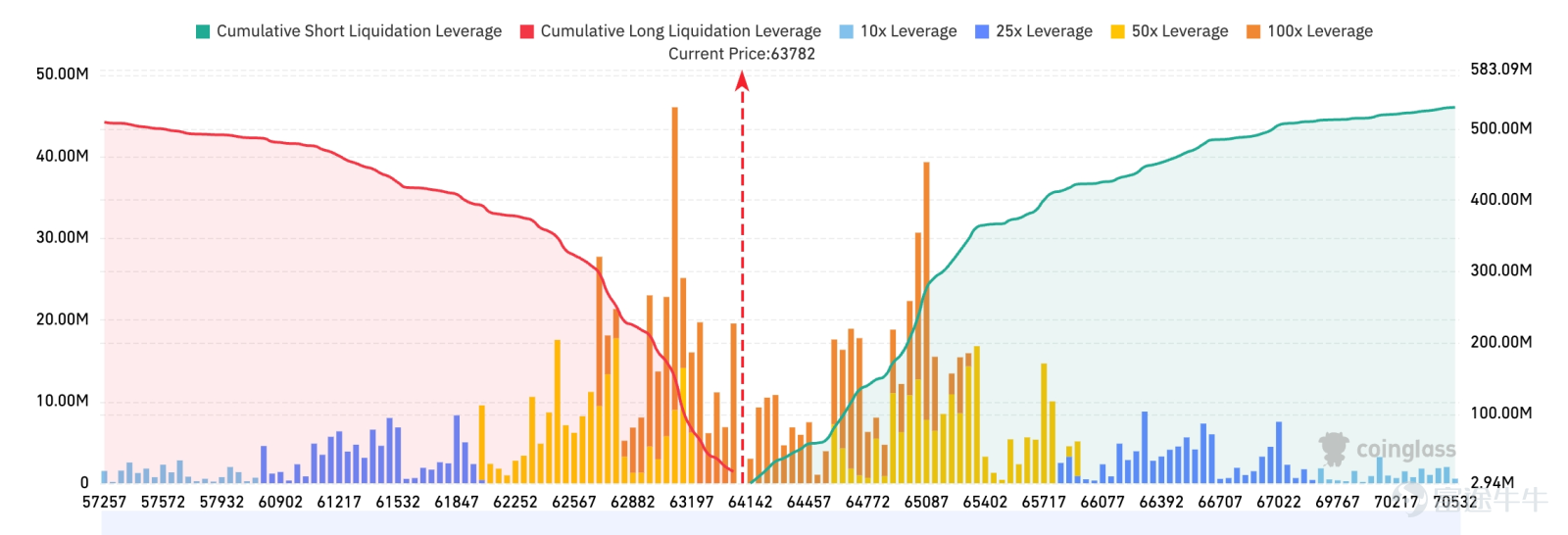
Bitget BTC/USDTLiquidation Map: Liquidation pressure near the current price (63,782) is limited, while a significant concentration of 50x and 100x short liquidation orders exists in the USD 64,700–65,300 range. A breakout above this zone could trigger a wave of short-covering, amplifying upward momentum. Cumulative short liquidation exposure above stands at approximately USD 500 million, compared to roughly USD 440 million in long liquidations below, indicating dominant short-side risk. This makes a short squeeze more likely in the near term, though resistance from dense high-leverage liquidation clusters around USD 65,000 warrants close attention.
Spot ETF net inflows/outflows: Bitcoin spot ETFs recorded net outflows of approximately USD 50 million yesterday and about USD 58 million in today's preliminary figures, marking five consecutive days of net outflows.
Driver Analysis: Following the Federal Reserve’s decision to hold rates steady, market uncertainty around the policy path has partially subsided, leading to a marginal recovery in risk appetite, with both BTC and Ethereum rebounding. However, macro headwinds persist due to oil price spikes and inflation concerns stemming from geopolitical tensions. Reduced leverage-driven liquidation pressure is supporting price stabilization. Cautious ETF flows suggest institutional investors remain on the sidelines. Overall, the trend remains moderately bullish within a volatile range, with near-term focus shifting to earnings reports from Apple and Amazon, as well as developments in Iran.
Dow Jones Industrial Average: Closed at 51,594.14 points (down 2.19%), marking a sharp pullback
S&P 500: Closed at 7,316.15 points (down 1.52%), hitting a one-month low
Nasdaq: Closed at 24,442.94 points (down 1.74%), notably dragged down by semiconductor stocks
NVDA: USD 190.01 (down 3.55%)
AAPL: $338.19 (-0.56%)
MSFT: $390.54 (-0.71%)
GOOGL: $335.76 (+0.95%)
AMZN: $226.65 (-1.82%)
META: approximately $585.61 (-1.31%)
TSLA: approximately $298.32 (-2.97%)
Performance Summary and Driver Analysis: The tech sector continues to diverge. Chip and memory stocks pulled back sharply, with Micron Technology down nearly 10%,AMD、Inteldown more than 5%, and NVIDIA falling over 3%, weighing on the Nasdaq; meanwhile, AI application software stocks maintained strength,Adoberising nearly 6%,Workdayand others rose over 5%. Apple and Microsoft held up relatively well, while Google rose against the broader trend. Microsoft rebounded sharply in after-hours trading on strong cloud business performance, reflecting the market's continued preference for 'earnings realization.' Overall, hardware names are under pressure while software and select large-cap tech firms remain relatively resilient, highlighting ongoing investor concerns about the returns on AI-related capital expenditures.
Storage concept continued to plummet
Representative stocks: Micron Technology fell nearly 10%, SanDisk dropped over 7%, and SK Hynix-related shares declined nearly 3%
Drivers: Cooling expectations for AI storage demand, compounded by chip sell-off sentiment.
Optical CommunicationsCollective weakness
Representative stocks: Applied Optoelectronics dropped over 13%,Coherentfell nearly 9%,Lumentumfell nearly 8%
Drivers: Following concerns over capital expenditure and hardware sentiment.
AI Application SoftwareContinued strength
Representative stocks: Adobe rose nearly 6%, Workday,Datadogrose more than 5%,ServiceNowup nearly 5%,
Drivers: Software implementation and earnings visibility are gaining favor with investors.
Event summaryMicrosoft dipped slightly during regular trading but rebounded sharply by nearly 8% in after-hours trading, driven by better-than-expected quarterly cloud revenue. The market is closely watching progress on the actual returns from its AI infrastructure investments.Market AnalysisAmid a broad sell-off in tech hardware stocks, Microsoft’s strong cloud performance demonstrates that its massive AI-related capital expenditures are beginning to translate into revenue, partially alleviating market concerns about 'excessive spending with uncertain returns.' This stands in contrast to the continued pullback in semiconductor stocks, highlighting the relative advantage of companies delivering tangible earnings.Investment InsightProgress in cloud and AI monetization remains the key focus; forward guidance will determine the extent of valuation recovery.
Event summaryThe stock fell nearly 10%, leading declines in the memory and semiconductor sectors, weighing on the Philadelphia Semiconductor Index.Market AnalysisMarket skepticism is deepening over the sustainability of the price rally in HBM and conventional memory, prompting continued outflows from high-valuation memory stocks. Earlier gains in the sector, fueled by expectations of strong AI server demand, have recently given way to sentiment dominated by downward revisions to those expectations.Investment InsightNear-term sentiment is driving the market; close monitoring of major customers’ capital expenditure plans and inventory data is essential.
Event summaryThe stock declined 3.55% to $190.01, continuing to face headwinds from concerns over AI infrastructure costs and competitive pressures.Market AnalysisThe market is still digesting multiple uncertainties—including the return timeline on capital spending, financing structures, and competitive dynamics—resulting in a lackluster rebound. This contrasts sharply with Microsoft’s cloud outperformance, underscoring growing divergence between hardware and software/cloud services segments.Investment InsightThe long-term AI demand thesis remains intact, but near-term valuations and spending cadence still require rigorous validation.
Event summaryShares fell 0.56% to $338.19, outperforming most tech stocks. The company will release earnings after market hours today.Market AnalysisAmid broad pressure on the hardware sector, Apple has secured a relative certainty premium thanks to its robust cash flow and resilient services business. The market awaits its earnings report to further validate growth in devices and services, as well as progress in monetizing AI-related investments.Investment InsightCertainty assets are favored in volatile markets, and earnings results will influence short-term capital flows.
Event summaryShares declined approximately 1.3%, with after-hours market attention focused on its capital expenditure outlook. Investors have remained sensitive to the scale of AI-related spending.Market AnalysisInvestors remain skeptical about the return timelines for hyperscalers’ continued heavy investments in AI infrastructure. Any upward revision to capital expenditure guidance could trigger volatility. This contrasts with Microsoft’s cloud business, which beat expectations, reflecting the market’s preference for realized revenue growth.Investment InsightCapital expenditure discipline and AI monetization efficiency are key pricing factors.
1. Samsung Electronics reported Thursday that second-quarter net profit was KRW 71.62 trillion (approximately USD 49.6 billion), up 1,299.9% year-over-year. Samsung, one of the world’s largest suppliers of high-end high-bandwidth memory (HBM) semiconductors, stated in a regulatory filing that operating profit for April–June rose 1,813.8% year-over-year to KRW 89.49 trillion, while revenue surged 130% to KRW 171.49 trillion.
2. The Ethereum Foundation has appointed Pascal Caversaccio (pcaversaccio) as its fourth board member. The current board includes Chair Aya Miyaguchi, founder Vitalik Buterin, and Swiss legal counsel Patrick Storchenegger. Caversaccio is co-founder of the Ethereum security group SEAL 911 and is known for his technical security expertise and philosophical commentary on cypherpunk culture, privacy, and decentralization. He is also the author of the 'Ethereum Cypherpunk Manifesto.'
3. On the afternoon of July 29 local time, U.S. President Trump told the media at the White House that the United States would 'deliver a heavy blow' to Iran due to 'Iran launching missiles at U.S. forces in the Middle East,' adding that 'it’s America’s turn to strike back.' Trump stated that 'Iran knows this strike is inevitable and has asked the U.S. not to carry it out,' but the U.S. will 'teach them a lesson.'
4. Microsoft reported fiscal fourth-quarter revenue of $90.01 billion, up 18% year-over-year; Meta posted second-quarter revenue of $60.8 billion, an increase of 28% year-over-year.
5. On July 29 local time, the latest Federal Open Market Committee (FOMC) meeting minutes from the U.S. Federal Reserve showed that the committee voted 9 to 3 to maintain the target range for the federal funds rate at 3.5% to 3.75%. Meanwhile, Waller reiterated the 2% inflation target and rejected characterizations that the Fed is 'standing pat.'
after-hours
United States
Apple and Amazon earnings reports
⭐⭐⭐⭐⭐
This week
United States
Core PCE, GDP, and other data
⭐⭐⭐⭐
July 30 (Thursday)
★★★★★ The Federal Reserve announces its interest rate decision; markets expect no change. Chair Powell holds a press conference afterward—watch for guidance on future rate path and potential for a September rate hike restart; current inflation pressures coexist with tariff-related uncertainty
★★★★★ US releases June core PCE price index, Q2 preliminary annualized real GDP growth rate, and weekly initial jobless claims
★★★★★ Apple and Amazon release earnings reports, testing the commercial viability of AI
★★★★ Samsung Electronics releases full Q2 earnings report (memory and AI chips)
★★★ Coinbase and Strategy release earnings reports after market close
Friday, July 31
★★★★ Kioxia releases earnings report (concluding results from Japan and Korea's memory trio)
US releases July Chicago PMI and final University of Michigan consumer sentiment index
Analysts broadly agree that Trump’s remarks about 'striking Iran hard' have significantly elevated geopolitical risk premiums and oil prices, intensifying inflation concerns and further complicating the Federal Reserve’s policy path. Waller’s reaffirmation of the 2% inflation target and downplaying of forward guidance indicate the Fed remains vigilant on inflation. U.S. equity hardware and storage stocks continue to face pressure, reflecting a deepening repricing of AI-related capital expenditure returns; however, Microsoft’s better-than-expected cloud business provided partial support. The crypto market stabilized and rebounded following the Fed decision, though macro uncertainty remains elevated. The overall consensus is that geopolitical and policy factors will jointly dominate near-term volatility, with Apple and Amazon earnings reports serving as the next key pricing catalysts.
Disclaimer: The above content has been compiled by AI-powered search and verified only by human review prior to publication. It does not constitute any form of investment advice. Data presented herein may inevitably contain inaccuracies; please refer to real-time market data for accuracy.
Risk Disclaimer: The above content only represents the author's view. It does not represent any position or investment advice of Futu. Futu makes no representation or warranty.Read more
Comments
to post a comment