
US individual stock warrants: Stock prices are highly volatile, but many warrant products are even harder to trade than the underlying stocks.
The divergence in individual stock performance this time is very clear.
Apple remains strong, closing at $338.19, close to its recent high of $344.57; Netflix rebounded from a low of $65 to $73.63. On the other hand, chip and high-volatility tech stocks plunged sharply: AMD fell 5.51%, NVIDIA dropped 3.55%, Micron tumbled 9.94%, and Tesla also fell below $300.
However, the biggest issue with Hong Kong-listed products is that the range of terms available for individual stocks is far more limited compared to index-linked products. The US individual stock products listed in the attachment are mainly call and put warrants, with no corresponding bull/bear certificates seen; moreover, each underlying stock typically has only one to three warrant products, and their strike prices may not align well with current technical levels.
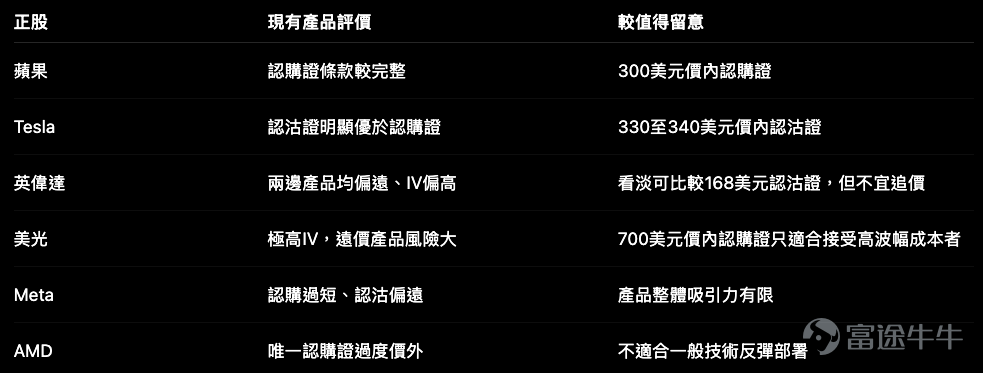
Apple $Apple (AAPL.US)$ : The underlying stock is the strongest, yet its call warrant is actually one of the more stable ones.
Apple closed at $338.19, with its Bollinger Band midline around $293. The share price is significantly above the midline, and the short-term RSI is also at a high level. The trend is strong, but it’s no longer an ideal setup for entering at a low price.
The current call warrant strike price is 300 USD, already approximately 12.4% in-the-money, expiring in early October, with an effective gearing of about 6xand a delta of approximately 83%, at a premium of approximately 1.6%, with daily time decay of about 0.3%.
The biggest advantage of this product is that its terms closely track the underlying stock’s movements. It doesn’t require Apple to rise by dozens of percentage points before becoming sensitive—whenever the underlying stock moves up or down, the warrant price generally reacts quite directly. Although the 6x leverage isn’t particularly high, it represents a reasonable trade-off given that the stock price has already risen significantly and volatility may increase.
Bearish products are exactly the opposite. The existing put warrants have an exercise price of only USD 248, about 27.6% out-of-the-money, with a delta of only around 3% and daily time value decay exceeding 6%. Even if Apple drops from USD 338 to USD 320, this put warrant may still not respond favorably.
Therefore, those bullish on Apple can still consider in-the-money call warrants, while those bearish should avoid chasing deeply out-of-the-money put warrants simply because their prices appear low.
NVIDIA $NVIDIA (NVDA.US)$ : The underlying stock has fallen to a support zone, but both call and put warrant terms are relatively expensive.
NVIDIA closed at USD 190.01, right near the lower Bollinger Band at approximately USD 190.20, with the RSI already at a low level. The stock may see a short-term technical rebound, but the overall trend has not yet regained strength.
The existing call warrants have an exercise price of $275, about 39.8% out-of-the-money, with an effective leverage of approximately 6.8x, a delta of less than 20%, and an implied volatility of around 47%. This product isn't merely betting on a rebound of the underlying stock to USD 200; it requires the stock price to retest much higher levels by year-end. Even if NVIDIA rebounds by 5% to 10%, the warrant’s price response may still fall short of expectations.
There are two sets of put warrants, with strike prices at USD 168 and USD 130. The USD 168 strike is approximately 14.6% out-of-the-money, with a delta of around 24% and implied volatility of about 52%. The USD 130 strike is even further out-of-the-money, with a delta below 10% and implied volatility close to 60%.
NVIDIA has now fallen to the lower Bollinger Band, reducing the risk-reward appeal of shorting it directly. Combined with relatively high implied volatility and distant strike prices, the warrant terms offer no clear advantage. Bearish investors who still wish to position themselves should note that the USD 168 strike at least tracks the underlying stock more closely than the USD 130 strike, but they must also be mindful of the pressure on warrant prices from a potential decline in implied volatility.
Tesla$Tesla (TSLA.US)$ : Put warrant terms are considerably more reasonable than call warrant terms.
Tesla closed at USD 298.32, breaking below the USD 300 level after several days of sharp declines. Its short-term RSI is now approaching extreme oversold territory. The trend remains weak, but those considering chasing the downside from here must account for rebound risk.
There are currently two put warrants with strike prices of USD 340 and USD 330, both in-the-money, with deltas of approximately 49% to 53%, expiring at year-end, effective gearing of about 2.7x to 2.8x, and daily time decay of only around 0.3%.
The gearing isn't high, but the terms are relatively solid. Since these warrants are already in-the-money, even if Tesla continues with a moderate decline—rather than plunging another few dozen dollars—the warrant prices should reflect the movement fairly steadily.
In contrast, the call warrant has a strike price of $490, nearly 60% out-of-the-money, expiring in October, with a delta of only about 5% and daily time decay of approximately 5.5%. Even if Tesla rebounds from USD 298 to USD 320, this call warrant may see only limited improvement.
Therefore, Tesla’s current warrant products are not suitable for betting on a rebound solely based on RSI being oversold. The issue isn’t that the underlying stock won’t rebound, but rather that the strike prices and maturity terms of existing call warrants may not effectively capture a typical technical rebound.
Micron dropped nearly 10% in a single day, closing at USD 739, breaking below the Bollinger Band lower band at USD 787, with an RSI of approximately 22. From a technical perspective, it has already entered a severely oversold short-term zone, yet the trend remains downward.
Currently, a more practical call warrant has a strike price of $700, is about 13.3% in-the-money, expires in early November, with a delta of approximately 71% and an effective leverage of around 2.6x. The problem lies in its implied volatility exceeding 100% and a premium of approximately 13.6%. In other words, although its directional sensitivity is acceptable, the product already embeds a very high volatility cost.
Another call warrant with a strike price of USD 1,800 is more than 100% out-of-the-money, carrying a premium of approximately 128%, making it unsuitable for capturing a normal rebound.
A put warrant with a strike price of USD 400 is about 50% out-of-the-money, with a delta of only around 8% and implied volatility reaching approximately 110%. Micron has already plunged sharply, yet this put warrant remains so far out-of-the-money—meaning an extremely severe additional decline would be required to generate noticeable returns.
Micron’s situation is very typical: while the underlying stock’s volatility appears most attractive, the warrants have already priced in this high volatility through elevated implied volatility. Choosing the wrong strike price under these conditions means that even if your directional view is correct, high premiums and a subsequent drop in volatility could erode your returns.
Meta $Meta Platforms (META.US)$ and AMD $Advanced Micro Devices (AMD.US)$ : There is still room for downside, but the product isn't cheap
Meta closed at USD 585.61, just touching the Bollinger Band lower band at approximately USD 580.90. Existing put warrants have a strike price of USD 475, about 21% out-of-the-money, with a delta of roughly 18% and implied volatility around 53%—terms that are relatively distant. Call warrants, meanwhile, carry a strike price of USD 830 and expire at the end of August, sitting about 38% out-of-the-money with daily time decay exceeding 12%, making them unsuitable for typical rebound strategies.
AMD closed at $429.56, breaking below the Bollinger Band lower rail of $455, technically also oversold. However, there is currently only one call warrant with a strike price $700, approximately 55% out-of-the-money, with implied volatility exceeding 82% and a premium over 63%. This product has limited actual sensitivity to a short-term AMD rebound and is closer to a high-risk, deep out-of-the-money option.
The real focus of individual stock products
What’s most noteworthy about this batch of U.S. equity-linked products isn’t which underlying stock has fallen the most, but rather which warrants still maintain normal directional sensitivity.

This product list actually reflects very clearly:Index-linked products offer a more complete ladder of strike prices and knock-out levels, whereas individual stock products often feature only one or two extreme terms.
Therefore, correctly forecasting the underlying stock’s direction is only the first step. If the strike price is too far out-of-the-money, delta is too low, implied volatility is too high, or expiry is too near, the warrant’s performance may significantly diverge from the underlying stock’s movement. For this current batch of U.S. equity-linked warrants, it’s better to choose products with lower leverage but already in-the-money and higher delta, rather than selecting deeply out-of-the-money warrants solely because of their low face value.
Risk Disclaimer: The above content only represents the author's view. It does not represent any position or investment advice of Futu. Futu makes no representation or warranty.Read more

Comment (1)
to post a comment
3
2