
HK Stock Market Barometer | Super Earnings Week for HK Stocks!

HSI breaks above the Bollinger Band upper band; 25,800 becomes the intraday support/resistance level: nearby out-of-the-money bear warrants offer leverage over 60x—check knock-in distance before chasing direction
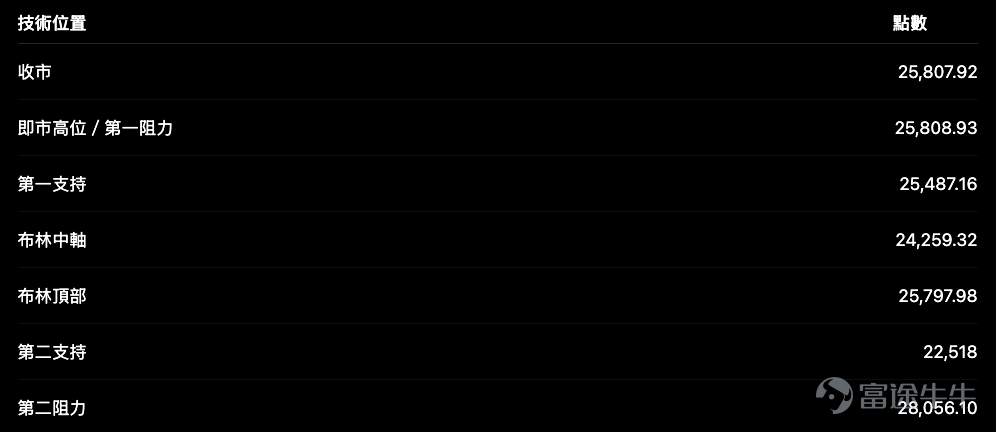
Hang Seng Index $Hang Seng Index (800000.HK)$ Closing at 25,807.92 points, up 497.07 points or 1.96%, reaching an intraday high of 25,808.93 points and closing nearly at the day's peak.
The key takeaway from this bullish candle isn’t just the nearly 500-point gain, but that the index has now risen to the vicinity of short-term resistance and the upper Bollinger Band. The trend remains strong, but above 25,800, the market is no longer in a simple bounce-from-lows phase—it’s now testing whether a genuine breakout can be achieved.
For bull and bear warrant investors, the most important question today isn’t “Should I chase after such a big rally?” but rather:
The closest-to-the-money bear warrants have a knock-in distance of less than 1%; the nearest bull warrants are only about 2.3% away.
While getting the direction right is crucial, choosing products that are too close to the current price means even a normal intraday pullback or spike could trigger early knock-in.
Hang Seng Index technical level: 25,800 is both a breakout point and a short-term risk level
From the daily chart, the Hang Seng Index has risen from its July low 22,518 points Since the rebound began, the index has risen by over 3,200 points and has now broken decisively above the upper Bollinger Band.
Key technical indicators currently stand as follows:

The Hang Seng Index closed slightly above the upper Bollinger Band by about 10 points, and the RSI has also moved into the relatively strong zone:
– Short-term RSI around 64.6
– Medium-term RSI around 61.1
– Longer-term RSI around 54.6
This structure is not yet severely overbought, but the short-term upward momentum has clearly accelerated. We can now consider two scenarios.
Scenario 1: Holding steady above 25,800
If the Hang Seng Index (HSI) can consistently hold above 25,800, it would indicate that this breakout above the Bollinger Band upper band is not just an intraday spike, and the short-term uptrend could extend further.
However, from a product perspective, chasing near-the-money bull certificates at this point does not equate to low risk. The index is currently in a breakout confirmation phase, and if it pulls back to around 25,500, bull certificates with knock-in levels close to the current price could still experience significant price volatility.
Scenario 2: Falling below 25,487
25,487 was today’s opening level and the day’s lowest point, and currently serves as the first support level.
If the HSI breaks above 25,800 but quickly falls back below 25,487, we should be wary of a failed breakout. In such a case, the index may first retest 25,000, or even the Bollinger Band midline at 24,259.
Therefore, the key for deploying bull certificates is not how much the HSI rose today, but whether the 25,487–25,800 range can hold firm.
Bull certificate distribution: Few near-the-money products are available; market participants are mainly focusing on those with more distant knock-in levels.
Among Hang Seng Index (HSI) bull certificates, product distribution by distance to call price is as follows:

Currently, only 11 bull certificates are within 3% of the underlying index—significantly fewer than in other groups.
This indicates that although there are numerous HSI bull certificates in the market, the selection of those closely tracking the current spot price and offering very high leverage is relatively limited. Most products have call prices set further away, resulting in more moderate leverage.
Two representative bull certificates listed in the product overview share identical terms:

Both products have a call price of 25,210 points, approximately 598 points below the HSI closing level.
At first glance, 598 points may seem like a comfortable buffer; however, the HSI has already risen nearly 500 points today, and recent volatility has clearly widened. A gap opening followed by a pullback the next day, or weakening overseas markets, could easily trigger moves of several hundred points—it’s not uncommon under current conditions.
With 35.8x leverage, even minor movements in the underlying index will cause rapid and amplified price changes in the product. Such bull certificates are better suited for traders who:
– Clearly expect the HSI to continue its short-term breakout;
– Can actively monitor intraday support at 25,487 points;
– Are willing to cut losses quickly if the upward momentum fails.
– Do not treat the call price as a stop-loss level.
Particularly note that the call price of 25,210 is about 277 points below the first support level at 25,487. If the Hang Seng Index (HSI) breaks below the first support, bull certificates will not be immediately called, but the safety margin will noticeably narrow.
Therefore, for these near-the-money bull certificates, true risk management should be based on technical levels of the index, rather than waiting until the product approaches its call price to take action.
Bear certificate distribution: 150 contracts already exist within 3%, indicating significantly denser supply of near-the-money bear certificates.
The distribution of bear certificates differs from that of bull certificates:

There are already 150 bear certificates within a 3% range, clearly more than bull certificates in the same interval.
This reflects that after the HSI approached 25,800 points, near-the-money bear certificates above this level are quite concentrated. However, a larger number of products does not mean greater safety; on the contrary, the closer a bear certificate is to the current index level, the more likely it is to be called if the index continues to rise.
Two representative bear warrants listed in the product overview are:

The call prices of these two bear certificates are only about 230 points and 280 points above the HSI closing level, respectively.
With leverage of 80.6x and 67.9x, they are certainly attractive to those bearish on intraday movements, but the risk is also highly concentrated.
The HSI reached an intraday high of 25,808.93 points today; if it rises further the next day:
– A rise of about 229 points would bring it close to the call price of 26,038;
– A rise of about 279 points would bring it close to the call price of 26,088.
Given today’s gain of nearly 500 points, this is not a very wide gap.
Therefore, these two bear warrants are more like intraday directional tools rather than products for investors waiting for the Hang Seng Index to gradually weaken.
If betting on resistance at 25,800, should one directly choose the nearest bear warrant?
The Hang Seng Index has just risen to a resistance level, so some investors naturally consider deploying bear warrants against the trend.
However, 'the index being at a resistance level' and 'buying the bear warrant with the nearest call price' are actually two different things.
If the Hang Seng Index shows the following signals near the 25,800 level:
– Opens higher but then pulls back;
– Fails multiple times to break through the 25,800–26,000 range;
– Falls back below 25,487 points;
– Both tech stocks and heavyweight stocks weaken simultaneously;
At this point, the bearish case becomes more complete.
However, if the Hang Seng Index remains stable above 25,800 points and the market is merely experiencing a brief consolidation after a sharp rally, bear warrants at 26,038 and 26,088 points may be breached and called first before the index pulls back.
Therefore, to express a view that resistance will hold effectively, it isn’t necessary to use bear warrants with call prices less than 1% away. Products with slightly more distant call prices, though offering lower leverage, actually give investors more time to confirm the market direction.
Three product strategies: breakout, pullback, and failed breakout
1. Hang Seng Index holds above 25,800 points: prefer bull warrants, but avoid chasing only the highest-leverage products
If the Hang Seng Index holds above 25,800 points, 25,487 points can be viewed as the first risk threshold.
Near-the-money bull warrants can capture breakouts, but 35.8x leverage is already quite aggressive. Unless trading intraday, bull warrants with more distant call prices are better able to withstand normal pullbacks.
Deployment focus:
– Watch whether the Hang Seng Index can stabilize above 25,800 points;
– The recovery price should ideally be a reasonable distance below the first support level;
– Do not ignore the effective leverage just because the product price is low;
– If the index breaks below 25,487 points, reassess whether the breakout remains valid.
2. Hang Seng Index rebounds after retesting 25,487 points: Bull certificates may offer better risk-reward potential
Compared to chasing entry above 25,800 points, if the Hang Seng Index first retraces to test 25,487 points and then shows support, it would be easier to establish clear risk parameters when deploying bull certificates.
Observe at that time:
– Whether 25,487 points transitions from resistance to support;
– Whether trading volume contracts during the pullback;
– Whether the index can reclaim 25,800 points.
Only if the support holds effectively should one consider using bull certificates to capture the second leg of the rally, as this is often easier to manage than chasing the market higher directly.
3. Hang Seng Index falls below 25,487: Bear certificates shift from contrarian bets to confirmed trades
If the Hang Seng Index breaks below 25,487, it indicates that the upward momentum failed to sustain after breaching the upper Bollinger Band, potentially triggering a short-term pullback.
At this point, deploying bear certificates shifts from 'trying to call the top' to 'following the confirmed weakening trend.'
However, the knock-in levels of these bear certificates are only 0.89% to 1.09% away. Even if the trend turns bearish, investors should beware of a potential rebound testing 25,800 to 26,000 first. For those not planning to close positions intraday, choosing certificates with more distant knock-in levels would be more prudent.
Alternative warrant strategy: To avoid immediate knock-in risk, consider slightly out-of-the-money call or put warrants.
In the product overview, Hang Seng Index call warrants primarily fall into two groups based on their terms:
– Strike price at 26,000: Approximately 0.7% out-of-the-money, with effective gearing around 10.4x and delta around 53.85%
– Strike price at 28,000Approximately 8.5% out-of-the-money, with effective gearing of about 12x to 13.9x and delta ranging from approximately 29.59% to 32.96%
If bullish on a Hang Seng Index (HSI) breakout but wishing to avoid the mandatory call risk of bull certificates, call warrants near the 26,000 level with higher deltas will more closely track the index’s performance.
Although the 28,000-strike call warrants offer higher gearing, they are also deeper out-of-the-money. If the HSI merely oscillates between 25,800 and 26,000 points, these warrants may not respond as directly as at-the-money warrants and will incur daily time decay.
For put warrants, representative products have strike prices ranging from 21,800 to 22,500 points—approximately 12.8% to 15.5% out-of-the-money—with deltas of only about 14% to 19.27%.
This group of put warrants carries lower knock-out risk compared to bull/bear contracts but is relatively deep out-of-the-money. If the HSI declines by only a few hundred points, the product’s sensitivity may not be particularly high, making it more suitable for investors who anticipate a larger correction and are willing to allow some time for the move to unfold.
Today’s Key Deployment Levels for HSI Bull/Bear Certificates
The HSI trend remains relatively strong, but the closing price has slightly exceeded the upper Bollinger Band, with 25,800 now serving as a breakout confirmation level.
We will set our short-term support/resistance levels at:
– Upside confirmation: 25,800 to 26,000 points
– First support: 25,487 points
– Key medium-term support level: 24,259 points
For bull certificates, representative products with a call price of 25,210 points and approximately 35.8x leverage can capture breakout continuation, but the 598-point buffer should not be considered very safe.
For bear certificates, those with call prices between 26,038 and 26,088 points are only about 0.89% to 1.09% away from the current index level, offering extremely high leverage of 67.9x to 80.6x. The key consideration for trading these products is not whether the Hang Seng Index will decline, but whether it will first rise above the call price before any potential drop.
Although directional judgment remains important after the Hang Seng Index rose nearly 500 points today, it’s often the distance to the call price that ultimately determines trading outcomes.
Bullish traders should guard against pullbacks, while bearish traders should beware of further short squeezes. It’s best to overlay call prices, leverage ratios, and technical levels from the product overview onto a single chart for comparison, rather than selecting solely based on the cheapest or highest-leverage product.
Risk Disclaimer: The above content only represents the author's view. It does not represent any position or investment advice of Futu. Futu makes no representation or warranty.Read more


Comments
to post a comment
5
1