NVIDIA's revenue doubles, beating expectations; is the AI trade narrative making a comeback?

Five Key Truths Behind the 'De-leveraging Style' Plunge in Semiconductor and Memory Sectors, and What to Watch Next
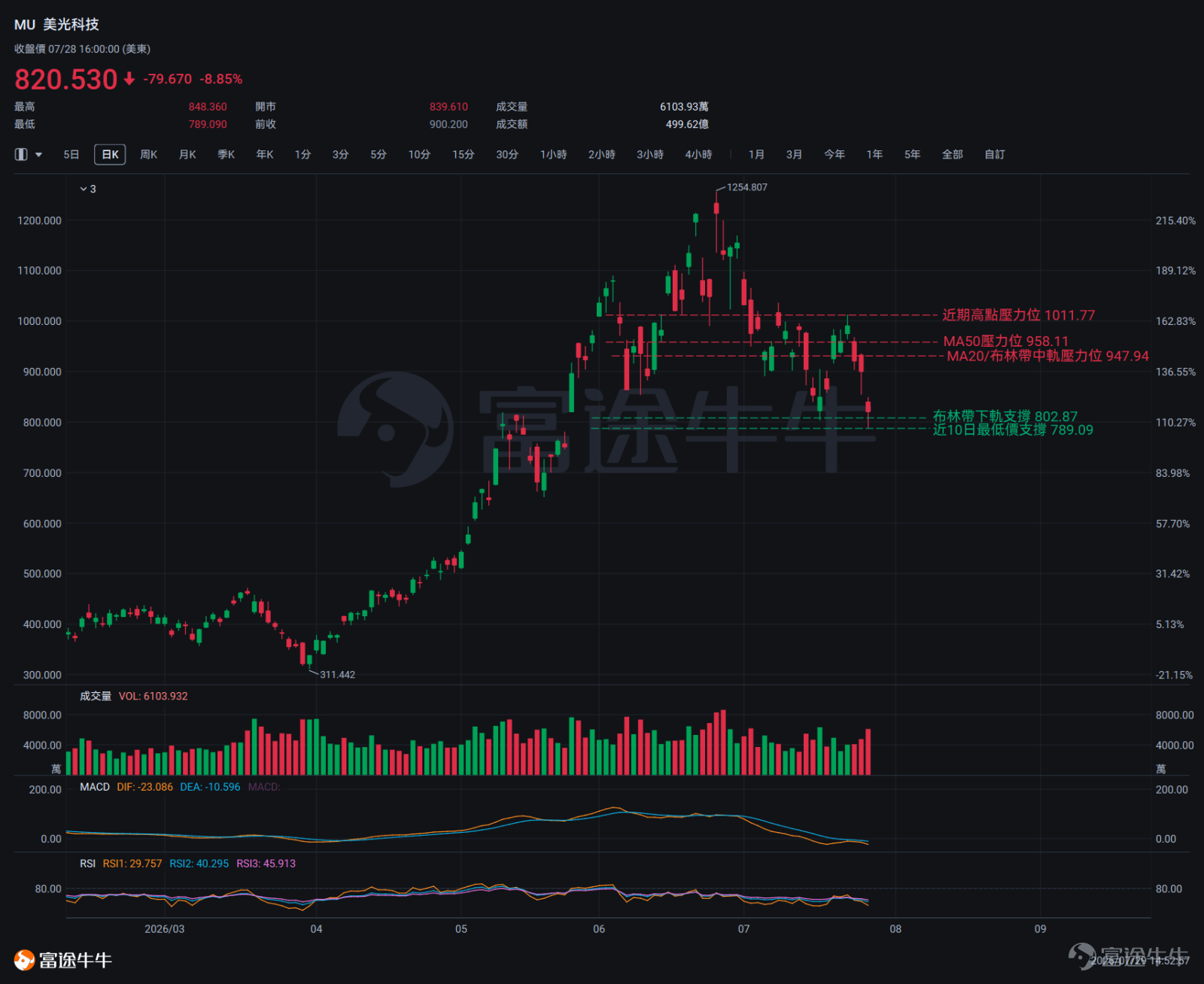
Global semiconductor and memory sectors faced a sharp sell-off in July,Market conditions were brutal. Both sector indices and core stocks recorded double-digit monthly declines— $Korea Composite Index (.KOSPI.KR)$ As of the July 29 market close, the index posted itslargest single-month drop since inception (-33.19%),triggering seven market-wide circuit breakers in a single month—more than the total number triggered in the previous 25 years combined; $PHLX Semiconductor Index (.SOX.US)$ In the same month, it alsoplummeted by over 20%; $Micron Technology (MU.US)$ From its all-time high of $1,254.80 (intraday peak on June 25)It has continued to decline, falling all the way to its current level of around $800; $SanDisk (SNDK.US)$ and $SK Hynix (000660.KR)$ It even halved in a single month,erasing nearly half of its market capitalization.
Take Micron and Western Digital as examples. Micron is facing significant technical pressure,The overall trend has recently remained in a downward pattern,forming a distinct bearish dominance structure. The stock price has been consistently trading near the lower end of the Bollinger Bands, between the middle band ($947.94) and the lower band ($802.87),indicating that selling pressure has not yet fully subsided. On the support side, $802.87 marks the lower Bollinger Band;if this level is decisively breached,the next key support to watch would be $789.09 (the intraday low reached on July 28).
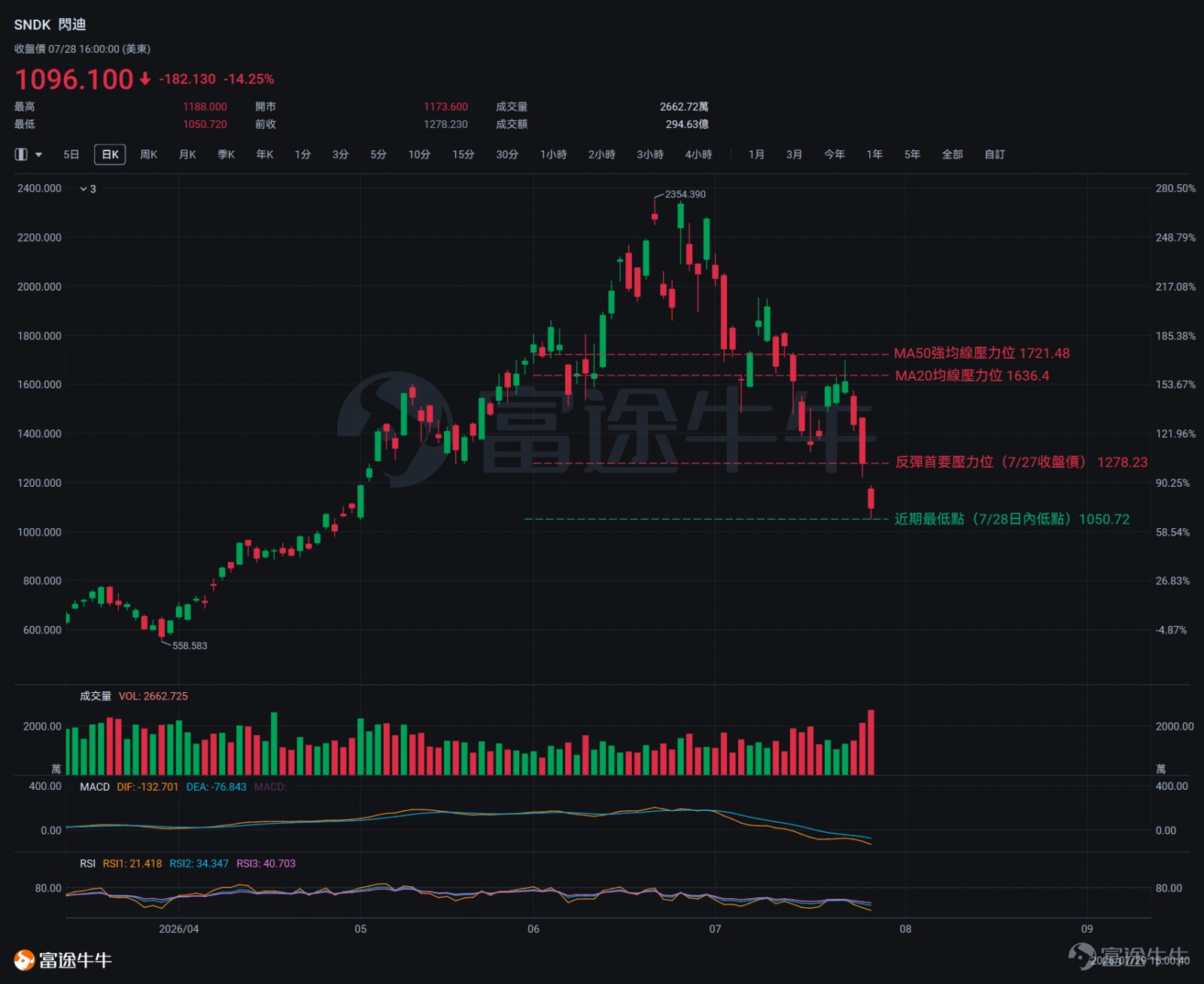
Similarly for SanDisk, its current share price has already sharply broken below the 20-day moving average (USD 1,636.4) and the 50-day moving average (USD 1,721.48), and has effectively pierced through the lower Bollinger Band (USD 1,108.46),reflecting extremely concentrated selling pressure. In terms of support, USD 1,050.72 represents the lowest intraday level reached on July 28 and serves as the recent extreme low point,and once this level is decisively breached, there is no significant technical support below.Further downside risks warrant caution.
This round of selling has gone beyond the scope of a cyclical correction,exhibiting characteristics of systemic deleveraging.—Five independent pressure lines converged in late July, compounding an extremely crowded trade structure and ultimately triggering a disorderly sell-off. Until deleveraging is complete and foreign investor selling pressure shows marginal relief,sector volatility is expected to remain at historically elevated levels.
The following sections will break down these five resistance levels one by one and outline the key price points investors should monitor in both the short term and medium to long term.
I. Formation and Convergence of the Five Pressure Lines
Pressure Line #1: Repeated KOSPI circuit breakers—the first domino in the July crash
On July 7, Samsung Electronics released preliminary Q2 results: operating profit surged 1,800% year-over-year, hitting a record high. However, the market was unimpressed—the KOSPI index plunged as much as 8% intraday, triggering a circuit breaker, and ultimately closed down 4.91%. U.S. equities followed suit: Micron fell 4.71% and SanDisk dropped 7.26% that day.
Samsung and SK Hynix together account for over 50% of the KOSPI index weight, creating the index’s most acute concentration risk. This structural featureThis has made any negative signal in the memory sector instantly amplify into systemic selling, directly transmitting panic sentiment to U.S. markets after the close of Asian trading hours.
Pressure Point #2: The Deleveraging Spiral in Trading
If the previous pressure point explains 'why the market is falling,' this one explains 'why the decline is so severe.'
On May 27, 2026, South Korea’s Financial Services Commission (FSC) approved the official listing of single-stock, 2x leveraged ETFs tracking Samsung Electronics and SK Hynix. In their first month of trading, these ETFs recorded cumulative turnover of KRW 212 trillion. Meanwhile,Retail margin debt in South Korea surged to a record high of KRW 60 trillion (approximately USD 41 billion) in May, with retail margin accounts accounting for 35% of total market trading activity and an average leverage ratio of about 3x.According to Goldman Sachs data, as of July 13,1.2 million retail leveraged accounts had received margin calls, of which 320,000 to 360,000 accounts were forcibly liquidated,equivalent to one in every 30 South Korean adults facing the risk of account liquidation.On July 29, South Korean retail investors faced forced liquidations totaling approximately KRW 1.7 trillion (about USD 1.2 billion) in a single day due to margin calls.
The U.S. market has also been hit hard. According to Seeking Alpha,The total assets of U.S. leveraged semiconductor ETFs have evaporated from a peak of $163 billion to approximately $60 billion,Over $100 billion vanished within just a few weeks.
On July 16, the Financial Services Commission (FSC) announced emergency regulatory tightening:Suspending new single-stock leveraged ETF listings and raising the minimum cash margin requirement from KRW 10 million to KRW 30 million,with the measures taking effect early on July 31. The product was halted by regulators just 50 days after its launch,as regulators acknowledged through action the systemic risks created by the initially overly rapid pace of market opening.
Pressure Point #3: ChangXin Memory IPO
On July 27, $CXMT Corporation (688825.SH)$ Its listing on the STAR Market (with a first-day gain of +465%) appears to have triggered a market reassessment of the memory sector’s competitive landscape—SanDisk fell over 11% that day, while Micron dropped 2.25%.
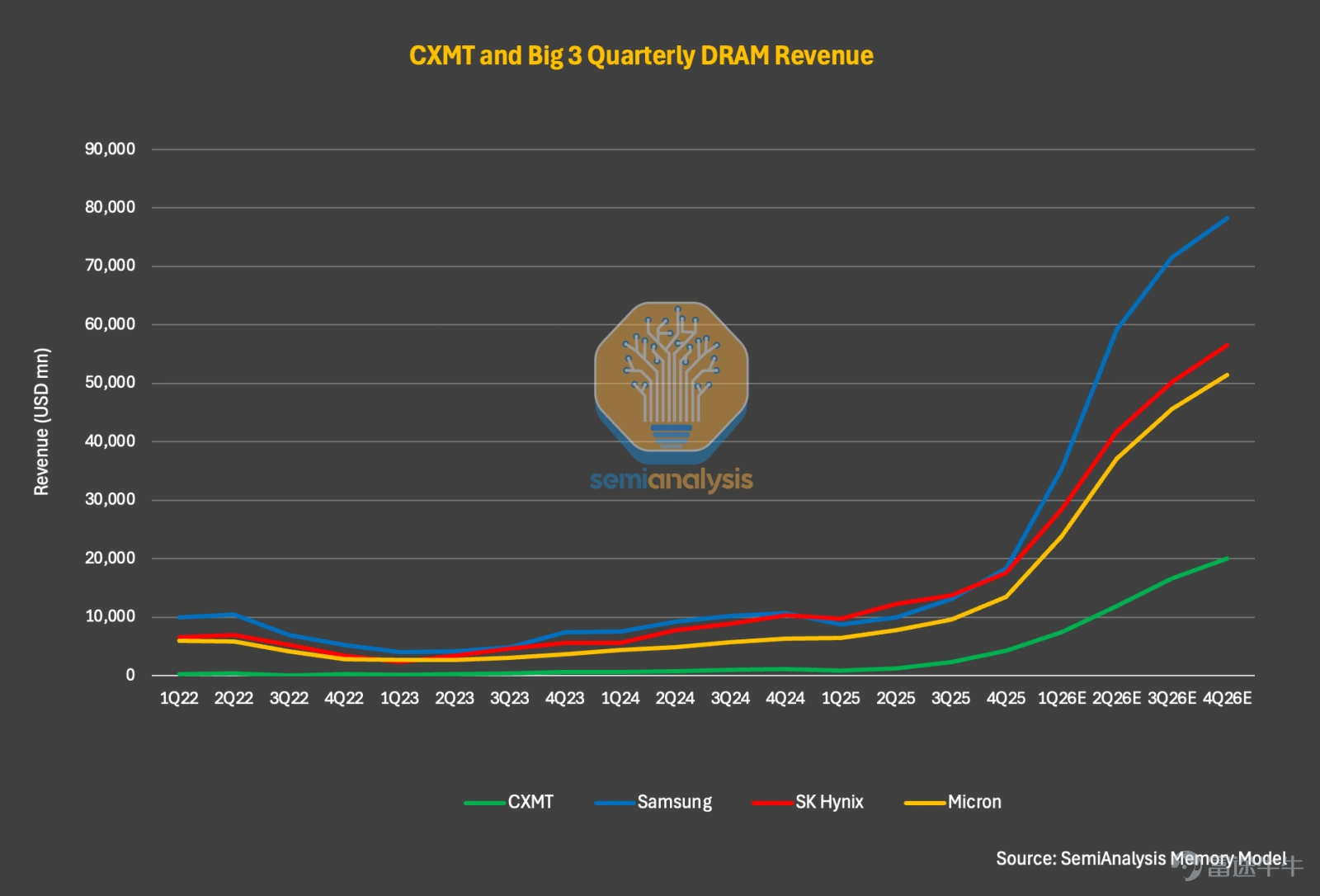
However, there is a notable cognitive bias worth highlighting. According to a SemiAnalysis research report,even if all of ChangXin’s新增产能 is fully accounted for, the global DRAM market will remain severely supply-constrained through at least 2028.The ChangXin IPO is essentially asentiment-driven narrative event rather than a fundamental one.In a highly crowded trading setup, the market needs a compelling pretext to initiate profit-taking, andthe ChangXin IPO has provided such a window.
Pressure Point #4: Widening NVIDIA CDS Spreads – Credit Market Pricing of the AI Capex Narrative
Also on July 27, Bloomberg and The Wall Street Journal reported that $NVIDIA (NVDA.US)$ negotiations are underway regarding providing a $250 billion financing guarantee for OpenAI’s Ohio data center and arranging $350 billion in financing for OpenAI’s chip purchases. NVIDIA’s five-year credit default swap (CDS) spread widened by 14 basis points that day to approximately 82 basis points.What the market is pricing in is the risk of 'circular financing'—is demand being artificially inflated?
This logic chain is impacting memory stocks due to its transmission pathway:If the ROI of AI commercialization comes under scrutiny → Will HBM and DRAM demand forecasts be revised downward? → Potential revaluation of memory stocks.
Pressure Point #5: Peak Trading Crowding and Profit-Taking
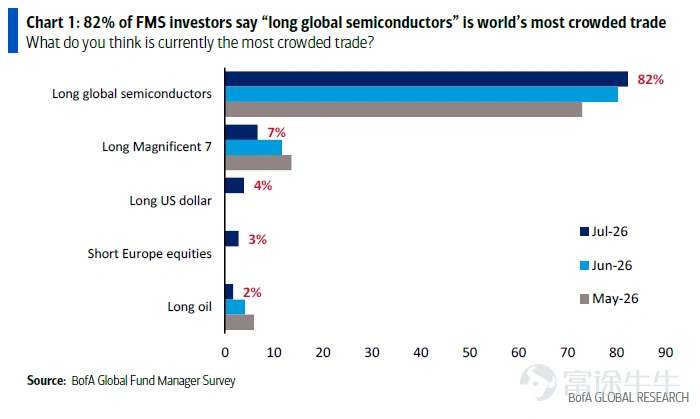
Bank of America's July Global Fund Manager Survey shows that 82% of surveyed fund managers listed 'long global semiconductors' as the most crowded trade in history—up from just 24% in May. Hedge funds have recorded net selling of tech and semiconductor stocks for the fourth consecutive week.
Take Micron as an example: its stock price rose from $285 at the end of 2025 to a record high of $1,254.80 in June 2026, representing a cumulative gain of approximately 340% (about 3.4x).Massive accumulated gains, combined with multiple uncertainties this week—including earnings reports from major tech giants (Meta, Microsoft, Amazon, Apple) and the latest FOMC interest rate decision—mean that any negative narrative could trigger panic-driven profit-taking sell-offs.
2. Is the memory supercycle ending, or is this an overreaction?
Fundamentals have not deteriorated; rather, valuations have simply run ahead of fundamentals.
Micron’s Q3 FY2026 (ended May 2026): Revenue reached $41.4 billion, up 346% year-over-year, exceeding Wall Street expectations by about 15%, with a GAAP gross margin of 84.6%. It guided Q4 revenue at $50 billion. Samsung reported a record-high operating profit margin in Q2. According to TrendForce, as of early July 2026, Samsung was still requesting a 13–18% increase in Q3 server DRAM contract prices.
Bloomberg Intelligence’s view is that Q2 2026 could mark the peak of the current memory shortage, butthis does not mean prices are about to reverse; rather, the steepest phase of supply-demand imbalance may have passed.
Based on the above data, the current decline in the semiconductor and memory sectors is morea correction process reverting from an 'extremely crowded and overly optimistic' position back to 'reasonable' levels, rather than a signal marking the end of the memory supercycle.
III. Key Upcoming Milestones to Watch
InvestorsIn the near term, investors should closely monitor the Federal Reserve's interest rate decision meeting and the upcoming密集 earnings season of major technology companies,Institutional investors systematically reducing risk exposure ahead of earnings season is standard practice, not a standalone bearish call on the memory sector.
Over the medium to long term, investors should focus on the most critical 'thesis' for the entire AI supply chain right now—How each company demonstrates to the market that its massive AI-related capital expenditures can generate commensurate—or even better-than-expected—commercial returns. Only if companies fail to demonstrate this in a timely manner, or if demand shows any signs of slowing, will the tech sector face a genuine cyclical reassessment of risk—rather than the current correction driven primarily by sentiment and leverage.
In summary:The AI story isn’t over yet, but the part where profits came easily may already be behind us.
Risk Disclaimer: The above content only represents the author's view. It does not represent any position or investment advice of Futu. Futu makes no representation or warranty.Read more


Comments (42)
to post a comment
279
437