
HK Stock Market Barometer | Super Earnings Week for HK Stocks!

Hang Seng Index rebounds above 25,300: Bull and bear warrants' near-term zones are equally crowded—should the next focus be 25,000 or 25,440?
Hang Seng Index $Hang Seng Index (800000.HK)$ Closed at on July 28 25,310.85 points, up 103.67 points or 0.41%, with intraday high and low at 25,440.68 pointsand 25,069.85 points。
Following the recent rebound from the low of 22,518 points, the index has reclaimed the 25,000 level and is gradually approaching the resistance ahead. From the chart, the Bollinger Bands middle band currently sits around 24,373 points, and the upper band is around 25,868 points; short-term RSI is around 67.1, and the medium-term RSI has also risen above 62.
This means the Hang Seng Index (HSI) remains in an ongoing rebound phase, but short-term momentum is already relatively high. At this level, when deploying bull or bear warrants, one should not only consider that 'the uptrend continues,' but also assess how close the index is to overhead resistance levels and the warrant’s call price.
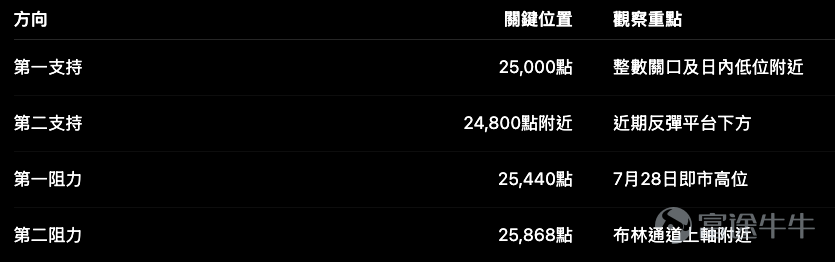
Key short-term support and resistance levels for the HSI
Four key levels should be monitored for now:

As long as the HSI holds above 25,000 points, the rebound structure remains intact; if it breaks above 25,440 points, the next natural test zone would be 25,800 to 25,870 points.
Conversely, if the 25,000-point level is breached, the index could first retest 24,800 points, after which attention shifts to whether the middle Bollinger Band—around 24,373 points—can provide more noticeable support.
Therefore, at this stage, the strategy isn’t simply about chasing bulls or bears, but rather deciding upfront:Whether you’re positioning for a breakout above 25,440 or betting on a breakdown below 25,000.
Bull warrant distribution: Few near-the-money products, but trading volume is highly concentrated
Based on the HSI bull warrants listed in the product overview, the distribution by distance to call price is as follows:

The most obvious point is thatonly 18 bull certificates are within 2%, yet their trading volume is significantly higher than those in other ranges。
This indicates that short-term capital is primarily concentrated in near-the-money bull certificates. However, street float should only be viewed as a lagging indicator of positions; one should not assume the Hang Seng Index will definitely rise solely based on higher street float or active trading.
The issue with near-the-money bull certificates is that their call prices are often very close to the 25,000 level. If the Hang Seng Index experiences even a single intraday pullback, these products may be called first—investors would then be unable to participate even if the index rebounds afterward.
Representative Bull Certificate Terms
Two representative bull certificates listed in the product overview are as follows:

Both products have leverage exceeding 50x, making them highly sensitive, but their call prices are also extremely close to the index level.
When the Hang Seng Index closed at 25,310, a bull certificate callable at 25,000 had only about 310 points of buffer. Given the Hang Seng Index’s typical intraday volatility, this margin is quite narrow.
Therefore, these types of bull certificates are more suitable for:
– Clearly positioning for an intraday breakout above 25,440;
– Able to strictly control position holding duration;
– Willing to accept the risk of a quick retracement triggering a knock-in event.
If you are only moderately bullish or expect the Hang Seng Index to consolidate between 25,000 and 25,440 points, choosing a bull certificate with a 3% to 5% knock-in bufferis generally easier to manage than chasing 60x leverage.
Bear Certificate Distribution: Products and open interest are more concentrated within 2%
For bear certificates, both the number of products and open interest are more concentrated near-the-money compared to bull certificates:

The Hang Seng Index is currently close to the intraday high of 25,440 points, so nearby out-of-the-money bear certificates naturally see higher activity.
However, note that the Hang Seng Index remains in a rebound structure, and the RSI has not yet shown clear signs of weakening. If the index breaks above 25,440 points, bear certificates near 25,600 points will quickly face knock-in pressure.
Represents bear certificate terms

The call price of both bear warrants is near the 25,640 level.
This level is still some distance away from the upper Bollinger Band at 25,868, but only about 200 points above the Hang Seng Index's high of 25,440 on July 28. If the index gaps up sharply the next day or surges rapidly after a breakout, bear warrants would react very violently.
Therefore, nearby-strike bear warrants are better suited for deployment when:
– The Hang Seng Index clearly meets resistance around 25,440;
– Intraday price shows a pullback from highs;
– After re-breaking below 25,300, betting on a test of 25,000 again.
If the index remains firmly above 25,300, buying nearby-strike bear warrants solely because RSI is approaching 70 carries relatively high risk. In strong market conditions, RSI can stay elevated for an extended period and does not necessarily indicate an immediate reversal.
Current product strategy
Bullish on the Hang Seng Index: First clarify whether you're betting on a breakout or waiting for a pullback
If positioning for a breakout above 25,440, high-leverage bull warrants with a call price close to 25,000 can offer higher sensitivity, but should be treated as ultra-short-term instruments.
If you simply believe the Hang Seng Index’s overall rebound isn’t over yet but are uncertain about an immediate breakout, a more prudent approach is to widen the distance to the call price to 3% to 5%, to avoid early recall triggered by normal intraday volatility.
Another approach is to wait for the Hang Seng Index (HSI) to retest the 25,000 level and hold firm before considering bull certificates, rather than chasing in near the resistance at 25,400.
Bearish on the HSI: first need to see effective resistance at 25,440
Currently, the call-back prices of nearby bear certificates are mostly clustered around the 25,600 level, not far from the current HSI.
If the index breaks above 25,440 and stabilizes, the risk for nearby bear certificates will rise rapidly; if the HSI meets resistance near 25,440 and falls back below 25,300, bear certificates would then have a clearer short-term support/resistance level.
A more conservative bearish strategy could involve selecting bear certificates with a buffer of **3% to 5%**, sacrificing some leverage in exchange for greater tolerance if the index moves upward to test key levels.
Warrants as an alternative instrument
Investors who wish to avoid the call-back mechanism may consider Hang Seng Index warrants.
Among the product overview, representative slightly out-of-the-money call warrants have strike prices at 25,125 points, approximately 0.7% in-the-money, with an effective leverage of about 9.8x, a delta of around 58.5%, and a premium of approximately 5.23%.
Compared to nearby bull certificates with leverage exceeding 50x, warrants naturally react more slowly, but they won’t be immediately called due to a brief dip in the Hang Seng Index below a certain level.
For slightly out-of-the-money call warrants at the 28,000-point strike, effective leverage can reach 12x to 14x, but delta is only about 25% to 29%, and the premium exceeds 12%. If the Hang Seng Index rises only gradually, the performance of these products may not directly reflect their stated leverage.
On the put side, strikes at 21,800 and 22,500 points are relatively far from the current index level and are better suited for positioning ahead of a significant correction in the Hang Seng Index. If one is merely betting on a pullback from 25,440 to 25,000 points, at-the-money bear certificates would offer higher short-term sensitivity, but also carry significantly greater knock-out risk.
Summary: Between 25,000 and 25,440 points, knock-out distance matters more than direction
The Hang Seng Index remains above the 25,000-point level for now. The short-term rebound structure remains intact, but the index is already approaching the 25,440 resistance, and RSI has risen into overbought territory.
Nearby bull and bear certificates generally offer leverage close to or exceeding 60x, with knock-out distances of only about 1.2% to 1.4%. With these products, it’s not enough to simply 'get the direction right'—entry timing and the index path are equally important.
At this stage, we can broadly consider three scenarios:
– Break above 25,440 pointsBullish strategies are favorable, but avoid chasing overly close-to-the-money bull certificates.
– Consolidating between 25,000 and 25,440 pointsProducts with 3% to 5% knock-in buffers are easier to manage.
– A break below 25,000 pointsShort-term structure has weakened; next supports seen at 24,800 and 24,373 points.
The product overview already compares different knock-in levels, leverage ratios, trading volumes, and open interest distributions. For Hang Seng Index bull/bear certificates, the most important factor to consider first is often not the product price, but whether the knock-in level allows room for normal index fluctuations.
Risk Disclaimer: The above content only represents the author's view. It does not represent any position or investment advice of Futu. Futu makes no representation or warranty.Read more


Comments
to post a comment
4