
BYD and CATL: Both leaders in new energy, but their risk-reward ratios have diverged into two different worlds
BYD Company Limited (01211) $BYD COMPANY (01211.HK)$ and Contemporary Amperex Technology Co. Limited (CATL) (03750) $CATL (03750.HK)$ , have recently shown a fairly clear divergence in their price trends.
Let’s first look at the risk-reward ratio.

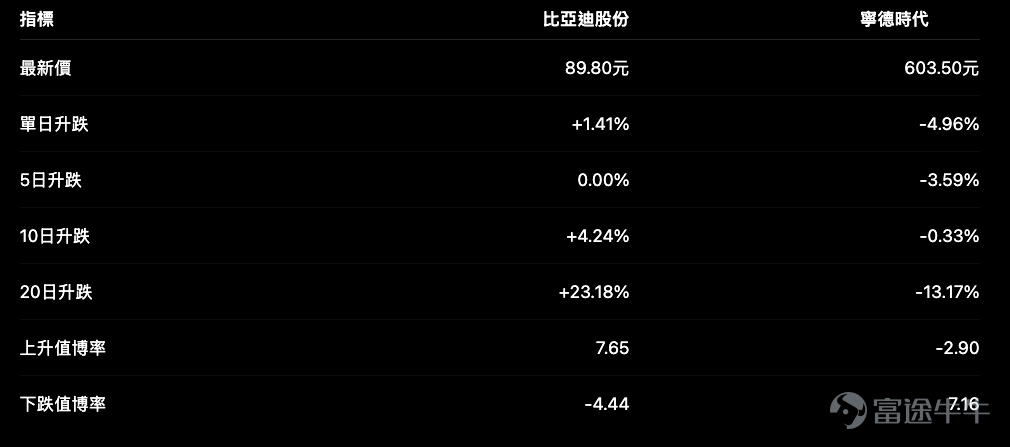
From the data, BYD still maintains a medium-term upward structure, while CATL is currently in a notably weaker phase.
BYD's support levels are at HK$86.45 and HK$84.60, and resistance levels are at HK$91.65 and HK$91.70Current price is RMB 89.80, meaning the share price is already approaching resistance.
CATL's support levels are at RMB 599.50 and RMB 598.50, with resistance at RMB 637 and RMB 640The current price of RMB 603.50 is already very close to the support zone.
The trading setups for these two stocks are exact opposites:
– BYD shows stronger momentum but is nearing resistance;
– CATL shows weaker momentum but is also approaching support.
Product lineup: BYD offers a more comprehensive selection
BYD has a total of 160products, including 51 call warrants, 33 put warrants, and 76 bull/bear certificates.
CATL has a total of 105products, including 58 call warrants, 19 put warrants, and 28 bull/bear certificates.
BYD offers a relatively comprehensive range of terms across bullish, bearish, and bull/bear certificate products. Although CATL also has a considerable number of products, some of its terms feature higher degrees of out-of-the-moneyness and volatility, requiring more careful selection.
BYD: For bullish products, avoid chasing the highest leverage alone
Among representative BYD call warrants, those with strike prices around HK$90.88 and HK$91.88are only about 1.2% to 2.3% out-of-the-money, with effective gearing of approximately 4.7x to 4.8xand a delta of approximately and implied volatilities ranging from 54.76% to 56.21%, with a premium of approximately 13.17% to 13.79%。
These warrants have strike prices closer to the current market price; if BYD breaks above HK$91.70, the reaction would be relatively immediate.
Another type of call warrant has a strike price of HK$121.10, about 34.9% out-of-the-money, with a premium of approximately 44.04%, yet its leverage is only 3.9x. This is a classic example: a distant strike price doesn’t necessarily mean the product will have higher explosive potential.
Regarding bull certificates, the call-back price is around HK$82 and HK$77, approximately 8.69% and 14.25%, with leverage of approximately 8.8x and 5.9x, respectively.
Since the nearest support level is at HK$86.45, the HK$82 call-back price remains below support, making the structure relatively reasonable; however, BYD’s current price is already near resistance, so traders should still account for the possibility of a failed breakout when positioning.
CATL: Being near support doesn't mean you should immediately bet on a rebound
The terms of representative CATL call warrants vary significantly.
The call warrant with a strike price of HK$605 is only about 0.2% out-of-the-money, with a delta of approximately 57.92%, but its effective leverage is only around 4.3x; the call warrant with a strike price of HK$668 is about 10.7% out-of-the-money, offering leverage of approximately 8.3x, but suffers daily time decay of 1.82%。
If investors merely expect a technical rebound near HK$600, products that are closer to-the-money and have higher delta are generally more suitable than those chasing leverage above 8x.
Regarding bull certificates, the product with a knock-out price of HK$585 is only about 3.07%, with a nominal leverage of 20.1 times. This level of leverage is attractive, but CATL has already dropped 4.96% in a single day, and its support zone is only between HK$598.50 and HK$599.50—there isn’t much additional buffer before hitting the HK$585 knock-out level.
Another bull certificate with a knock-out price of HK$520 is about 13.84% away from the current price, reducing its leverage to 6.2x, offering significantly more safety margin.
How to compare?
In terms of price trend, BYD currently appears stronger; in terms of positioning, CATL is closer to its support level.
From a product perspective, BYD’s near-the-money calls and mid-range bull certificates make it easier to formulate a clear strategy; although CATL’s high-leverage bull certificates are appealing, their knock-out risk is also more concentrated.
Therefore, the choice isn’t simply ‘buy calls on the strong, buy puts on the weak.’
A more practical approach is:
– BYD: Wait for a breakout above RMB 91.70, or consider entering after a retest of RMB 86.45;
– CATL: First observe whether RMB 598.50 can hold steady; avoid buying into falling products solely due to 20x leverage.
By comparing the terms of both stocks side-by-side in the product overview, it becomes clear: although both are new energy stocks, their optimal trading strategies differ significantly.
Between these two stocks right now, would you prefer to follow the trend with BYD, or wait for a rebound signal from CATL near the RMB 600 level?
Risk Disclaimer: The above content only represents the author's view. It does not represent any position or investment advice of Futu. Futu makes no representation or warranty.Read more
Comments
to post a comment