
NVIDIA's earnings report is set to be released on Thursday, putting AI-related trades to the test on

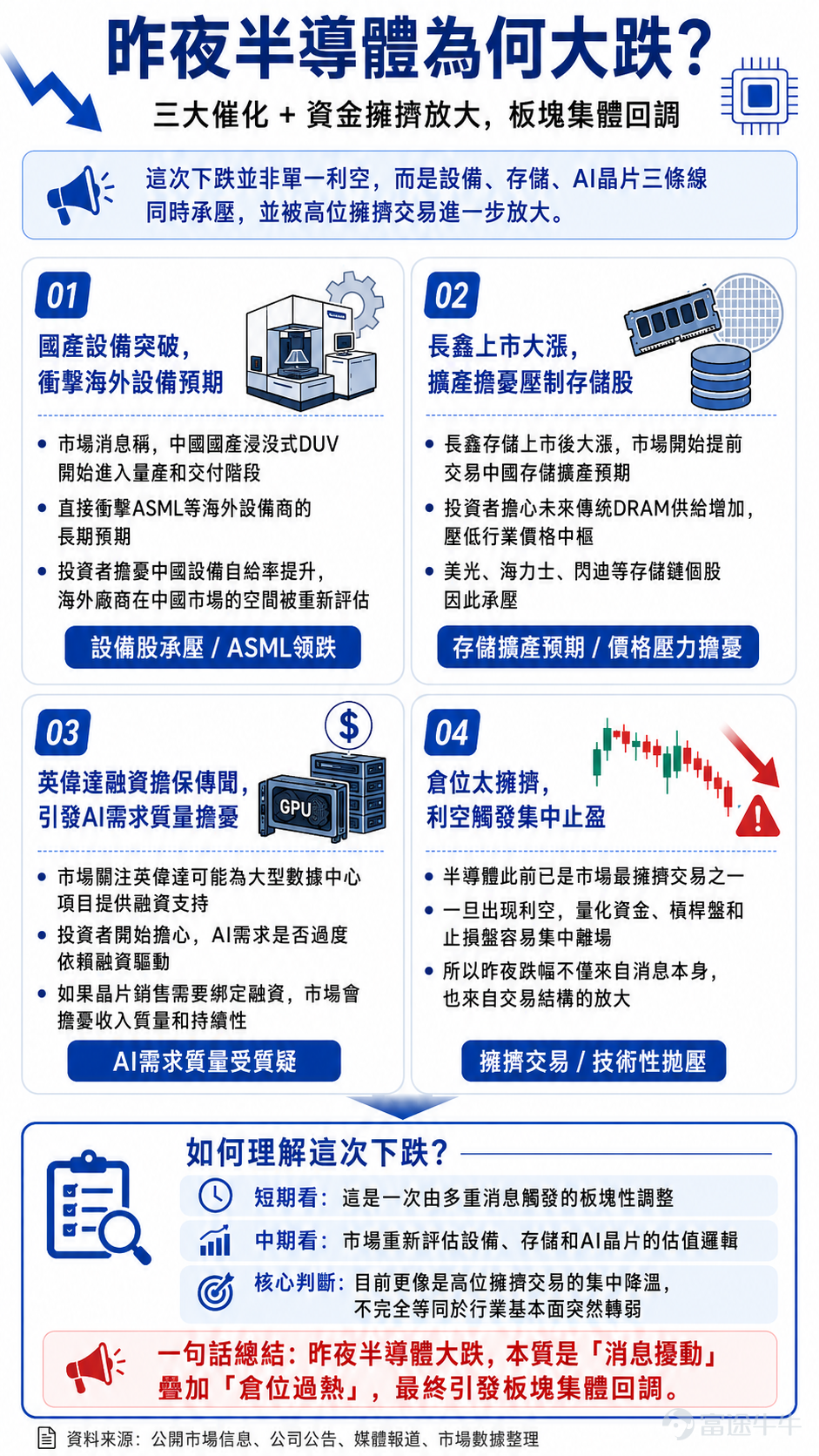
60-Second Visual Breakdown: Why Did Semiconductors Plunge Last Night? Three Bearish Catalysts Hit Overcrowded Trades—One Chart Explains the Sell-Off Logic
Last night, the semiconductor sector showed a clearintraday reversal,with equipment, memory, and AI chips all under simultaneous pressure. On the surface, multiple news items separately impacted different sub-sectors; however, from a trading structure perspective, the clustering of these negative catalysts precisely triggered collective profit-taking by funds positioned at elevated levels. Multiple factors intertwined,Options Sir helps you clarify the sell-off logic in one chart.

1. Pressure on the equipment side stems from progress in domestically developed immersion DUV lithography tools.
The market has started reassessing the pace of China's semiconductor equipment localization, as well as $ASML Holding (ASML.US)$ the long-term growth potential of overseas equipment vendors in the Chinese market.The core concern isn't that China will immediately catch up with EUV capabilities, but rather that tangible progress is now emerging in lithography—the segment previously considered the hardest to localize.
However, the short-term market reaction may be exaggerated.Domestically produced equipment still has a long way to go before achieving full substitution, with capacity, yield rates, and overlay accuracy yet to be thoroughly validated. But once expectations shift, highly valued equipment stocks often adjust first.
2. The memory storage segment was disrupted by expectations of capacity expansion,
with CXMT’s listing surging sharply,prompting investors to front-run China's DRAM capacity expansion.In the short term, the supply-demand balance has not fundamentally changed, but market concerns have shifted further out: once traditional DRAM supply increases, can the price upcycle continue? $Micron Technology (MU.US)$ 、 $SK hynix (SKHY.US)$ Will earnings expectations for companies like these need to be revised downward?
3. The pressure on AI chip stocks primarily stems from controversies surrounding their financing models.
$NVIDIA (NVDA.US)$ They may provide financing support for large-scale data center projects, sparking market discussions about the quality of AI orders. Investors worry that AI chipmakers are gradually shifting from 'selling chips' to 'financing data center construction for customers.'This model can sustain order growth but lowers revenue quality and increases risk entanglement between suppliers and customers.
The sharp drop in NVIDIA's stock price reflects investors beginning to ask two questions: First, do clients like OpenAI have sufficient cash flow to independently fund massive data center construction? Second, how much of AI demand relies on financing jointly provided by chipmakers, cloud providers, and capital markets? $Advanced Micro Devices (AMD.US)$ The synchronized decline in other AI chip stocks indicates this concern has spread beyond NVIDIA alone to the entire AI hardware valuation framework.
4. Positioning remains the key factor amplifying the sell-off.
Semiconductors had already become an extremely crowded trade,once negative catalysts emerge, quant funds, leveraged positions, and stop-loss orders exit the market in succession,causing share prices to fall significantly faster than changes in fundamentals.
5. When will the decline end?
$PHLX Semiconductor Index (.SOX.US)$ Down approximately 22% from the June 22 peak, with July’s cumulative decline nearing 20%; all 30 constituent stocks have fallen below their 50-day moving averages, indicating a fairly deep position washout. The market remains in a phase of trend-driven selling.
The sector is more likely to undergo3–10 trading days of high-volatility bottoming, during which a sharp rebound may occur, or prices may retest last night's low. A definitive confirmation signal will most likely await this week's $Microsoft (MSFT.US)$ 、 $Meta Platforms (META.US)$ 、 $Apple (AAPL.US)$ 、 $Amazon (AMZN.US)$ earnings releases and the Fed meeting outcome, after which the market will reassess whether AI-related capital spending can still support chip demand.
6. With volatility intensifying, how can options be used to protect existing positions?
Semiconductors currently remain in a phase ofoversold conditions without confirmed bottoming and elevated implied volatility, so options strategies should prioritize limited-risk structures: for example, existing holdings could implement a Collar, buy a protective put below and simultaneously sell an out-of-the-money call above to reduce losses if the decline continues;
Investors preparing to bottom-fish are better suited to implement a Bull Put Spread, collecting premium by leveraging high volatility while capping maximum loss with a lower-strike put; if the sector subsequently holds its prior low and shows signs of reversal, consider a Bull Call Spread, participating in the rebound by buying an at-the-money call and selling an out-of-the-money call above.
At this stage, naked put selling or directly chasing short-term options carries significant risk: the former exposes one to substantial assignment risk if the downtrend persists, while the latter risks both directional misjudgment and declining volatility.
 Want stock picks or portfolio diagnostics? Curious about opportunities and risks in your holdings? Any investment-related questions—just ask Futubull AI!
Risk and Disclaimer Notice: 'Futubull' is an all-in-one financial investment trading platform. Brokerage services are provided by Futu Securities International (Hong Kong) Limited. This content does not constitute an offer, solicitation, recommendation, advice, opinion, or any form of guarantee regarding any securities, financial products, or instruments.
Risk Disclaimer: The above content only represents the author's view. It does not represent any position or investment advice of Futu. Futu makes no representation or warranty.Read more


Comments (18)
to post a comment
72
147