
Apple and Amazon reported starkly contrasting earnings— which one are you bullish on?

Apple reclaims the title of world's most valuable company—why did NVIDIA suddenly lose its 'throne'? What is the market worried about?
The title of the world's most valuable company has changed hands once again.
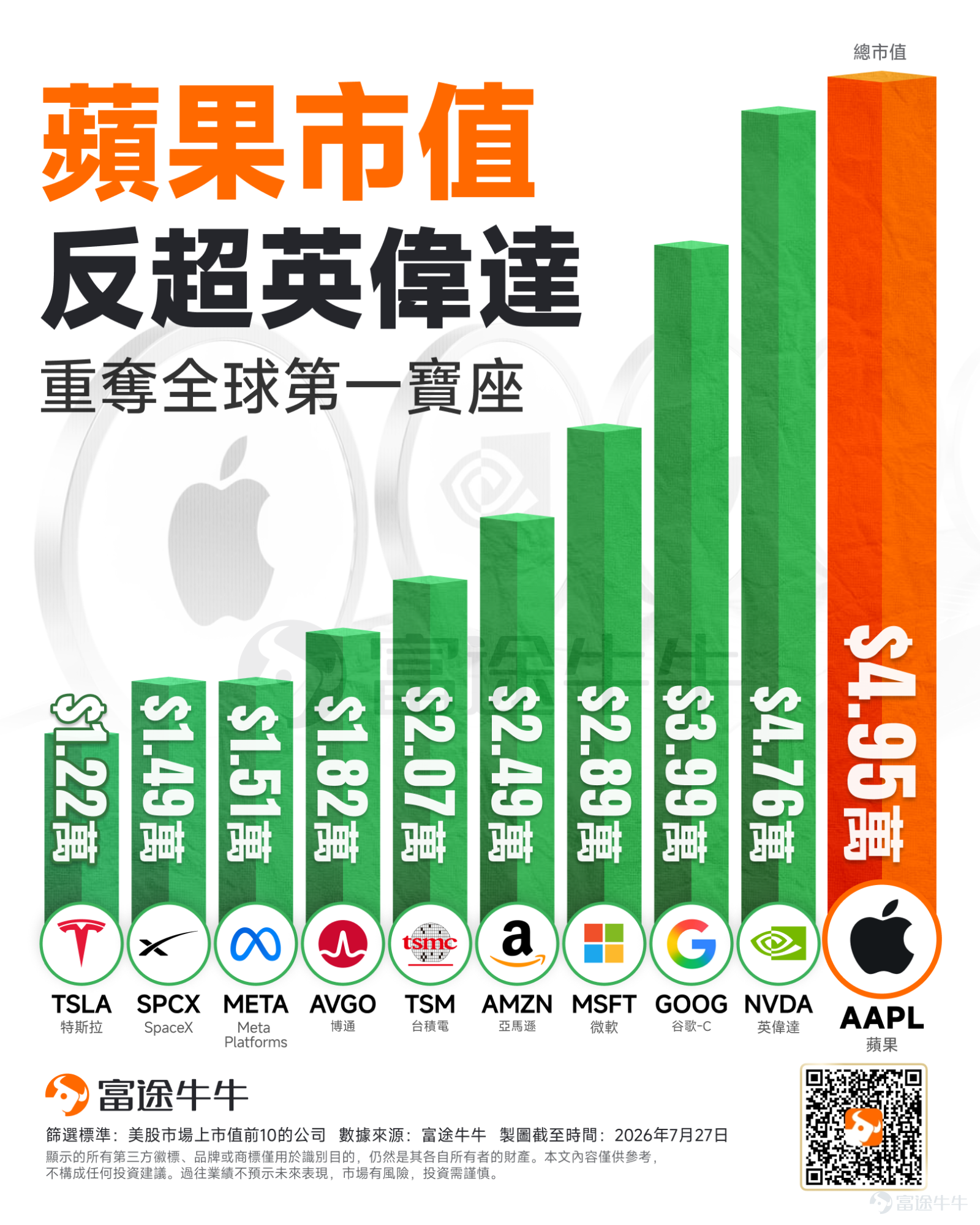
As of Monday's market close, $Apple (AAPL.US)$ Market cap exceeds $NVIDIA (NVDA.US)$ , becoming the world's most valuable publicly traded company. This marks the first time since April 2025 that Apple has regained its lead over NVIDIA at market close.

On the surface, this appears to be just another shift in market capitalization rankings, but beneath it lies a change in investor focus within the AI sector—from 'how strong is demand?' toward 'will these massive investments ultimately generate profits?'
Why is NVIDIA falling? What is the market worried about?
The immediate trigger for this decline was reports that NVIDIA might provide substantial financing support for OpenAI’s data center project.
According to reports, NVIDIA is negotiating to provide up to $250 billion in financing guarantees for OpenAI’s data center leasing project. Additionally, NVIDIA is pushing forward a new round of AI infrastructure deals with a potential scale exceeding $750 billion.
NVIDIA’s five-year credit default swap (CDS) rose intraday by approximately 14 basis points, peaking at around 82 basis points annually—the largest intraday increase since the contract became actively traded in November last year, according to ICE Data Services. This implies an annual cost of about $82,000 to purchase five-year default protection on $10 million worth of NVIDIA debt.

If these transactions materialize, they will further expand AI infrastructure development and could continue to drive demand for GPUs, servers, data centers, power, and networking equipment.
However, capital markets are concerned not just with the size of orders, but rather where the funding actually comes from and whether these projects can generate sufficient cash flow.
Over the past two years, the market has assigned NVIDIA a high valuation because the company sits at the very top of the AI investment wave: the more tech companies invest, the more chips NVIDIA sells.
But if NVIDIA not only sells GPUs but also provides financing guarantees to customers or even participates in supporting data center construction, the market will begin to worry that part of the AI demand may be increasingly reliant on supplier-funded support.
In other words, investors are concerned about a potential 'circular financing' model:NVIDIA provides financial support to AI companies or data center projects, which then use that funding to purchase or deploy NVIDIA chips, ultimately creating a closed loop where supplier financing and product sales reinforce each other.
This model does not necessarily mean that demand is fake, nor does it imply that the related transactions are inherently problematic. However, it does make it harder for the market to assess genuine demand and investment returns, while also transferring some of the customers’ financing and project risks onto NVIDIA itself.
AI investment logic is now entering its second phase.
Over the past two years, the market’s primary question has been: Is there enough AI computing power?
During the stage of severe computing power shortages, as long as cloud providers continued to increase capital expenditures, the GPU, HBM, optical modules, and data center supply chains generally received high valuations.
But as AI infrastructure investment continues to scale up, the market is now asking new questions: How high is the utilization rate of these data centers? How much revenue can AI services actually generate? Do customers have sufficient cash flow to keep purchasing computing power? And what is the actual payback period for this capital expenditure?
This means AI-related trading is shifting from simply betting on 'capital expenditure growth' to verifying 'returns on capital expenditures.'
In the past, whenever large tech companies announced increased AI investments, the market typically interpreted this as new orders for NVIDIA; now, the same news may be seen as signaling cost pressures, financing risks, and declining free cash flow.
What NVIDIA faces isn’t a sudden disappearance of AI demand, but rather investors demanding higher quality from every dollar of that demand.
Apple’s rise to the top reflects renewed pricing power for its defensive characteristics.
Apple reclaiming its position as the world’s most valuable company also reflects a shift in market risk appetite.
Compared with NVIDIA, which is highly dependent on the AI capital expenditure cycle, Apple boasts a more mature hardware ecosystem, a vast user base, stable services revenue, and stronger cash flow generation.
When markets are willing to take on risk, capital favors high-growth, high-beta AI names like NVIDIA; when investors start worrying about excessive capital spending, complex financing models, and stretched valuations, Apple’s stable profitability and cash flows regain a premium.
Therefore, Apple regaining the title of the world’s most valuable company doesn’t necessarily mean the market believes Apple’s growth rate exceeds NVIDIA’s—it likely signals that the market has temporarily placed a higher valuation on 'certainty' and reduced the weight given to long-term AI growth expectations.
This shift in market-cap leadership essentially represents a switch between two asset-pricing logics: Apple embodies mature business models, cash flow, and shareholder returns; NVIDIA represents AI-driven capital expenditures, high growth, and long-term upside potential.
Why has NVIDIA underperformed the broader market this year?
Recent volatility has also caused NVIDIA to underperform the S&P 500 year-to-date. As of Monday's market close, the S&P 500 had risen approximately 8% this year, while NVIDIA's stock price had gained only about 5%.

This does not mean NVIDIA’s fundamentals have reversed, but rather that market expectations for the company have clearly risen.When a company’s market capitalization approaches $5 trillion, even if profits continue to grow, it will need significantly larger increases in new revenue and cash flow to sustain further stock price appreciation.
Meanwhile, NVIDIA is gradually moving beyond being just a chip supplier, increasingly engaging in data center construction, cloud computing partnerships, AI enterprise investments, and infrastructure financing.
While this ecosystem expansion can strengthen NVIDIA’s control over the AI industry, it may also increase capital intensity, credit risk, and business model complexity.
Markets previously assigned NVIDIA a high valuation based on the 'pick-and-shovel' logic; however, if NVIDIA begins directly assisting customers with financing, building data centers, or even assuming partial project risk, its valuation framework could gradually shift from that of a light-asset chipmaker to one incorporating discount factors typical of infrastructure investors.
The AI rally isn’t over, but the market has started rejecting narratives based solely on storytelling.
NVIDIA’s pullback does not signal the end of the AI infrastructure cycle.
Global tech companies are still aggressively investing in AI, and demand for GPUs, memory, advanced packaging, optical communications, power, and data centers remains robust.What has truly changed is that the market is no longer willing to grant valuation premiums to all AI companies based solely on the scale of their capital expenditures.
Next, investors will pay closer attention tothree key indicators:
First,whether AI infrastructure projects can generate real revenue and stable cash flows;Second,whether NVIDIA’s financing guarantees and investment commitments will significantly increase its balance sheet burden;Third,whether large tech companies’ AI-related capital expenditures can translate into sustained growth in cloud services, advertising, software, and subscription revenues.
If AI monetization keeps pace with infrastructure investments, current concerns may simply reflect a normal valuation reset amid high multiples.
However, if the industry increasingly relies on complex financing arrangements to sustain capital expenditure expansion, market valuations across the AI supply chain could continue to diverge.
Apple reclaiming the title of the world’s most valuable company is merely a symbolic moment.
It does not signal the end of the AI era, but rather reflects a shift in capital markets—from chasing 'who spends the most' to scrutinizing 'who ultimately generates the most cash flow.'
For NVIDIA, what it must now prove is no longer just that GPUs remain in short supply, but that the entire AI ecosystem—fueled by massive capital outlays—can deliver sustainable and verifiable returns on investment.
Risk Disclaimer: The above content only represents the author's view. It does not represent any position or investment advice of Futu. Futu makes no representation or warranty.Read more


Comments (11)
to post a comment
60
180