Welcome Zone | Claim your 100,000 anniversary reward and kickstart your investment journey!

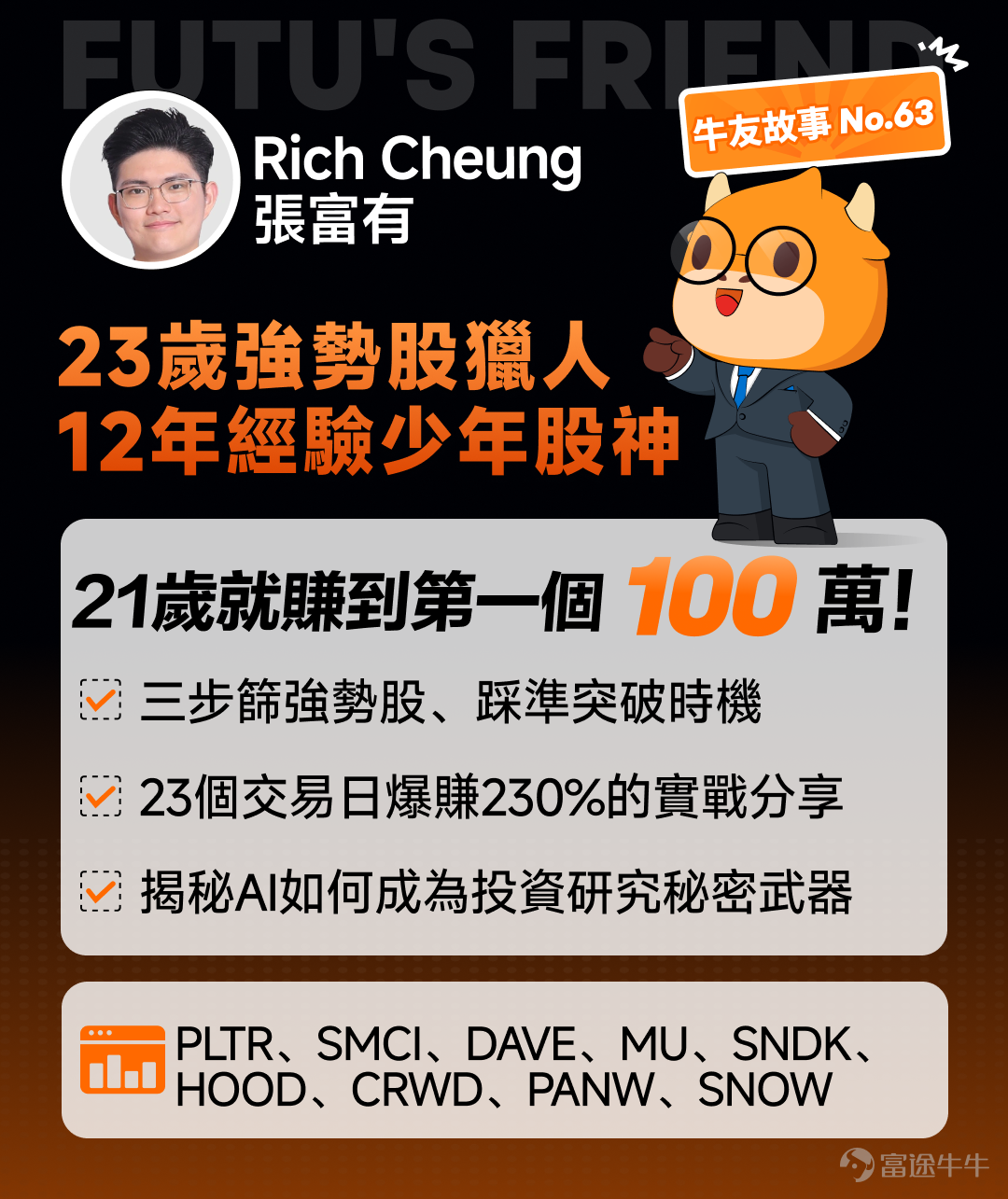
【Investor Story】Entered the market at 11, made a million by 21! A 23-year-old trader reveals his 'Strong Stock Hunting Strategy'!
Started following my father at age 11@ChiefPapa張志雲(Founder of Smart Wealth Academy) to learn investing, experienced the feeling of losing everything at 13, and earned his first HK$1 million by age 21—this 23-year-old’s 12-year investment journey is a real-life ‘making of a young stock prodigy.’ This edition of 【Investor Story】features a young investing expert who primarily uses technical analysis supplemented by fundamental analysis@Rich Cheung 張富有(referred to as Rich below), who shares his 'Strong Stock Hunting Strategy' and AI trading insights.
 Tip: This article is quite long. We recommend liking and bookmarking it for a thorough read—there’s a surprise waiting for you at the end!
![Started following my father at age 11@ChiefPapa張志雲(Founder of Smart Wealth Academy) to learn investing, experienced the feeling of losing everything at 13, and earned his first HK$1 million by age 21—this 23-year-old’s 12-year investment journey is a real-life ‘making of a young stock prodigy.’ This edition of 【Investor Story】features a young investing expert who primarily uses technical analysis supplemented by fundamental analysis@Rich Cheung 張富有(referred to as Rich below), who shares his 'Strong Stock Hunting Strategy' and AI trading insights. [Microphone]Tip: This article is quite long. We recommend liking and bookmarking it for a thorough read—there’s a surprise waiting for you at the end! 1. Entered the Market at Age 11: Investment Seeds Planted by Dad’s ‘Businessman’s Eye’ Q: How did you get into the stock market as early as age 11? Rich:I’m Rich, 23 years old, and I’ve been involved in the stock market for 12 years already. At age 11, I started following my dad[Share Link: @ChiefPapa_CheungChiWan] I started learning about investing and formally got into fundamental analysis. But in fact, I was exposed to investment concepts even earlier—my dad often talked about investing when I was a kid. What influenced me the most was his frequent advice:to view a business with 'an entrepreneur’s perspective.'。 When I was young, walking with my dad down Nathan Road in Hong Kong, we saw hordes of individual tourists queuing at Luk Fook to buy gold. I told my dad, 'Luk Fook’s doing great business—we should buy its stock.' At the time, he was surprised that a kid like me even understood stock investing. But later...](https://nnqimage.futunn.com/sns_client_feed/999992/20260728/web-1785208059651-GHTmsYM4r7.png/big?area=1&is_public=true&imageMogr2/ignore-error/1/format/webp)
1. Entered the Market at Age 11: Investment Seeds Planted by Dad’s ‘Businessman’s Eye’
Q: How did you get into the stock market as early as age 11?
Rich:I’m Rich, 23 years old, and I’ve been involved in the stock market for 12 years already. At age 11, I started following my dad@ChiefPapa_CheungChiWan I started learning about investing and formally got into fundamental analysis. But in fact, I was exposed to investment concepts even earlier—my dad often talked about investing when I was a kid. What influenced me the most was his frequent advice:to view a business with 'an entrepreneur’s perspective.'。
When I was young, walking down Nathan Road in Hong Kong with my dad, we saw large crowds of individual travelers lining up at Luk Fook to buy gold. I told my dad, 'Luk Fook’s business is booming—we should buy Luk Fook stock.' At the time, my dad was surprised that a kid like me even knew about buying stocks. But roughly a year and a half later,$LUK FOOK HOLD (00590.HK)$the stock price rose from just over HK$1 to nearly HK$30. Although I was too young to buy stocks back then and missed out on the gain, that experience gave me a major insight—investing can actually be very simple; using a businessman’s perspective to evaluate a company really can make you money.Moreover,Exchanging money for money is far easier than relying solely on trading time for money.。
Q: Did you pay any 'tuition fees' during your investment journey?
Rich:At age 13, I experienced my first total loss in life.. At the time, I had my eye on $SUNNY OPTICAL (02382.HK)$ , and asked my dad to buy it for me. Unexpectedly, the stock price kept falling afterward. My dad asked me to add more funds to cover the margin call, but I didn’t even have the money to do so, so I had no choice but to cut my losses. Not only did I fail to make money, but I also had to reimburse my dad for his losses. This made me much more cautious in all my subsequent investment decisions.
My dad never gave me a dedicated seed fund for investing—every 'tuition fee' I paid in the stock market and every dollar of principal came from part-time job savings. The most valuable wealth he gave me was a complete and correct investment mindset, hands-on experiential teaching, and the mental resilience to grow from losses—benefits far exceeding monetary value.
As soon as I turned 18, I opened my own Futu account and caught the 2021 bull market rally. However, my understanding of market cycles was still incomplete at the time, so when the 2022 bear market hit, that’s when I really started paying tuition. Back then, I held quality companies like $CrowdStrike (CRWD.US)$ 、$Meta Platforms (META.US)$but because my timing was off, their share prices still dropped sharply. In fact, even $Meta Platforms (META.US)$ 、 $Netflix (NFLX.US)$ Even companies with massive market capitalizations can drop more than 70% in a bear market. This experience deeply impressed upon methat market cycles take precedence over a company's fundamentals, and it was from that point onward that I began to recognize the importance of technical analysis and gradually developed my own investment framework.
2. Hunting Strong Stocks: Full Disclosure of My Analytical Framework
Q: How do you identify strong stocks from the vast universe of equities on a daily basis?
Rich:I primarily focus on U.S. equities, with the core idea of identifying strong stocks that are outperforming the broader market and are in 'Stage 2' (per Stan Weinstein’s theory). I use stock screeners and adjust my screening criteria based on the prevailing market environment:
1、Share price:When the broader market is trading above its 50-day moving average but below its 20-day moving average, I prioritize stocks whose prices remain above their 20-day moving average. If the market is in a sideways consolidation phase with limited upside, I screen for stocks that have risen more than 5% over the past week. I also observe which sectors consistently produce strong individual stocks to identify potential sector rotation trends.
2、Moving Averages:ScreeningThe stock price is above the 10-day, 20-day, 50-day, and 200-day moving averagesstocks.
The screening typically yields around 100+ stocks, which is an ideal range for observation. If the results remain very sparse even under fairly relaxed criteria, that itself is a warning signal—indicating broad market weakness and potentially signaling the start of a correction or bear market. This method also helped me identify early signs of market weakness at the beginning of 2025, allowing me to successfully avoid a significant downturn.
![Started following my father at age 11@ChiefPapa張志雲(Founder of Smart Wealth Academy) to learn investing, experienced the feeling of losing everything at 13, and earned his first HK$1 million by age 21—this 23-year-old’s 12-year investment journey is a real-life ‘making of a young stock prodigy.’ This edition of 【Investor Story】features a young investing expert who primarily uses technical analysis supplemented by fundamental analysis@Rich Cheung 張富有(referred to as Rich below), who shares his 'Strong Stock Hunting Strategy' and AI trading insights. [Microphone]Tip: This article is quite long. We recommend liking and bookmarking it for a thorough read—there’s a surprise waiting for you at the end! 1. Entered the Market at Age 11: Investment Seeds Planted by Dad’s ‘Businessman’s Eye’ Q: How did you get into the stock market as early as age 11? Rich:I’m Rich, 23 years old, and I’ve been involved in the stock market for 12 years already. At age 11, I started following my dad[Share Link: @ChiefPapa_CheungChiWan] I started learning about investing and formally got into fundamental analysis. But in fact, I was exposed to investment concepts even earlier—my dad often talked about investing when I was a kid. What influenced me the most was his frequent advice:to view a business with 'an entrepreneur’s perspective.'。 When I was young, walking with my dad down Nathan Road in Hong Kong, we saw hordes of individual tourists queuing at Luk Fook to buy gold. I told my dad, 'Luk Fook’s doing great business—we should buy its stock.' At the time, he was surprised that a kid like me even understood stock investing. But later...](https://nnqimage.futunn.com/sns_client_feed/999992/20260728/web-1785208133774-FTVQVB4jtp.png/big?area=1&is_public=true&imageMogr2/ignore-error/1/format/webp)
Q: What are the specific criteria for identifying 'strong stocks'?
Rich:I mainly look at three aspects:
1. Relative Strength (RS) Rating:Stocks are scored from 1 to 99, with higher scores indicating outperformance against a greater percentage of the market. For example, an RS rating above 85 means the stock has outperformed 85% of all stocks, reflecting strong relative strength and warranting close attention.
2. Moving Average Position:The stock price remains above all major moving averages, which are arranged in a bullish (ascending) order.
3. Volatility Contraction Pattern (VCP):During the consolidation period, price volatility gradually narrows and trading volume concurrently declines. A breakout above a key level accompanied by expanding volume presents a higher-probability buying opportunity.
Q: How do you plan your stop-loss and take-profit levels before entering a position?
Rich:Before every trade entry, I predefine my stop-loss level and implement it using conditional orders:
I place my stop-loss slightly below a support level. If the price decisively breaks below this point, it signals my trend assessment was incorrect, and I exit the position immediately.
If the stock price rises as expected, I cancel the original stop-loss order and move it up in line with the new support level. Throughout the trade, I dynamically adjust the stop order based on support levels across different timeframes. As for timing my exit, I primarily follow two sets of criteria:
(1) Technical topping signals:For example, patterns like a 'bearish engulfing candle' (a large down candle that opens high and closes low) or excessive deviation from moving averages clearly indicate profit-taking. In such cases, I’ll reduce or fully exit my position.
(2) Risk-reward ratio rule:When a single trade achieves a risk-reward ratio exceeding 5:1, I consider taking profits in stages—gradually recovering my initial capital until my cost basis reaches zero. The remaining position then represents pure profit, which I’ll fully exit once the price falls below the support line.
![Started following my father at age 11@ChiefPapa張志雲(Founder of Smart Wealth Academy) to learn investing, experienced the feeling of losing everything at 13, and earned his first HK$1 million by age 21—this 23-year-old’s 12-year investment journey is a real-life ‘making of a young stock prodigy.’ This edition of 【Investor Story】features a young investing expert who primarily uses technical analysis supplemented by fundamental analysis@Rich Cheung 張富有(referred to as Rich below), who shares his 'Strong Stock Hunting Strategy' and AI trading insights. [Microphone]Tip: This article is quite long. We recommend liking and bookmarking it for a thorough read—there’s a surprise waiting for you at the end! 1. Entered the Market at Age 11: Investment Seeds Planted by Dad’s ‘Businessman’s Eye’ Q: How did you get into the stock market as early as age 11? Rich:I’m Rich, 23 years old, and I’ve been involved in the stock market for 12 years already. At age 11, I started following my dad[Share Link: @ChiefPapa_CheungChiWan] I started learning about investing and formally got into fundamental analysis. But in fact, I was exposed to investment concepts even earlier—my dad often talked about investing when I was a kid. What influenced me the most was his frequent advice:to view a business with 'an entrepreneur’s perspective.'。 When I was young, walking with my dad down Nathan Road in Hong Kong, we saw hordes of individual tourists queuing at Luk Fook to buy gold. I told my dad, 'Luk Fook’s doing great business—we should buy its stock.' At the time, he was surprised that a kid like me even understood stock investing. But later...](https://nnqimage.futunn.com/sns_client_feed/999992/20260728/web-1785208125907-yj43lVHvit.jpeg/big?area=1&is_public=true&imageMogr2/ignore-error/1/format/webp)
III. Real-World Breakdown: 230% Gains in 23 Trading Days—My First Fortune at Age 21
Q: Can you share your real-world trading story in detail?
Rich:A significant portion of the first million I made from investing came from $Palantir (PLTR.US)$ . In August 2024, the entire market was undergoing a correction, but I noticed that Palantir gapped up sharply after its earnings release,showing unusually strong performance amid a broad market sell-off and quickly breaking above all moving averages.These 'outperforming-the-market' characteristics immediately caught my attention. On the fundamental side, I observed that PLTR hadconsistently accelerating revenue growth, extremely strong cash flow, and zero debt,fully meeting the criteria of a growth stock.
I initiated my first position around $26, added to it when the price pulled back to test the 20-day moving average support, and then increased my stake again in the $40s following PLTR’s announcement of inclusion in the S&P 500 and its strong Q3 earnings. The stock’s momentum accelerated from there. I sold my first tranche in the $70s, most of my position in the $80s, and trimmed further between the $100s and low $120s.
![Started following my father at age 11@ChiefPapa張志雲(Founder of Smart Wealth Academy) to learn investing, experienced the feeling of losing everything at 13, and earned his first HK$1 million by age 21—this 23-year-old’s 12-year investment journey is a real-life ‘making of a young stock prodigy.’ This edition of 【Investor Story】features a young investing expert who primarily uses technical analysis supplemented by fundamental analysis@Rich Cheung 張富有(referred to as Rich below), who shares his 'Strong Stock Hunting Strategy' and AI trading insights. [Microphone]Tip: This article is quite long. We recommend liking and bookmarking it for a thorough read—there’s a surprise waiting for you at the end! 1. Entered the Market at Age 11: Investment Seeds Planted by Dad’s ‘Businessman’s Eye’ Q: How did you get into the stock market as early as age 11? Rich:I’m Rich, 23 years old, and I’ve been involved in the stock market for 12 years already. At age 11, I started following my dad[Share Link: @ChiefPapa_CheungChiWan] I started learning about investing and formally got into fundamental analysis. But in fact, I was exposed to investment concepts even earlier—my dad often talked about investing when I was a kid. What influenced me the most was his frequent advice:to view a business with 'an entrepreneur’s perspective.'。 When I was young, walking with my dad down Nathan Road in Hong Kong, we saw hordes of individual tourists queuing at Luk Fook to buy gold. I told my dad, 'Luk Fook’s doing great business—we should buy its stock.' At the time, he was surprised that a kid like me even understood stock investing. But later...](https://nnqimage.futunn.com/sns_client_feed/999992/20260728/web-1785208137554-FVcd4uIQEd.png/big?area=1&is_public=true&imageMogr2/ignore-error/1/format/webp)
Rich:In addition, I also made a staggering 230% profit on the stock $Super Micro Computer (SMCI.US)$ over just 23 trading days. One day in 2024, its name appeared in my stock screener results—its share price was over $300 (pre-split), with a relatively high RS Rating, trading above all moving averages, and exhibiting a Volatility Contraction Pattern (VCP) on the chart. So I added it to my watchlist and bought it outright when it broke out.
After buying, it launched into a very strong rally. I sold in tranches, locking in profits step by step at around $500 and $600, and finally exited my last position near $1,200 upon seeing a 'bearish engulfing' signal. Overall, I made over 200% during the main uptrend phase, which lasted only 23 trading days. In hindsight, selling at $500 might seem foolish, but now SMCI has fallen back to around $20 (over $200 pre-split), which reinforces my understanding of 'selling into strength.'The importance.
![Started following my father at age 11@ChiefPapa張志雲(Founder of Smart Wealth Academy) to learn investing, experienced the feeling of losing everything at 13, and earned his first HK$1 million by age 21—this 23-year-old’s 12-year investment journey is a real-life ‘making of a young stock prodigy.’ This edition of 【Investor Story】features a young investing expert who primarily uses technical analysis supplemented by fundamental analysis@Rich Cheung 張富有(referred to as Rich below), who shares his 'Strong Stock Hunting Strategy' and AI trading insights. [Microphone]Tip: This article is quite long. We recommend liking and bookmarking it for a thorough read—there’s a surprise waiting for you at the end! 1. Entered the Market at Age 11: Investment Seeds Planted by Dad’s ‘Businessman’s Eye’ Q: How did you get into the stock market as early as age 11? Rich:I’m Rich, 23 years old, and I’ve been involved in the stock market for 12 years already. At age 11, I started following my dad[Share Link: @ChiefPapa_CheungChiWan] I started learning about investing and formally got into fundamental analysis. But in fact, I was exposed to investment concepts even earlier—my dad often talked about investing when I was a kid. What influenced me the most was his frequent advice:to view a business with 'an entrepreneur’s perspective.'。 When I was young, walking with my dad down Nathan Road in Hong Kong, we saw hordes of individual tourists queuing at Luk Fook to buy gold. I told my dad, 'Luk Fook’s doing great business—we should buy its stock.' At the time, he was surprised that a kid like me even understood stock investing. But later...](https://nnqimage.futunn.com/sns_client_feed/999992/20260728/web-1785208139276-3HoLZRCUVO.png/big?area=1&is_public=true&imageMogr2/ignore-error/1/format/webp)
4. The painful lesson of missing the multi-bagger SNDK: Trust your system and set aside subjective biases
Q: Have you ever 'missed the boat' on a stock?
Rich:There's one stock that has been extremely hot this year, and I completely missed it—it's $SanDisk (SNDK.US)$ 。
I personally really enjoy photography, and in photography circles, everyone jokes that SanDisk SD cards break easily, so I've always had a poor impression of the brand. Back in June–July last year, SNDK was trading at just over $40 per share, which fully met my criteria for strong-performing stocks and appeared in my stock screener results. However, due to my personal bias against the brand, I didn't bother looking into it deeply and simply skipped over it. Only later did I realize that it actually plays a critically important role in AI-related storage solutions—and its share price subsequently rose tenfold, while I missed out entirely.
This experience made me even more aware that, even though I constantly remind myself not to make subjective judgments, I’m still prone to this mistake. Ever since then, I’ve placed greater trust in my trading system—if the system flags a stock as meeting the criteria for a strong performer, I should study it seriously rather than dismiss it based on gut feeling.The system is more reliable than gut feeling.
In contrast, $Micron Technology (MU.US)$ I did my due diligence and learned that it already has long-term orders locked in through 2030 within the AI supply chain, giving it exceptional earnings visibility. I bought in around RMB 440 and eventually exited with over 100% profit. As for SNDK, I guess we just weren’t meant to be.
![Started following my father at age 11@ChiefPapa張志雲(Founder of Smart Wealth Academy) to learn investing, experienced the feeling of losing everything at 13, and earned his first HK$1 million by age 21—this 23-year-old’s 12-year investment journey is a real-life ‘making of a young stock prodigy.’ This edition of 【Investor Story】features a young investing expert who primarily uses technical analysis supplemented by fundamental analysis@Rich Cheung 張富有(referred to as Rich below), who shares his 'Strong Stock Hunting Strategy' and AI trading insights. [Microphone]Tip: This article is quite long. We recommend liking and bookmarking it for a thorough read—there’s a surprise waiting for you at the end! 1. Entered the Market at Age 11: Investment Seeds Planted by Dad’s ‘Businessman’s Eye’ Q: How did you get into the stock market as early as age 11? Rich:I’m Rich, 23 years old, and I’ve been involved in the stock market for 12 years already. At age 11, I started following my dad[Share Link: @ChiefPapa_CheungChiWan] I started learning about investing and formally got into fundamental analysis. But in fact, I was exposed to investment concepts even earlier—my dad often talked about investing when I was a kid. What influenced me the most was his frequent advice:to view a business with 'an entrepreneur’s perspective.'。 When I was young, walking with my dad down Nathan Road in Hong Kong, we saw hordes of individual tourists queuing at Luk Fook to buy gold. I told my dad, 'Luk Fook’s doing great business—we should buy its stock.' At the time, he was surprised that a kid like me even understood stock investing. But later...](https://nnqimage.futunn.com/sns_client_feed/999992/20260728/web-1785208128192-qeVDt7D0Lo.png/big?area=1&is_public=true&imageMogr2/ignore-error/1/format/webp)
5. Sector Rotation Instinct: Current Portfolio Positioning and Market Outlook
Q: What’s your view on the current US stock market?
Rich:The broader market is currently in a consolidation phase, needing to digest the sharp rally in April. Previously hot sectors like AI hardware, semiconductors, and memory have generally broken below their 50-day moving averages. Looking at the historical price action of , $iShares Semiconductor ETF (SOXX.US)$ after peaking in July 2024, it consolidated for more than half a year before launching its next upward move in June–July 2025. This current correction may also take some time.
However, at the same time, I’ve noticed clear signs of sector rotation in capital flows, with some previously overlooked sectors starting to show strength:
① Fintech:Slow-bull blue-chip stocks like this $Robinhood (HOOD.US)$ , which I bought in June at over HK$80 and quickly rose to HK$118; $Dave Inc (DAVE.US)$ I bought this stock on June 12 and sold it 16 trading days later, realizing a gain of approximately 36%. The share price continued rising afterward, climbing about 50% above my purchase price within just one month.
② Cybersecurity: $CrowdStrike (CRWD.US)$ 、 $Palo Alto Networks (PANW.US)$ 、 $SentinelOne (S.US)$ and others have recently surged significantly, benefiting from AI applications.
③ AI Software: $Snowflake (SNOW.US)$ 、 $MongoDB (MDB.US)$ Companies that benefit more as enterprises increasingly adopt AI are also starting to gain momentum.
Some AI software companies operate on a per-user pricing model, such as $monday.com (MNDY.US)$ . Given the trend of AI enabling businesses to reduce headcount, such companies’ operations could face downward pressure. Therefore, I personally remain relatively cautious about this per-user pricing business model.
![Started following my father at age 11@ChiefPapa張志雲(Founder of Smart Wealth Academy) to learn investing, experienced the feeling of losing everything at 13, and earned his first HK$1 million by age 21—this 23-year-old’s 12-year investment journey is a real-life ‘making of a young stock prodigy.’ This edition of 【Investor Story】features a young investing expert who primarily uses technical analysis supplemented by fundamental analysis@Rich Cheung 張富有(referred to as Rich below), who shares his 'Strong Stock Hunting Strategy' and AI trading insights. [Microphone]Tip: This article is quite long. We recommend liking and bookmarking it for a thorough read—there’s a surprise waiting for you at the end! 1. Entered the Market at Age 11: Investment Seeds Planted by Dad’s ‘Businessman’s Eye’ Q: How did you get into the stock market as early as age 11? Rich:I’m Rich, 23 years old, and I’ve been involved in the stock market for 12 years already. At age 11, I started following my dad[Share Link: @ChiefPapa_CheungChiWan] I started learning about investing and formally got into fundamental analysis. But in fact, I was exposed to investment concepts even earlier—my dad often talked about investing when I was a kid. What influenced me the most was his frequent advice:to view a business with 'an entrepreneur’s perspective.'。 When I was young, walking with my dad down Nathan Road in Hong Kong, we saw hordes of individual tourists queuing at Luk Fook to buy gold. I told my dad, 'Luk Fook’s doing great business—we should buy its stock.' At the time, he was surprised that a kid like me even understood stock investing. But later...](https://nnqimage.futunn.com/sns_client_feed/999992/20260728/web-1785208125951-4BkwOzEyVH.png/big?area=1&is_public=true&imageMogr2/ignore-error/1/format/webp)
Additionally, I really like Futu's 'One-Chart Clarity' feature, which clearly lays out all the upstream and downstream companies in an entire industry. This has saved me a lot of time and helped me quickly understand which sectors are rotating.
![Started following my father at age 11@ChiefPapa張志雲(Founder of Smart Wealth Academy) to learn investing, experienced the feeling of losing everything at 13, and earned his first HK$1 million by age 21—this 23-year-old’s 12-year investment journey is a real-life ‘making of a young stock prodigy.’ This edition of 【Investor Story】features a young investing expert who primarily uses technical analysis supplemented by fundamental analysis@Rich Cheung 張富有(referred to as Rich below), who shares his 'Strong Stock Hunting Strategy' and AI trading insights. [Microphone]Tip: This article is quite long. We recommend liking and bookmarking it for a thorough read—there’s a surprise waiting for you at the end! 1. Entered the Market at Age 11: Investment Seeds Planted by Dad’s ‘Businessman’s Eye’ Q: How did you get into the stock market as early as age 11? Rich:I’m Rich, 23 years old, and I’ve been involved in the stock market for 12 years already. At age 11, I started following my dad[Share Link: @ChiefPapa_CheungChiWan] I started learning about investing and formally got into fundamental analysis. But in fact, I was exposed to investment concepts even earlier—my dad often talked about investing when I was a kid. What influenced me the most was his frequent advice:to view a business with 'an entrepreneur’s perspective.'。 When I was young, walking with my dad down Nathan Road in Hong Kong, we saw hordes of individual tourists queuing at Luk Fook to buy gold. I told my dad, 'Luk Fook’s doing great business—we should buy its stock.' At the time, he was surprised that a kid like me even understood stock investing. But later...](https://nnqimage.futunn.com/sns_client_feed/999992/20260728/web-1785208138875-G29HEytxed.png/big?area=1&is_public=true&imageMogr2/ignore-error/1/format/webp)
Note: The above interview was conducted in mid-July, and the market conditions referenced are accurate as of that time.
6. Deep Dive into Fundamentals: From Financial Metrics to Company Visits
Q: You mentioned combining fundamental analysis—specifically, what aspects do you look at to judge whether a company is 'good' or not?
Rich:I analyze fundamentals primarily to confirm that the strong-performing stocks I've selected are backed by 'real substance,' not just speculative capital flows. Typically, I focus on several key dimensions:
First is the acceleration in revenue and earnings. I don’t just check whether a company is profitable; I assess whether its growth rate is accelerating. If a company shows accelerating revenue growth or rapidly improving profitability, it has the potential to become a major market winner—a key factor that attracts sustained capital inflows.
Second is industry leadership. I specifically look for companies that are 'number one' or even the 'only' player in their industry, such as $Palantir (PLTR.US)$ It has this kind of uniqueness.
Third is financial health.I place great emphasis on free cash flow and debt levels. For example, a company like Palantir (PLTR), which previously demonstrated strong cash flow and zero debt, gives me greater confidence in holding its shares.
However, I must emphasize,No matter how strong the fundamentals are, you can't ignore market cycles.Fundamentals serve as my 'filter' to confirm whether this is a good business; but for actual entry or exit points, I wait for clear signals from technical chart patterns.
Q: Besides reviewing earnings reports, are there other ways to understand a company?
Rich:Financial figures from earnings reports are flat, but the details you observe when visiting a company are three-dimensional. That's why I started conducting on-site research, visiting several listed companies, including $Futu Holdings Ltd (FUTU.US)$ 、 $HKEX (00388.HK)$ 、 $UBTECH ROBOTICS (09880.HK)$ and $HAITIAN FLAV (03288.HK)$ 。
What impressed me most was my visit to Haitian Soy Sauce. Everyone knows it’s a condiment maker, but before my visit, I had a question: Could traditional manufacturing become obsolete? Walking through their production line, I saw fully automated assembly lines. Yet, workers hadn’t been laid off—they’d transformed into 'AI translators.' Their role was to digitize and capture via video the tacit knowledge of veteran craftsmen—information that was previously hard to quantify—and convert it into data that AI systems could learn from.
This visit was incredibly inspiring: I realized that AI doesn't simply replace human labor—it can also amplify human expertise. This kind of on-the-ground observation of the industrial chain is something you just can't grasp by sitting at home looking only at financial figures.
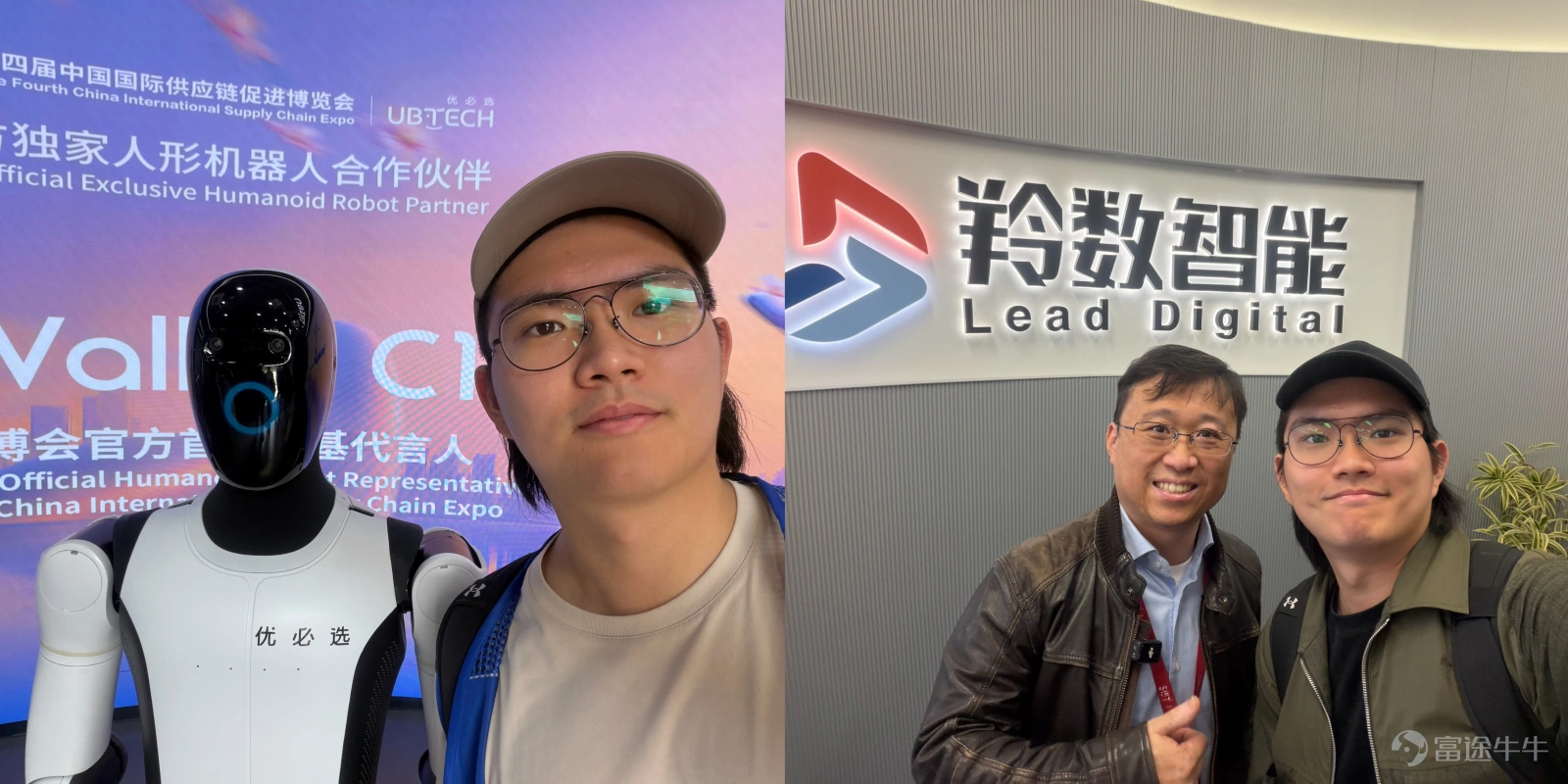
Rich personally visited the listed company Ubtech Robotics and exchanged insights with the co-founder of LingShu Intelligence.
7. AI Assistant: My Secret Weapon for Efficient Research
Q: How do you normally use AI to assist with investing?
Rich:I have a special prompt technique—I tell the AI,"Please explain this to me as if I were an 18-year-old,"and then ask about a company’s business, recent catalysts, and competitors. It gives me vivid analogies that make things much easier to understand.
![Started following my father at age 11@ChiefPapa張志雲(Founder of Smart Wealth Academy) to learn investing, experienced the feeling of losing everything at 13, and earned his first HK$1 million by age 21—this 23-year-old’s 12-year investment journey is a real-life ‘making of a young stock prodigy.’ This edition of 【Investor Story】features a young investing expert who primarily uses technical analysis supplemented by fundamental analysis@Rich Cheung 張富有(referred to as Rich below), who shares his 'Strong Stock Hunting Strategy' and AI trading insights. [Microphone]Tip: This article is quite long. We recommend liking and bookmarking it for a thorough read—there’s a surprise waiting for you at the end! 1. Entered the Market at Age 11: Investment Seeds Planted by Dad’s ‘Businessman’s Eye’ Q: How did you get into the stock market as early as age 11? Rich:I’m Rich, 23 years old, and I’ve been involved in the stock market for 12 years already. At age 11, I started following my dad[Share Link: @ChiefPapa_CheungChiWan] I started learning about investing and formally got into fundamental analysis. But in fact, I was exposed to investment concepts even earlier—my dad often talked about investing when I was a kid. What influenced me the most was his frequent advice:to view a business with 'an entrepreneur’s perspective.'。 When I was young, walking with my dad down Nathan Road in Hong Kong, we saw hordes of individual tourists queuing at Luk Fook to buy gold. I told my dad, 'Luk Fook’s doing great business—we should buy its stock.' At the time, he was surprised that a kid like me even understood stock investing. But later...](https://nnqimage.futunn.com/sns_client_feed/999992/20260728/web-1785208125693-abgcUfuBf5.png/big?area=1&is_public=true&imageMogr2/ignore-error/1/format/webp)
![Started following my father at age 11@ChiefPapa張志雲(Founder of Smart Wealth Academy) to learn investing, experienced the feeling of losing everything at 13, and earned his first HK$1 million by age 21—this 23-year-old’s 12-year investment journey is a real-life ‘making of a young stock prodigy.’ This edition of 【Investor Story】features a young investing expert who primarily uses technical analysis supplemented by fundamental analysis@Rich Cheung 張富有(referred to as Rich below), who shares his 'Strong Stock Hunting Strategy' and AI trading insights. [Microphone]Tip: This article is quite long. We recommend liking and bookmarking it for a thorough read—there’s a surprise waiting for you at the end! 1. Entered the Market at Age 11: Investment Seeds Planted by Dad’s ‘Businessman’s Eye’ Q: How did you get into the stock market as early as age 11? Rich:I’m Rich, 23 years old, and I’ve been involved in the stock market for 12 years already. At age 11, I started following my dad[Share Link: @ChiefPapa_CheungChiWan] I started learning about investing and formally got into fundamental analysis. But in fact, I was exposed to investment concepts even earlier—my dad often talked about investing when I was a kid. What influenced me the most was his frequent advice:to view a business with 'an entrepreneur’s perspective.'。 When I was young, walking with my dad down Nathan Road in Hong Kong, we saw hordes of individual tourists queuing at Luk Fook to buy gold. I told my dad, 'Luk Fook’s doing great business—we should buy its stock.' At the time, he was surprised that a kid like me even understood stock investing. But later...](https://nnqimage.futunn.com/sns_client_feed/999992/20260728/web-1785226417787-BXi8KRTObj.jpeg/big?area=1&is_public=true&imageMogr2/ignore-error/1/format/webp)
Recently, I’ve been using Futubull AI frequently to support my research. A while back, I also took a deep dive into Futubull AI’s Expert Mode. After comparing multiple AI models, I believe Futubull AI provides the most detailed answers on industry and company-related questions.
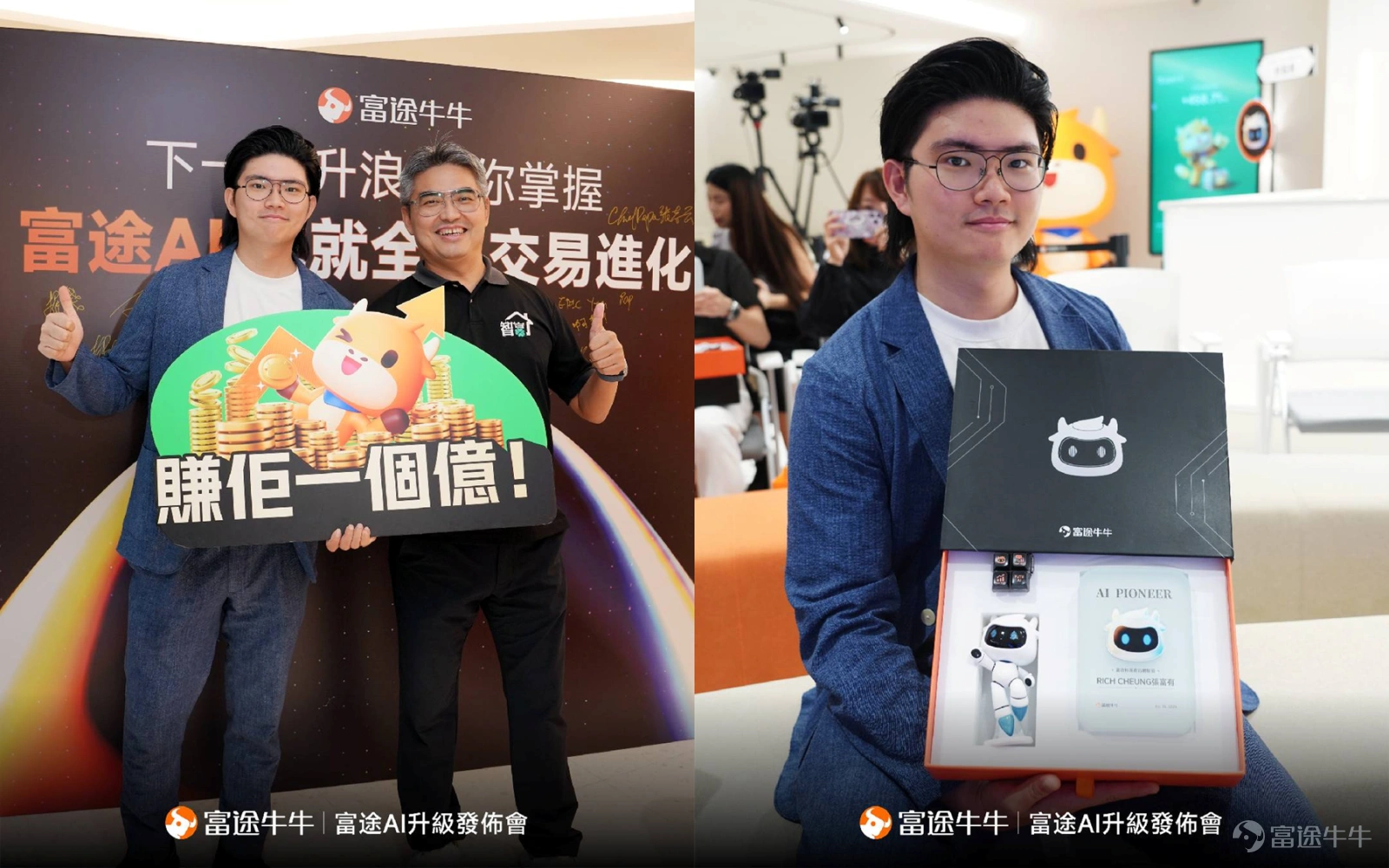
Rich and Chief PaPa Cheung Chi-wan attended Futu's AI Upgrade Launch Event.
I’ve also built an AI bot, pre-set my screening criteria, and let it automatically find stocks that meet my conditions or alert me when certain sectors start showing up—saving me a lot of time on repetitive tasks.
8. A word to young fellow investors: Investing is a lifelong discipline
Q: What advice do you have for young, new fellow investors?
Rich:There are three key points:
First, understand which investment style suits you.My dad practices value investing, but his approach might not suit me. I’m not as patient as he is, nor do I have his life experience or multiple entrepreneurial ventures. So, I developed my own analytical method better suited to identifying multibagger stocks. No matter how effective someone else’s strategy is, if it doesn’t align with your personality, it’ll be hard to execute consistently.
Second, discipline is the hardest—but also the most important.There are usually only two triggers for breaking bad investing habits: one is having a strong goal; the other is losing a significant amount of money—so painfully that you’re forced to change. When I was younger, I lost money; the amount might seem small now, but at the time, it hurt deeply and made me far more cautious afterward. Sometimes, letting yourself feel that 'pain' once is more effective than reading a hundred books.
Third, investing is a lifelong discipline, so don’t view it with a short-term mindset. Don’t get overly excited if you make big gains in the short term, and don’t be too pessimistic if you incur short-term losses. Investing is a marathon—the key is whether you can maintain a consistent edge over the long run, not how fast you sprint at any given moment. Markets evolve, tools evolve, and you must keep learning and stay current.
We hope Rich’s trading philosophy—'trust the system, let go of subjectivity, and follow the trend'—offers inspiration to all fellow investors. Remember: investing has never been a sprint; it’s a lifelong discipline.
[Contest Interaction]
Share your reflections on this article in the comments section. The first 150 fellow investors whose comments exceed 30 words and offer thoughtful insights will receive 66 points.
If you find this article inspiring for your investment, feel free to @ your friends to read it together~
Event deadline: From now until August 1, 2026
If you have more suggestions for our column, feel free to leave a comment below! Follow@牛友有料到so you won’t miss the next Investor Story!
Disclaimer: This content is based on an interview with@Rich Cheung 張富有 Accept@牛友有料到and the images in this article were provided by@Rich Cheung 張富有Provided and authorized for use. The article case is for reference only and does not constitute any investment advice. The information related to the article does not form any industry or indicator recommendation; the individual stock information and introductions represent the user’s personal opinion and do not constitute any stock recommendation. Past performance of individual stocks is not indicative of future results. The stock market involves risks, and investment should be approached with caution.
Risk Disclaimer: The above content only represents the author's view. It does not represent any position or investment advice of Futu. Futu makes no representation or warranty.Read more


Comments (247)
to post a comment
371
317