
Apple and Amazon reported starkly contrasting earnings— which one are you bullish on?

Options Sir on Macro | Fed + Earnings: A Dual-Front 'Super Week'—How to Navigate It?
As we enter the final week of July, the Federal Reserve's interest rate decision, key macroeconomic data releases, and a new wave of earnings reports from tech giants will converge densely, creating a 'super catalyst week.' For investors, this implies that market volatility could intensify further. Faced with an onslaught of information and sharp asset price swings, how should one interpret the situation and respond calmly?
Fed rate decision + PCE data: Consensus points to a hold, but undercurrents remain
In the early hours of Thursday, July 30 (Beijing time), the Federal Reserve will announce its July interest rate decision, followed by a press conference by Chair Waller.
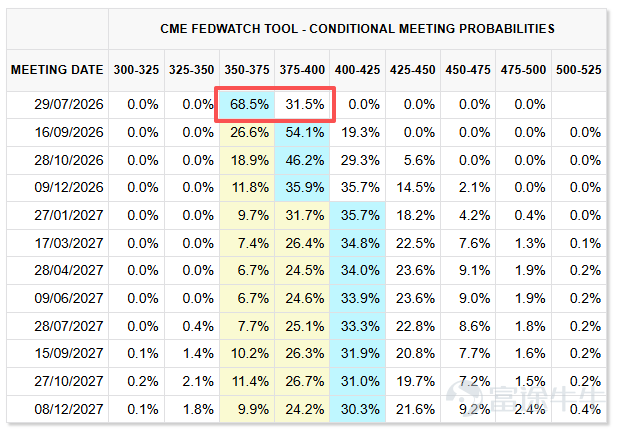
Based on current market expectations and institutional analysis, holding rates steady in July remains the prevailing view.The core rationale lies in recent U.S. economic data for June, which has given the Fed some 'breathing room': nonfarm payrolls rose by only 57,000 in June, far below the average of previous months, signaling marginal softening in the labor market; meanwhile, June CPI declined month-over-month, clearly indicating cooling inflation—providing data support for the Fed to keep rates unchanged.

However, this meeting is far from 'uneventful,' and investors should watch out for any 'hawkish' undercurrents emerging from the meeting:
Waller’s stance and inflation tolerance: Chair Waller has previously stated explicitly that he cannot tolerate 'persistently high inflation.' Investors should closely monitor how Waller balances the tension between 'improving data' and 'upside risks' during the press conference.
Tug-of-war between September rate hike expectations and geopolitical variables: Although a hold in July is highly likely, market expectations for a September rate hike had risen significantly due to recent geopolitical tensions pushing up oil prices. In early July, the U.S.-Iran ceasefire memorandum of understanding collapsed, and the U.S. military launched airstrikes on Iran for 13 consecutive nights. Brent crude oil prices briefly surged above $100 per barrel on July 23.
However, the situation took another critical turn over the past weekend.On Friday, July 24, U.S. President Trump declined to approve a new military operation, halting further airstrikes on Iran; Iran also announced on the 26th that it would suspend all retaliatory strikes against the U.S.Amid this cycle of escalation followed by de-escalation, international oil prices opened sharply lower on Monday, July 27, with Brent crude futures falling below $90 per barrel. The rapid cooling of oil prices has temporarily reduced upside inflation risks, but September rate hike expectations will remain contingent on how the Middle East situation evolves.
Additionally, on the same day (the 30th), the U.S. June core PCE price index will be released in the evening.As the Federal Reserve’s preferred inflation gauge, this data release will also influence market pricing of future policy paths.
Analysts widely expect that, based on already released June CPI and PPI components, the June PCE reading could show a notable cooldown.If the data continues the cooling trend as anticipated, it would further bolster the Fed’s confidence in extending its pause, potentially leading to a temporary easing of rate hike expectations.
Nevertheless, investors should not let their guard down. Navigation through the Strait of Hormuz remains effectively disrupted, and shipping is unlikely to return to normal in the near term, leaving room for repeated fluctuations in geopolitical risk premiums. Should subsequent negotiations stall again, oil prices could rebound and feed into core inflation.
Earnings season reaches its climax: Tech giants and memory chipmakers face a critical 'exam'
Amid conflicting macro liquidity expectations, this week also serves as a 'verification period' for corporate earnings. $Microsoft (MSFT.US)$ (after market close on July 29) and $Meta Platforms (META.US)$(After market close on July 29), $Amazon (AMZN.US)$(after market close on July 30), $Apple (AAPL.US)$(after market close on July 30) and other leading tech stocks will release their earnings results en masse this week; the memory sector will also see a wave of reports, $SK hynix (SKHY.US)$、 $Samsung Electronics (005930.KR)$、 $Kioxia Holdings (285A.JP)$with financial results scheduled for release on the 29th, 30th, and 31st.
Currently, the global AI industry trend continues, with semiconductor and cloud computing supply chains maintaining high levels of activity. However, the market is shifting from 'expectations of strength' to 'confirmation of strength.' Below are several key points to watch:
Realization of cloud providers’ capital expenditures: Earnings season is a critical window to assess the ROI of AI investments by tech giants. Corporate earnings momentum remains resilient, especially in the tech and financial sectors. The AI investment cycle is expanding beyond early-stage semiconductors to a broader range of beneficiaries, including power infrastructure, data transmission, network infrastructure, and cloud infrastructure. Investors should closely monitor cloud giants’ guidance on AI-related capex and their monetization capabilities.
The memory chip supercycle: The memory supply chain and certain industrial electronics segments have benefited from price increases and low inventory levels, delivering strong headline earnings in Q2. Reports from industry leaders like SK Hynix and Samsung will validate the extent of supply-demand tightness and pricing expectations for key AI-driven components such as HBM (High Bandwidth Memory). Tight capacity for AI compute chips and advanced-node semiconductors may lead to further price hikes.
Since July, the pricing logic in the AI market has become unprecedentedly stringent, placing the market in a clear dilemma:
If hyperscale cloud providers continue to significantly increase capital expenditures to maintain their leadership in the AI race, their free cash flow will come under severe pressure. Investors will question their return on investment (ROI), leading to downward pressure on cloud providers’ stock prices. However, if these cloud providers cut capital spending to improve cash flow, upstream hardware supply chains—such as chips, storage, and optical modules—will face slowing orders and valuation corrections, causing hardware-related stocks to decline.
As a result, the market is no longer simply rewarding narratives of 'burning cash to scale up' or 'selling shovels'but instead demands clear paths to monetization and visible profitability.Companies with pricing power and earnings visibility will continue to benefit, while sectors lacking cost-pass-through ability will face pressure.
Options Strategy Guide for High-Catalyst Weeks
This week’s 'Super Week' is expected to set a new directional anchor for global asset pricing in the second half of the year. The Fed’s 'pause' does not signal the definitive end of the rate-hike cycle, and tech giants’ earnings reports will determine whether the AI narrative can continue. During periods packed with major events, market volatility is expected to intensify, typically causing implied volatility (IV) in options to surge and making option premiums expensive.
In this high-volatility environment, it is more advantageous to act as an options seller to collect rich premiums. Since elevated volatility is difficult to sustain over the long term, it is likely to subside afterward,sellers not only receive high initial premiums but also benefit from the dual tailwinds of declining volatility and time decay. However, sellers must manage risk carefully and avoid naked selling without collateral or protection, as unexpected black swan events could trigger margin calls or blowups.
Below are two seller strategies well-suited for this environment: Covered Calls and Cash-Secured Puts, offered for investor reference.
Strategy 1: Covered Call
A covered call is a strategy that combines 'holding the underlying stock' with 'selling a call option.'
Strategy mechanics: The investor must hold at least 100 shares of the underlying stock (the basis for being 'covered') and simultaneously sell a call option on that stock, immediately receiving the premium. The held shares serve to 'cover' the potential delivery obligation from selling the call option.
If the stock price is below the strike price at expiration: the option expires worthless, and the investor keeps both the underlying shares and the full premium. They may choose to sell another covered call in the next cycle.
If the stock price is above the strike price at expiration: the option will be exercised by the buyer, and the investor must sell their shares at the strike price.The investor retains the premium and any capital gains up to the strike price but forfeits any upside beyond the strike price.

(The illustrative graphics shown on screen are for demonstration purposes only and do not constitute investment advice or guarantees; market conditions change frequently, and the displayed option prices do not reflect real-time data.)
Strategy 2: Cash-Secured Put
A cash-secured put is essentially a seller's strategy aimed at 'being ready with cash to buy shares at a lower price.' The investor sets aside sufficient cash in their account (as collateral for potential assignment) and sells a put option on the target stock, immediately collecting the premium. If the stock price remains above the strike price, the investor keeps the premium as net profit; if the price falls below the strike price, the investor is obligated to buy the stock at the strike price.
If the stock price is above the strike price at expiration: the option expires worthless, and the seller keeps the full premium, with the cash released for use in the next trade.
If the stock price is below the strike price at expiration: the seller must buy 100 shares at the strike price, which is higher than the market price, but the premium received offsets part of the purchase cost.It should be noted that if the stock price drops significantly due to fundamental deterioration, the investor is still obligated to purchase the shares at the agreed-upon price and will incur unrealized losses.
Take Apple as an example:

(The illustrative graphics shown on screen are for demonstration purposes only and do not constitute investment advice or guarantees; market conditions change frequently, and the displayed option prices do not reflect real-time data.)
Risk Disclaimer: The above content only represents the author's view. It does not represent any position or investment advice of Futu. Futu makes no representation or warranty.Read more


Comments
to post a comment
35
22