Apple and Amazon reported starkly contrasting earnings— which one are you bullish on?

Earnings & Options Strategy | Trillion-dollar AI compute meets the monetization test—can Microsoft’s earnings report shatter market hesitation around AI?
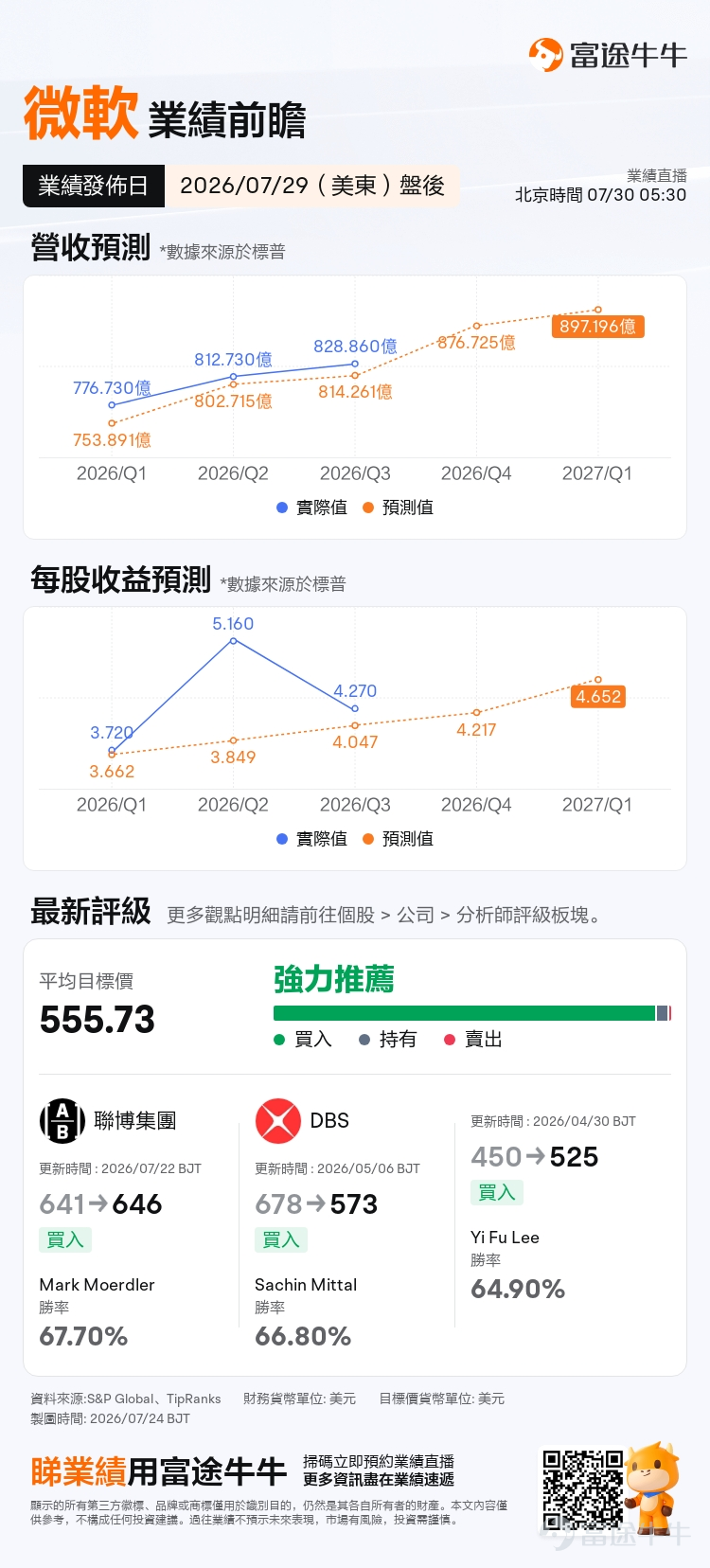
After market close on July 29, 2026, $Microsoft (MSFT.US)$ will release its full fourth-quarter fiscal year 2026 earnings (corresponding to calendar Q2 2026). Analysts expect Q4 FY2026 revenue of $87.672 billion, up 14.69% year-over-year, and earnings per share of $4.217, an increase of 15.54% year-over-year.
The above figures are reported under US-GAAP accounting standards.

For the broader tech sector, this is not just another quarterly earnings report—it is a critical validation point for whether massive AI investments can translate into tangible revenue. Market focus has already shifted from 'Is AI demand real?' to 'Can infrastructure spending deliver commercial returns?'
Over the past year, $Microsoft (MSFT.US)$ the stock price has declined nearly 30% from its all-time high (reached on July 31, 2025).Market concerns do not stem from deteriorating fundamentals, but from a more fundamental question—After hundreds of billions of dollars in capital expenditures have been poured into AI infrastructure, can the pace of commercial returns keep up with the scale of investment?
First, the global AI compute arms race is driving sustained capital expenditures higher, raising market concerns that heavy spending will continue to pressure free cash flow and margins over the long term. Second, uncertainty remains around the pace of AI commercialization, leading investors to adopt a wait-and-see stance on Azure cloud growth and Copilot monetization capabilities.Can this earnings report ease market concerns? Will Microsoft’s AI-driven valuation begin a recovery?

From the perspective of an ordinary U.S. equity investor, this article breaks down three key focal points for the earnings report and proposes trading strategies aligned with different risk appetites, incorporating implied volatility from the options market.
I. Three Key Variables That Will Determine Post-Earnings Stock Price Direction
1. Azure Growth Rate: 39%–40% Is the Critical Threshold
Cloud computing (Azure) remains the core pillar of Microsoft’s valuation and is the most closely watched metric in this earnings report. Ahead of the results, Bank of America analyst Liani clearly defined the market’s expectation threshold:If Azure’s quarterly growth rate reaches 39% to 40%, the stock price could receive solid support and strengthen; if it falls short of this range, doubts about AI investment returns will intensify again, amplifying valuation pressures.
Meanwhile, $Microsoft (MSFT.US)$ remaining performance obligations (RPO) have reached $627 billion, nearly doubling year-over-year.This figure represents contracted but not yet recognized future revenue, reflecting enterprise clients’ long-term commitments to Microsoft’s cloud services and AI products. However, whether RPO can accelerate into actual revenue in Q4 and subsequent quarters is a deeper measure of Azure’s growth quality.While the scale of the order backlog is indeed substantial, conversion efficiency is the true core driver of share price performance.
2. Capital expenditure guidance: FY2027 CapEx figure is capturing market attention
$Microsoft (MSFT.US)$ It was previously confirmed that capital expenditures for calendar year 2026 would be approximately$190 billion, a figure already largely priced in by the market.The real focus of this earnings report lies in what forward-looking FY2027 capital expenditure guidance management will provide.
Analysts generally expect FY2027 capital expenditures to reach around $220 billion, representing a year-over-year increase of 20% to 30%.If the actual guidance broadly aligns with this expectation, the market will likely react calmly; however, if guidance significantly exceeds $220 billion, concerns over pressure on free cash flow will quickly intensify, and investor skepticism regarding capital efficiency may rise accordingly.
Last quarter, Microsoft reported capital expenditures of $31.9 billion and free cash flow of approximately $15.8 billion. Rising expenditures and pressured cash flow epitomize the recent valuation headwinds facing tech stocks. Investors need to distinguish between two things:Short-term cash flow volatility and long-term platform competitiveness do not always move in the same direction. The key lies in whether the company can demonstrate that spending growth will ultimately be matched—or surpassed—by revenue and profit growth.
3. Copilot Monetization – AI monetization enters a critical acceleration phase
If Azure addresses infrastructure questions, Copilot addresses application monetization.
Last fiscal quarter, Microsoft’s Copilot paid commercial seats surpassed 20 million, with annualized AI revenue exceeding $37 billion—a year-over-year growth rate of 123%. The contours of commercialization are becoming increasingly clear.
An even more significant structural shift is occurring on the supply side: starting July 1, 2026, Microsoft has officially embedded Copilot into Microsoft 365 Business editions, no longer offering it as a separately priced add-on module. This means Copilot’s adoption path is shifting from 'active selection' to 'default integration,' leading to a quantum leap in potential user reach.
For retail investors, this implies two key changes:First, the monetization pathway is clearer,Seats, ARPU, and product integration provide stronger support for valuation discussions than abstract concepts alone;Second, forward-looking metrics will become more concrete,including whether seat growth can be sustained, whether enterprise deep usage increases, and whether the embedded strategy boosts penetration among small and medium-sized businesses.
Of course, caution is still warranted.High revenue growth from AI does not automatically guarantee strong short-term stock price performance. What the market cares about more is whether this revenue growth is sufficient to offset the cash flow pressure caused by capital expenditures.
2. Options Strategy: With an expected move of 6.9%, how should you choose an appropriate strategy?
As earnings season approaches, the options market typically prices in event-driven volatility in advance. Currently, the market expects $Microsoft (MSFT.US)$ a post-earnings stock price move of approximately 6.9% in either direction.

From an options volatility perspective, Microsoft’s implied volatility (IV) is not high in absolute terms at 44.07%, but relative to its own historical levels, it is relatively elevated, sitting at the 93rd percentile of its IV history.

Considering Microsoft’s current fundamentals and varying investor risk appetites, the following strategies may be worth considering:
1. Bull Call Spread
Suitable for investors with a moderately bullish outlook who wish to control premium costs. This involves buying a call option with a strike price near the current stock price while simultaneously selling a call with a higher strike price, using the spread structure to mitigate the cost burden from elevated implied volatility.
The main advantage of this strategy is significantly reduced premium outlay. Even if the stock moves less than expected, the maximum loss is limited to the net premium paid at initiation, offering controlled risk—ideal for investors holding light positions and betting on valuation recovery.

(The design image shown on screen is for illustrative purposes only and does not constitute any investment advice or guarantee; market conditions change frequently, and displayed prices do not reflect real-time data.)
2. Long Straddle
Suitable for investors who anticipate significant volatility from earnings but are uncertain about the direction. This strategy involves simultaneously buying a call and a put with the same strike price. Profit is achievable as long as the actual price movement exceeds the total cost of the options, regardless of whether the stock surges or plunges.
Note that when implied volatility (IV) is elevated, the cost of a straddle position is relatively high. If the post-earnings price movement fails to exceed the market’s implied expectation, the position will suffer from time decay eroding the premium of both legs.

(The illustrative images shown on screen are for demonstration purposes only and do not constitute investment advice or guarantees; market conditions change rapidly, and displayed prices do not reflect real-time data)
3. Cash-Secured Put
Ideal for investors who believe in Microsoft’s long-term AI monetization thesis but have not yet established a position. The current share price has retraced approximately 30% from its recent high and is trading near its lowest level in the past year. Entering directly ahead of earnings carries high uncertainty; by selling a put option, investors can collect elevated premiums in this high-IV environment if the stock stabilizes or rebounds from this support zone. Should the price decline further due to concerns over capital expenditures (CapEx), they may also acquire the shares at a more attractive, risk-adjusted entry point.

(The illustrative images shown on screen are for demonstration purposes only and do not constitute investment advice or guarantees; market conditions change rapidly, and displayed prices do not reflect real-time data)
Summary
The core tension in Microsoft’s upcoming earnings reportlies in the alignment between rapidly growing AI-driven commercial revenue and the pace of its continuously expanding capital expenditure.If Azure growth reaches the upper end of market expectations, Copilot demonstrates clear monetization acceleration, and capital expenditure guidance does not rise beyond forecasts, the fundamental recovery narrative will gain strong support, creating potential for a阶段性 price rebound.
Investors should rationally assess the AI narrative and focus on long-term opportunities.
First, distinguish between short-term volatility and long-term trends.High capital expenditures (CapEx) creating cash flow pressure is a common phase for growth-stage tech companies. The key lies in order conversion efficiency and competitive moats. Microsoft’s substantial RPO backlog and ecosystem advantages provide it with a strong buffer.
Second, focus on execution details rather than single metrics.Whether growth targets are met, the monetization pace of Copilot, and the path to CapEx returns—these are critical indicators for evaluating a company's economic moat. Post-earnings conference calls often offer valuable forward-looking insights and warrant close review.
As the AI narrative enters its validation phase, the market tends to reward not the company with the most compelling story, but the one that clearly articulates its investments and delivers tangible returns. Microsoft is now at precisely this inflection point.
 Fellow investors, Microsoft has pulled back nearly 30% from its highs—do you think its Q4 FY2026 earnings report could spark a valuation recovery rally?
Finally, Options Sir has a small giveaway for fellow investors—feel free to claim it!Options Starter Pack
*This promotion is exclusively available to invited Hong Kong users. Click to learn more.Detailed terms and conditions of the promotion >>
Market conditions are complex and ever-changing,Options strategiesToo many choices and unsure how to proceed? Let Futubull help you build a strategy in three simple stepsOptions strategies, making investing simple and efficient!

Options Risk Disclosure:An option is a contract that grants the holder the right—but not the obligation—to buy or sell an underlying asset at a predetermined price on or before a specified date. Option prices are influenced by multiple factors, including the current price of the underlying asset, the strike price, time to expiration, and implied volatility. Implied volatility reflects the market’s expectation of future price fluctuations over the life of the option; it is derived by reverse-engineering the Black-Scholes pricing model and is commonly viewed as an indicator of market sentiment. When investors anticipate higher volatility, they may be willing to pay more for options to hedge their risk, resulting in higher implied volatility. Traders and investors use implied volatility to assess the attractiveness of option prices, identify potential mispricings, and manage their risk exposure.
Disclaimer:This content does not constitute an offer, solicitation, recommendation, opinion, or any form of guarantee regarding any securities, financial products, or instruments. The risk of loss in trading options can be substantial. In certain circumstances, your losses may exceed the initial margin deposit. Even if you place contingent orders such as 'stop-loss' or 'limit' orders, there is no assurance that losses will be avoided, as market conditions may prevent execution of these orders. You may be required to deposit additional margin on short notice. If you fail to meet such margin calls within the stipulated time, your open positions may be liquidated. You remain fully liable for any resulting deficit in your account. Therefore, prior to trading options, you should thoroughly research and understand how options work and carefully consider whether such trading aligns with your financial situation and investment objectives. If you trade options, you should become familiar with the procedures for exercising options and handling expiration, as well as your rights and obligations upon exercise or expiration. Options trading involves significant risk and is not suitable for all investors. Investors should carefully read"Characteristics and Risks of Standardized Options"。
Risk Disclaimer: The above content only represents the author's view. It does not represent any position or investment advice of Futu. Futu makes no representation or warranty.Read more


Comment (1)
to post a comment
29
24