
Apple and Amazon reported starkly contrasting earnings— which one are you bullish on?

Earnings & Options Strategy | Apple: A Capital-Light AI Winner—Can It Withstand Erosion from Rising Memory Prices?
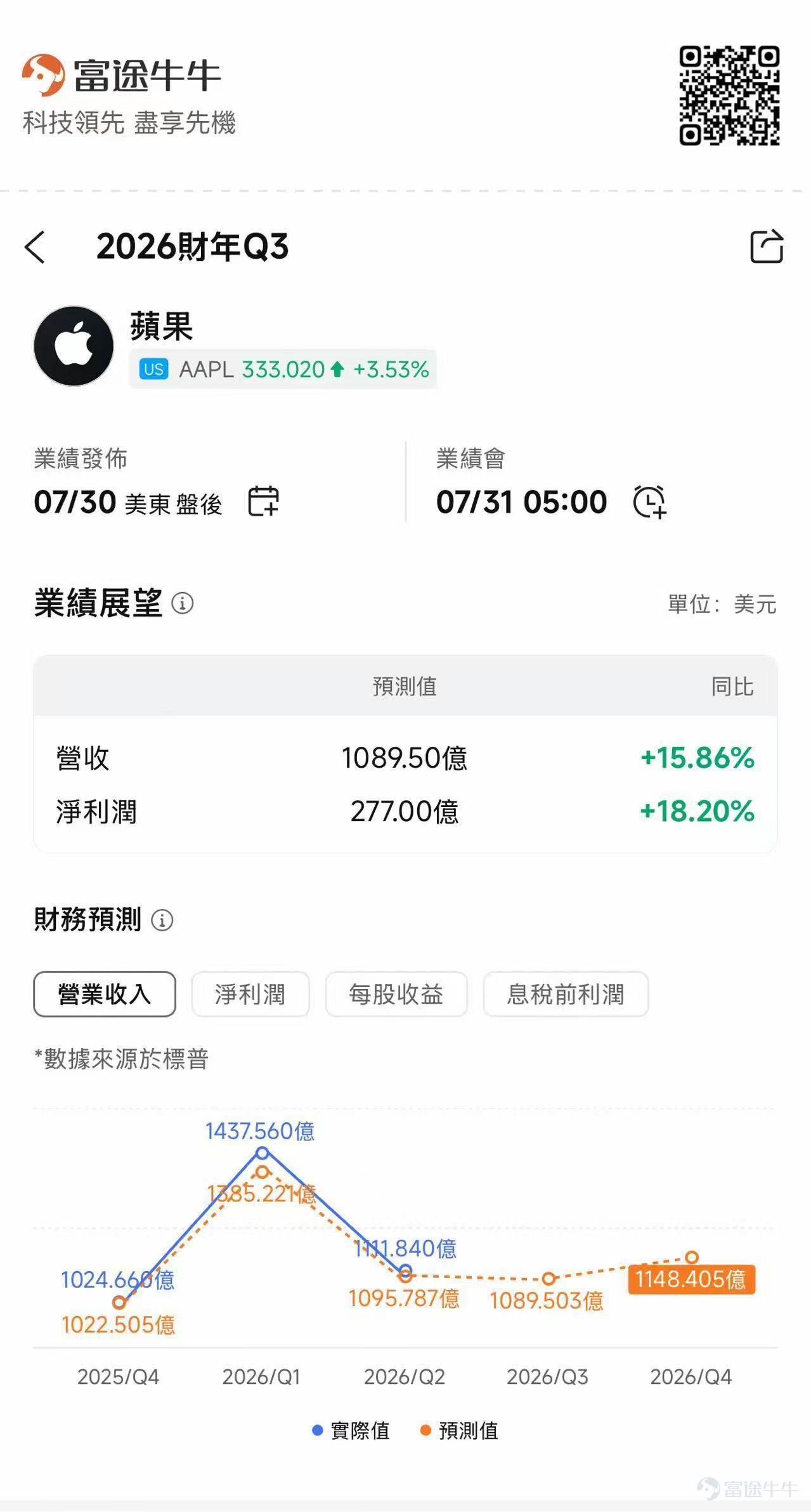
$Apple (AAPL.US)$ Apple will release its fiscal Q3 2026 earnings (covering the period from March 29, 2026, to June 27, 2026) after U.S. market hours on July 30. Analysts expect Apple to report revenue of $108.95 billion, up 15.80% year-over-year, and net profit of $27.7 billion, an 18.2% year-over-year increase.
The July 30 earnings call will be Tim Cook’s last as CEO before stepping down.Apple has announced that John Ternus will assume the role of CEO on September 1, with Cook transitioning to Executive Chairman. The market will closely watch the new leadership team's comments on product roadmaps, AI investments, supply chain strategy, and capital return policies.
Apple provided guidance last quarter for this quarter’s revenue growth of 14%–17% and gross margin of 47.5%–48.5%.Current consensus estimates already sit in the upper half of the revenue guidance range.

I. What should we pay most attention to in this earnings report?
1. iPhone is a clear positive factor this quarter
Apple’s revenue last quarter reached $111.2 billion, up 17% year-over-year, primarily driven by the iPhone 17 series, Services, and the China market. Although iPhone sales faced some supply constraints,demand remained robust.The market expects iPhone revenue of approximately $53 billion this quarter, making it the core driver of Apple’s overall revenue growth.
External shipment data appears positive. According to Counterpoint, global smartphone shipments in Q2 declined 11% year-over-year,while Apple’s shipments still grew by about 3%, with its global market share reaching 20% for the first time.This indicates that Apple continues to demonstrate strong resilience in premium demand despite industry-wide headwinds. This growth stems from two factors: resilient end-user demand for iPhones, and low channel inventory at the end of Apple’s March quarter, leading to significant channel restocking in the June quarter.

Therefore, Morgan Stanley believes iPhone revenue this quarter could slightly exceed market expectations, providing key support to Apple’s overall results. However, this restocking implies that part of the revenue growth does not entirely reflect accelerated end-user sales. Going into the second half of the year, the market will need to continue monitoring genuine upgrade demand.
If iPhone revenue comes in around $53 billion, the market will likely view it as meeting expectations; only if it significantly exceeds $54 billion—and management emphasizes continued strength in orders and upgrade demand—would it potentially serve as a basis for upward earnings revisions.
2. Memory chip prices continue to rise—can the gross margin hold at 48%?
Apple reported an overall gross margin of 49.3% last quarter, with product gross margin at 38.7% and services gross margin at 76.7%. For this quarter, the company guided to a lower range of 47.5%–48.5%, reflecting pressure from rising memory chip and component costs, as well as shifts in product mix.
Memory chip prices are currently rising continuously. As Apple depletes its inventory of low-cost components and maintains stable product pricing—which has helped it gain smartphone market share—hardware margins are likely to be compressed.
The market is already aware that costs are rising; what will truly impact the stock price is management’s outlook for the next few quarters.On June 25, Apple implemented broad price increases of 15% to 30% across product lines including Mac, iPad, HomePod, Apple TV, and Vision Pro to counter soaring memory chip costs driven by AI data center demand.
The biggest risk centers on the September quarter gross margin, Due to the time lag between price hikes and cost increases, iPhone product gross margin may face sequential pressure.Recent industry reports indicate Apple is seeking additional memory supply options, highlighting that cost control has become a key management priority.
3. The services segment may face sequential slowdown risks.
The market expects services revenue of approximately $31.4 billion. Last quarter, services revenue reached a record high of about $31 billion, driven primarily by advertising, the App Store, and cloud services.
Morgan Stanley is more cautious than the market on services, believing the main drag comes from slowing App Store growth.Tracking data cited in the report shows that App Store developer revenue grew only about 3.2% year-over-year in the June quarter, a notable slowdown from the previous quarter; performance weakened further in early July.
Price increases for Apple Music, iCloud+, and other services may provide some support, but they are unlikely to fully offset the App Store slowdown for now. The services segment has very high gross margins, so any shortfall in growth expectations would have a significantly larger impact on valuation sentiment compared to typical hardware businesses.
4. Can Apple’s AI strategy translate from a product narrative into financial contributions?
The market is currently reassessing AI-related capital expenditures by large tech companies. Following Alphabet’s earnings, its stock declined despite strong revenue and cloud performance, due to concerns over capital spending and free cash flow pressure. Apple’s current advantage lies in its relatively restrained capital expenditure, as it controls investment through in-house on-device models and partnerships with external models,thus earning a 'capital-light AI' valuation premium.
However, lower capital expenditure only reduces risk—the market still needs to see AI-driven revenue: whether Apple Intelligence drives device upgrades, the rollout timeline for the new Siri, and the pace of AI feature launches in key markets like China;
If management merely reiterates its long-term AI vision without near-term execution, the impact on the stock price will be limited. More critical are specific launch dates, user adoption metrics, and the underlying business model.
II. How might the stock price react after earnings?
As of July 24, Apple’s share price was approximately $333, with a total market capitalization of about $4.9 trillion., with a forward P/E ratio exceeding 36x, indicating that valuations have already largely priced in market expectations.: iPhone performance was solid in the June quarter; revenue and EPS for the September quarter came in above expectations; Apple offset some cost pressures through price increases; and a premium is being assigned to Apple’s 'low capex AI model.'

The options market is currently pricing in a post-earnings move of approximately ±4.1%. At $333, this roughly corresponds to a range of $319–$347. Apple’s average actual one-day post-earnings move over recent quarters has been about 2.5%., with implied volatility notably higher this time, reflecting additional uncertainty stemming from high valuation, CEO transition, and near-term cost pressures.

Morgan Stanley characterizes the short-term trading setup around this earnings release as neutral and demanding. Even if revenue and EPS beat expectations, the stock may not see a meaningful rally. Only a material upside surprise in services revenue or gross margin—significantly better than their relatively conservative forecast—could drive genuine positive momentum.
Conversely, if gross margin guidance is weak or services growth slows markedly, the market could experience a 'good results, falling stock price' scenario—a case of positive news being sold off.
In terms of options strategy,the Apple options market is currently sending a 'cautiously bullish' signal.Despite strong upward price momentum, options data shows elevated volatility, with current IV Rank at 74 and IV Percentile as high as 86%. The cost of buying options is relatively high by historical standards, meaning that even if the stock continues to rise as expected, traders may still fail to profit due to declining volatility (Vega risk).
(1) Sell Out-of-the-Money Put Options (Cash-Secured Put) — "Buy Stocks at a Discount"
Strategy Logic: Commit to buying the stock at a strike price below the current market price in exchange for an option premium. When implied volatility (IV) is high, premiums are more attractive. If the stock price stays above the strike price until expiration, the seller keeps the entire premium; if the stock price falls below the strike price and the option is exercised, the seller effectively purchases the underlying stock at a discounted price equal to the strike price minus the premium received.
(The chart below illustrates the simulated profit/loss profile of this strategy at expiration. The on-screen graphic is for illustrative purposes only and does not constitute investment advice or a guarantee; market conditions change rapidly, and the prices shown do not reflect actual market data.)

(2) Covered Call — "Earn Premiums Near Resistance Levels"
Strategy Logic: Hold the underlying stock while selling out-of-the-money call options above the current price to collect premiums. The stock price is near its 52-week high (peak at 334.99, currently at 334.55), with the upper Bollinger Band at 345.548. Technical indicators suggest overbought conditions, implying potential short-term consolidation or pullback. In this environment, selling slightly out-of-the-money calls near key resistance levels can enhance returns during price consolidation or modest declines.
(The chart below illustrates the simulated profit/loss profile of this strategy at expiration. The displayed graphic is for demonstration purposes only and does not constitute investment advice or guarantees; market conditions change rapidly, and the prices shown do not reflect real-time data.)

(3) Hold Apple Stock with a Collar Protection Strategy
Strategy Logic: Apple’s stock has risen consecutively, and short-term indicators are approaching overbought territory. Selling an out-of-the-money call above the current price allows capturing relatively high premiums due to elevated implied volatility (IV). The premium received can then be used to offset the cost of purchasing a protective put below the current price. If the stock trades sideways or rises modestly after earnings, the time decay of the sold call benefits the position. If gross margin guidance disappoints and the stock gaps down, the put limits further downside losses.
(The chart below illustrates the simulated profit/loss profile of this strategy at expiration. The on-screen graphic is for illustrative purposes only and does not constitute investment advice or a guarantee; market conditions change rapidly, and the prices shown do not reflect actual market data.)

Finally, Options Sir has a small giveaway for fellow investors—feel free to claim it!Options Starter Pack
*This promotion is exclusively available to invited Hong Kong users. Click to learn more.Detailed terms and conditions of the promotion >>
Market conditions are complex and ever-changing,Options strategiesToo many choices and unsure how to proceed? Let Futubull help you build a strategy in three simple stepsOptions strategies, making investing simple and efficient!

Options Risk Disclosure:An option is a contract that grants the holder the right—but not the obligation—to buy or sell an underlying asset at a predetermined price on or before a specified date. Option prices are influenced by multiple factors, including the current price of the underlying asset, the strike price, time to expiration, and implied volatility. Implied volatility reflects the market’s expectation of future price fluctuations over the life of the option; it is derived by reverse-engineering the Black-Scholes pricing model and is commonly viewed as an indicator of market sentiment. When investors anticipate higher volatility, they may be willing to pay more for options to hedge their risk, resulting in higher implied volatility. Traders and investors use implied volatility to assess the attractiveness of option prices, identify potential mispricings, and manage their risk exposure.
Disclaimer:This content does not constitute an offer, solicitation, recommendation, opinion, or any form of guarantee regarding any securities, financial products, or instruments. The risk of loss in trading options can be substantial. In certain circumstances, your losses may exceed the initial margin deposit. Even if you place contingent orders such as 'stop-loss' or 'limit' orders, there is no assurance that losses will be avoided, as market conditions may prevent execution of these orders. You may be required to deposit additional margin on short notice. If you fail to meet such margin calls within the stipulated time, your open positions may be liquidated. You remain fully liable for any resulting deficit in your account. Therefore, prior to trading options, you should thoroughly research and understand how options work and carefully consider whether such trading aligns with your financial situation and investment objectives. If you trade options, you should become familiar with the procedures for exercising options and handling expiration, as well as your rights and obligations upon exercise or expiration. Options trading involves significant risk and is not suitable for all investors. Investors should carefully read"Characteristics and Risks of Standardized Options"。
Risk Disclaimer: The above content only represents the author's view. It does not represent any position or investment advice of Futu. Futu makes no representation or warranty.Read more

Comment (1)
to post a comment
18
6