
Bessent interprets signals from US-Iran talks, oil prices plunge

Bitget UEX Daily Report | U.S.-Iran hostilities paused, oil prices drop sharply; pivotal week for U.S. tech stocks as Apple, Amazon, Microsoft, Meta, SK Hynix, and others release earnings (July 27, 2026)


I. Key Headlines
Federal Reserve Updates
Falling oil prices ease pressure for rate hikes, markets focus on the future policy path
Following the pause in Middle East conflict,Crude oilprices fell sharply, easing rate hike expectations that had intensified due to surging oil prices.
Markets continue to assess the inflation trajectory and the Federal Reserve's next move.Market ImpactDeclining energy prices help alleviate near-term inflation concerns, supporting rate-sensitive assets and boosting risk appetite.
US and Iran suspend mutual strikes, oil prices fall sharply
The United States and Iran have suspended mutual military strikes for several consecutive days, signaling de-escalation and raising expectations for ceasefire negotiations.
Brent and WTI crude oil prices fell significantly, easing the previously elevated geopolitical risk premium.Market ImpactThe rapid unwinding of the geopolitical risk premium has driven energy prices lower, directly reducing inflation concerns, benefiting risk assets, and dampening safe-haven demand.
SpotGoldApprox. USD 4,109 per ounce, +1.36%
SpotSilverApprox. USD 60.0 per ounce, +2.45%
WTI Crude OilApprox. USD 85.4 per barrel, -4.42%
Brent crudeApprox. USD 82.68 per barrel, -4.33%
US Dollar Index (DXY)Approx. 101.7, -0.3%
Driver AnalysisThe pause in mutual attacks between the U.S. and Iran has significantly reduced the geopolitical risk premium, with the sharp drop in crude oil prices becoming the dominant driver. Gold and silver have diverged amid falling oil prices and improving risk appetite, with silver supported by its industrial attributes. The dollar has remained relatively stable. Institutional views suggest that short-term commodity markets are being led by geopolitical de-escalation; declining energy prices help ease inflation and rate-hike expectations, creating a positive feedback loop: falling oil prices → cooling inflation concerns → support for risk assets.
BTC: Approximately $65,195, +1.11%
ETH: Approximately $1,974, +3.65%
Total cryptocurrency market capitalization: Approximately $2.31 trillion, +1.7%
Market liquidation overview: Total 24-hour liquidations of approximately $213 million, with $160 million from short positions
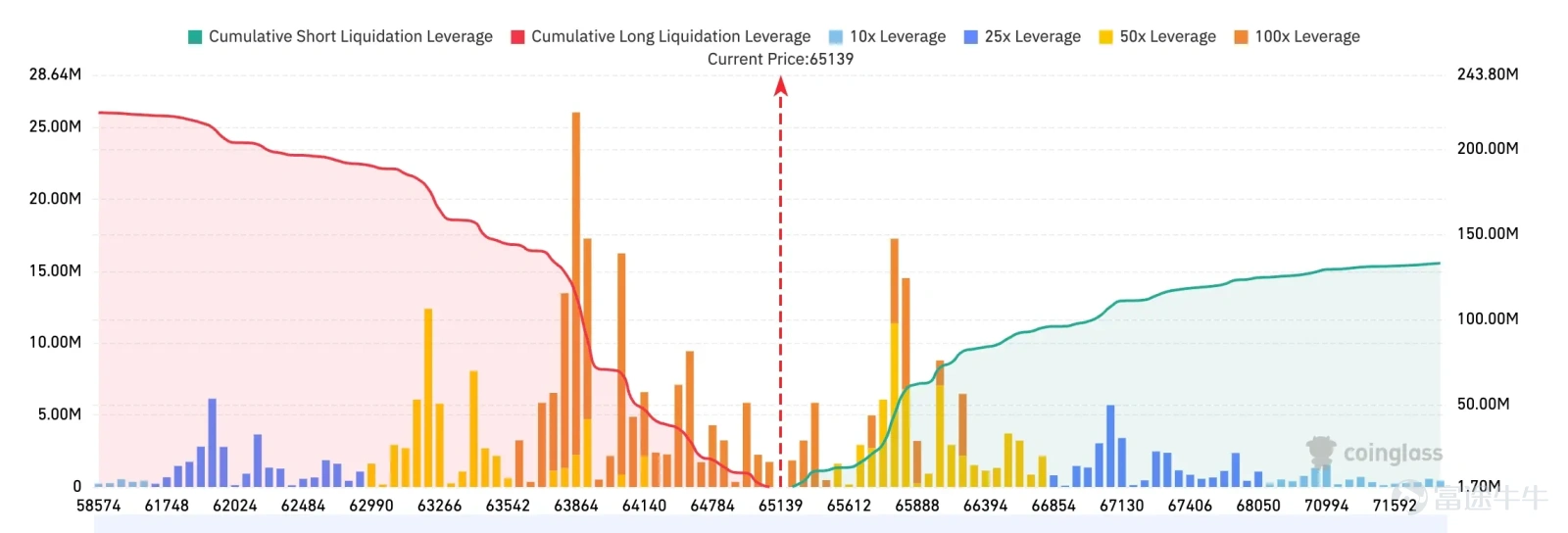
Bitget BTC/USDTLiquidation Map: Current price is around $65,139. Downside long-position liquidation pressure has largely been relieved, while a significant concentration of short-position liquidation orders sits near $65,700–$66,000. If prices continue rising, short-covering could be easily triggered, amplifying upward momentum. The $63,800–$64,200 range was previously a dense zone for long liquidations and has already undergone substantial cleansing. Short-term market leverage has shifted upward; monitor potential cascading short liquidations in the $65,800–$67,100 range and sustainability following any breakout.
Driver Analysis: Easing Middle East tensions and falling oil prices have boosted risk appetite, supporting a recovery in crypto markets. BTC held its key range and edged slightly higher, while ETH showed relatively stronger elasticity. Improved macro conditions and funding dynamics jointly underpin the short-term trend. Institutional consensus points to a period of range-bound recovery, but fluctuating ETF flows and leveraged liquidations indicate lingering caution. Geopolitical volatility remains a risk to sentiment.
As of last Friday’s close:
Dow Jones Industrial Average: Closed at approximately 51,947, up 0.46%
S&P 500: Closed at approximately 7,412, up 0.05%
NasdaqClosed at approximately 24,976, down 0.64%, with the technology sector still under pressure
NVDA$206.84, down 0.92%
AAPL$333.02, up 3.53%
MSFT$381.70, up 0.03%
GOOGL$319.74, up 0.65%
AMZN$232.11, down 0.66%
META$595.19, down 1.80%
TSLA$313.03, down 2.08%
Performance Summary and Driver AnalysisThe Magnificent Seven showed clear divergence. Apple rose sharply by 3.53% against the broader trend, serving as the main source of support; Microsoft and Google posted modest gains. NVIDIA, Amazon, Meta Platforms, and Tesla all declined, with Tesla experiencing a relatively larger drop. Lingering concerns over AI-related capital expenditure continue to weigh on high-valuation growth stocks, though easing geopolitical tensions and falling oil prices provided some support. The stock-specific divergence reflects a market shift from pure thematic trading toward repricing based on company fundamentals and capital expenditure efficiency.
Semiconductor/memory sector saw a sharp pullback (leading the decline)
Representative stocks: Micron Technology (MU) dropped 6.99%, Intel (INTC) fell 7.89%, Western Digital (WDC) declined approximately 6.9%, Marvell (MRVL) dropped around 7.3%.
Driving Factors: Profit-taking emerged clearly after earlier AI demand expectations drove prices higher, compounded by market concerns over the pace of return on capital expenditures, amplifying volatility in memory and semiconductor subsectors, making them among the day's worst-performing segments.
Optical communications and related tech stocks declined significantly
Representative stocks:Coherent (COHR) fell about 9.8%,Lumentum (LITE) declined approximately 8.5%.
Driving Factors: Investor enthusiasm for AI optical modules and interconnect themes cooled, prompting capital to exit highly volatile niche segments.
Software and select growth stocks held up relatively well or rose
Representative stocks:ServiceNow (NOW) rose about 7.4%, with some software and services stocks performing relatively well.
Driving Factors: Amid concerns over heavy AI hardware investment, capital partially rotated into software and cloud-related names, leading to market divergence.
Energy sector performed steadily
Representative stocks: Exxon Mobil (XOM) up 0.03%, Chevron (CVX) up 0.19%.
Driving FactorsOil prices had not fully reflected the weekend’s easing of tensions by Friday’s close, leaving the sector relatively resilient; however, crude prices plunged over the weekend, potentially pressuring the market on Monday.
Event summary: Intel reported Q2 revenue of $16.13 billion, up 25% year-over-year (its strongest growth in 15 years), with adjusted EPS of $0.42 (well above the estimated $0.21). Data Center and AI revenue reached $6.26 billion, surging 59% YoY; Client Computing grew 13%, and Foundry business rose 31%. Operating margin improved dramatically from a negative figure a year ago to approximately 17%, and operating cash flow increased by over 240% YoY. The company guided for Q3 revenue of $15.8–16.8 billion and adjusted EPS of $0.38, both above market expectations. The CEO emphasized that AI is driving unprecedented computing demand, and capital expenditures in 2027 will be significantly higher than in 2026.Market Analysis: Institutions widely view this as a genuine turning point, with AI demand significantly revitalizing its server CPU business and delivering strong operating leverage. Some analysts (e.g., Seeking Alpha) note that the foundry business remains deeply unprofitable and heavily reliant on internal demand, with limited progress in securing external clients. Current valuations already price in assumptions of foundry breakeven and sustained high growth, leading to a 'Hold' rating. Wall Street is also closely watching progress on the 18A process node, potential major external customers (such as Apple, Microsoft, and Amazon), and the impact of sharply higher capital spending on free cash flow.Investment InsightThe results and guidance validate AI-driven demand for CPUs, improving the medium-term investment thesis, but investors must closely monitor the realization of external foundry orders and the timing of returns on elevated capital expenditures to avoid valuation overextension risks.
Event summary: Tesla reported record Q2 revenue of $28.24 billion (up 26% YoY), with record deliveries of 480,100 vehicles. However, adjusted EPS came in at just $0.33 (far below the estimated ~$0.53), operating profit fell 57% YoY to $398 million, and operating margin plunged from 4.1% a year ago to 1.4%. Free cash flow turned negative at approximately $1.09 billion, while capital expenditures surged 142% YoY to $5.79 billion, primarily allocated to AI, Robotaxi, andOptimus. Regulatory credit revenue dropped sharply by 67%. Energy storage deployments reached 13.5 GWh. During the earnings call, Musk continued to emphasize progress on Robotaxi and Optimus, but markets remain highly skeptical about the timeline for delivery.Market Analysis: Institutions believe strong deliveries cannot mask the core issues of deteriorating profitability and cash flow, with heavy investments in AI and robotics significantly pressuring near-term earnings. Analysts note that current valuation already embeds very high growth expectations; if commercialization of Robotaxi and Optimus falls short of forecasts, downside risks are substantial. Some views highlight energy business as a bright spot, but overall returns post the peak capex period still need to be observed.Investment InsightNear-term volatility remains elevated; key focus areas include actual Robotaxi mileage, FSD subscription growth, and any adjustments to full-year capex guidance—all critical to validating whether the AI narrative can translate into sustainable profits.
Event summary:Alphabet Q2 revenue was approximately $119.8 billion (up ~24% YoY), with Google Cloud revenue at $24.8 billion, up 82% YoY, and substantially improved operating profit. Cloud backlog rose to $514 billion. However, the company raised its full-year capital expenditure guidance to $195–205 billion (from prior guidance of $180–190 billion), with quarterly capex of roughly $44.9 billion, causing free cash flow to turn negative at approximately $5.9 billion. Management stressed that demand continues to outstrip supply and plans to further expand both owned and leased capacity.Market Analysis: Institutions acknowledge the robust demand for cloud services and AI infrastructure but express concern that persistently large increases in capital spending could extend payback periods and constrain near-term cash flow. Analysts are closely monitoring the resilience of search advertising, TPU sales cadence, and whether capital expenditures will continue rising into 2027. Market sentiment is shifting from 'growth confirmation' to 'capital efficiency validation.'Investment InsightThe long-term advantages in cloud and AI ecosystems are clear, but near-term focus should be on tracking the alignment between capital expenditure and revenue conversion, particularly the speed at which backlog translates into actual revenue.
Event summaryAMD announced a collaboration with Cerebras Systems to combine its Helios rack-scale systems with Cerebras’ wafer-scale engines, launching a joint solution optimized for ultra-low-latency inference. The offering is expected to become available later this year via Cerebras Cloud. AMD’s chips focus on prompt processing and large context windows, while Cerebras emphasizes high-bandwidth token generation, claiming higher performance per watt.Anthropicsupply up to 2 gigawatts of computing power and invest up to $5 billion.Market AnalysisAnalysts view this as reflecting the trend toward 'disaggregation' of AI workloads, helping AMD differentiate itself from NVIDIA in the inference market. Analysts are watching the implementation timeline, real-world performance benchmarks, and whether the partnership can translate into sustained orders. A multi-vendor landscape is favorable for AMD over the medium to long term.Investment InsightAs a key play in diversified AI compute allocation, monitor progress on product commercialization and customer expansion.
Event summaryNVIDIA has entered into a multi-year strategic partnership with Amkor Technology, providing a $1.5 billion advance payment to support Amkor’s expansion of advanced semiconductor packaging and testing capacity in the United States—particularly in Arizona—and to jointly develop packaging technologies for next-generation AI and accelerated computing platforms. The collaboration covers high-density interconnects and heterogeneous integration.Market AnalysisAnalysts believe this strengthens NVIDIA’s control over its advanced packaging supply chain and reinforces its U.S. domestic capacity footprint, aligning with ongoing AI infrastructure expansion and geopolitical supply chain security considerations. Analysts are monitoring the timing of capacity ramp-up (Amkor’s project is expected to reach volume production in 2028) and its impact on overall AI hardware costs and delivery schedules.Investment InsightLong-term positive for AI computing power leaders due to resilient supply chains; watch for packaging capacity ramp-up and its potential support for gross margins.
1. Iranian military spokesperson Mohammad Akraminia stated to official media that Iran has halted retaliatory strikes as the U.S. did not attack the country over the past two nights, and its operations are currently paused.
Madhavi Arora of Emkay Global said Brent crude’s rally is no longer driven solely by known risks in the Strait of Hormuz and the latest Red Sea disruptions. Visible shipping through the Strait of Hormuz has now dropped to near zero, global inventories are depleted, and new supply disruptions are intensifying tensions. Additionally, Russian fuel exports remain constrained after months of Ukrainian drone attacks, while Kazakhstan has started cutting output following the shutdown of the CPC (Caspian Pipeline Consortium) export terminal. The supply side faces multiple tightening pressures.
2. According to GitHub Trending page data publicly shared by Twitter co-founder Jack Dorsey,Blockthe open-source collaboration platform Buzz, permissionlesstech’s decentralized Bluetooth chat app BitChat, and citrolabs’ AI browser ego-lite ranked among the top three trending repositories globally today.
3. Data:SUI、EIGENTokens such as FF will see significant unlocks this week, with SUI’s unlock valued at nearly $10 million.
4. According to Fortune, the Trump administration in the United States is leveraging at least four agencies—including the Department of Commerce, the Department of Defense, the Department of Energy, and the U.S. International Development Finance Corporation—toIntel、MPMaterials, Vulcan Elements, xLight, and several quantum computing companies have collectively invested approximately USD 26.7 billion in equity or equity-like instruments, including a passive stake of about 9.9% in Intel held through the U.S. Department of Commerce, which has risen in market value from approximately USD 8.9 billion to around USD 42 billion.
5. NVIDIA (NVDA.O) is negotiating to provideOpenAIapproximately USD 25 billion in financial guarantees to support a massive data center project—one of the largest financial transactions yet in the U.S. artificial intelligence boom.
6. South Korea's largest trading company, POSCO International, is partnering with LG CNS, a technology subsidiary of LG Group, to tokenize real-world commercial invoices using theInjectivenetwork.
According to PAnews, global investors' inflation fears are being reignited by a triple shock of surging energy prices, new U.S. tariffs, and a sharp rise in AI-related capital expenditures. This week, the Nasdaq led losses among U.S. equity indices, with technology stocks hit by both macroeconomic and fundamental pressures throughout the week. The Philadelphia Semiconductor Index plunged 5% on Friday, with memory chip stocks bearing the brunt. Investors remain cautious ahead of the Federal Reserve’s policy meeting next week, with many anticipating a potential hawkish surprise. Below are key events the market will closely watch in the coming week (all times in UTC+8):
Tuesday at 20:15, U.S. weeklyADPemployment for the week ending July 4;
Thursday 02:00 – FOMC interest rate decision
Thursday 02:30 – Fed Chair Waller holds monetary policy press conference
Thursday 17:00 – Eurozone Q2 GDP year-over-year preliminary estimate, Eurozone June unemployment rate, Eurozone July industrial confidence index, Eurozone July economic sentiment index
Thursday 19:00 – Bank of England interest rate decision, meeting minutes, and Monetary Policy Report
Thursday 19:30 – Bank of England Governor Bailey holds monetary policy press conference
Thursday 20:30 – U.S. initial jobless claims, U.S. June core PCE price index year-over-year/month-over-month, U.S. June personal spending month-over-month, U.S. Q2 preliminary annualized real GDP growth rate, preliminary quarterly real personal consumption expenditures growth rate, and preliminary annualized core PCE price index growth rate
Friday 17:00 – Eurozone July preliminary CPI year-over-year/month-over-month
Friday 21:45 – U.S. July Chicago PMI
Friday at 22:00, the final reading of the University of Michigan Consumer Sentiment Index for July and the final reading of the one-year inflation expectation for July in the United States
This week brings a heavy slate of tech earnings reports, with Apple (AAPL.O), Meta Platforms (META.O), Amazon (AMZN.O), Microsoft (MSFT.O), Qualcomm (QCOM.O), and SK Hynix all scheduled to release their earnings this week.
Investment bank analysts believe that the temporary halt in mutual attacks between the U.S. and Iran has significantly reduced geopolitical risk premiums. The sharp decline in crude oil prices helps ease inflation and rate hike expectations, providing short-term support to risk asset sentiment. Friday’s mixed close in U.S. equities reflects lingering concerns over prior AI-related spending in the tech sector, though improved macro conditions offer room for recovery. Cryptocurrency markets have rebounded alongside the broader improvement in risk appetite. Overall strategy suggests monitoring the inflation trajectory following the drop in energy prices and developments in geopolitical negotiations, maintaining a flexible allocation approach.
Disclaimer: The content above has been compiled by AI search, with human verification for publishing purposes only. It is not intended as investment advice. Data mentioned in the text may inevitably contain biases; please refer to real-time market data for accuracy.
Risk Disclaimer: The above content only represents the author's view. It does not represent any position or investment advice of Futu. Futu makes no representation or warranty.Read more

Comments
to post a comment
1