
Novartis AG: Pelacarsen is poised to be the first to achieve clinical validation for the Lp(a) target, unlocking a new market in residual cardiovascular risk management
This article represents personal opinions only and does not constitute investment advice. Please assume all risks yourself.
I. Pelacarsen: Leading in clinical development, with pivotal data expected in 2H26
Pelacarsen is a hepatocyte-targeted antisense oligonucleotide (ASO) therapy primarily developed to reduce the risk of cardiovascular events in patients with established cardiovascular disease and elevated lipoprotein(a) [Lp(a)]. Elevated Lp(a) exhibits pro-atherosclerotic, pro-inflammatory, and potentially pro-thrombotic properties and is a significant hereditary risk factor for myocardial infarction, ischemic stroke, and aortic valve calcification. However, whether lowering Lp(a) will translate into a clinically meaningful reduction in cardiovascular events awaits final confirmation from the Phase III HORIZON trial, with data expected in the second half of 2026.
Pelacarsen does not directly neutralize lipoprotein(a) already present in the bloodstream. Instead, it blocks the synthesis of apolipoprotein(a) within hepatocytes, thereby reducing the production of new Lp(a) particles at the source. Its mechanism of action is as follows: GalNAc-mediated liver targeting → binding to LPA mRNA → RNase H1-mediated degradation of mRNA → reduced apo(a) synthesis → decreased generation of Lp(a) particles.
Lp(a) is essentially another cholesterol-containing lipoprotein particle, but it differs from standard LDL by containing an additional unique protein—apolipoprotein(a), or apo(a).
Lp(a) can be understood as a specialized lipoprotein particle formed by attaching apo(a) to an apoB-100–containing LDL-like particle. Apo(a) is the distinctive component that differentiates Lp(a) from conventional LDL and is encoded by the LPA gene in the liver. Without sufficient apo(a), even if apoB-100–containing lipoprotein particles are present, new Lp(a) cannot be properly assembled. Therefore, targeting apo(a) allows for relatively selective reduction of Lp(a), rather than broadly and non-specifically inhibiting the production of all LDL particles.
LDL-C stands for 'low-density lipoprotein cholesterol,'which refers to the total amount of cholesterol carried by low-density lipoprotein particles in the blood. It is commonly known as 'bad cholesterol.' Cholesterol itself is not entirely harmful—it is an essential substance for the human body. However, when LDL-C levels remain chronically elevated, excess cholesterol-carrying particles may infiltrate the arterial wall, leading to: LDL particle entry into the vessel wall → cholesterol deposition → inflammatory response → formation of atherosclerotic plaques.
As plaques progressively enlarge, they can cause arterial narrowing; if a plaque ruptures and triggers thrombosis, it may lead to myocardial infarction, ischemic stroke, or peripheral artery disease. Consequently, LDL-C is one of the most important and well-established modifiable cardiovascular risk factors in clinical practice.
Patients may have well-controlled LDL-C levels yet still exhibit high Lp(a). In such cases, they may remain at substantial 'residual cardiovascular risk.' Pelacarsen is expected to play a role primarily in managing this residual risk rather than replacing existing LDL-C–lowering therapies. Its potential use case involves further risk reduction in patients who, despite treatment with maximally tolerated doses of statins, ezetimibe, or PCSK9 inhibitors, continue to have elevated Lp(a) levels.
Lp(a) levels are predominantly determined by genetics; an individual’s Lp(a) concentration is typically established early in life, with limited influence from diet or exercise. High Lp(a) is usually asymptomatic and can only be detected through blood testing. It is not merely a bystander marker but is recognized as an independent, hereditary, and causal risk factor for atherosclerotic cardiovascular disease. Extensive epidemiological, genetic, and Mendelian randomization studies consistently show that higher Lp(a) levels are associated with increased risks of myocardial infarction, ischemic stroke, peripheral artery disease, and calcific aortic valve stenosis.
Lp(a) increases cardiovascular risk in patients primarily through the following three mechanisms:
1. Promotes atherosclerosis:Lp(a) contains a cholesterol-rich particle similar to LDL, enabling it to enter and become retained in the arterial wall. The process is as follows: elevated plasma Lp(a) → more particles infiltrate the arterial wall → cholesterol deposition → plaque formation and progression.
2. Carries oxidized phospholipids and promotes inflammation:Lp(a) is a major carrier of oxidized phospholipids.
3. May promote thrombosis:The apo(a) component of Lp(a) exhibits structural similarity to plasminogen.
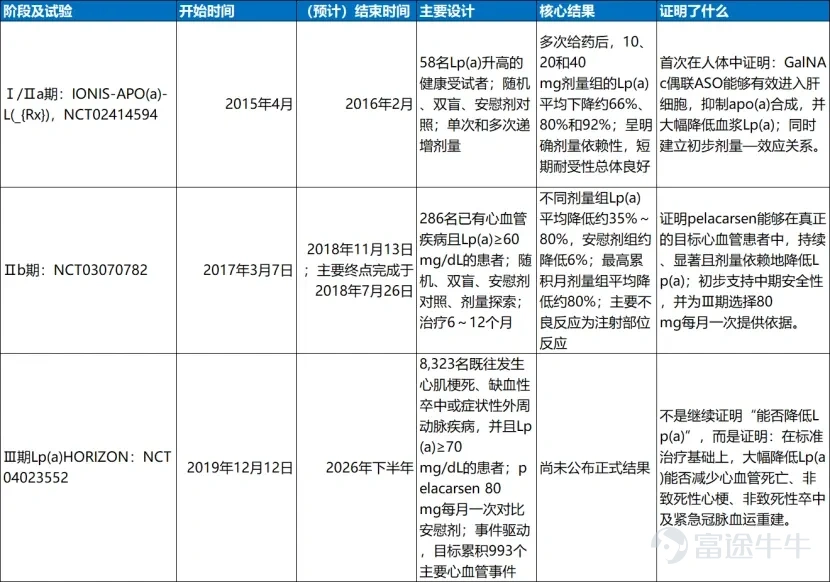
Previous Phase I/II clinical trials have demonstrated that Pelacarsen:
1. Has clear target pharmacological activity:It effectively enters hepatocytes, inhibits apo(a) synthesis, and significantly reduces plasma Lp(a) levels.
2. Exhibits dose-dependent efficacy:Higher doses or more frequent dosing generally led to greater reductions in Lp(a). The highest cumulative dose regimen in Phase II reduced Lp(a) by approximately 80% on average, indicating that the drug effect is not due to chance and providing a basis for dose selection in Phase III.
3. Short- to medium-term safety was generally acceptable:Existing studies have not identified clear dose-related hepatic, renal, or platelet toxicity.
Exhibit 1: Summary of Pelacarsen Clinical Trial Results
![This article represents personal opinions only and does not constitute investment advice. Please assume all risks yourself. I. Pelacarsen: Leading in clinical development, with pivotal data expected in 2H26 Pelacarsen is a hepatocyte-targeted antisense oligonucleotide (ASO) therapy primarily designed to reduce the risk of cardiovascular events in patients with established cardiovascular disease and elevated lipoprotein(a) [Lp(a)]. Elevated Lp(a) exerts pro-atherogenic, pro-inflammatory, and potentially pro-thrombotic effects, making it a significant hereditary risk factor for myocardial infarction, ischemic stroke, and aortic valve calcification. However, whether lowering Lp(a) translates into a reduction in cardiovascular events remains to be confirmed by the Phase III HORIZON trial, with results expected in 2H26. Pelacarsen does not directly neutralize circulating lipoprotein(a) already present in the bloodstream; instead, it inhibits apolipoprotein(a) synthesis within hepatocytes, thereby reducing the production of new Lp(a) particles at the source. Its mechanism of action is as follows: GalNAc-mediated liver targeting → binding to LPA mRNA → RNase H1-mediated degradation of mRNA → reduced apo(a) synthesis → decreased Lp(a) particle formation. Lp(a) is essentially another cholesterol-containing lipoprotein particle, but it differs from standard LDL by carrying an additional unique protein—apolipoprotein(a), or apo(a). Lp(a) can be understood as...](https://nnqimage.futunn.com/sns_client_feed/27292799/20260727/web-1785124062113-8iBhOQosJI.webp/big?area=1&is_public=true&imageMogr2/ignore-error/1/format/webp)
Source: Prepared by the author
The most critical registrational trial for Pelacarsen is Lp(a)HORIZON (NCT04023552), designed to determine whether lowering Lp(a) translates into a reduction in cardiovascular events. Most Lp(a)-targeting candidates are currently in Phase III trials, with Pelacarsen being the most advanced. The HORIZON trial enrolled 8,323 patients with established cardiovascular disease and elevated Lp(a), who received pelacarsen 80 mg via monthly subcutaneous injection. The primary endpoint was the first occurrence of cardiovascular death, non-fatal myocardial infarction, non-fatal stroke, or urgent coronary revascularization requiring hospitalization. The trial employed an event-driven design, targeting 993 confirmed primary cardiovascular events.
Exhibit 2: Primary and Secondary Endpoints of the Pelacarsen HORIZON Study
![This article represents personal opinions only and does not constitute investment advice. Please assume all risks yourself. I. Pelacarsen: Leading in clinical development, with pivotal data expected in 2H26 Pelacarsen is a hepatocyte-targeted antisense oligonucleotide (ASO) therapy primarily designed to reduce the risk of cardiovascular events in patients with established cardiovascular disease and elevated lipoprotein(a) [Lp(a)]. Elevated Lp(a) exerts pro-atherogenic, pro-inflammatory, and potentially pro-thrombotic effects, making it a significant hereditary risk factor for myocardial infarction, ischemic stroke, and aortic valve calcification. However, whether lowering Lp(a) translates into a reduction in cardiovascular events remains to be confirmed by the Phase III HORIZON trial, with results expected in 2H26. Pelacarsen does not directly neutralize circulating lipoprotein(a) already present in the bloodstream; instead, it inhibits apolipoprotein(a) synthesis within hepatocytes, thereby reducing the production of new Lp(a) particles at the source. Its mechanism of action is as follows: GalNAc-mediated liver targeting → binding to LPA mRNA → RNase H1-mediated degradation of mRNA → reduced apo(a) synthesis → decreased Lp(a) particle formation. Lp(a) is essentially another cholesterol-containing lipoprotein particle, but it differs from standard LDL by carrying an additional unique protein—apolipoprotein(a), or apo(a). Lp(a) can be understood as...](https://nnqimage.futunn.com/sns_client_feed/27292799/20260727/web-1785124060791-hYr3t2D8TJ.webp/big?area=1&is_public=true&imageMogr2/ignore-error/1/format/webp)
Source: Prepared by the author
II. Data and Expectations of Interest to Investors
1) Relative risk reduction in the primary endpoint, expressed as hazard ratio (HR). The author believes investor expectations center around an HR between 0.85 and 0.88. An HR ≤ 0.80 would represent an optimistic, better-than-expected outcome.
According to Reuters, citing UBS analysts, HORIZON could achieve statistical significance with an approximate 12% relative risk reduction, corresponding to a hazard ratio (HR) of about 0.88. This HR is derived by back-calculating from the 'nominal statistical significance boundary' using the approximate standard error from survival analysis, based on the expected accumulation of 993 primary endpoint events in HORIZON. Clinicians typically require at least a 15% risk reduction—equivalent to an HR of 0.85—to consider the treatment effect clinically meaningful. Market optimism, however, centers on a 20% relative risk reduction, implying an HR ≤ 0.80.
This optimistic expectation is grounded in prior epidemiological modeling estimates. In patients with established cardiovascular disease and elevated lipoprotein(a) [Lp(a)], if a drug reduces Lp(a) by approximately 80%, it could lower overall cardiovascular disease risk by about 20% and coronary heart disease risk by roughly 24%.
Relevant paper: Lipoprotein(a) and cardiovascular disease: prediction, attributable risk fraction, and estimating benefits from novel interventions
2) Assuming trial success, the quality of success for the three-point MACE and each individual component event. The four-point MACE composite primary endpoint (defined as the first occurrence of any component event) includes: cardiovascular death, non-fatal myocardial infarction, non-fatal stroke, and urgent coronary revascularization requiring hospitalization.
Because urgent revascularization is considered a relatively soft endpoint, if the four-point MACE outcome is positive but primarily driven by a reduction in revascularizations—with no clear improvement in myocardial infarction, stroke, or cardiovascular death—the market would likely discount the result. The trial design also includes a key secondary endpoint of three-point MACE that excludes revascularization. Urgent revascularization is more susceptible to variations in clinical decision-making, diagnostic practices, and regional healthcare patterns, whereas death, myocardial infarction, and stroke are closer to objective biological events and thus carry greater weight.
3) Wall Street’s consensus expectation for pelacarsen’s global peak annual sales mostly falls within the $3–5 billion range.Novartis AG has classified pelacarsen as a pipeline asset with 'multi-billion-dollar' peak sales potential but has not provided specific guidance.
Sales = treatable patient population × actual penetration rate × net annual drug price
Treatable patient population × actual penetration rate:Ionis estimates that over 8 million patients globally have both established cardiovascular disease and elevated Lp(a). This figure represents the epidemiological upper bound for pelacarsen’s current secondary prevention indication. However, the actual commercial patient pool must pass through multiple funnel layers. Real-world data from five large U.S. healthcare systems show that only about 0.4% of patients with established ASCVD have ever been tested for Lp(a); another study covering approximately 71 million individuals found an overall historical testing rate of just ~0.1%. The 2026 ACC/AHA guideline on lipid management will, for the first time, explicitly recommend that all adults be tested for Lp(a) at least once in their lifetime—a change expected to significantly accelerate future patient identification.
Annual net drug price:Market pricing can be benchmarked against injectable lipid-lowering drugs already launched in the U.S. Repatha currently has a conventional annual list price of approximately USD 5,850. Leqvio is priced at about USD 3,587.73 per dose in the U.S., with two doses administered annually during the maintenance phase, resulting in an annual list price of roughly USD 7,175. The author assumes an annual net drug price of USD 10,000 in the U.S. and USD 5,000 in Japan, Europe, and other regions, yielding a global weighted average net drug price of approximately USD 8,000.
Based on peak sales forecasts of USD 3–5 billion and working backward using the assumed annual net price, the implied patient population ranges from 380,000 to 630,000, representing an implied overall patient penetration rate of 5–8%.
III. Pelacarsen is poised to benefit from first-mover advantage, though competition may intensify in the near-to-medium term
Most candidates in the Lp(a) space are currently in Phase III trials. Pelacarsen’s advantages include potentially being the first to report Phase III data, achieving early market launch, and accumulating physician experience. Its disadvantages include monthly dosing, potential local injection-site reactions, and possibly lower Lp(a) reduction compared to long-acting siRNA therapies.
In non-head-to-head cross-trial comparisons based on Lp(a) reduction: Pelacarsen achieves approximately 80%; Olpasiran exceeds 95%; Lepodisiran shows an average time-weighted reduction of about 94%; Zerlasiran demonstrates a time-weighted reduction exceeding 80%, with a maximum reduction surpassing 90%.
Note: For reference only. Due to differences in baseline patient characteristics, measurement methods, and dosing timepoints across trials, cross-trial comparisons of efficacy are not definitive and do not necessarily indicate inferior efficacy for Pelacarsen. The true determinant of its value will be the magnitude of cardiovascular event reduction demonstrated in the Horizon Phase III outcomes trial, not the degree of Lp(a) lab value reduction.
Mechanistically, Pelacarsen is an ASO that acts via the RNase H1 pathway, degrading LPA transcripts through RNase H1 rather than altering RNA splicing. In contrast, competitors Olpasiran, Lepodisiran, and Zerlasiran are siRNAs that operate through the RISC/Ago2 pathway. After the siRNA guide strand loads into RISC, it remains active within the protein complex and can repeatedly recognize and cleave target mRNA.
Pelacarsen benefits from a mature ASO platform, precise targeting, and a lead in clinical development. However, its effect duration is relatively short, requiring more frequent dosing—once monthly. In the Lp(a) space, which demands long-term or even lifelong treatment, siRNA leverages the stable RISC mechanism to achieve more durable gene silencing, enabling less frequent dosing intervals such as quarterly, biannually, or annually. The market generally believes that the more convenient dosing regimens of siRNA competitors could pose competitive pressure on Pelacarsen.
In the near-to-medium term, Pelacarsen’s biggest competitor is Amgen’s Olpasiran. Both Olpasiran and Pelacarsen primarily target secondary prevention patients with established ASCVD and significantly elevated Lp(a). Amgen also possesses an established cardiovascular commercial team. Eli Lilly and Co’s Lepodisiran stands out for its ultra-long duration, allowing dosing once every six months or annually. Additionally, Eli Lilly and Co’s Muvalaplin (LY3473329) is an oral small molecule taken daily, offering a differentiated route of administration.
Chart 3: Future Competitive Landscape of Pelacarsen
![This article represents personal opinions only and does not constitute investment advice. Please assume all risks yourself. I. Pelacarsen: Leading in clinical development, with pivotal data expected in 2H26 Pelacarsen is a hepatocyte-targeted antisense oligonucleotide (ASO) therapy primarily designed to reduce the risk of cardiovascular events in patients with established cardiovascular disease and elevated lipoprotein(a) [Lp(a)]. Elevated Lp(a) exerts pro-atherogenic, pro-inflammatory, and potentially pro-thrombotic effects, making it a significant hereditary risk factor for myocardial infarction, ischemic stroke, and aortic valve calcification. However, whether lowering Lp(a) translates into a reduction in cardiovascular events remains to be confirmed by the Phase III HORIZON trial, with results expected in 2H26. Pelacarsen does not directly neutralize circulating lipoprotein(a) already present in the bloodstream; instead, it inhibits apolipoprotein(a) synthesis within hepatocytes, thereby reducing the production of new Lp(a) particles at the source. Its mechanism of action is as follows: GalNAc-mediated liver targeting → binding to LPA mRNA → RNase H1-mediated degradation of mRNA → reduced apo(a) synthesis → decreased Lp(a) particle formation. Lp(a) is essentially another cholesterol-containing lipoprotein particle, but it differs from standard LDL by carrying an additional unique protein—apolipoprotein(a), or apo(a). Lp(a) can be understood as...](https://nnqimage.futunn.com/sns_client_feed/27292799/20260727/web-1785124062228-DWavgkiSu7.webp/big?area=1&is_public=true&imageMogr2/ignore-error/1/format/webp)
Source: Prepared by the author
Potential Risks:
1) Intensifying market competition.
2) Clinical development falling short of expectations.
Risk Disclaimer: The above content only represents the author's view. It does not represent any position or investment advice of Futu. Futu makes no representation or warranty.Read more
Comments
to post a comment