
Bambu Lab plans to manufacture 3 million 3D printers—who’s going to buy them?
(This article was authored by Xin Lichang Pro and published by TMT Post with authorization)
By New Stance Pro
In 2013, DJI launched its first-generation Phantom. It unlocked the consumer drone market by embedding expertise in flight control, stabilization, and calibration into the product itself. A decade later, a group of engineers who had left DJI applied a similar engineering philosophy to 3D printers, leading to the creation of Bambu Lab.
In its third year on the market, Bambu Lab has already demonstrated that a machine once requiring constant tinkering by enthusiasts can be reimagined as a consumer product. Now, the company is translating this insight into manufacturing: earlier this year, the Shenzhen municipal government disclosed that Bambu Lab will build an automated production facility in Guangming District, targeting an annual capacity exceeding 3 million units.
For a product category still expanding from enthusiast circles into the mass market, an annual capacity of 3 million units is far from ordinary scaling. Yet for a company whose annual revenue has already surpassed RMB 10 billion in just its third year on the market, this move appears to be a natural progression. If 3D printing is to reach beyond hobbyists and appeal to a broader consumer base, the company must have factories, supply chains, and shipping capabilities to match.
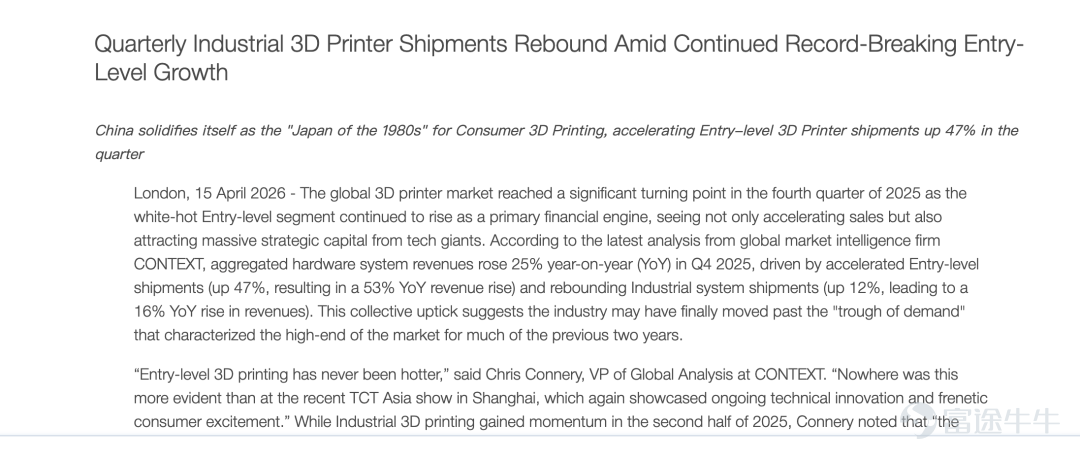
Growth in the 3D printing market is also providing real-world justification for this bet on capacity.According to a report released by CONTEXT on April 15, global revenue from 3D printing hardware systems in Q4 2025 increased by 25% year-over-year. Shipments of entry-level 3D printers priced under USD 2,500 grew by 47% year-over-year, driving a 53% increase in revenue within that price segment. For the full year, shipments of entry-level products rose by 26%, with Bambu Lab capturing a 37% market share, ranking first.Shao Hui, a partner at IDG Capital, later remarked while reviewing early investment documents that Bambu Lab’s actual revenue and market share during the first two years after its product launch deviated only slightly from initial projections made at the company's founding.

This confidence underpins Bambu Lab’s expansion—and also marks the starting point of the challenge. The 'entry-level' segment referenced by CONTEXT is defined by price—devices under USD 2,500—but in terms of user composition, it includes consumers, prosumers, professionals, and manufacturing-oriented print farms. In other words, it does not equate solely to the mainstream household market. Bambu Lab has demonstrated that cheaper, easier-to-use machines can expand the 3D printing market, but that doesn’t mean 3D printing has yet become a household necessity akin to home appliances.
Therefore, the planned annual capacity of three million units is first and foremost an assumption about demand.Bambu Lab believes more people will need 3D printers in the future, and those who buy them will continue to find worthwhile things to print. The first issue can be partly addressed through distribution channels, pricing, and product quality; the second depends on whether a household, a small business, or an ordinary user will press 'print' again 30 days, 90 days, or even a year after purchasing the machine.
Bambu Lab’s first victory was gradually automating the tedious tasks users previously had to tolerate.
Before Bambu Lab emerged, consumer-grade 3D printers were already a well-established niche. The industry had experienced waves of crowdfunding enthusiasm, maker culture, and open-source hardware hype, yet it remained confined to a niche audience for a long time.Bed leveling, calibration, parameter tuning, and repeated trial-and-error consumed time users should have spent creating; the more a machine demanded manual attention, the harder it became for 3D printing to evolve into a routine activity.
Even Tao Ye himself initially didn’t consider 3D printing a promising project. Recalling the early days of evaluating potential ventures, he noted that his team had nearly dismissed 3D printing within five minutes: a 20-kilogram product was being sold for just over 1,000 yuan amid fierce price wars among numerous manufacturers. It wasn’t until the team later purchased a 3D printer for prototyping another project that they closely engaged with user forums and communities, where they saw countless users discussing daily how to fine-tune their machines.Tao Ye quickly realized that intense competition didn’t necessarily mean the product category was mature—there were still many fundamental user experience issues left unresolved in the industry.
After reassessing the market, Bambu Lab identified several key characteristics of this niche segment: it wasn’t large in scale, but user experience was poor; the product was sufficiently complex with high technical barriers; and advances in sensors, algorithms, motion control, and supply chain capabilities now offered an opportunity to 'rebuild the product from scratch.' Consequently, Bambu Lab’s first-generation product integrated cameras, LiDAR, gravity sensors, and other components, redesigned hardware and software from the ground up, and developed proprietary motion control algorithms to maintain higher precision stability during high-speed nozzle movement.

For its first-generation product crowdfunding campaign, Bambu Lab followed a classic engineer-driven approach: out of a team of over 150 people, roughly 120 were engineers. During 22 months of stealth development, the team built more than 700 test units and consumed three metric tons of printing materials. Tao Ye later put the issue bluntly:In the past, the consumer-grade 3D printing space hadn’t attracted enough top-tier engineers, nor had it effectively organized them.
Bambu Lab succeeded in doing exactly that. It transformed a printer into something more akin to a small robot—one that could sense, self-calibrate, correct errors, and use software to automate many steps that previously required manual expertise. The first batch of users were largely people who had struggled with older machines; when they used the X1 for the first time, what they saw was finally 'a machine that actually works well.'
But new users won’t always interpret the product this way. Early adopters—often tech enthusiasts—were moved by every incremental reduction in failure rates. However, subsequent users from households, educational institutions, and small businesses, encountering the same equipment, began treating many 'awkward' aspects as inherent flaws, asking instead: 'Why is it still so hard to use?'
This is where 3D printing differs from mature consumer electronics like smartphones, cameras, or robotic vacuum cleaners. Those products are largely supported by established use cases: communication, photography, cleaning, travel documentation. They only need to deliver better experiences within those contexts. 3D printing is different. For many households, 'What should I print today?' isn’t a natural question. Users don’t inherently need a new part every day or feel compelled to print a decorative item each week.
Bambu Lab’s initial phase expanded the pool of 'people who can use it.' The next phase must expand the 'reasons worth printing.' The former relies on engineering prowess; the latter requires a combination of pricing, model libraries, software, consumables, intellectual property rights, and real-world scenarios. Once the core question shifts from 'How do we build a better machine?' to 'Why do users keep using it?', engineering excellence alone is no longer sufficient. Pricing, content, copyright frameworks, and community governance are challenges that can’t be solved merely by adding another sensor or tweaking an algorithm.
Bambu Lab plans to expand production capacity, also because industry growth is shifting toward lower price segments.
In 2025, shipments of entry-level 3D printers priced below USD 2,500 grew by 26%; meanwhile, professional-grade products priced between USD 2,500 and USD 20,000 declined by 15% for the full year, and mid-range systems priced between USD 20,000 and USD 100,000 fell by 12% year-over-year. The report noted that the professional and mid-range markets continue to feel pressure from demand shifting toward lower price points.

This trend is both an opportunity and a warning for Bambu Lab. The opportunity lies in the fact that lower price segments are becoming the main engine of industry growth. Bambu Lab’s A1 and A1 Mini products can further lower the entry barrier and attract more first-time 3D printer buyers.
The warning is that once growth comes from lower price segments,Bambu Lab’s pricing power—previously built on superior user experience—will need to be reassessed.Geeks, professional users, and small businesses are willing to pay a premium for speed, precision, multi-color capabilities, and material versatility. Ordinary households are not. Home users care more about where to place the machine, how noisy it is, whether it’s safe, if their children can use it, how expensive consumables are, and how often they can actually print per month.
Capacity expansion will help Bambu Lab reduce per-unit manufacturing costs and may also bring price competition to the forefront sooner. A production capacity of three million units implies stronger procurement leverage and greater economies of scale, meaning that when competitors follow suit, market leaders will have more room to cut prices. Manufacturing advantages won’t just translate into gross margins—they’ll also become ammunition for price wars.
Creality’s IPO has introduced the first publicly visible pricing benchmark into this competition.On May 29, Creality officially listed on the Hong Kong Stock Exchange, becoming the 'first consumer-grade 3D printing stock.' On June 8, the Science and Technology Innovation Bureau of Longhua District, Shenzhen Municipality disclosed that Creality’s offering price was HKD 18.80 per share, raising approximately HKD 13.8 billion in total. Its closing price on the first trading day was HKD 22.80, giving it a market capitalization of nearly HKD 10.7 billion. The company reported revenues of RMB 1.883 billion, RMB 2.288 billion, and RMB 3.127 billion for 2023, 2024, and 2025, respectively; it posted a net loss of RMB 182.4 million in 2025, with an adjusted net profit of RMB 923.8 million.
The Hong Kong listing has thus established the first public valuation benchmark for consumer-grade 3D printing companies. Creality is not a marginal player: based on 2025 GMV, it ranked second globally in the consumer-grade 3D printer market with an 11.2% share and held the top position in the consumer-grade 3D scanner market with a 45.3% share.
Its listing is highly representative; its revenue scale, profit quality, market share, and growth sustainability will become explicit benchmarks for every consumer-grade 3D printing company.Bambu Lab may eventually command a premium due to its higher shipment share and larger revenue scale, but ever since Creality’s IPO, the market will no longer price companies solely based on product reputation and growth narratives: revenue structure, profit quality, cash flow, and growth sustainability will all be compared side by side on the same table.
This is also why Tao Ye has consistently emphasized software and ecosystem. Hardware capabilities can be replicated. Features like auto bed leveling, high-speed printing, multi-color systems, and closed-loop control were once Bambu Lab’s differentiators but may become industry standards in the future. New entrants could offer 80% or 90% of Bambu Lab’s user experience at lower prices. That’s precisely why Bambu Lab developed its own embedded printer control system from day one and invested heavily in community building as soon as it became profitable—because ‘pure hardware is too grueling.’
But as Tao Ye himself put it: hardware is easy to copy, software is harder, and building an ecosystem is the hardest of all.
The printer completes the first sale; MakerWorld aims to secure the second, third, and subsequent print sessions.
Bambu Lab has integrated models, slicing, parameters, printers, and filaments into a unified workflow. When users see a model on the platform, they don’t need to design it themselves or repeatedly tweak settings—they can send the print job directly to their device. This shortens the critical path in 3D printing: from ‘I want to print something’ to ‘the machine starts working,’ eliminating many hurdles that previously only experienced users could overcome.
According to media reports citing Bambu Lab’s '2025 China 3D Printing Trends Report,' by the end of 2025, MakerWorld’s China site had over 280,000 active creators and more than one million models, with nearly 100,000 new models added each month. Bambu Lab’s low-barrier modeling tool, MakerLab, attracted approximately 310,000 users who collectively generated 2.6 million original models. Other media outlets reported that MakerWorld’s monthly active users stood at around 10 million, with roughly 83% of users who purchased a printer still actively using the platform one year later.

Bambu Lab already operates a content platform capable of continuously driving printing activity.However, these figures still do not prove that average households have formed stable, high-frequency usage habits. Heavy users likely include print farms, small businesses, and seasoned enthusiasts. Total printing hours were not disclosed alongside the total number of active devices, so it is not possible to directly calculate the average print frequency per typical household device.
For Bambu Lab, platform engagement is a positive signal; for investors, what matters more is whether devices are still in use 30 days, 90 days, and one year after purchase, and whether MakerWorld has driven higher consumption of consumables, accessory purchases, and device repurchases.
Cricut offers a more mature set of metrics.This U.S.-based smart cutting machine company sells desktop cutting devices that allow users to select designs via software and then create stickers, apparel, and home goods using materials like paper, vinyl, and fabric. Cricut shares a similar business model with Bambu Lab: first selling a creative hardware device, then extending the revenue lifecycle of that hardware transaction through design content, software tools, consumables, and subscriptions. According to Cricut’s 2025 annual report, the company had nearly 5.9 million annual active users and approximately 3.7 million 90-day active users by year-end. The earnings report also noted that continued creation leads to repeat purchases of accessories and materials.
However, Cricut also emphasized that this flywheel doesn’t automatically spin just because all components are in place. The company’s 2025 earnings announcement showed that full-year product revenue declined by 5% to $381.4 million, while paid subscription users grew by over 4% to more than 3.09 million, and annual active users remained largely flat. Management also acknowledged disappointment over the lack of growth in total company sales for 2025.Even when hardware, platform, consumables, and subscriptions are all in place, user engagement can still stall. Selling a creative tool and getting users to keep creating month after month are two entirely different businesses.
Bambu Lab also faces difficulty replicating the social-sharing-driven usage frequency boost seen in imaging hardware.Action cameras and 360-degree cameras are naturally suited for social sharing—the content they capture can be edited and immediately viewed or shared.
Insta360’s app community, awards, and creator programs aggregate user-generated content into a system of showcases, challenges, and incentives, which then gain secondary exposure through external platforms like Instagram. High-quality content serves both as a community asset and as natural demonstration material showcasing the camera’s capabilities. However, the sharing chain for 3D printing is much longer: from the moment a model is seen to when it’s actually printed, users must evaluate its dimensions, structure, material requirements, time commitment, assembly complexity, and intended use.
MakerWorld therefore bears a heavier burden. It cannot function merely as a model repository—it must also address printability, copyright, creator incentives, and content quality. The more models available, the easier it is for users to find a reason to fire up their printers again; the more accurate the parameters, the lower the failure rate; and the more creators onboarded, the better the platform can serve long-tail demand.
On the flip side of any ecosystem lies responsibility—a point already highlighted by the dispute between Pop Mart and Bambu Lab. The lawsuit filed by Pop Mart against Bambu Lab originated from the presence of numerous unauthorized Pop Mart IP-based 3D printing models on MakerWorld, allowing users to download files and print popular collectibles like LABUBU, even for commercial purposes. Although Bambu Lab quickly issued a statement confirming that it had amicably negotiated and reached a settlement with Pop Mart, and that all related content had been fully removed.
This is an inevitable issue after platformization: popular IPs can drive downloads, print volumes, and virality, but they also bring copyright pressure. Creator incentives can boost content supply, but may also amplify gray-area content. The more active MakerWorld becomes, the less Bambu Lab can afford to see itself merely as a hardware company. It needs content moderation, licensing, revenue sharing, copyright protection, and must manage the interests between creators and IP holders.
AI will continue to expand model supply, but it cannot automatically solve demand for Bambu Lab. Text-to-3D and image-to-3D model generation lower design barriers, but actual printing still requires addressing structural strength, support design, dimensional tolerances, material compatibility, assembly relationships, and copyright ownership. Growth in model quantity does not equate to growth in reasons to print. Only when AI-generated models are reliably printable, assemblable, and usable will they become a reason to power up the printer again.
MakerWorld thus becomes key for Bambu Lab to establish an alternative pricing logic.If the platform can consistently increase device utilization, consumables repurchase rates, and creator earnings, Bambu Lab will be selling more than just a machine—it will be offering a long-term consumption gateway. If these metrics fail to improve, MakerWorld will resemble little more than a traffic pool left over after a period of rapid hardware growth.
Since Creality went public, the public markets have already set a clear benchmark. If Bambu Lab merely scales up these numbers further, it will ultimately still be viewed as a hardware company—albeit one with higher efficiency, better products, and greater scale.
The prerequisite for securing an alternative valuation framework is first demonstrating that its revenue structure has already shifted.Printers bring users in, while MakerWorld, consumables, accessories, and creator transactions continue generating revenue after the machine is sold. At that point, what the market truly needs to monitor will no longer be just annual shipment volume, but rather device activity rates one year after purchase, consumables spend per active device, and whether creators can consistently deliver printable, usable, and licensable content.
Tao Ye and his team excel at breaking down complex engineering problems: errors can be detected by sensors, motion controlled by algorithms, and failures preemptively avoided through software. But whether a household will power up their printer again next month is not purely an engineering problem. It hinges on content availability, consumption habits, copyright norms, and whether stable revenue-sharing mechanisms can be established among creators, users, and the platform.
Of course, a factory can produce 3 million printers a year—but 3 million sustained reasons to print won’t roll off the production line.
*The title image and in-text illustrations are sourced from the internet.
Risk Disclaimer: The above content only represents the author's view. It does not represent any position or investment advice of Futu. Futu makes no representation or warranty.Read more
Comment (1)
to post a comment
1