
Options Sir on Macro | Geopolitical black swan reemerges, U.S. Treasury yields surge—market alarm bells ringing?
Over the past few trading sessions, risk-off sentiment has rapidly intensified across global financial markets. If fellow investors have been monitoring their portfolios recently, they’ve likely noticed an increase in market volatility.From escalating conflicts in the Middle East and surging U.S. Treasury yields to the upcoming peak of earnings season and the Federal Reserve’s FOMC meeting, interconnected macro signals are weaving a web of uncertainty.Today, we’ll unpack these complex macro indicators.
Geopolitical black swans loom as U.S. Treasury yields surge again
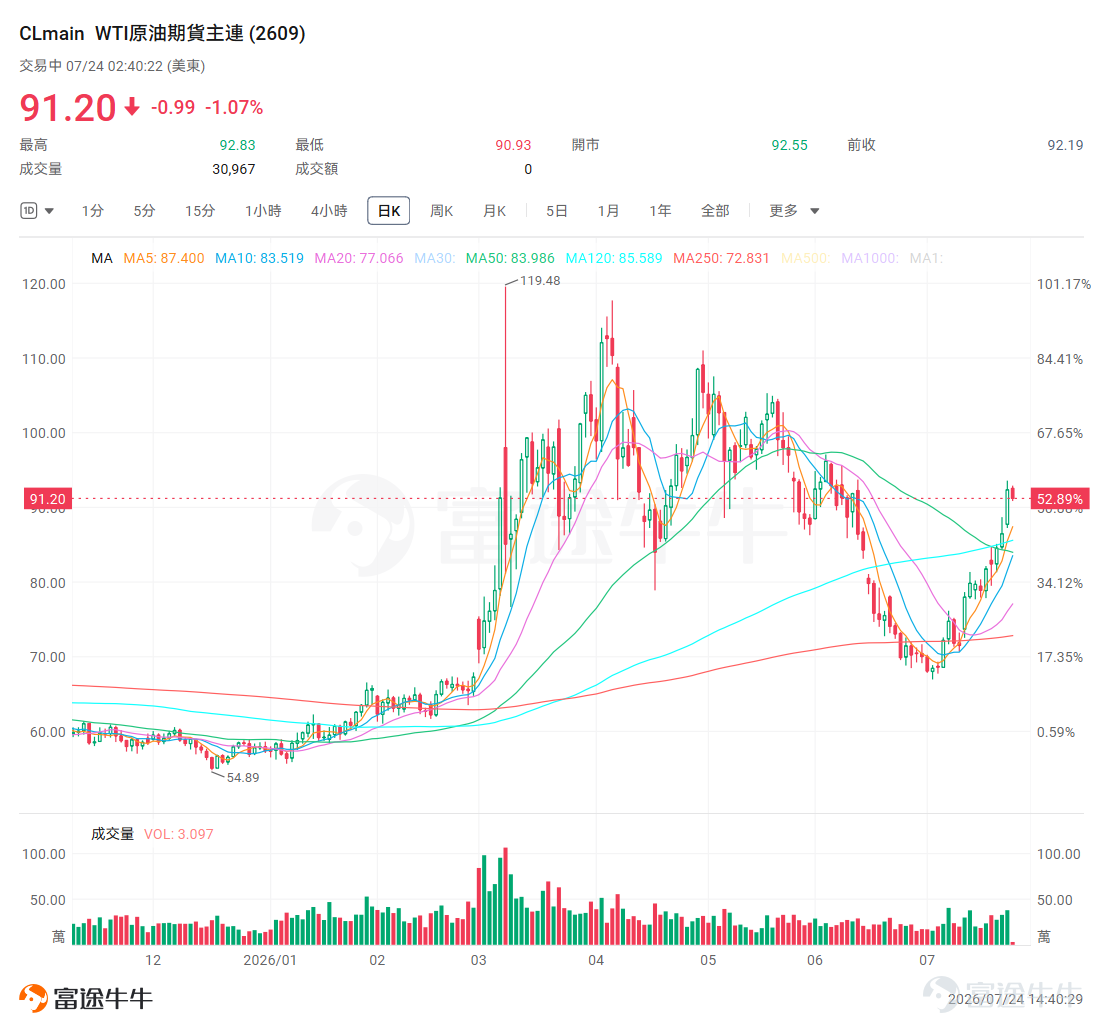
The most significant recent macro variable is undoubtedly the sharp deterioration in Middle Eastern geopolitical tensions. Conflict in the region has escalated once more, and President Trump is currently weighing within the White House whether to launch a 'larger-scale war,' issuing fresh threats of strikes against Iran. This renewed shadow of conflict has reignited sentiment in global energy markets.
As a result, crude oil prices have surged like a runaway horse. For investors, rising oil prices aren’t just about paying more to fill up their tanks—they’re the most direct trigger for heightened global inflation expectations.

As the heart of global crude supply, any expansion of military conflict in the Middle East could disrupt supply chains once again. The Trump administration’s tough rhetoric suggests this geopolitical crisis is unlikely to subside soon, and the 'risk premium' embedded in oil prices is being repriced. Against this backdrop, global capital has frantically sought safe havens—but surprisingly, funds haven’t flowed into U.S. Treasuries; instead, they’ve triggered a sell-off in U.S. government bonds.
Traditionally viewed as the world’s safest asset, U.S. Treasuries have defied convention during this geopolitical flare-up—prices have fallen rather than risen, and yields have spiked sharply. This reflects deep-seated market concerns about U.S. fiscal health and future inflation.
Currently, the 10-year U.S. Treasury yield has reached its highest level since January 2025. Even more alarming,the 30-year Treasury yield has climbed to 5.19% and has remained above 5% longer than in any period since 2007.

Energy is the lifeblood of the modern economy—costs across transportation, manufacturing, chemicals, and virtually every other sector rise in tandem. This threatens to significantly undermine the Fed’s hard-won progress in fighting inflation over recent years. We now face highly resilient 'inflation stickiness'—a situation where upward price pressures cling stubbornly to the economic system like chewing gum and can’t be easily wiped away. If energy prices remain elevated, CPI (Consumer Price Index) data over the coming months could very well rebound, forcing the Fed to keep interest rates higher for even longer.
U.S. Treasury yields serve as the 'anchor' for global asset pricing. When this risk-free rate surges, it triggers a powerful ripple effect:
A higher risk-free rate increases the opportunity cost of investing in equities. High-valuation growth stocks—particularly tech stocks—that rely heavily on future earnings expectations will face valuation repricing. Corporate borrowing costs will also rise, eroding profit margins.
Moreover, long-term U.S. Treasury yields are closely tied to mortgage rates. Yields breaking above 5% imply that new mortgage rates will remain elevated, posing a headwind to the housing market.
Key focus ahead: Tech giants’ 'ghost stories' and next week’s FOMC meeting
With macro risks intensifying, the coming week will be pivotal in determining the market’s direction for the second half of the year. Investors should closely monitor two key events:
(1) Hyperscalers’ capital expenditures during earnings season: Will there be more 'ghost stories' after Google?
This week, $Alphabet-A (GOOGL.US)$ released its earnings report.Although revenue was acceptable, the market expressed significant concern over its massive capital spending in AI (artificial intelligence), causing its stock price to plummet.This is what the market refers to as a 'ghost story'—AI investments appearing like a bottomless pit, with no tangible profits materializing in the near term.
In the coming week, we will see earnings reports from $Microsoft (MSFT.US)$ (after market close on July 29), $Meta Platforms (META.US)$ (after market close on July 29), $Amazon (AMZN.US)$ (after market close on July 30), and other tech giants known as Hyperscalers.
Market focus is no longer solely on their profit growth, but rather on their spending budgets for AI infrastructure. If these giants all follow Google’s lead and signal that they will continue burning cash with slow monetization in the coming quarters, major U.S. tech stocks could face a brutal sell-off. Tech stocks have been the engine driving the U.S. equity bull market over the past few years—if this engine stalls, the broader market will lose its most critical support.
(2) FOMC Meeting: How Will Waller Balance Inflation and the Economy?
Additionally, the market is closely watchingthe Federal Open Market Committee (FOMC) meeting the Fed will hold next week (July 28–29).
Unlike the Powell era, Waller has clearly stated he does not favor forward guidance, shifting instead toward a more traditional Fed decision-making approach. Moreover,this meeting is not a quarter-end meeting (i.e., March/June/September/December), and by convention, it will not release an updated dot plot or Summary of Economic Projections (SEP). This means investors will need to scrutinize the wording of the FOMC statement and Waller’s press conference even more carefully.
Investors should focus on the following aspects:
First, Wachs’ assessment of recent geopolitical risks—particularly U.S.-Iran tensions and the situation in the Strait of Hormuz—and their impact on energy prices and inflation transmission effects; second, his remarks on the new inflationary risk stemming from the AI investment boom driving up prices of tech products and electricity—This marks the first time the Fed has identified AI-related investment as a source of inflation risk.; third, his qualitative description of the future policy path, specifically the triggering conditions for two scenarios: holding rates steady versus implementing modest rate hikes.

Data source: CME FedWatch
The market currently prices in approximately a 66% probability of unchanged rates in July and about a 33% chance of a rate hike,Standing pat remains the consensus; however, the probability of a rate hike in September has already exceeded 50%.Any hawkish commentary exceeding expectations—especially emphasis on AI-driven inflation risks and Middle Eastern energy shocks—could become the final straw that breaks the stock market. Conversely, if Wachs signals greater confidence in inflation easing, risk assets may gain some breathing room.
Options Strategy: Build a broad-market hedge
With geopolitical black swans looming, Treasury yields surging, earnings landmines in tech stocks, and FOMC uncertainty, retail investors holding only long equity positions may face significant psychological pressure.
$SPDR S&P 500 ETF (SPY.US)$ And, $Invesco QQQ Trust (QQQ.US)$ As the two most liquid ETF options underlying assets in the US stock market, they offer an advantage often overlooked by investors—daily expiring contracts. This means investors can precisely select expiration dates aligned with specific macro event timelines (e.g., FOMC decision days or key earnings release dates), significantly enhancing hedging flexibility and capital efficiency.Unconstrained by traditional monthly or weekly expirations, investors can execute 'precision-strike' short-term hedges around a single event or extend coverage over several weeks to span an entire high-volatility period.
In the current environment, consider the following strategies:
(1) Protective Put – Insuring Your Position
Buying a protective put is a straightforward and effective way to hedge against downside risk. The core idea is to pay a premium (akin to an insurance premium) to cap the downside risk of your underlying asset while preserving its long-term upside potential.
Leveraging the flexibility of daily expirations, if you only wish to hedge against the risk of next week’s FOMC event, you can choose a short-dated contract expiring the day after the meeting to minimize time-value decay; if you aim to cover the entire peak earnings season, opt for a contract expiring in 2 to 4 weeks.
Take SPY as an example:

(The illustrative graphics shown on screen are for demonstration purposes only and do not constitute investment advice or guarantees; market conditions change frequently, and the displayed option prices do not reflect real-time data.)
(2) Long Straddle – Betting on Event-Driven 'Double-Sided Volatility'
When the market faces major uncertain events (such as FOMC decisions or sudden shifts in the Middle East situation) but the direction is unclear, a Long Straddle is more suitable. It involves simultaneously buying a call and a put option with the same strike price and expiration date.As long as the underlying asset experiences a sufficiently large one-sided move—whether up or down—there is potential for profit.。
This strategy entails buying one at-the-money call and one at-the-money put. If the market undergoes significant volatility before expiration (regardless of direction), the gain from one leg of the position will far exceed the loss from the other, resulting in a net profit. This is essentially a 'long volatility' play—you're betting not on direction, but on the magnitude of market movement.
Take QQQ as an example:

(The illustrative graphics shown on screen are for demonstration purposes only and do not constitute investment advice or guarantees; market conditions change frequently, and the displayed option prices do not reflect real-time data.)
Note that the strategies described above are fundamentally options-buying strategies, requiring the payment of premiums to establish hedged positions. Currently, the implied volatility (IV) of these two ETFs is generally in a neutral range. However, if geopolitical risks escalate or macro uncertainty intensifies in the future, driving volatility even higher,higher implied volatility would significantly increase the time value of options, making them more expensive and directly raising the entry cost for buyers.

(SPY’s IV is at a moderate level, but its percentile rank is relatively high.)
Reviewing the current macro landscape: Middle Eastern conflicts are pushing oil prices higher, with war threats lingering unresolved; sticky inflation combined with record-high U.S. Treasury yields is causing pain across global asset pricing; the market’s faith is being tested by the 'horror stories' around tech giants’ AI spending; and next week’s FOMC meeting will set the tone for future monetary policy.
As ordinary investors, we cannot predict geopolitical developments or influence the Fed’s decisions—but we can manage our own risk exposure. Use options as 'bulletproof vests' for your broad market positions and maintain ample liquidity.
Risk Disclaimer: The above content only represents the author's view. It does not represent any position or investment advice of Futu. Futu makes no representation or warranty.Read more


Comments (5)
to post a comment
70
135