
US Stock Market Chat | NVIDIA reports earnings tomorrow; can it avoid a drop this time?

Intel's Q2 earnings 'take off,' but $20 billion in capital spending raises market concerns—how to position options?
$Intel (INTC.US)$ After releasing its Q2 2026 earnings report, the market exhibited a typical“rally-then-hesitate”reaction: results and guidance significantly exceeded expectations, driving an initial double-digit surge in after-hours share price; however, attention then shifted to the sharply increased capital expenditure guidance, causing gains to narrow noticeably.

1. Performance Highlights: AI demand rebounds, and CPUs return to center stage
In the second quarter of 2026, $Intel (INTC.US)$ released an impressive earnings report that caught the market's attention. The data shows that the company's revenue for the quarter reachedUSD 16.1 billion,up 25% year-over-year,marking its strongest single-quarter growth since 2011,approximately 12% above the consensus market expectation of USD 14.4 billion; adjusted earnings per share (Non-GAAP EPS) came in atUSD 0.42, exactly double the analysts' average expectation of USD 0.21.

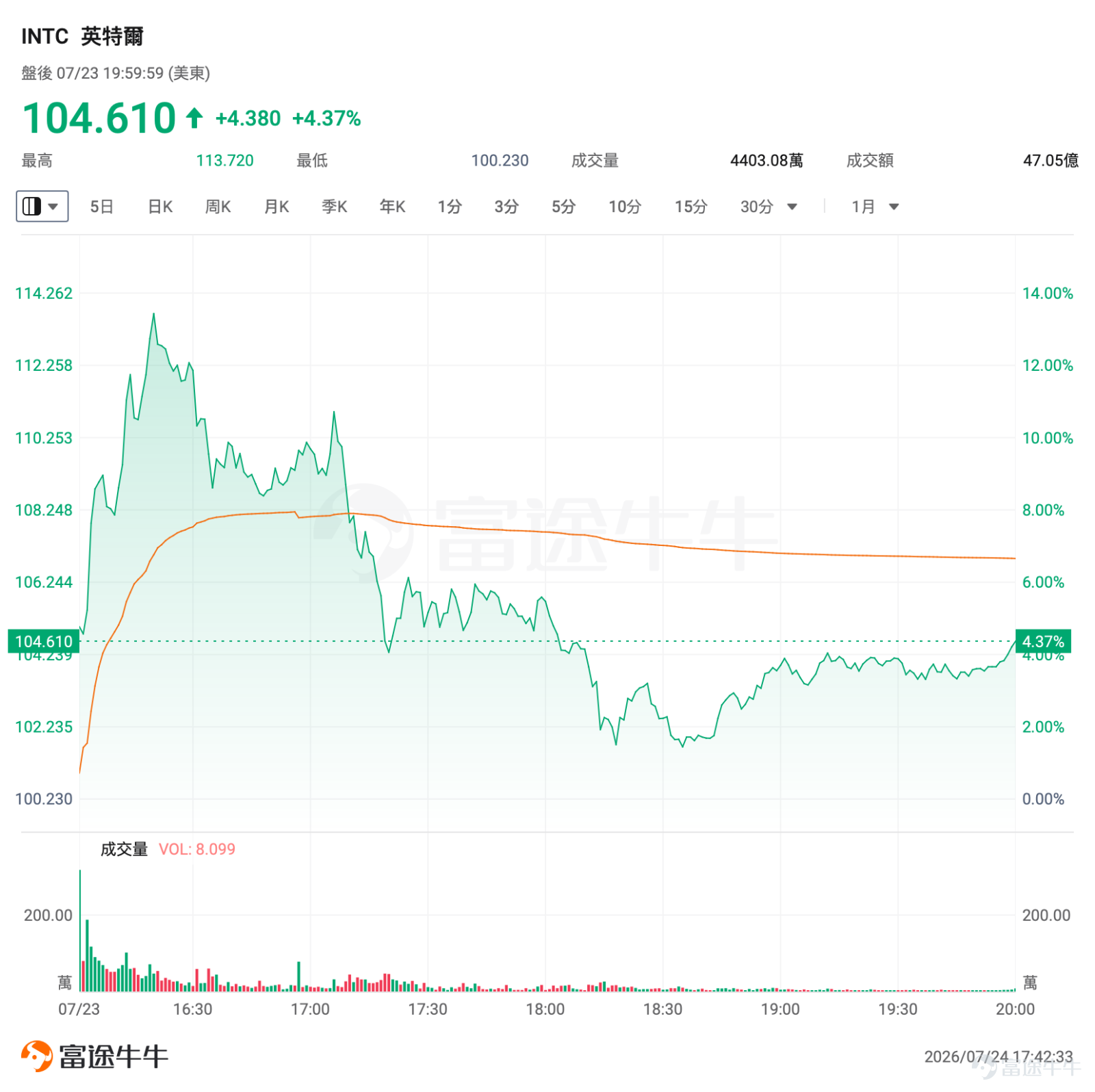
Following the earnings release, Intel's stock price surged more than 13% in after-hours trading, significantly boosting market sentiment.
From a business segment perspective, the key highlight of this earnings report centered on the Data Center and AI Group (DCAI).The segment reported quarterly revenue of $6.3 billion, up 59% year-over-year, setting a new record for Intel's highest-ever quarterly revenue from its server business. Management stated that AI-related business overall grew by more than 70% and now contributes approximately 70% of the company's total revenue.
The Client Computing Group (CCG) also posted solid growth, with rising AI PC adoption providing new structural support for Intel's consumer processor market.
Meanwhile, the company provided third-quarter revenue guidance in the range of approximately $15.8 billion to $16.8 billion, generally exceeding prior market expectations.Both the earnings results and forward guidance point to a common conclusion: large models are transitioning from training to large-scale inference deployment, driving cloud providers and enterprise customers to continuously expand their data center infrastructure, thereby significantly boosting demand for CPUs.
II. The Biggest Variable: Soaring Capital Expenditures Spark Market Divergence
However, after the earnings release, Intel's after-hours share price gain narrowed from an initial peak of 13% down to around 4%, signaling underlying market divergence that warrants close investor attention.
During the earnings call,the company simultaneously announced it is raising its 2026 capital expenditure forecast from $18 billion to over $20 billion and explicitly stated that 2027 capital spending will be 'significantly higher' than the 2026 level.CFO David Zinsner further disclosed that between 2021 and 2026, Intel’s combined capital expenditures on tools and facilities in the U.S. alone have approached $100 billion—surpassing any single-market investment by any other semiconductor company over the same period. The company is actively securing equipment purchase orders, accelerating cleanroom construction, and ensuring supply of substrates and memory.
This aggressive capacity expansion plan has triggered concerns across three dimensions in the market:
First, sustained pressure on free cash flow. Although operating cash flow reached $7 billion in Q2, adjusted free cash flow stood at -$8.4 billion due to capital expenditures. If investments continue to rise through 2027, any improvement in cash flow could be further delayed.
Second, the risk of mismatch between investment payback periods and market timing. In semiconductor manufacturing, it typically takes 3 to 5 years from facility construction to achieving volume production. During this period, downstream demand structures may undergo fundamental shifts, and competitors—particularly Taiwan Semiconductor—maintain a lead in advanced process technology that Intel cannot close in the short term. Significant uncertainty remains as to whether the substantial capital outlays will translate into commensurate revenue within the intended timeframe.
Third, the foundry business has yet to demonstrate external customer traction. A core element of Intel's ongoing 'IDM 2.0' strategy is opening its in-house wafer fabrication capacity to external clients, aiming to attract leading chip design companies for foundry services to spread fixed costs and improve capacity utilization. Based on currently available public information, although Intel has secured an order for Tesla’s next-generation AI chip, the realization of large-scale, high-volume customer orders still requires time to validate.
Moreover, the market is experiencing 'fatigue' over massive AI-related spending. Previously, $Alphabet-C (GOOG.US)$ and $Tesla (TSLA.US)$ after announcing massive capital expenditures, its share price similarly came under pressure, with investors beginning to question whether the semiconductor industry’s enormous capital spending can continue delivering returns.
III. Options Strategy
After the earnings release, $Intel (INTC.US)$ implied volatility (IV) in the options market is already at a relatively high level.In this environment, directional bets alone face significant time decay (Theta), reducing their risk-reward appeal.

Given current market conditions, the following three options strategies are worth considering:
1. Bull Call Spread
If investors are moderately bullish on sustained demand for Intel’s data center CPUs over the medium term but concerned that capital expenditure disputes could cap valuation expansion, they may consider buying a call option with a lower strike price and simultaneously selling a call with a higher strike price to construct a bull call spread.
The maximum profit of this strategy equals the difference between the two strike prices minus the net premium paid, while the maximum loss is capped at the net premium paid. Compared to buying a single call option, a bull call spread effectively reduces exposure to volatility when IV is elevated, improving the risk-reward ratio—albeit at the cost of capping upside potential. This strategy suits investors who are moderately bullish on Intel’s stock price over the medium term but wish to avoid paying high premiums in a high-IV environment.

(The illustrative chart shown on screen is for demonstration purposes only and does not constitute investment advice or any guarantee; market prices change frequently, and the displayed prices do not reflect real-time conditions.)
2. Covered Call
This strategy is suitable for investors who already hold Intel shares and seek to generate additional income in a range-bound or mildly bullish market. The approach involves selling an out-of-the-money near-term call option with a strike price above the current share price after a temporary rally in the stock.
If the stock price does not reach the strike price by expiration, the option naturally expires worthless, and the entire premium is retained by the investor, effectively lowering the actual cost basis of the underlying shares. If the stock price rises to or above the strike price and the option is exercised, it is equivalent to partially or fully selling the underlying shares at a predetermined higher price—an equally acceptable outcome. In the post-earnings environment where implied volatility (IV) remains elevated, options carry relatively rich time value, making it a comparatively favorable window to implement a covered call strategy. Note, however, that this strategy caps upside gains on the underlying stock; if Intel’s share price surges significantly beyond expectations, potential gains on the long position will be limited.

(The design images shown on screen are for illustrative purposes only and do not constitute any investment advice or guarantee; market conditions change rapidly, and displayed prices may not reflect actual market values.)
3. Sell puts to collect premium before IV declines (Cash-Secured Put)
Following earnings announcements, options’ implied volatility (IV) typically undergoes a natural decline (commonly referred to as an “IV crush”). During this window, option sellers hold a relative advantage. Investors seeking to establish a long position in Intel shares at a lower effective cost mayconsider selling near-term out-of-the-money put options with strike prices below the current share price.
If the stock price remains above the strike price at expiration, the option expires worthless, and the seller keeps the full premium. If the stock price falls below the strike price, the seller is obligated to buy the shares at that strike price—effectively establishing a long position at the target price, with the option premium further reducing the net purchase cost.
The core premise of this strategy is that the investor holds a neutral-to-bullish outlook on Intel’s fundamentals and is willing to take ownership of the underlying shares at the specified strike price.Deploying this strategy early in the IV decline phase allows investors to capture richer premium income.

(The design images shown on screen are for illustrative purposes only and do not constitute any investment advice or guarantee; market conditions change rapidly, and displayed prices may not reflect actual market values.)
Overall, Intel’s business recovery reflected in this quarter’s earnings demonstrates that the long-cycle demand driven by AI infrastructure build-out provides a relatively certain incremental boost to its Data Center business, while the AI PC upgrade cycle in its Client Computing segment is also expected to contribute stable cash flows going forward.
However, significant capital expenditure plans exert pressure on cash flow, and uncertainties surrounding customer acquisition progress in its foundry business have contributed to the notable narrowing of Intel’s post-earnings stock price gains.
Going forward, key focal points will include developments in Intel’s foundry customer wins and the pace of improvement in quarterly free cash flow—both likely to serve as critical indicators for assessing the stock’s medium-term trajectory.
 Fellow investors, what do you think Intel's stock price will do after its earnings report?
Finally, we have a small gift for our fellow investors—feel free to claim it!OptionsBeginner’s Welcome Pack
*This promotion is exclusively available to invited HK users. Click to learn more.Detailed terms and conditions of the promotion >>

OptionsRisk Warning:An option is a contract that gives the holder the right—but not the obligation—to buy or sell an underlying asset at a predetermined price on or before a specific date. Option prices are influenced by multiple factors, including the current price of the underlying asset, the strike price, time to expiration, and implied volatility. Implied volatility reflects the market’s expectation of future price fluctuations over the option's life and is derived by reversing the Black-Scholes option pricing model. It is commonly viewed as a gauge of market sentiment. When investors anticipate greater volatility, they may be willing to pay higher premiums for options to hedge their risk, resulting in higher implied volatility. Traders and investors use implied volatility to assess the attractiveness of option prices, identify potential mispricings, and manage risk exposure.
Disclaimer:This content does not constitute an offer, solicitation, recommendation, advice, opinion, or any guarantee regarding any securities, financial products, or instruments. The risk of loss in trading options can be substantial. In certain circumstances, your losses may exceed the initial margin deposit. Even if you set contingent orders such as 'stop-loss' or 'limit' orders, there is no assurance these will prevent losses. Market conditions may render such orders unexecutable. You may be required to deposit additional margin on short notice. If you fail to meet the margin call within the specified timeframe, your open positions may be liquidated. You remain fully liable for any deficit balance in your account resulting from such liquidation. Therefore, prior to trading options, you should thoroughly research and understand options and carefully consider whether such trading aligns with your financial situation and investment objectives. If you trade options, you should be familiar with the procedures for exercising options and handling expiration, as well as your rights and obligations upon exercise or expiration. Options trading involves substantial risk and is not suitable for all investors. Investors should carefully read"Characteristics and Risks of Standardized Options"。
Risk Disclaimer: The above content only represents the author's view. It does not represent any position or investment advice of Futu. Futu makes no representation or warranty.Read more


Comments (7)
to post a comment
10
54