
Dividend Income Made Easy: August Dividend Season Arrives, Yields Up to 21%

【Must-read for beginners】Can you really 'earn dividends and capital gains'? Data analysis: A review of 5 high-dividend stocks that have risen year-to-date
Hello everyone! Welcome to 'Futubull Takes You Flying'!
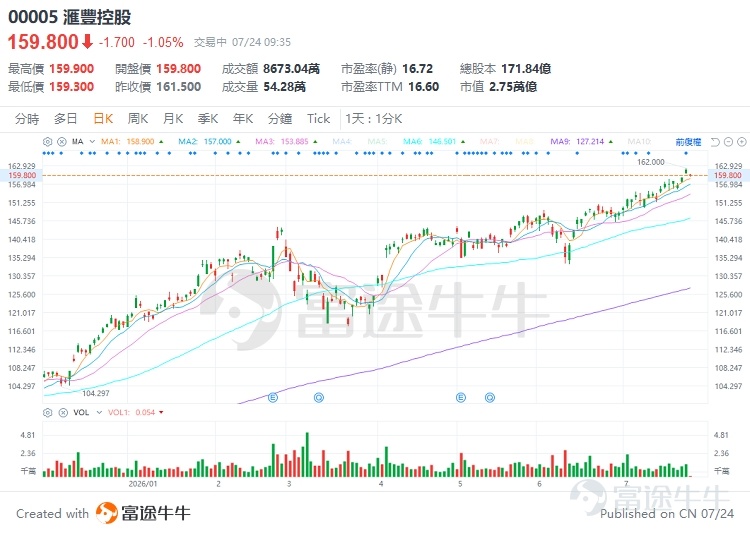
The Hong Kong stock market has recently started heating up again, with the local banking sector showing strong performance. As of today (July 24, 2026), several representative bank stocks have continued hitting multi-year highs. Among them, the leading large bank $HSBC HOLDINGS (00005.HK)$ recently announced earnings and a share buyback plan that exceeded market expectations, reaching an all-time high;

Looking at the longer-term trend, HSBC and $BOC HONG KONG (02388.HK)$ have both gained more than 30% year-to-date!

Bank stocks have long been classic examples of 'income stocks' in the Hong Kong market. Seeing this wave of 'dividends plus price appreciation,' are you itching to jump in? Today, we’ll run through an 'Income Stock Starter Class'—breaking down the fundamentals and showing you how to avoid pitfalls and identify truly high-quality income-generating assets!
1. Why does the market love 'income stocks' so much?
In Hong Kong, investing in income stocks is a key strategy many investors use to achieve asset appreciation.
Income-generating stocks typically exhibit the following characteristics:
– Industry structure and economic moats: They are mostly found in traditional sectors such as banking, utilities, large-cap energy, and telecommunications. These industries feature high barriers to entry and relatively stable market shares.
– Strong cash flow support: Thanks to mature business models, these companies no longer need to make large-scale expansionary capital expenditures, enabling them to return abundant cash flows from operations to shareholders in the form of dividends.
– A Buffer During Market Volatility: When market uncertainty rises, consistent dividend policies often provide strong downside support for share prices, demonstrating solid defensive qualities.
Compared to highly volatile and high-beta assets, these stocks are better suited for investors seeking steady cash flow, who don’t want the stress of monitoring the market daily, and who are planning long-term wealth accumulation.
2. The Most Common Pitfall: Beware of 'Earning Dividends but Losing on Price'!
Many investors fall into the trap of focusing solely on dividend yield when selecting income stocks, overlooking the capital loss caused by falling share prices—a scenario commonly known as 'earning dividends but losing on price.'
The 'total return' from dividend-paying stocks consists of two components:
Total Return = Capital Gain (from share price appreciation) + Dividends
When you encounter 'earning dividends but losing on price,' it meansalthough you successfully received the dividend, the decline in the stock price far exceeded the dividend income you earned,resulting in an overall paper loss.
1. Failure to Achieve 'Dividend Recovery': On the ex-dividend date, a stock’s price is adjusted downward by the amount of the dividend paid. If the company’s fundamentals weaken and the share price fails to recover to its pre-ex-dividend level in subsequent trading, investors effectively end up 'paying themselves with their own principal.'
2. The 'high-yield illusion' caused by deteriorating fundamentals: Since dividend yield is calculated as 'historical dividends per share / current share price,' if a company's business is declining and its stock price halves, the dividend yield will passively 'soar'—even if the dividend amount remains unchanged for the time being. However, this is often followed by earnings deterioration and dividend cuts, ultimately exposing investors to a double blow of shrinking income and significant capital losses.
III. How to screen quality dividend stocks? Balance 'dividend performance' with 'share price trend'
1. Dividend Yield:Generally, a range of 4%–8% is considered a reasonable defensive zone. Yields significantly higher than this warrant caution, as they may reflect peak cyclical conditions or one-time special dividends.
2. Payout Ratio:The payout ratio reflects the proportion of earnings distributed as dividends. An excessively high payout ratio (e.g., approaching or exceeding 100%) suggests the company is overextending itself and lacks funds for essential maintenance capital expenditures; too low a ratio indicates insufficient emphasis on shareholder returns. Typically, a healthy range lies between 40% and 80%.
3. Dividend History and Stability:Examine the company’s dividend record over the past five years or longer—has it consistently paid stable dividends year after year, or even achieved 'annual dividend increases'?
4. Share Price Trend and Volatility:This is the first line of defense against 'price erosion.' Investors should monitor the medium- to long-term moving average trends of a company's stock price. Healthy dividend-paying stocks should exhibit sideways consolidation or a gradual upward channel, and investors should avoid stocks trading in a prolonged downtrend. Additionally, sectors with high leverage and pronounced price volatility should be avoided.
5. Industry Outlook and Earnings Fundamentals: High-quality dividend stocks must be grounded in industries with sustained profitability and strong resilience to economic cycles. Key metrics to analyze include the company’s return on equity (ROE) and the strength of its operating cash flow. Only companies with consistent earnings power can generate upward momentum in their share prices and sustain reliable dividend payouts.
IV. Are there any stocks in the market that offer both capital appreciation and dividends?
Based on objective, data-driven quantitative screening, using the closing data of Hong Kong-listed stocks as of July 21, 2026, we applied the following criteria:
– Market capitalization ≥ HK$500 billion (to ensure sufficient liquidity and industry leadership)
– Average dividend yield over the past 5 years and trailing twelve-month (TTM) dividend yield both ≥ 5% (to ensure historical consistency and current attractiveness of dividends)
– Top 5 Hong Kong-listed stocks by year-to-date (YTD) cumulative price gain

Company Overview:PetroChina is primarily engaged in businesses related to oil and natural gas, including exploration, development, production, and sales of crude oil and natural gas, as well as refining of crude oil and petroleum products, and production and sales of petrochemical products. The company was established in 1999 and is listed on both the A-share and H-share markets.
Dividend Information:Historically, its strong operating cash flow and consistent dividend policy have made it a notable name in the income-generating segment. As of 15:00 on July 24, 2026, its latest trailing twelve months (TTM) dividend yield stood at 5.19%, with a 5-year average dividend yield of 14.98%. The latest fiscal year (LFY) dividend payout ratio was 54.43%, and dividends have grown for six consecutive years.
Data Source: Futubull App – Market – HK Stocks – Dividend Rankings

Company Overview:China Shenhua Energy Company Limited was established in 2004 and is an A+H listed company under China Energy Investment Corporation. The company operates across six core business segments: coal, power generation, coal chemical processing, railways, ports, and shipping. It integrates upstream coal mining, railway transportation, port handling, and downstream power generation and coal chemical operations under a vertically integrated business model.
Dividend Information:As of 15:00 on July 24, 2026, its latest trailing twelve months (TTM) dividend yield stood at 4.99%, with a 5-year average dividend yield of 22.56%. The latest fiscal year (LFY) dividend payout ratio was 76.77%.

Data Source: Futubull App – Market – HK Stocks – Dividend Rankings
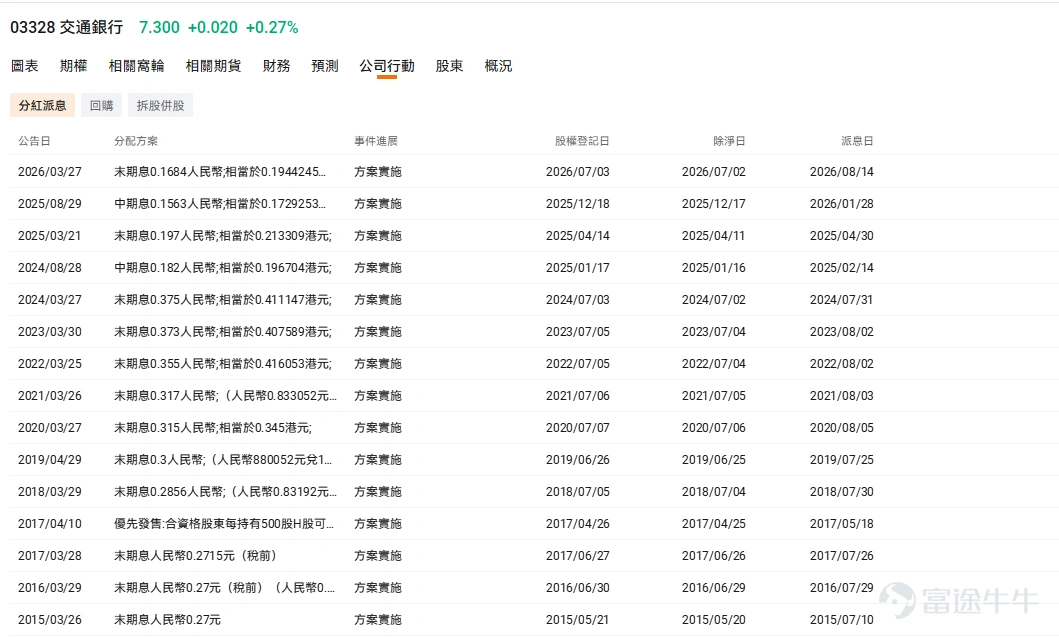
Company Overview:A large state-owned commercial bank with a dominant market share in retail banking and infrastructure project financing.
Dividend Information:As of 15:00 on July 24, 2026, the latest trailing twelve months (TTM) dividend yield is 5.01%, the 5-year average dividend yield is 10.66%, the last fiscal year (LFY) dividend payout ratio is 29.87%, and dividends have grown for 1 consecutive year.
Data Source: Futubull App – Market – HK Stocks – Dividend Rankings

Company Overview:A long-established national joint-stock commercial bank. It has achieved tangible results in asset structure optimization and risk control in recent years, maintaining stable overall profitability.
Dividend Information:As of 15:00 on July 24, 2026, the latest trailing twelve months (TTM) dividend yield is 5.02%, the 5-year average dividend yield is 10.77%, and the last fiscal year (LFY) dividend payout ratio is 29.87%.
Data Source: Futubull App – Market – HK Stocks – Dividend Rankings
Company Overview:CNOOC Limited primarily engages in the exploration, development, production, and sale of crude oil and natural gas, both in China and overseas.
Dividend Information:As of 15:00 on July 24, 2026, the latest trailing twelve months (TTM) dividend yield is 5.45%, the average dividend yield over the past five years is 19.47%, and the last fiscal year's (LFY) dividend payout ratio is 45.01%.
Data Source: Futubull App – Market – HK Stocks – Dividend Rankings

Investing in dividend-paying stocks is not simply a 'buy-and-forget' strategy; it requires a comprehensive approach that considers fundamental asset quality, industry trends, and stock price volatility. While pursuing dividend returns, continuously monitoring a company’s intrinsic value and long-term price performance is key to achieving sustainable and healthy asset appreciation.
If you’d like to further explore and compare different income-generating investment opportunities based on your personal risk tolerance, specific debt ratios, or sector preferences, you can tryFutubull AI’s Expert Mode. By inputting customized screening criteria and multi-dimensional financial metrics, it helps you objectively evaluate various asset allocation opportunities in the market.

Risk Disclaimer: The above content only represents the author's view. It does not represent any position or investment advice of Futu. Futu makes no representation or warranty.Read more


Comments (5)
to post a comment
42
120