
Hong Kong stocks are rebounding—what sectors deserve attention?

Warrant Market Focus Stock Watch | Rebounding Stocks Begin to Diverge: Which Are Breaking Out and Which Are Merely Retracing to Resistance?
On July 23, sentiment in the Hong Kong market improved, but stock performance remained structurally inconsistent.
Some stocks have already broken above recent short-term highs—for example, China Construction Bank; others are merely rebounding from lows without yet reversing their downtrend, such as Tencent; meanwhile, some stocks are hovering near moving averages or range boundaries awaiting direction, like Meituan and CATL.
In such market conditions, warrant positioning should not rely solely on a stock’s intraday gains. The underlying stock’s current price level, its cumulative trend over recent days, and how close callable bull/bear certificates’ knock-out levels are to the spot price will directly affect the product's margin for error.
First, a clarification: the open interest changes mentioned in this article are only considered as lagging position traces left from the previous trading daylagging position traces, and should not be directly interpreted as same-day capital flow direction. Underlying stock data for market observations is as of July 23, while warrant open interest data is as of July 22.

Data on concentrated knock-out zones for bull/bear warrants shows that, for the aforementioned stocks, knock-out levels on both sides generally remain at a distance from current prices. These zones reflect historical areas of concentrated positions and should not be directly viewed as guaranteed support or resistance levels for the underlying stocks.
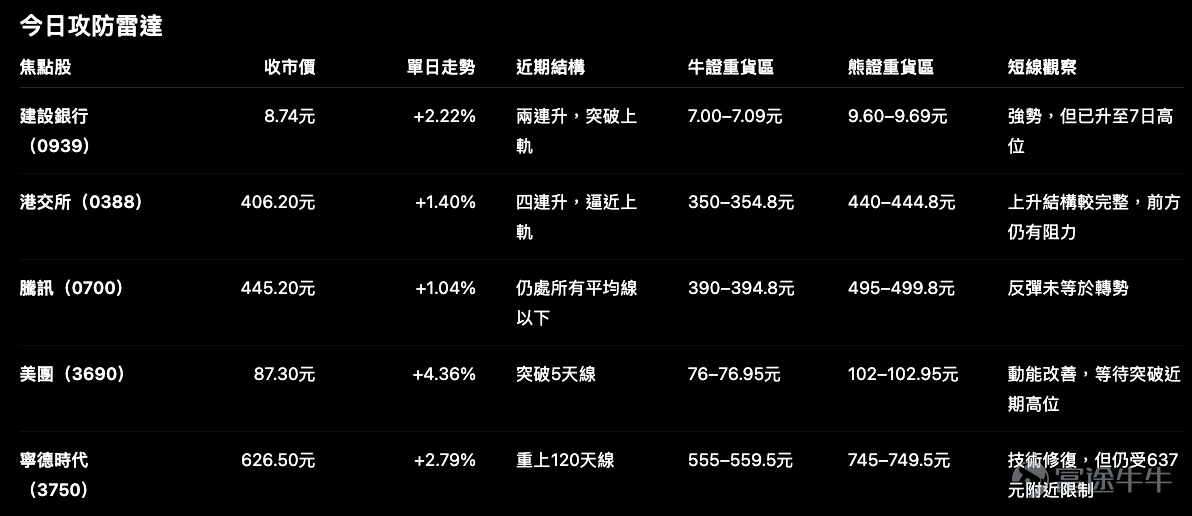
I. China Construction Bank $CCB (00939.HK)$ The risk-reward ratio is relatively high, but this phase has shifted from 'accumulation at lows' to 'breakout trading'.
CCB closed at HK$8.74, up 2.22%, marking its second consecutive gain and breaking above the upper Bollinger Band. Over the past seven trading days, the share price rose from a low of HK$8.15 to HK$8.74, with the latest close representing the highest level during this period.
The advantage of this price action is its clear direction, but the issue is also straightforward:The stock is no longer at a low level.
In terms of warrant open interest, call warrant open interest increased by 4.19%, while put warrant open interest declined slightly by 0.04%. CBBC bull open interest has fallen for seven consecutive days, whereas bear open interest rose by 2.59% in a single day.
This set of indicators can be interpreted in two ways:
First, as the underlying stock rises, some bull CBBC holders may be taking profits, leading to the continued decline in bull open interest. Second, bear positions are beginning to increase, suggesting some investors are attempting to position for a pullback from elevated levels. However, open interest data is lagging and should not be used alone to conclude that the uptrend is about to end.
Product Strategy
The major concentration zone for CCB bull CBBCs is between HK$7.00 and HK$7.09, which is quite far from the current price; the bear CBBC concentration zone lies between HK$9.60 and HK$9.69.
For investors bullish on the direction, the more reasonable approach at present is not to chase the most deeply in-the-money bull certificates, but first to monitor whether the price can stabilize above HK$8.74. If a breakout lacks follow-through, high-leverage bull certificates close to the current price could face sharp retracements.
For those bearish, it’s also unwise to immediately deploy near-knockout bear certificates solely because the stock price has breached the upper Bollinger Band. CCB has recently posted a 5-day gain of 6.72% and a 10-day gain of 8.30%, indicating the trend remains upward; counter-trend positioning should wait for the price to fall back below the breakout level for a more complete signal.
II. HKEX $HKEX (00388.HK)$ : Its price action is stronger than that of the index, but resistance testing begins above HK$406.
HKEX closed at HK$406.20, up 1.40%, marking its fourth consecutive gain and approaching the upper Bollinger Band.
Over the past seven trading days, the share price gradually rose from a low of HK$388 to a high of HK$409.20, with the latest close near the top of this range. The 5-day gain stands at 2.52%, the 10-day gain at 6.78%, and the 20-day gain at 9.43%. Cumulative returns across different timeframes remain positive, and its price structure is more intact than many large-cap tech stocks.
In terms of street inventory, call warrant holdings have risen for two consecutive days, increasing by 0.68% in a single day; put warrant holdings rose sharply by 22.96%. Bull certificate holdings declined by 2.94%, while bear certificate holdings have fallen for three straight days, dropping another 4.55% in one day.
The notable increase in put warrant street inventory suggests some positions are starting to watch for a pullback from elevated levels; however, bear certificate holdings continue to decline, meaning the two bearish instruments aren’t showing entirely consistent signals. This precisely illustrates that conclusions shouldn’t be drawn based solely on changes in one type of street inventory.
Product Strategy
The dense holding zone for HKEX bull certificates lies between HK$350 and HK$354.8, while that for bear certificates is between HK$440 and HK$444.8.
With the current price at HK$406.20, there remains significant room before reaching either dense holding zone. For bullish positioning, HK$409.20 can serve as a near-term breakout reference. If the price fails to break above this level, investors should avoid overly out-of-the-money call warrants, as such products may suffer from time decay if the underlying stock trades sideways.
If the stock price breaks above HK$409.20, at-the-money or slightly out-of-the-money call warrants are more likely to follow suit; if it falls back below HK$400, we’ll need to reassess whether this four-session rally is beginning to lose momentum.
Regarding bull certificates, even if the knock-out price remains a certain distance from the current market price, stop-loss discipline should not be ignored. HKEX stocks often experience significant single-day volatility, and highly leveraged products can undergo substantial price swings well before approaching their knock-out levels.
3. Tencent $TENCENT (00700.HK)$ : A 1% gain is merely a rebound; in the short term, the stock still needs to consolidate within the HK$445–HK$455 range first.
Tencent closed at HK$445.20, up 1.04%, but market observers clearly note that the share price remains below all moving averages.
Over the past seven trading days, Tencent reached a high of HK$494.80 and a low of HK$439; the latest close has already fallen below this range. The 5-day decline stands at 8.02%, and the 10-day decline at 5.20%, indicating that the current 1% gain should, for now, be viewed only as a bounce from lower levels rather than a full reversal of trend.
Open interest data clearly leans bullish: call warrant open interest rose for two consecutive days, increasing by 8.92% in a single day; put warrant open interest dropped by 22.94%; bull certificate open interest rose for two straight days, surging 46.49% in one day; bear certificate open interest declined for two days in a row, falling 16.02% in a single day.
However, the key point to emphasize here is this: when a large number of bullish positions accumulate during a period of stock weakness, it doesn’t necessarily guarantee a successful rebound—in fact, it may concentrate downside risk further.
Product Strategy
The major concentration zone for Tencent bull certificates lies between HK$390 and HK$394.8, while that for bear certificates is between HK$495 and HK$499.8.
Both concentration zones are relatively far from the current price, so when selecting short-term products, traders should prioritize actual knock-out prices over market concentration zones alone.
For a bullish outlook, it’s first necessary to monitor whether the HK$439 level can hold and whether the share price can reclaim the HK$455 area. If the price merely trades sideways around HK$445, out-of-the-money call warrants may not respond favorably; at-the-money call warrants with sufficient time to expiry would be easier to manage.
When using bull certificates, avoid placing the knock-out price too close to HK$439. Tencent is currently still trading below its key moving averages, and if a rebound fails, its decline could be faster than that of stronger stocks.
For a bearish stance, it’s also unwise to chase put warrants or bear certificates at low levels. A more reasonable scenario would be a rebound toward resistance followed by renewed weakness, or a clear breakdown below HK$439.
4. Meituan $MEITUAN-W (03690.HK)$ : Showed the strongest single-day rebound, but HK$88.95 is the true breakout level
Meituan closed at HK$87.30, up 4.36%, breaking above its 5-day moving average—making it one of the more noticeable rebounds among major platform stocks today. Market data shows call warrant open interest increased by 2.96%, while put warrant open interest declined for two consecutive days, dropping 3.67% in a single day. Bull certificate open interest rose for two straight days but only gained 0.86% in one day, while bear certificate open interest increased by 2.41%.
Over the past seven trading days, Meituan traded between a low of HK$77 and a high of HK$88.95. Its latest closing price of HK$87.30 is already very close to the top of this range.
Notably, Meituan’s 5-day gain is only 0.11%, but its 10-day gain stands at 11.21% and its 20-day gain at 28.86%. This indicates the stock had already experienced a significant rally earlier, recently consolidated, and then saw a sharp single-day rebound.
Therefore, the key focus for positions above HK$87 is not how much it rose today, but whether it can break through HK$88.95.
Product Strategy
The main concentration zone for Meituan bull certificates is between HK$76 and HK$76.95, while the main concentration zone for bear certificates is between HK$102 and HK$102.95.
The bull certificate concentration zone is near the previous low of HK$77, indicating a significant build-up of positions in that area. If Meituan falls back toward HK$80, market volatility and bull certificate risk could increase simultaneously.
If the stock breaks above RMB 88.95, bull certificates can maintain a sufficient buffer from the call price, avoiding positioning too close to recent lows just to chase higher leverage. For warrants, prioritize slightly in-the-money call warrants with higher delta.
If the stock fails to break above RMB 88.95 and pulls back, put warrants may be more suitable than bear certificates for capturing a typical pullback, as bear certificates—even with distant call prices—still carry high leverage that amplifies short-term adverse volatility.
5. CATL $CATL (03750.HK)$ : Reclaimed the 120-day moving average, but RMB 637 remains the upper limit for the rebound
CATL closed at RMB 626.50, up 2.79%, reclaiming the 120-day moving average. Call warrant open interest rose by 4.83%, while put warrant open interest declined by 1.18%. Bull certificate open interest rose for two consecutive days, increasing 17.56% in a single day, whereas bear certificate open interest fell for three straight days, dropping 21.79% on the day.
This pattern of open interest shows a clear increase in bullish positions, though the underlying stock has not yet fully broken out.
Over the past seven trading days, CATL traded between a high of RMB 637 and a low of RMB 598.50; its latest close at RMB 626.50 places it in the upper half of this range. However, its 5-day gain is only 0.89%, while the 10-day change remains down 1.73%, and the 20-day change shows a decline of 13.17%, indicating the current move is primarily a technical rebound within a medium-term downtrend.
Product Strategy
The main concentration zone for CATL bull certificates is between RMB 555 and RMB 559.5, while the bear certificate concentration zone lies between RMB 745 and RMB 749.5.
Both concentration zones are relatively far from the current price, so short-term traders should pay attention to whether the actual call prices of specific products in the market are too close.
For bullish strategies, wait for a confirmed breakout above RMB 637 first. Otherwise, using high-leverage bull certificates within the RMB 620–637 range risks being caught in volatile swings. If using call warrants, terms that are closer to being at-the-money and with longer time to expiry are better suited for waiting for breakout confirmation.
For bearish strategies, watch the RMB 600 level closely. Only if the stock re-breaks below RMB 598.50 will the rebound structure clearly weaken. Until then, shorting via bear certificates against the trend entails the risk of an extended rebound following the reclaim of the 120-day moving average.
Warrants Trading Reminder: This round shouldn't just chase the stocks that have risen the most
Today's five focus stocks can broadly be categorized into three types:
Strong breakout type: CCB, HKEX
Direction is relatively clear, but prices are already near or hitting short-term highs. The key for positioning is to avoid buying bull warrants with knock-out levels too close and excessive leverage.
Low-level recovery type: Tencent, CATL
A single-day rebound doesn't mean the trend has reversed. Before using call warrants or bull certificates, check whether key resistance levels can be convincingly breached.
Range breakout type: Meituan
Short-term momentum has improved, but HK$88.95 remains the confirmation level. Until a breakout occurs, warrant structures should allow room for price fluctuations.
Finally, three more reminders:
First,An increase in street inventory only reflects past positioning activity—it doesn't guarantee the market direction was correctly predicted on that day。
Second,The heavy position zone is neither a support nor resistance level for the underlying stock, nor is it necessarily where a short squeeze occurs.。
Third,Bull and bear warrants not yet reaching their call price does not mean losses are still limited.; Highly leveraged products can experience significant price drops when the underlying stock moves in the opposite direction.
Which stock caught everyone's attention most today—CCB or HKEX, which have already risen to high levels, or Tencent and Meituan, which are still waiting for confirmation of a rebound?
Risk Disclaimer: The above content only represents the author's view. It does not represent any position or investment advice of Futu. Futu makes no representation or warranty.Read more

Comments
to post a comment
1