
Hong Kong's two market leaders reported a significant surge in earnings; is there still room to posi

Earnings & Options Strategy | Fiber Optic Star Stock Drops 40%—What Will Corning’s Earnings Report Validate?
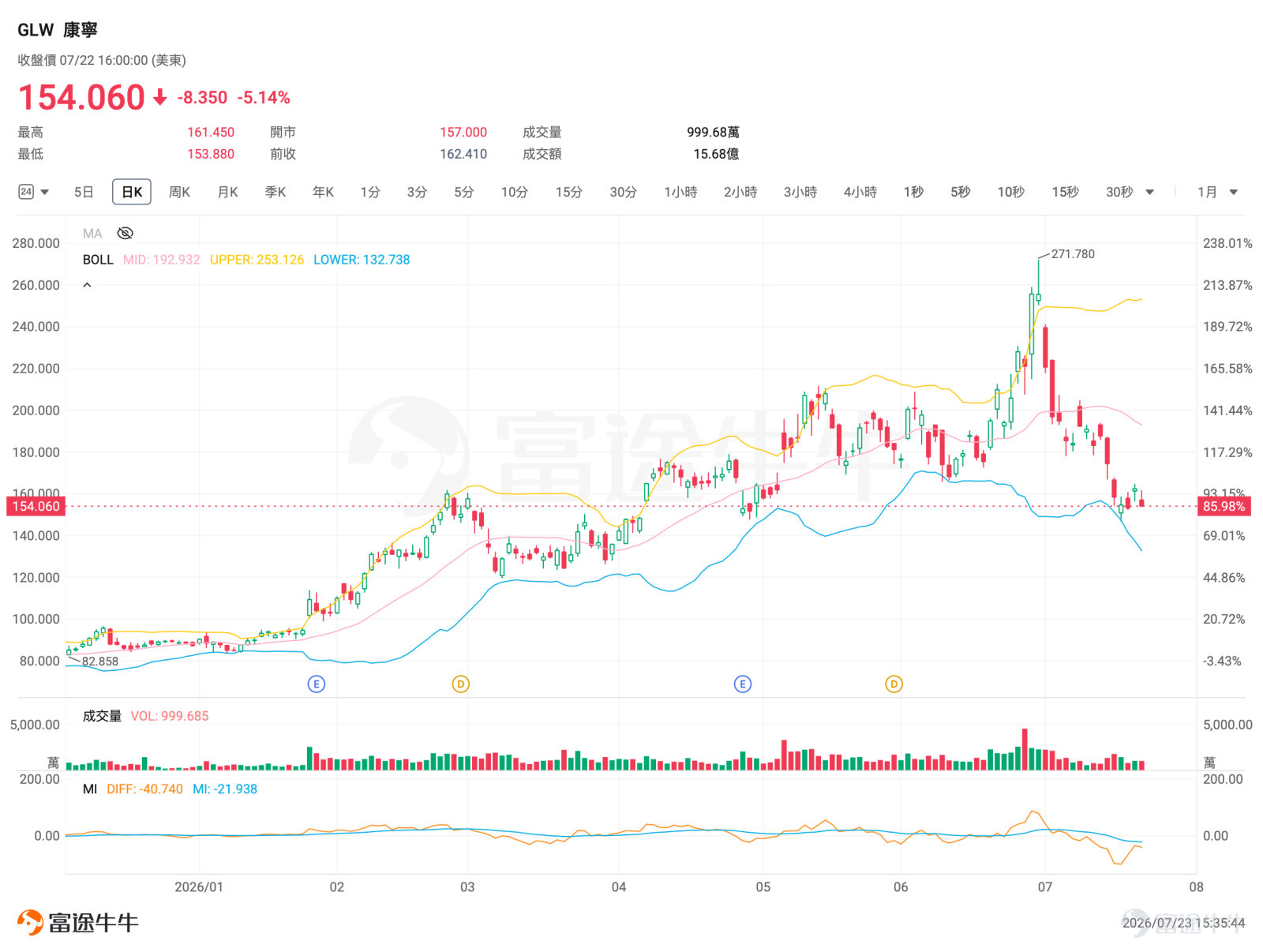
A month ago,$Corning (GLW.US)$ it was still one of the hottest names in the AI hardware supply chain, with its share price peaking above $270; as of July 22, the stock has retreated to around $154, down more than 40% from its recent high in less than a month.

Amid this sharp pullback in share price, Corning’s latest earnings report is imminent. Corning will release its Q2 2026 earnings before the U.S. market open onJuly 28.
The key question this earnings report truly needs to address isn't just whether revenue and EPS will beat expectations, but more importantly, it must clarify the future growth trajectory for the market: How much of the AI-driven optical communications demand from Meta, NVIDIA, and Amazon has already translated into actual revenue and profit?
This will directly determine whether the market should continue viewing Corning as a high-growth AI infrastructure stock or revalue it as a traditional materials company.
What are market expectations ahead of the earnings release?
Last quarter, Corning already provided relatively clear guidance for Q2, with core sales expected at approximately $4.6 billion, representing a 14% year-over-year increase, and a midpoint EPS of $0.75, implying 25% year-over-year growth.
According to consensus estimates, current market expectations are broadly aligned with this guidance, with revenue forecast at around $4.6296 billion. Recently, both Citi and BofA Securities raised their price targets above $240.

There are three key factors that will determine whether this earnings report and the subsequent conference call are viewed as successful or not.
First key factor: Can Optical Communications sustain its high growth?
If you still think of Corning as 'the company that makes smartphone glass,' you’re likely misunderstanding the current pricing logic behind this stock.
Corning’s Optical Communications revenue in Q1was $1.846 billion, up 36% year-over-year.
has become the company's most important growth engine. The key driver behind this shift is the significant increase in demand for fiber optics, optical cables, and high-speed connectivity from AI data centers.
Over the past few months, Corning has secured multiple major AI infrastructure customers:
NVIDIA:In May, it announced a long-term collaboration, under which Corning plans to expand its Optical Connectivity capacity in the U.S. 10x, increase fiber optic production capacity over 50%, and build three new factories.
Meta:A multi-year agreement was signed, with a total value of up to 6 billion USD, covering fiber optics, optical cables, and connectivity solutions.
Amazon:In June, it signed another multi-yearmulti-billion-dollardata center fiber optic and connectivity solutions partnership.
NVIDIA simultaneously paid Corning $500 million to acquire 3 million pre-funded warrants and up to 15 million ordinary share warrants with an exercise price of $180.
These are no longer just AI concepts or TAM narratives, but rather:Customer → long-term contracts → capacity expansion → revenue recognition—the entire chain has been confirmed.

Therefore, what’s most worth watching in Q2 isn’t whether the company’s total revenue exceeds expectations by $10–20 million, but rather how much Optical Communications actually delivered.
Based on approximately $15.66 billion in the same period last year, if Q2 can still maintain roughly 30% year-over-year growth, revenue would approach$20 billion.
This can serve as a key observation point for this earnings report.
If Optical solidly achieves $20 billion or more, and Q3 guidance continues to accelerate, it would indicate that AI demand is materializing in line with prior market expectations.
Conversely, if Optical falls significantly short of $20 billion, even if the company narrowly beats total revenue expectations, the market may begin to question again:There are many large orders, but is the speed of revenue recognition being overestimated?
The second critical factor: Q3 guidance is more important than Q2 EPS
Major AI contracts have already been announced; the market in the next phase will no longer be satisfied with just 'many orders.'
The real question to answer is:When will these orders start appearing on the financial statements?The market currently expects Q3 revenue to be approximately USD 4.8 billion.
Therefore, the most important thing to check immediately after the earnings release is actually the Q3 guidance.
If management provides Q3 revenue guidance significantly above USD 4.8 billion and confirms accelerating conversion of demand from Meta, Amazon, and NVIDIA, Corning’s investment thesis will shift from:"AI order expectations"Further shift toward"AI earnings realization."
The valuation tolerance under these two scenarios is entirely different.
The third critical factor: Can growth truly translate into profits?
Corning's operating profit margin in Q1 has risen to:20.2%,an improvement of 220 basis points year-over-year.
This is a very significant number.
because one of the core objectives of Corning's Springboard program is to maintain an operating margin of 20% or higher。
Q2 faces one known drag: extended maintenance at the solar wafer facility, which the company expects will incur approximately $30 million in costs, and the related impact has already been incorporated into Q2 guidance.
Therefore, if Q2 revenue continues to grow while the operating margin remains around 20%, it indicates that the optical product mix and operating leverage are effectively enhancing overall earnings quality.
Conversely, if revenue growth remains strong but the margin clearly falls below 20%, the market will need to reassess:Is AI capacity expansion driving high-quality earnings growth, or is it merely trading high capex for revenue growth?
The stock price has dropped 40%—is the valuation now sufficiently cheap?
GLW surged from below $90 to $272 this year, as the market rapidly priced in several years of anticipated AI optical growth.
Recently, the entire AI hardware sector has started reducing risk exposure, with hyperscaler capex growth rates, AI infrastructure ROI, and elevated valuations becoming focal points of renewed market discussion—GLW has thus become part of the deleveraging process for high-beta AI names.
However, $154 does not necessarily mean GLW has entered traditional value stock territory.
Based on current market estimates of roughly 2026 Core EPS estimate of $3.18Roughly calculated, GLW still trades at nearly 47x the 2026 forward P/E ratio.
So the current situation is more accurately described as:Valuation pressure has clearly eased, but the high-growth assumption still requires consistent earnings validation.

Options market: Large moves are already expensive
As of July 22, the options market is implying an earnings-day price swing of approximately 14%, compared to an average absolute move of about 7.2% on the first trading day following GLW’s last four earnings announcements, with the stock declining after each of the previous three.。
This means the key to options strategies betting on this earnings event isn’t simply predicting 'up or down,' but also assessing whetherthe options themselves are already too expensive given the elevated implied volatility.

(The illustrative screenshots shown are for demonstration purposes only and do not constitute investment advice or guarantees; market conditions change rapidly, and the displayed option prices may not reflect actual market values.)
Earnings Season Options Strategy #1: Aggressive Call Spread
If your core thesis is:
– AI optical demand shows no clear signs of weakening;
– The recent >40% pullback has already unwound a significant amount of crowded positioning;
– Earnings present an opportunity for meaningful valuation repair;
Consider using a long call vertical spread (call spread) instead of buying a naked call.

(The illustrative graphics shown on screen are for demonstration purposes only and do not constitute investment advice or guarantees; market conditions change frequently, and the displayed option prices do not reflect real-time data.)
The advantage of this strategy is:Selling a higher-strike call offsets part of the extremely elevated implied volatility (IV) around earnings.
However, this is clearly an aggressive structure. The stock price must rise above a certain level before the position enters its profitable zone at expiration, making it more suitable when you have a clear positive earnings expectation differential—not merely a general 'long-term bullish' view on the company.
Earnings Season Options Strategy #2: Covered Call
For investors who actually hold Corning (GLW) shares, if they believe this earnings report is unlikely to deliver a gain exceeding 14% but still want to capture some premium income from the elevated implied volatility (IV) ahead of earnings, they could consider a Covered Call strategy.

(The illustrative graphics shown on screen are for demonstration purposes only and do not constitute investment advice or guarantees; market conditions change frequently, and the displayed option prices do not reflect real-time data.)
The biggest advantage of this strategy is that it doesn't require GLW’s stock to surge sharply after earnings—as long as the share price doesn’t drop significantly, the substantial time value collected from selling the call can lower the overall cost basis of the position.
This approach is better suited for investors who:
– Remain bullish on AI Optical growth over the medium term;
– Are willing to hold GLW shares outright;
– Believe the current share price has already significantly relieved valuation pressure from previous highs;
– But think the stock may not break above the strike price again in the near term;
– Want to leverage the high IV ahead of earnings to boost portfolio returns.
Overall, Corning’s Q2 earnings report essentially serves as a validation test for demand in AI optical communications.
If Optical continues its high-speed growth, Q3 guidance is raised, and orders from major AI customers start translating into revenue more quickly, the market would have good reason to reprice GLW’s growth potential upward following the recent sharp pullback.
Conversely, if orders remain confined to forward-looking narratives and the pace of revenue and earnings realization lags behind prior valuations, the market’s tolerance for high multiples will remain limited.
Finally, we’ve got a little perk for our fellow investors—feel free to claim it!Options Starter Pack
*This promotion is exclusively available to invited Hong Kong users. Click to learn more.Detailed terms and conditions of the promotion >>
Market conditions are complex and ever-changing,Options strategiesToo many choices and unsure how to proceed? Let Futubull help you build a strategy in three simple stepsOptions strategies, making investing simple and efficient!

Risk Disclaimer: The above content only represents the author's view. It does not represent any position or investment advice of Futu. Futu makes no representation or warranty.Read more


Comments (3)
to post a comment
33
70