

Wuzhou Medical Crosses into Semiconductors: Three Years Post-IPO, Revenue and Profits Both Plummet; a 'Blank-Slate' Restructuring Proposal Sparks a 20% Limit-Up | M&A Frontline
When markets opened on July 22, Wuzhou Medical (301234.SZ) resumed trading after a two-week suspension, closing at its daily trading limit of RMB 40.80. The stock saw a peak morning buy order of 160,000 lots, with 103,400 lots still locked in by market close—equivalent to RMB 422 million.
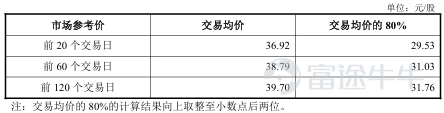
The medical consumables company, which held firmly onto its 20% daily trading limit throughout the day and has a total market capitalization of RMB 2.774 billion, surged on the back of a cross-sector merger and acquisition proposal. Under the plan, the company intends to acquire 100% of Xuanzhi Technology’s equity through a combination of newly issued shares and cash payments, while also issuing new shares to no more than 35 qualified institutional investors to raise配套 funds. These proceeds will be used to cover the cash portion of the transaction consideration and related advisory fees, with the share-based asset purchase priced at RMB 31.40 per share.
By pivoting from low-end medical infusion consumables into the motor control chip sector, the company’s dramatic industry leap immediately ignited sentiment in the secondary market. In its preliminary announcement, the company stated that this acquisition aims to establish a second growth curve to hedge against earnings volatility risks stemming from reliance on a single consumables business.
However, beneath the surface of surging share prices lies the persistent pressure of weakening growth in its core consumables business—a challenge that cannot be ignored. Moreover, the restructuring remains in an early stage: audit and valuation work has yet to be completed, and key terms such as total transaction consideration, cash-versus-share payment ratios, and profit compensation commitments remain unspecified. Despite the heightened investor enthusiasm, this capital move is still subject to numerous unresolved variables.
The fundamental driver behind this large-scale cross-sector acquisition of a semiconductor asset lies in the continuously deteriorating fundamentals of Wuzhou Medical’s core business.

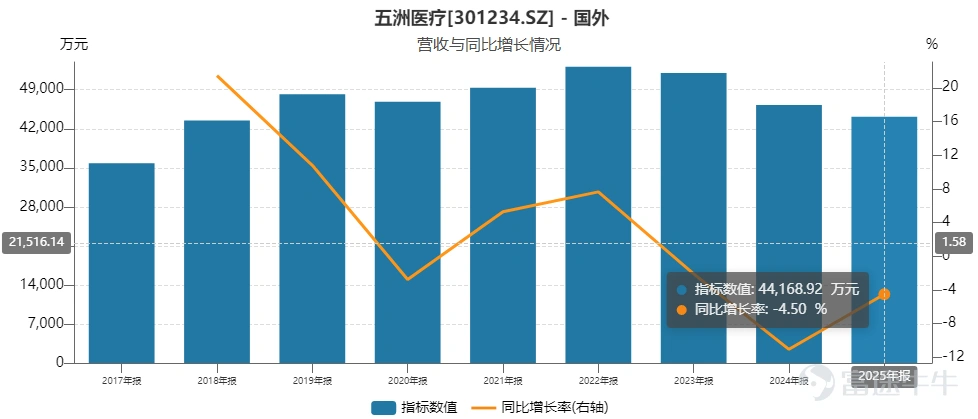
The company listed on the ChiNext board in July 2022, achieving peak financial performance in its IPO year with revenue of RMB 547 million and net profit attributable to shareholders of RMB 70.93 million.
However, both revenue and profits have declined for three consecutive years since then. By 2025, revenue had contracted to RMB 458 million, down 19.43% from its IPO peak, while net profit attributable to shareholders plummeted by 73.35% year-over-year to just RMB 18.89 million.
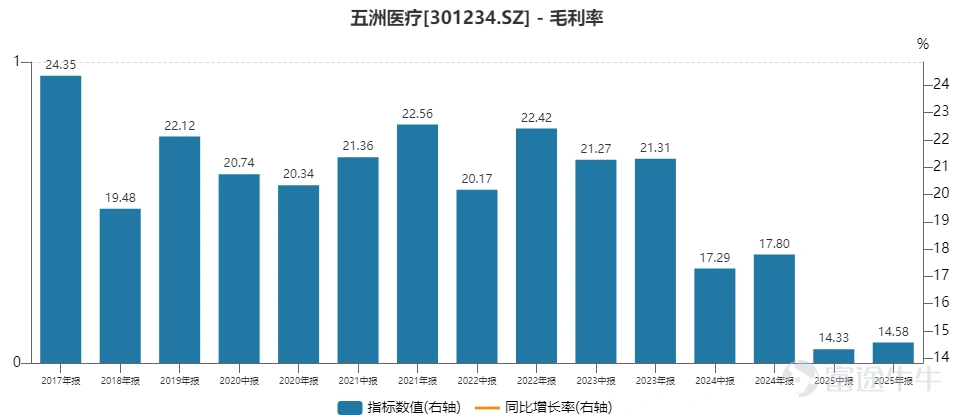
Profit margins have narrowed in parallel, with the company’s overall gross margin declining annually from 22.42% in 2022 to 14.58% in 2025.
First-quarter 2026 results showed mixed trends: revenue stood at RMB 101 million, down 3.33% year-over-year, while net profit attributable to shareholders rose 42.89% year-over-year to RMB 8.05 million. However, this profit increase was primarily driven by non-recurring gains. Meanwhile, net cash flow from operating activities amounted to negative RMB 0.82 million, a 106.91% year-over-year decline, underscoring the persistent weakness in core operations.
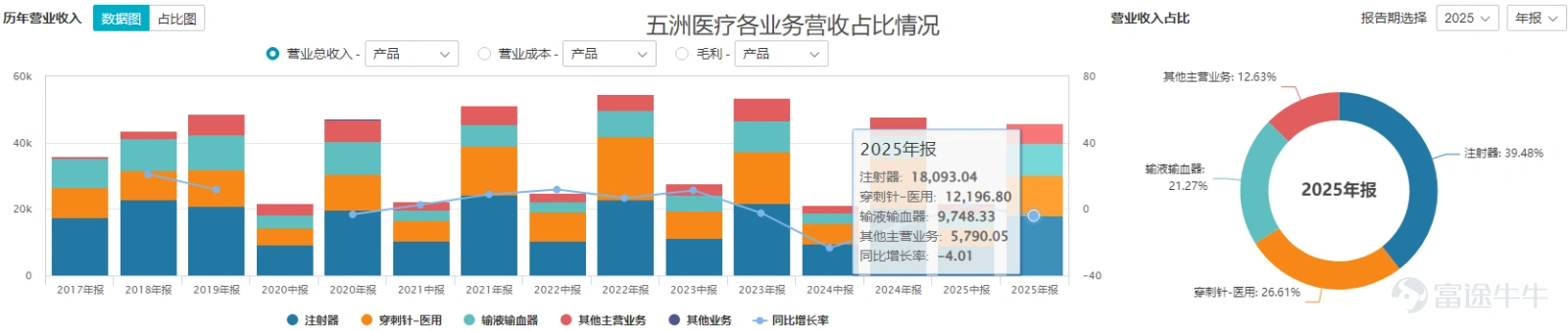
A breakdown of product segments reveals clear growth bottlenecks. The two main product categories—syringes and puncture needles—saw revenue declines of 11.16% and 20.15% year-over-year in 2025, respectively. Only the infusion and transfusion sets category posted逆势 growth of 41.73%, raising its revenue contribution to over 20%, though this was insufficient to offset the overall downward trend in performance.
In terms of business model, Wuzhou Medical operates under an ODM (Original Design Manufacturer) export framework, partnering with overseas medical device brand owners, with foreign sales consistently accounting for more than 95% of total revenue.
In recent years, overseas end-market demand has returned to normal levels, compounded by rising trade barriers globally and intensified price-based competition within the industry, causing the growth ceiling for low-value infusion consumables to become increasingly apparent and eroding the momentum of the company’s traditional export-oriented business model.
Relying solely on its current medical consumables product line, the company struggles to reverse the persistent downward trend in revenue and profits, making the pursuit of a new high-growth sector an urgent strategic priority for management.
Motor control chips represent a sector currently benefiting from strong tailwinds both from government policy and market demand. Multiple national industrial policy documents have identified integrated circuits as a key area for technological breakthroughs, while downstream applications—including white goods, industrial automation, new energy vehicles, and low-altitude equipment—continue to expand rapidly.
The acquisition target, Xuanzhi Technology, originates from the motor control business spin-off of Fairchild Semiconductor. Its core R&D team has extensive experience at leading international chipmakers. Operating under a fabless, asset-light model, the company focuses exclusively on chip design and sales, outsourcing wafer fabrication and packaging/testing entirely to third-party specialized vendors.
Its chip products are already being supplied in volume to industry leaders such as Midea, Gree, and DJI, with cumulative shipments exceeding 200 million units. Its shareholder base includes prominent domestic semiconductor-focused investment firms such as Yuanhe Puhua, Suzhou Xineng Investment, Zhangjiang Suifeng, and Shenzhen Guangyuan Digital Technology.
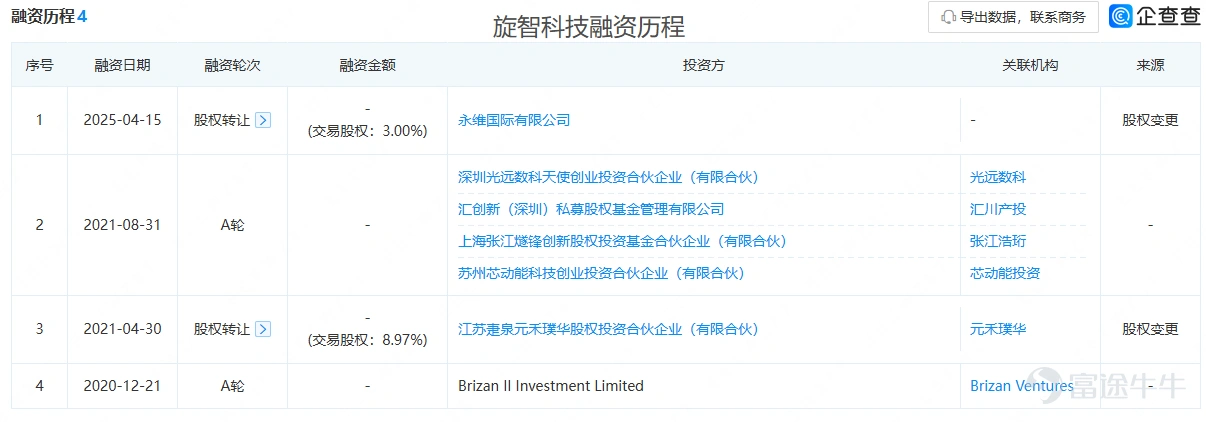
Financially, Xuanzhi Technology reported a net loss of RMB 41.8544 million in 2024 but turned profitable in 2025 with full-year net profit reaching RMB 32.7898 million. In the first half of 2026 alone, net profit already amounted to RMB 20.91 million, reflecting a notably sharp short-term earnings recovery trajectory.
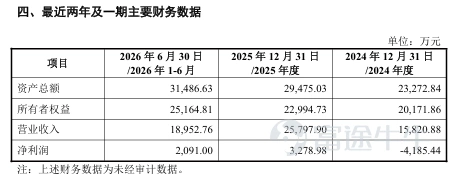
Notably, one day prior to the disclosure of this restructuring proposal, Wuzhou Medical had already completed a round of strategic capital introduction. The company’s controlling shareholder and several founding shareholders jointly transferred 11.8071% of the company’s shares to Jiaxing Huixin at a price of RMB 48.53 per share, amounting to a total transaction value of approximately RMB 390 million.
Corporate registry and equity linkage data indicate that Jiaxing Huixin is affiliated with Yuanhe Puhua, a shareholder of Xuanzhi Technology. Following the completion of this equity transfer, Jiaxing Huixin will become a related party holding more than 5% of Wuzhou Medical’s shares. Consequently, the listed company’s acquisition of Xuanzhi Technology’s equity held by Yuanhe Puhua will constitute a related-party transaction. The coordinated move—involving strategic capital entering the listed company ahead of time while simultaneously facilitating a cross-sector acquisition of semiconductor assets by a medical device firm—clearly reveals an integrated strategy spanning both primary and secondary markets.
The market has signaled approval of this cross-sector acquisition with a 20% daily trading limit surge, yet several critical variables still stand between the current proposal and final execution.
The primary uncertainty stems from the target’s valuation and the consideration payment structure. The audit and appraisal work related to this restructuring have not yet been completed, and key terms such as the total transaction amount, the ratio of share versus cash payments, performance commitments, and compensation arrangements remain unsettled.
As of the end of Q1 2026, Wuzhou Medical had total assets of RMB 854 million and a debt-to-asset ratio of 9.94%, with limited on-balance-sheet cash reserves. By contrast, Xuanzhi Technology reported total assets of RMB 315 million and shareholders’ equity of RMB 252 million as of June 30, 2026.
Based on an estimated transaction value exceeding RMB 1 billion from Purple Horse Capital, a financial services firm, and assuming full payment via newly issued shares at an issue price of RMB 31.4 per share, approximately 31.85 million new shares would need to be issued—equivalent to 47% of Wuzhou Medical’s current share capital of 68 million shares. Upon closing, Xuanzhi Technology’s founding team and its institutional shareholders would hold a substantial stake in the listed company, resulting in significant equity dilution.
The second layer of uncertainty arises from cross-industry integration challenges. The preliminary plan explicitly states that the listed company primarily operates in medical consumables, while the target specializes in motor control chips—two entirely distinct industries with no upstream-downstream or synergistic industrial logic. Wuzhou Medical’s mature overseas ODM manufacturing and distribution network cannot support chip R&D, wafer foundry operations, or end-customer development. Conversely, Xuanzhi’s core technologies—such as chip architecture and motor control algorithms—are unlikely to enhance Wuzhou’s infusion consumables business. Any earnings uplift from this acquisition will likely stem solely from consolidated financial reporting, with minimal operational synergy.
If the final appraisal results in a high valuation premium, it will generate significant goodwill. Should downstream cycles in home appliances, industrial controls, or automotive electronics subsequently weaken—or if the target experiences order declines or falls short of R&D iteration expectations—the year-end goodwill impairment test would directly drag down consolidated net profit. Thereafter, the listed company would face dual cyclical pressures: intensifying competition in overseas medical consumables markets and volatility in semiconductor industry sentiment.
From a broader perspective, Wuzhou Medical represents another recent case on China’s A-share market where a cross-sector asset restructuring is being used to re-rate valuation. Previously, Annuoqi announced its acquisition of Fengyun Information to enter computing power assets, and Jinli Huadian disclosed plans to acquire a commercial aerospace company. Both stocks surged by the daily 20% limit upon resumption of trading, highlighting investor enthusiasm for cross-sector narratives tied to hot investment themes.

Yet beneath the hype lie cautionary precedents. Xiangrikuí had planned to acquire a semiconductor materials company; its stock rose by the 20% daily limit for three consecutive days after resuming trading, only for the deal to collapse five months later. The company and its responsible personnel were subsequently penalized by regulators for misleading disclosures. Similarly, during Shuangcheng Pharmaceutical’s attempted acquisition of an analog chip company, its stock hit the 20% daily limit 24 times in 27 trading days—only for the deal to be shelved due to disagreements over valuation among parties.
Ultimately, cross-sector M&A is a probabilistic exercise fraught with uncertainty. Expanding into the high-growth chip sector amid plateauing core business growth is a rational strategic move for Wuzhou Medical to broaden its growth runway. However, market enthusiasm does not guarantee successful transformation. If Xuanzhi Technology fails to achieve sustained and stable profitability, the listed company could face simultaneous downturns in both its medical consumables and chip businesses, significantly amplifying operational pressure.By Company WatchBy Cao Qian, Edited by Cao Shengyuan
Risk Disclaimer: The above content only represents the author's view. It does not represent any position or investment advice of Futu. Futu makes no representation or warranty.Read more

Comments
to post a comment
2