
Hong Kong stocks are rebounding—what sectors deserve attention?

Today's Warrant Market Focus Stocks | Oil stocks approaching upper Bollinger Band, tech stocks pulling back: Same directional bias, entirely different product strategies
What’s most worth noting in today’s Hong Kong market isn’t just which stocks rose the most or fell the sharpest, but ratherwhether the underlying stock trend, changes in warrant open interest, and key support/resistance zones for bull/bear warrants all point in the same direction。
First, a clarification: The open interest data referenced in this article is as of market close on July 21, while the underlying stock data reflects market close on July 22. Therefore, open interest should only be viewed as a one-day lagging indicator of positioning—useful for observing how investors previously positioned themselves—but it should not be treated as real-time capital flow, nor should it be used alone to predict the next day’s price movement.
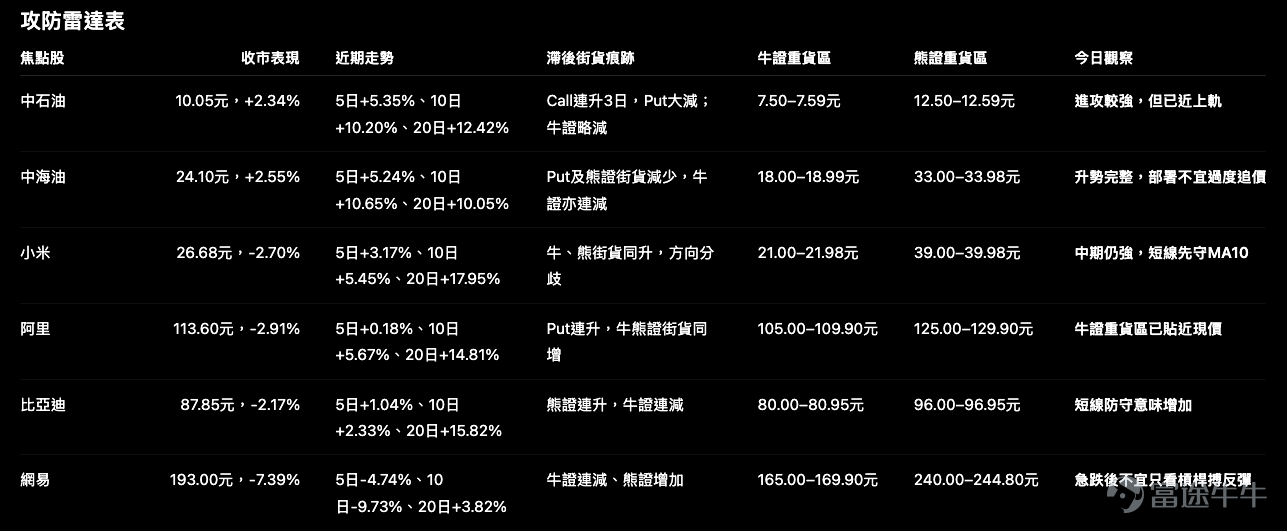
This time, we’ve selected six representative focus stocks:
– PetroChina and CNOOC: Underlying stocks continue their strong performance, approaching the upper Bollinger Band;
– Xiaomi, Alibaba, and BYD: Still showing mid-term gains, but experiencing short-term profit-taking;
– NetEase: Sharp single-day decline; faces the highest difficulty in terms of technical structure and product positioning.

The heavy concentration zones for callable/puttable warrants are derived from market positions as of July 21, representing previously accumulated holdings rather than immediate support or resistance levels.
1. PetroChina $PETROCHINA (00857.HK)$ : The upward trend aligns with increased call warrant open interest, but product aggressiveness should be moderated as the stock approaches the upper Bollinger Band.
PetroChina rose today 2.34%, closing at HK$10.05, with cumulative gains of 5.35%, 10.20%, and 12.42% over the past 5, 10, and 20 days respectively, bringing the underlying stock close to the upper Bollinger Band.
Regarding open interest, call warrant street positions have increased for three consecutive days, rising by 3.8% on the latest day; put warrant street positions dropped sharply by 20.95%. This indicates that, as of the previous trading day, market positioning was clearly biased toward bullish sentiment. However, bull warrant street positions declined by 2.95%, while bear warrants remained unchanged.
This combination can be interpreted as:Investors are still willing to use derivative warrants to capture upside momentum, but some bull warrant positions have already started to scale back.
The main concentration zone for PetroChina bull warrants is between HK$7.50 and HK$7.59, which is quite far from the current price of HK$10.05; the bear warrant concentration zone lies between HK$12.50 and HK$12.59.
Product Strategy
For those who remain bullish on PetroChina, it may not be necessary at this stage to simply chase the highest leverage products.
The underlying stock is approaching the upper Bollinger Band, so a more reasonable approach would be:
– If expecting a short-term breakout to continue, consider slightly out-of-the-money call warrants with higher delta;
– If expecting the uptrend to persist but with volatility, consider bull certificates with a distant call price;
– Do not ignore the actual call price of individual products just because the bull certificate's heavy open interest zone is far from the current price.
Open interest in warrants generally aligns with the underlying stock’s direction, but call warrant open interest has accumulated over several days. If the underlying stock starts consolidating at higher levels, time decay for out-of-the-money call warrants will gradually become more pronounced.
2. CNOOC $CNOOC (00883.HK)$ : The underlying stock's trend remains solid, but warrant market open interest appears to be reducing positions rather than chasing the upside.
CNOOC rose today 2.55%, closing at HK$24.10, up 5.24% over 5 days, 10.65% over 10 days, and 10.05% over 20 days—also nearing the upper Bollinger Band.
Unlike PetroChina, although CNOOC's call warrant open interest rose slightly by 1.04% on the day, data shows it had declined for two consecutive prior days; put warrant open interest dropped sharply by 26.68% on the day. Bull certificate open interest has declined for four straight days, while bear certificate open interest has also fallen for two consecutive days.
In other words, while the underlying stock continues to rise, there are signs of position reductions on both bull and bear sides. This doesn't necessarily indicate bearish sentiment; instead, it may reflect earlier positions being gradually unwound as the underlying stock advances.
For CNOOC, the densest region of bull warrants is between HK$18 and HK$18.99, while that of bear warrants is between HK$33 and HK$33.98—both significantly distant from the current share price.
Product Strategy
CNOOC’s biggest issue with its structured products right now is not that the knock-out levels are too close, but ratherGiven that the underlying stock has already risen close to a key technical resistance level, should investors still aggressively chase it using highly aggressive warrant terms?。
For those still bullish, consider the following strategies:
– For call warrants, prioritize moneyness, delta, and time to expiry;
– For bull warrants, examine each product’s specific distance-to-call level; do not substitute overall market concentration zones for individual product risk;
– If only a gradual upward move is expected, deeply out-of-the-money calls may not be the optimal choice;
– Only if the underlying stock breaks above its upper technical band and surges sharply will higher-leverage products offer meaningful upside potential.
Open interest in PetroChina call warrants tends to reflect chasing momentum, whereas CNOOC appears more like profit-taking after gains. Although the two oil stocks show similar underlying price movements, their warrant market footprints differ notably.
3. Xiaomi $XIAOMI-W (01810.HK)$ Down for two consecutive days in the short term, yet still up nearly 18% over 20 days—this can't simply be summed up as 'weakening.'
Xiaomi closed at HK$26.68, down 2.70%, marking its second straight day of declines and breaking below the 5-day moving average (MA5), though it is still holding above the 10-day moving average (MA10). The 5-day, 10-day, and 20-day returns remain up 3.17%, 5.45%, and 17.95%, respectively.
This structure resembles more closelyThe medium-term uptrend remains intact, but short-term consolidation has begun to digest the prior gains.。
In terms of open interest, both call and put warrants saw a decrease; bull warrant open interest increased by 2.48%, while bear warrant open interest rose by 5.38%.
The simultaneous increase in both bull and bear warrant open interest reflects growing divergence among investors regarding the market outlook as of the previous trading day.
The major concentration zone for Xiaomi bull warrants lies between HK$21 and HK$21.98, while that for bear warrants is between HK$39 and HK$39.98.
Product Strategy
When positioning in Xiaomi now, the first step is to clarify your own scenario:
If you believe this is merely post-rally consolidation:
Consider slightly out-of-the-money call warrants or bull certificates with a distant call price, focusing on products that can withstand the underlying stock retesting the MA10 or short-term support levels.
The short-term upward momentum is seen as having weakened:
Put warrants or bear certificates could be considered, but it's not advisable to chase highly leveraged products solely because of two consecutive down days. Xiaomi has still accumulated a gain of nearly 18% over the past 20 days; should a rebound occur, the risk associated with at-the-money bear certificates would rise rapidly.
Xiaomi's open interest data currently does not show a one-sided signal but rather typical simultaneous long and short position increases. In such a scenario, product terms are more important than the direction of open interest.
4. Alibaba $BABA-W (09988.HK)$ : Currently holding above the 10-day moving average (MA10) at HK$113.6, but the major bull certificate support zone between HK$105 and HK$109.9 is not far away.
Alibaba fell 2.91% today, closing at HK$113.60, marking two consecutive down days. It has broken below both the 5-day (MA5) and 60-day (MA60) moving averages but is still temporarily holding above the 10-day moving average (MA10). Its 5-day performance is nearly flat, up 5.67% over 10 days, and still up 14.81% over 20 days.
This is a fairly clear turning point: the medium-term gains have not yet fully eroded, but short-term defensive pressure is increasing.
As of the previous trading day, call open interest rose slightly by 0.44%, while put open interest has increased for two consecutive days, rising 5.99% most recently; bull certificate open interest rose 6.18%, and bear certificate open interest also rose for two straight days, up 4.45% most recently.
The market is simultaneously adding both bullish and bearish positions, but Alibaba’s major bull certificate concentration zone is at HK$105 to HK$109.9, while the densest zone of bear warrants lies between HK$125 and HK$129.9.
At HK$113.6, the upper boundary of the bull warrant dense zone at HK$109.9 is only about 3.3% lower. Although this dense zone does not represent the call price of all bull warrants, heightened caution is warranted in this range.
Product Strategy
If Alibaba holds above its 10-day moving average (MA10) and rebounds, there remains room to deploy bullish instruments—but when selecting bull warrants, avoid focusing solely on leverage:
– If call prices cluster near HK$109, even a normal pullback in the underlying stock could bring it close to the risk zone;
– Bull warrants with more distant call prices offer lower leverage but are better suited for waiting until the medium-term trend is confirmed again;
– Call warrants have no call mechanism, but attention should be paid to moneyness, implied volatility, and time decay.
On the bearish side, open interest in put warrants has increased, reflecting stronger hedging demand previously. However, Alibaba’s share price has still risen 14.81% over the past 20 days, and aggressive bear warrants remain vulnerable to rebounds as long as the MA10 hasn’t been clearly breached.
Alibaba currently isn’t directionless—it’s just thatshort-term support is beginning to overlap with the dense bull warrant zone,making product-related risks notably higher than in previous days.
5. BYD $BYD COMPANY (01211.HK)$ : Currently holding above the 10-day moving average (MA10), but bearish warrant open interest continues to rise, indicating growing defensive sentiment in the market.
BYD fell 2.17% today, closing at HK$87.85, marking its second consecutive decline and dropping below the 5-day moving average (MA5), though it remains above MA10 for now.
The 5-day and 10-day gains are only 1.04% and 2.33%, respectively, while the 20-day gain stands at 15.82%. This suggests mid-term upside remains intact, but momentum over the past one to two weeks has clearly weakened.
Open interest in both call and put warrants saw little change; bull warrant open interest declined for two consecutive days, down 0.48% most recently, while bear warrant open interest rose for two straight days, increasing by 6.29% in a single day.
The main concentration zone for BYD bull warrants is between HK$80 and HK$80.95, while that for bear warrants lies between HK$96 and HK$96.95.
Product Strategy
For those bullish on BYD, it’s currently more prudent to monitor whether the stock can hold above MA10, rather than chasing bull warrants simply because the 20-day trend remains upward.
– If BYD holds MA10 and reclaims MA5, consider slightly out-of-the-money call warrants or bull warrants with distant knock-in levels;
– If BYD breaks below MA10, the bull warrant concentration zone of HK$80–HK$80.95 will gradually come into market focus;
– For bear warrant positioning, the concentration zone of HK$96–HK$96.95 is roughly 9%–10% above the current price, but individual product strike levels should still be verified to ensure they’re closer than this range.
Rising bear warrant open interest merely reflects increased bearish sentiment or hedging activity previously—it shouldn’t be interpreted as an immediate sell signal. However, combined with the stock’s two-day decline and break below MA5, the short-term defensive posture is indeed more pronounced than that of Xiaomi.
6. NetEase $NTES (09999.HK)$ : After a sharp 7.39% drop, the most dangerous mindset is thinking, 'Since it fell so much, call warrants will naturally rebound strongly.'
NetEase fell 7.39% today, closing at HK$193, marking its second consecutive decline and breaking through the 5-day, 10-day, 20-day, 30-day, and 250-day moving averages in one go. It is currently holding only above the 60-day moving average.
It declined 4.74% over five days and 9.73% over ten days, though it remains slightly up by 3.82% over twenty days. Among the six focus stocks, NetEase has the weakest short-term technical structure.
In terms of open interest, call warrant open interest has declined for two consecutive days, while put warrant open interest dropped sharply by 12.85% in a single day; bull warrant open interest also fell for two straight days, whereas bear warrant open interest increased by 9.33%.
This set of data suggests that bullish positions are retreating while some bearish positions are increasing. However, since open interest data lags by one day, we cannot directly conclude that the market remains bearish following the sharp drop.
The key concentration zone for NetEase bull warrants is between HK$165 and HK$169.9, while that for bear warrants is between HK$240 and HK$244.8.
Product Strategy
After a sharp drop, when betting on a rebound, the priority isn’t finding the highest leverage, but first assessing:
– Whether the underlying stock is merely oversold and due for a technical bounce, or if it has the potential to reclaim key moving averages;
– Whether the call warrants are excessively out-of-the-money;
– Whether implied volatility has already been pushed higher following the sharp drop;
– Can the knock-in buffer of bull certificates withstand another downward test?
If one only expects a rebound of a few percentage points from HK$193, nearer-the-money call warrants with higher delta typically track the underlying more closely than deep out-of-the-money products.
If bearish sentiment persists, put warrants and bear certificates can serve as directional tools. However, entering after a single-day drop of 7.39% carries the risk of a technical rebound. This is especially true for high-leverage products—price movements can be pronounced even with a 2–3% rebound in the underlying stock.
Derivatives Trading Reminder
Today’s six focus stocks can be divided into three categories:
Category 1: Trend remains strong, but approaching technical resistance levels
For PetroChina and CNOOC, it’s unwise to chase the highest-leverage products solely because the underlying stocks are strong. As prices approach the upper Bollinger Band, nearer-the-money calls or bull certificates with more distant knock-in levels generally offer better risk control.
Category 2: Still potential for medium-term upside, but showing near-term weakness
For Xiaomi, Alibaba, and BYD, first observe whether the 10-day moving average (MA10) or recent lows hold. When deploying bull certificates, carefully verify individual knock-in prices—do not assume that the market’s widely held positions automatically represent safe support levels.
Category 3: Near-term structure clearly damaged
Following NetEase’s sharp decline, whether betting on a rebound or continuing to be bearish, leverage alone should not be the sole consideration. For call warrants, pay attention to moneyness and implied volatility; for bull/bear certificates, allow room for normal counter-trend price fluctuations.
One final reminder: street float data reflects lagging position footprints. Its greatest value lies in helping us understand which side of the market—long or short—was adding or reducing exposure previously, which we can then cross-check against the underlying stock's price action on the day;You shouldn't directly interpret an increase in street float as a sure sign the market will rise, nor should you treat dense warrant concentration zones as guaranteed support or resistance levels.
Among today’s six stocks, which one do you think is the hardest to pick a derivative product for? Personally, I’m paying closer attention to Alibaba: the underlying stock still shows a 20-day upward trend, but the bull warrant concentration zone is already moving closer—the directional bias and product risk aren’t fully aligned.
Risk Disclaimer: The above content only represents the author's view. It does not represent any position or investment advice of Futu. Futu makes no representation or warranty.Read more

Comments
to post a comment
3