
Hong Kong stocks are rebounding—what sectors deserve attention?

[Must-read for beginners] Hong Kong stocks remain volatile and unclear—how should you position yourself? Layered allocation between 'tech vs. high-dividend' stocks: this article shows you how to balance offense and defense in a choppy market!
Recently, US tech stocks have experienced sharp volatility. Hong Kong stocks had shown some earlier recovery, but followed global markets lower today (July 22, 2026). As of market close, $Hang Seng Index (800000.HK)$ fell 1.02% today, $Hang Seng TECH Index (800700.HK)$ and even recorded a notable drop of 3.01%.
Faced with this market situation, many investors are once again caught in a hesitant 'wait-and-see' phase: worried that US stocks might keep falling; yet if they decide to switch positions into Hong Kong stocks, they fear either a sudden US market rebound or that Hong Kong stocks simply can't hold their ground—leaving them stuck buying at the top only to suffer a pullback. Take the most painful example: if you bought one lot of Tencent yesterday, you could be sitting on an immediate loss of over 7% today!
So how should we approach investing in Hong Kong stocks at this stage? Ultimately, it still comes down to the underlying investment logic.Today, we’ll explain it to you in the simplest, plainest terms.
1. Assess the current situation rationally: Breaking down the fundamentals of Hong Kong stocks in plain language
Although the market pulled back today, if we zoom out and look beyond just one day’s volatility, Hong Kong stocks aren’t as bad as many imagine. Let’s break it down into three key points using plain and simple language:
1️⃣ Big institutions are actually quietly bullish
– Foreign capital is starting to 'place orders':
As the consensus around 're-rating Chinese assets' grows, foreign institutional investors are increasingly bullish on China's stock market in 2026. For example, major bank Goldman Sachs forecasts thatChinese equities will continue to rise in 2026, with corporate earnings expected to grow by 14% 。
– Shenwan Hongyuan: Sitting at a 'triple bottom'
Shenwan Hongyuan points out thatHong Kong stocks are currently in a 'triple-bottom' zone—characterized by low institutional allocations, fundamentals bottoming out, and tech valuations having retreated significantly. In plain terms: 'Everyone’s holding light positions (low exposure), fundamentals have started to bottom (can’t get much worse), and tech stocks have become very cheap.' With this underlying support in place, even a small catalyst could easily trigger a 'short squeeze'—meaning those who previously bet against the market would be forced to buy back shares at higher prices, thereby pushing the market upward.
2️⃣ Policy rates will remain 'stable as the top priority':
Although the 7-day reverse repo rate—the PBOC’s key policy rate—has remained unchanged for 14 consecutive months, reflecting the central bank’s reluctance to unleash massive stimulus, a package of financial support measures implemented by the PBOC in early July (such as expanding Stock Connect’s Southbound Trading and boosting offshore RMB liquidity) is nowbuilding a long-term, stable capital pool for Hong Kong equities at the foundational level。
3️⃣ Real ‘bulletproof vests’: The super buyback wave
Relentless Southbound buying: Mainland capital continues aggressive buying. Goldman Sachs forecasts net annual Southbound inflows could reach USD 200 billion by 2026.
The super ‘buyback + dividend’ wave: This year, Chinese companies listed in Hong Kong are expected to return a combined total of RMB 1.2 trillion (approximately USD 180 billion) through dividends and buybacks—demonstrating strong internal support and providing a robust defensive floor.
4️⃣Big tech firms aren’t just selling concepts—they’re delivering real substance.
Hong Kong-listed tech stocks are no longer relying solely on storytelling; they now have tangible technological progress to show:
– $XIAOMI-W (01810.HK)$ : Xiaomi’s share price has recently outperformed the market, primarily driven by new product launches and accelerated execution of its ‘Human-Car-Home’ ecosystem strategy. On one hand, its EV business has shown strong momentum, with cumulative deliveries surpassing 655,000 units; on the other, its self-developed AI core model, MiMo-V2.5-Pro, now ranks among the world’s top-tier open-source models. Additionally, Lei Jun revealed that humanoid robots have already started internships at its car manufacturing plants—significantly boosting investor confidence.
– $BABA-W (09988.HK)$ Qwen from Alibaba will be integrated into Apple Intelligence as an AI capability, delivering on-device AI experiences for Apple users in China—an immensely promising collaboration! They also launched the 'fast and smart' real-time voice conversation model, Qwen-Audio-3.0-Realtime.
– $TENCENT (00700.HK)$ Soaring alongside unicorns: DeepSeek, China's leading AI company with a significant stake held by Tencent, has seen its latest valuation skyrocket to RMB 351 billion.
– Kimi sets a new global record: Moonshot AI officially launched its next-generation model, Kimi K3, featuring a massive parameter count of 2.8 trillion—making it the world’s largest open-source model by parameter scale!
💡 In plain terms:Although Hong Kong stocks tend to react sharply to short-term external volatility, they are underpinned by expectations of institutional inflows, share buybacks acting as a protective buffer, and strong fundamentals from major players like Tencent and Alibaba.Over the medium to long term, the valuation appeal and defensive qualities of Hong Kong equities are becoming increasingly evident.The key lies in how you gradually and safely participate—not through a single, all-in bet.
II. Layered Entry Strategy: How to get in safely?
If you believe Hong Kong stocks are currently undervalued and poised for valuation recovery, your next consideration should be 'how to enter with reduced risk.'
In a volatile market, blindly following individual stocks carries higher risk.Investing via ETFs is a more risk-resilient approach to gaining market exposure.However, different ETFs have vastly different risk profiles, so investors must base their choices on their own risk tolerance:
1️⃣ If you have a 'higher risk tolerance': focus on the Hang Seng Tech Index🚀
If you seek high elasticity and want exposure to leading tech and internet companies, consider a Hang Seng Tech ETF—but be mentally prepared before entering:
– Objective data: Today, the Hang Seng Tech Index plunged 3.01%, once again demonstrating its high volatility. Historically, the index has easily experienced peak-to-trough drawdowns exceeding 15%, with frequent sharp single-day swings.
– Trading advice: If, after assessment, you believe you can withstand such volatility,We recommend using the 'dollar-cost averaging' (DCA) strategy to gradually build a position with small, regular investments or monthly contributions.。
💡 What is 'Dollar-Cost Averaging' (DCA)?
Explained simply for beginners: It’s 'regular fixed-amount investing.' Regardless of market ups and downs, you invest a fixed amount (e.g., HK$2,000 per month) at a set time (e.g., the 1st of every month).
– When share prices are low (falling), the same amount of money automatically buys more shares;
– When share prices are high (rising), the same amount buys fewer shares.
– Over the long term, your average purchase cost naturally smooths out to a moderate level, effectively reducing the risk of losing significant money by 'betting everything at once at the peak.' 🏖️
Hang Seng Tech-related ETFs: $CSOP Hang Seng TECH Index ETF (03033.HK)$ 、 $iShares Hang Seng TECH ETF (03067.HK)$ 、 $Hang Seng TECH Index ETF (03032.HK)$
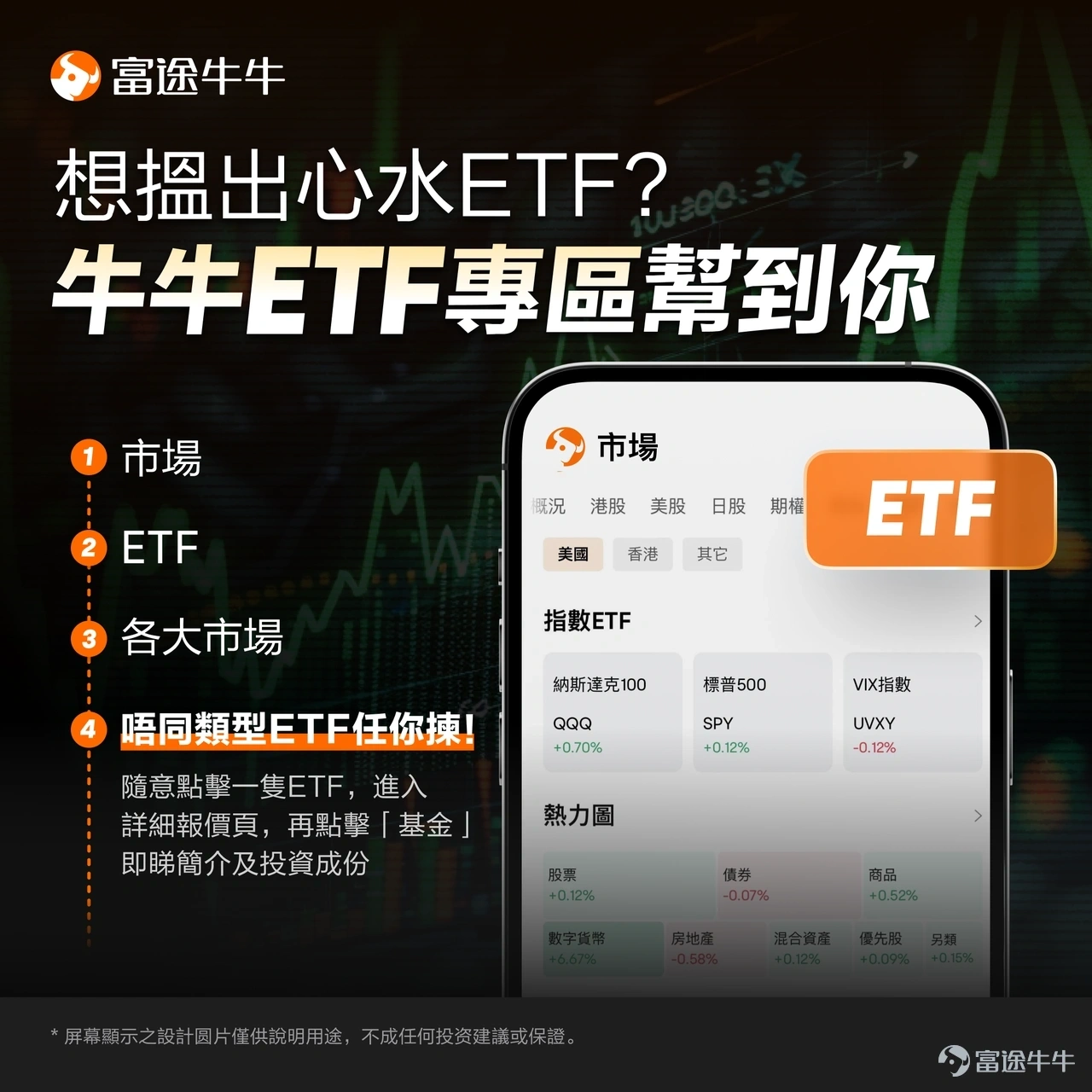
Source: The above products are selected from the Futubull app under 'Market' > 'ETF' > 'Hong Kong' > 'Index ETFs' > 'Hang Seng Tech,' representing the top 3 by assets under management and excluding leveraged ETFs. Data as of July 22, 2026.

2️⃣ If you’re a 'conservative investor with lower risk tolerance': Focus on high-dividend ETFs and income-generating assets
If you prefer your portfolio not to swing wildly day-to-day and seek relatively stable returns, high-dividend ETFs (such as dividend-focused ETFs covering mainland banks and Chinese telecom sectors) may be more suitable choices.
– The real risks and 'magic of compounding' of income-generating assets:
One concept must be clarified:Income-generating assets are not the same as 'guaranteed principal with steady profits.'。When the market experiences a systemic downturn, high-dividend stocks will also decline along with the broader market.
◦ Its buffering advantage: Although share prices may fluctuate, the regular and stable cash dividends they provide can serve as a buffer, offsetting a portion of the unrealized losses from price declines.
◦ More importantly, the power of compounding: These steady cash flows can be used to buy more quality assets 'at a discount.' Reinvesting dividends during market downturns means acquiring additional shares at lower prices. When the market eventually turns upward, the accumulated holdings will generate a powerful 'compounding effect,' significantly boosting long-term returns!
◦ Psychological benefit: This consistent cash flow also helps you stay calm and composed during bear markets, allowing you to patiently hold your investments and wait for the next market upswing. 💵
Data source: The above products are selected from the Futubull app > Market > ETFs > Hong Kong > High-Dividend ETFs, representing the top 3 products by trailing twelve-month (LTM) dividend yield as of July 22, 2026.
3️⃣ If you 'cannot tolerate any loss of principal': consider short-term U.S. Treasury bonds.
If you still find the volatility risk of the stock market (including high-dividend stocks) too high and your goal is capital preservation, there’s no need to force yourself into the market right now—U.S. Treasuries are a risk-hedging tool worth considering.
💡 Breaking Down U.S. Treasury Bonds: Why Can You 'Hold to Maturity and Receive Full Principal Plus Interest'?
1. Key Concept & Risks (Explained Simply): U.S. Treasury bonds are essentially IOUs where you lend money to the U.S. government, fully backed by the full faith and credit of the U.S. government. They have never defaulted in history and are regarded as the world’s safest risk-free asset.The main risk arises if you sell before maturity due to urgent cash needs—you may incur a loss due to price fluctuations in the market at that time.
2. Why opt for 'short-term bonds with maturities within 2 years': Because the shorter the maturity, the less sensitive the bond price is to changes in market interest rates (prices remain highly stable, with virtually no volatility risk).Additionally, they lock up your capital for a short period and offer extremely high liquidity, making them ideal as a 'safe haven' for short-term funds.。
3. Revenue structure (how you make money): There are two primary sources of income:
4. Regular coupon payments (T-Notes): After purchase, the government pays a fixed coupon interest every six months,You receive 100% of your principal back at maturity.。
5. Discount issuance (T-Bills): Purchase at a discount to face value (e.g., buy a $100 face-value Treasury bill for $96). At maturity, you receive $100, and the difference ($4) is your locked-in return.
Reference: U.S. Treasury securities with maturities within 2 years: $US Treasury Note 4.125% 10/31/2026 (US91282CLS88.BD)$ 、 $US Treasury Note 2% 11/15/2026 (US912828U246.BD)$ 、 $US Treasury Note 4.125% 02/28/2027 (US91282CMP31.BD)$ 、 $US Treasury Note 2.375% 05/15/2027 (US912828X885.BD)$ 、 $US Treasury Note 3.125% 08/31/2027 (US91282CFH97.BD)$ 、 $US Treasury Note 4.125% 09/30/2027 (US91282CFM82.BD)$ 、 $US Treasury Note 3.875% 10/15/2027 (US91282CLQ23.BD)$ 、 $US Treasury Note 4.125% 11/15/2027 (US91282CLX73.BD)$ 、 $US Treasury Note 2.75% 02/15/2028 (US9128283W81.BD)$ 、 $US Treasury Note 3.75% 05/15/2028 (US91282CND91.BD)$
Data source: The above products are selected from the Futubull app under 'Discover' > 'Wealth Management' > 'Bonds' > 'All Bonds', covering all U.S. medium- to long-term Treasury securities with remaining maturities of 2 years or less, as of July 22, 2026.
Amid volatile market conditions, if you still feel confused or uncertain,Why not try asking 'Futubull AI'?Whether it’s instantly breaking down earnings highlights of industry giants, analyzing market fund flows, or answering your investment questions, Futubull AI is always ready to provide professional, real-time analytical support—helping you confidently capture every investment opportunity in the volatile market of the second half of 2026!

📊 [Today's Poll] The market is swinging wildly—what’s your current 'shock-absorbing' strategy?
With the Hang Seng Index down 1.02% and the Hang Seng Tech Index down 3.01% today, how do you plan to position yourself?
💬 After voting, feel free to share your thoughts in the comments section!
Risk Disclaimer: The above content only represents the author's view. It does not represent any position or investment advice of Futu. Futu makes no representation or warranty.Read more


Comment (1)
to post a comment
16
13