
Intel reports strong earnings—will its stock price regain upward momentum?

60-Second Visual Breakdown | 'Tech Momentum Stocks' Rally for Two Consecutive Days—Wall Street Bulls and Bears Clash: Should You Follow the Trend or Trim Positions on Strength?
After an initial sharp pullback, the semiconductor sector has rebounded for two consecutive days,Memory, computing power chain, and high-beta chip stocks led the recovery.
However, following this brief market recovery, divergences among investors have widened,Is this the beginning of a new round of gains, or just a technical rebound following a sharp decline?Should we follow the trend and buy the dip, or reduce positions on the rebound?
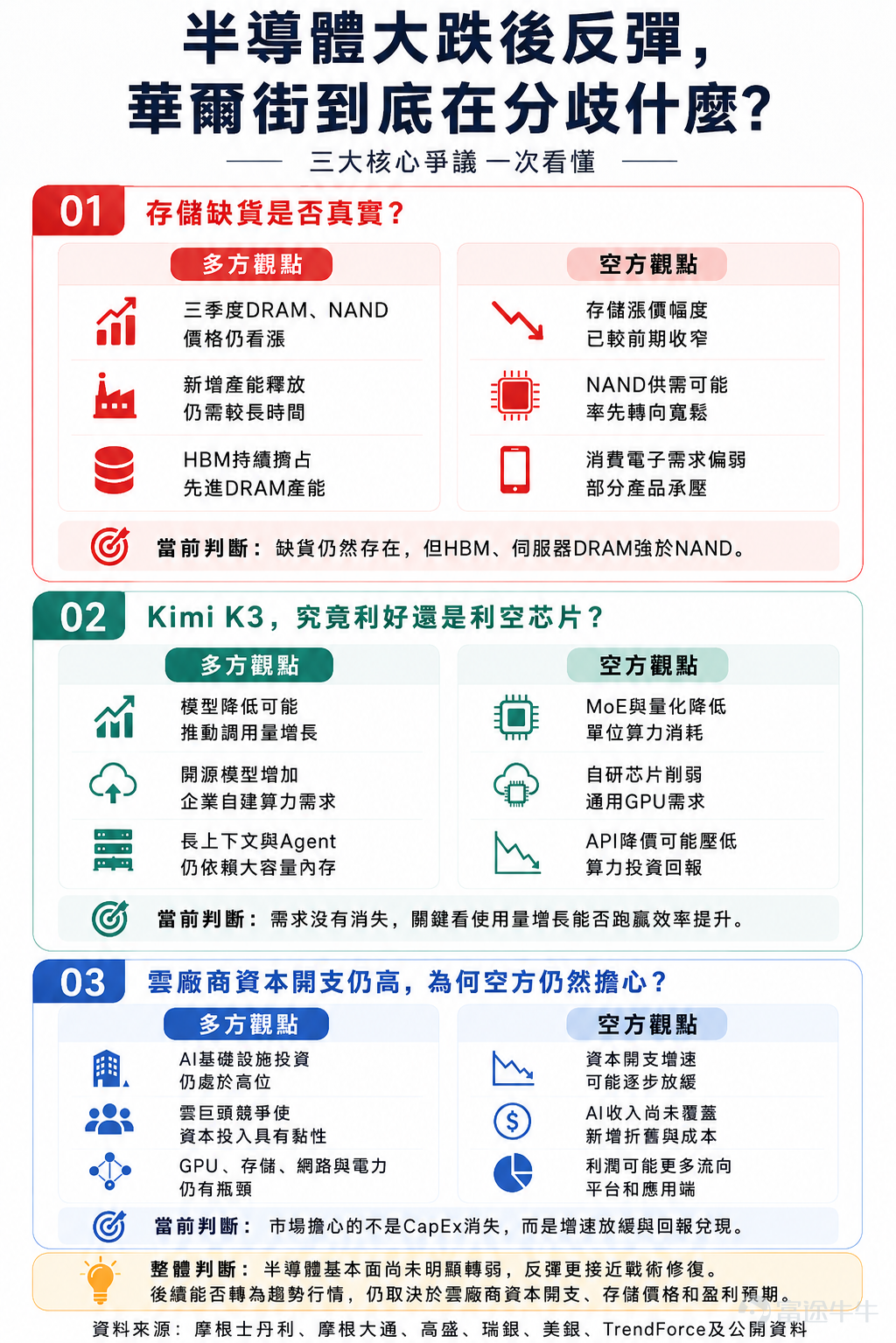
Market conditions are highly uncertain. Options Sir has compiled the current situation for investors.the bullish and bearish arguments from major Wall Street firms on several key questions, clarifying the three main points of contention:

1. First, is the memory supply shortage thesis still valid?
Bulls believe that, according to TrendForce, DRAM and NAND prices still have room to rise in the third quarter,Strong demand for AI servers, HBM, and enterprise SSDs, coupled with short-term insufficient capacity, is driving prices upward. Traditional DRAM prices are expected to increase by 13%–18% quarter-over-quarter in Q3, while NAND prices are projected to rise by 10%–15%;$SK hynix (SKHY.US)$ 、$SanDisk (SNDK.US)$ 、$Micron Technology (MU.US)$ although major memory manufacturers are increasing capital expenditures, the timelines for new fab construction, equipment installation, and yield ramp-up are lengthy, making it difficult for supply to quickly catch up with demand in the near term (Morgan Stanley);
Bears do not deny the supply shortage, but are more concerned about the slowing pace of price increases.. TrendForce also cautions that although prices are still rising, the pace of increase has slowed compared to earlier periods. Long-term contracts are limiting price growth, and profit growth may peak before prices reverse direction.especially for NAND, whose supply recovery could occur sooner than that of DRAM, while demand from consumer electronics, PCs, and smartphones remains relatively weak, potentially putting pressure on certain product lines first.
2. The second point of contention stems from efficient open-source models such as Kimi K3.
Optimists argue that declining model costs will broaden adoption, creating a Jevons effect.This will drive growth in inference volume, deployment scale, and demand for enterprise-built computing capacity. Long-context processing, AI agents, and high-concurrency inference still require substantial memory and storage (UBS Group).
Cautious views suggest that GPU, HBM, and KV Cache requirements per inference are declining; ASICs, compression technologies, and software optimizations are reducing hardware needs per unit of computation.If efficiency improvements outpace usage growth, demand expectations for general-purpose GPUs and high-bandwidth memory could be reassessed (Goldman Sachs).
3. The third disagreement concerns cloud providers’ capital expenditures.
$Microsoft (MSFT.US)$ 、 $Meta Platforms (META.US)$ 、 $Alphabet-C (GOOG.US)$$Alphabet-A (GOOGL.US)$ and $Amazon (AMZN.US)$ AI infrastructure is still undergoing large-scale construction, and bottlenecks in GPUs, storage, networking, and power have not fully disappeared.Bulls interpret this as evidence that semiconductor orders and earnings fundamentals remain solid.
Bears, however, worry about marginal shifts: although capital expenditure remains at high absolute levels, its future growth rate may gradually slow down.Meanwhile, newly added depreciation, power, and financing costs continue to rise, and it remains to be seen whether AI-related revenue can cover these investments.Failure to further raise guidance could also be bearish,Chip stocks have already priced in continuously rising capital expenditures; if cloud providers merely maintain their current guidance, valuations could come under pressure.
Recent views from major banks appearcontradictory, primarily because they focus on different analytical dimensions:Some discuss near-term risk-reward ratios, while Morgan Stanley emphasizes medium-term market leadership—these perspectives aren’t entirely conflicting.
– Bulls primarily assess short-term deleveraging and industry profitability: AI-related capital spending remains high, memory shortages persist, and semiconductor earnings forecasts continue to be revised upward.
– Bears primarily assess capital flows and marginal shifts: chip stocks have rallied excessively, positioning is crowded, and the pace of capital expenditure growth is poised to slow, making it uncertain whether they will continue to lead the market in the near term.
Overall, this rebound is better characterized as a tactically driven recovery supported by fundamentals.The narratives around memory price hikes, AI investments, and supply chain bottlenecks have not been disproven, but issues such as slowing efficiency gains, capital expenditure returns, and decelerating earnings growth remain unresolved. The initial, most intense wave of momentum-driven selling has likely entered its late stage, yet positions have not been fully unwound, and long-term crowding remains high. Tactical rebound conditions are currently in place, but a trend reversal will require confirmation from earnings, trading volume, and earnings expectations. Key focus areas ahead include:Cloud providers' CapEx guidance, memory pricing and long-term contract trends, and whether 2027 earnings expectations continue to be revised upward.
 Want stock picks or portfolio diagnostics? Curious about opportunities and risks in your holdings? Any investment-related questions—just ask Futubull AI!
Risk and Disclaimer Notice: 'Futubull' is an all-in-one financial investment trading platform. Brokerage services are provided by Futu Securities International (Hong Kong) Limited. This content does not constitute an offer, solicitation, recommendation, advice, opinion, or any form of guarantee regarding any securities, financial products, or instruments.
Risk Disclaimer: The above content only represents the author's view. It does not represent any position or investment advice of Futu. Futu makes no representation or warranty.Read more


Comments (15)
to post a comment
66
148