
Tengsi | BlackRock Raises $12 Billion in Bonds to 'Bet Big' on Meta's Texas Data Center—Hearing Thunder in Silence?
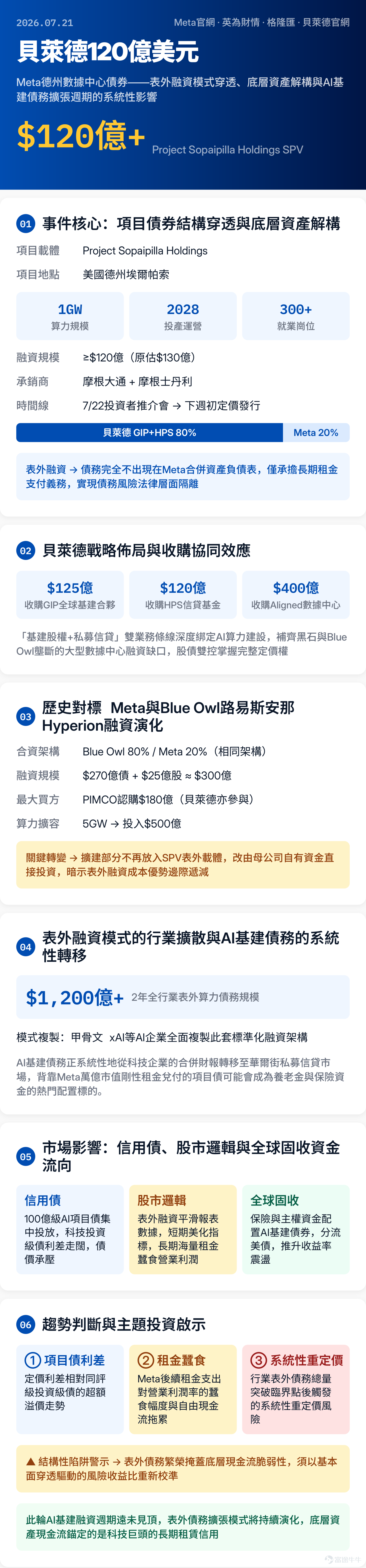
The financing target for this transaction is“Project Sopaipilla Holdings”a special purpose vehicle (SPV) located in El Paso, Texas, USA, with a total computing capacity of 1 GW. It is scheduled to commence operations in 2028 and is expected to create over 300 local jobs upon completion.
Looking at the evolution of the financing scale, the market initially estimated total funding of $13 billion in May 2026, whereas now $Blackrock (BLK.US)$ the bond issuance size has been officially set at no less than $12 billion, with $JPMorgan (JPM.US)$ And, $Morgan Stanley (MS.US)$ Joint bookrunners have scheduled a fixed income investor roadshow for July 22, with the bond expected to be priced and issued early next week.
For investors, the most noteworthy aspect is the project’s equity structure: BlackRock’s Global Infrastructure Partners (GIP) and two funds from HPS Credit collectively hold 80% of the SPV, while $Meta Platforms (META.US)$ holds only 20%, but acts as the sole tenant, exclusively operating and utilizing all computing resources.
This structure means that the substantial project debt does not appear at all on Meta's consolidated balance sheet for accounting purposes; Meta only assumes long-term lease payment obligations, thereby achieving legal isolation of debt risk—even if data center utilization falls short of expectations or AI monetization slows, it will not directly impact the parent company's credit rating or financial statements.
Reader’s Note: Unless otherwise specified, data in this article is sourced from official Meta Investor Relations announcements, Investing.com, GLG Research, and BlackRock’s official website, compiled by Gaoteng International Asset Management Co., Ltd., and has not been reviewed by the Securities and Exchange Commission.
BlackRock’s Strategic Positioning and Acquisition Synergies
In recent years, BlackRock has completed three strategically significant acquisitions: a $12.5 billion acquisition of GIP, a $12 billion acquisition of HPS, and a $40 billion investment to acquire Aligned Data Centers.
This bond issuance marks“infrastructure equity plus private credit”the landmark large-scale project that deeply integrates both business lines with AI computing infrastructure development, filling the gap previously left by $Blackstone (BX.US)$ And, $Blue Owl Capital (OWL.US)$ the dominance in financing for large-scale data centers.
From a look-through ownership perspective, BlackRock effectively controls both the equity and debt sides of the underlying assets, securing full pricing power and cash flow allocation rights over AI infrastructure assets—a“dual equity-debt control”This structure is uncommon in Wall Street’s private credit space and warrants inclusion in a thematic investment framework for long-term tracking.
Historical Benchmark: The Financing Evolution of Meta and Blue Owl’s Louisiana Hyperion Data Center
As the original template for such deals, the Hyperion campus employed an identical joint venture structure—Blue Owl holding an 80% stake and Meta holding 20%—with total financing comprising $27 billion in bonds and $2.5 billion in equity, amounting to nearly $30 billion, making it the largest private infrastructure financing transaction in U.S. history at the time. PIMCO, as the largest bond buyer, subscribed to $18 billion, with Blackrock also participating concurrently.
However, on July 13, 2026, Meta officially announced that Hyperion’s computing capacity would be expanded to 5 GW, raising total investment to $50 billion.
For the expansion phase, Meta opted not to place assets into an off-balance-sheet SPV vehicle, instead funding construction directly through the parent company; the original $30 billion financing framework covers only the initial site.
—Once computing capacity expansion entered Phase 2, the cost advantages of off-balance-sheet financing may have experienced diminishing marginal returns, making direct investment by the parent company more efficient.
This carries significant leading indicator value for assessing how financing models for similar future projects may evolve.
Industry-wide proliferation of off-balance-sheet financing structures and systemic migration of AI infrastructure debt
This“80% asset manager ownership + 20% tech company ownership, lease-based operations, plus SPV-issued debt”The standardized model has already been fully replicated by a host of AI companies, including Oracle and xAI.
Over the past two years, off-balance-sheet computing power debt across the industry has surpassed $120 billion, with AI infrastructure debt systematically shifting from tech giants’ consolidated financial statements to Wall Street’s private credit markets.
Simply reviewing the consolidated financial statements of tech giants no longer fully captures their true level of AI-related capital expenditure leverage. One must track the issuance pace, pricing spreads, and maturity structures of underlying SPV project bonds to reconstruct their full-scope debt picture.
In the current environment of elevated U.S. Treasury yields, risk-free returns from government bonds are limited. Project bonds backed by Meta’s trillion-dollar market cap and its firm rental payment commitments offer stable coupon income—essentially representing Wall Street collecting long-term computing power rents from AI giants—and this asset class is poised to become a popular allocation target for pension and insurance funds.
Market Implications: Credit Markets, Equity Logic, and Global Fixed-Income Capital Flows
On the credit side, the consecutive issuance of $10-billion-scale AI project bonds has continuously expanded the supply of tech-sector credit instruments. This was the direct catalyst behind last week’s widening of investment-grade tech bond spreads and downward pressure on bond prices in the U.S. market. The bond market has already priced in the debt burden from AI firms’ ongoing borrowing to expand capacity, corroborating the recent pullback in high-flying AI equities.
Regarding equity market dynamics, Meta’s use of off-balance-sheet financing smooths reported financials, temporarily enhancing key metrics and supporting valuations. However, massive long-term lease obligations will persistently erode operating profits. The market has begun reassessing the return on AI capital expenditures, marking a critical inflection point as this AI rally enters a phase of earnings validation.
From the perspective of global fixed-income capital flows, substantial allocations by insurance and sovereign wealth funds into these AI infrastructure bonds have diverted capital away from U.S. Treasuries, potentially serving as a secondary factor behind the recent difficulty in pushing Treasury yields lower.
In conclusion
From an intersectional view combining fundamental analysis and trend tracking, this AI infrastructure financing cycle is far from peaking. The off-balance-sheet debt expansion model will continue to be replicated and evolve, with cash flows from underlying assets (data center computing power) anchored to the long-term leasing creditworthiness of tech giants.
However, if computing power utilization falls short of expectations or AI commercialization continues to lag, credit spreads on SPV project bonds will be the first to reflect repricing of risk.
Investors should closely monitor the following three leading indicators:
First, the trend in the excess premium of project bond pricing spreads relative to investment-grade bonds of the same rating;
Second, the extent to which Meta’s future lease expenses erode its operating profit margin and the actual drag on free cash flow;
Third, the systemic repricing risk triggered once off-balance-sheet industry debt exceeds a critical threshold.

One graphic to understand the full article

$GaoTeng WeInvest Money Market Fund (HK0000478930.MF)$ $GaoTeng WeValue USD Money Market Fund (HK0000584752.MF)$ $GaoTeng WeFund-GaoTeng Asian Income Fund (HK0000447943.MF)$ $Global Multi-asset ETF Quant Strategy- Active (GTHK005.US)$ $Hang Seng Index (800000.HK)$ $Hang Seng TECH Index (800700.HK)$ $Dow Jones Industrial Average (.DJI.US)$ $S&P 500 Index (.SPX.US)$ $Nasdaq Composite Index (.IXIC.US)$ $USD (USDindex.FX)$
Risk Disclaimer: The above content only represents the author's view. It does not represent any position or investment advice of Futu. Futu makes no representation or warranty.Read more

Comments
to post a comment
1
1